
Synthetix is one of the oldest derivatives protocols in the decentralized finance (DeFi) ecosystem. The project initially emerged as a platform where users could trade "synthetic assets" that tracked the prices of real-world assets without owning them. Today, it has evolved into an order book-based perpetual futures exchange operating on Ethereum mainnet. SNX is the protocol's governance and collateral token. SNX holders stake their tokens to provide liquidity to the protocol and earn rewards in return.
What Is Synthetix and How Did It Start?
Synthetix was founded by Australian entrepreneur Kain Warwick under the name Havven. Havven's initial goal was to create a decentralized stablecoin. In 2018, the project rebranded as Synthetix and shifted its focus to synthetic assets. With the release of Synthetix v2 in 2019, users gained the ability to mint tokens tracking the prices of cryptocurrencies, indices, and traditional assets such as gold on Ethereum.
How Did Synthetic Assets Work?
In Synthetix's original model, synthetic assets known as "synths" were minted using SNX as collateral. When users staked their SNX, they could mint a dollar-pegged stablecoin called sUSD. This sUSD could then be converted into various synths, such as sBTC, sETH, or synthetic gold.
A key feature of this model was its shared debt pool structure. Everyone staking SNX assumed a portion of the system's total debt. When synth holders made profits, the total debt increased; when they incurred losses, it decreased.
This allowed trades to be executed directly through price oracles without the need to find counterparties. In exchange for assuming this risk, SNX stakers received a share of trading fees and SNX rewards.
Synthetix Perps
Over time, perpetual futures became Synthetix's most widely used product, replacing synthetic assets. Due to high transaction fees, Synthetix moved away from Ethereum mainnet in 2022 and migrated to Optimism, where it launched Perps v2.
The subsequent release of Synthetix v3 introduced cross-margin functionality, multiple collateral types, and a modular architecture. The protocol also expanded to other Layer 2 networks, including Base and Arbitrum.
During this period, Synthetix operated as a liquidity infrastructure provider for applications such as Kwenta, Polynomial, and Infinex rather than offering its own trading interface.
Return to Ethereum Mainnet
In December 2025, Synthetix announced its return to Ethereum mainnet after three years. The new Synthetix Perps exchange uses a central limit order book (CLOB) model similar to centralized exchanges, replacing its previous automated market maker (AMM) structure.
The protocol shut down its legacy markets on Layer 2 networks to focus on a single Ethereum mainnet exchange. According to the team, the exchange offers trading latency of less than 100 milliseconds.
In the new system, liquidity is provided through a vault called SLP, whose participants receive a share of the exchange's trading revenue. Since June 2026, traders have also been able to use ETH as collateral.
The exchange supports cross-margin trading, leverage of up to 50x, market and limit orders, and time-weighted average price (TWAP) orders.
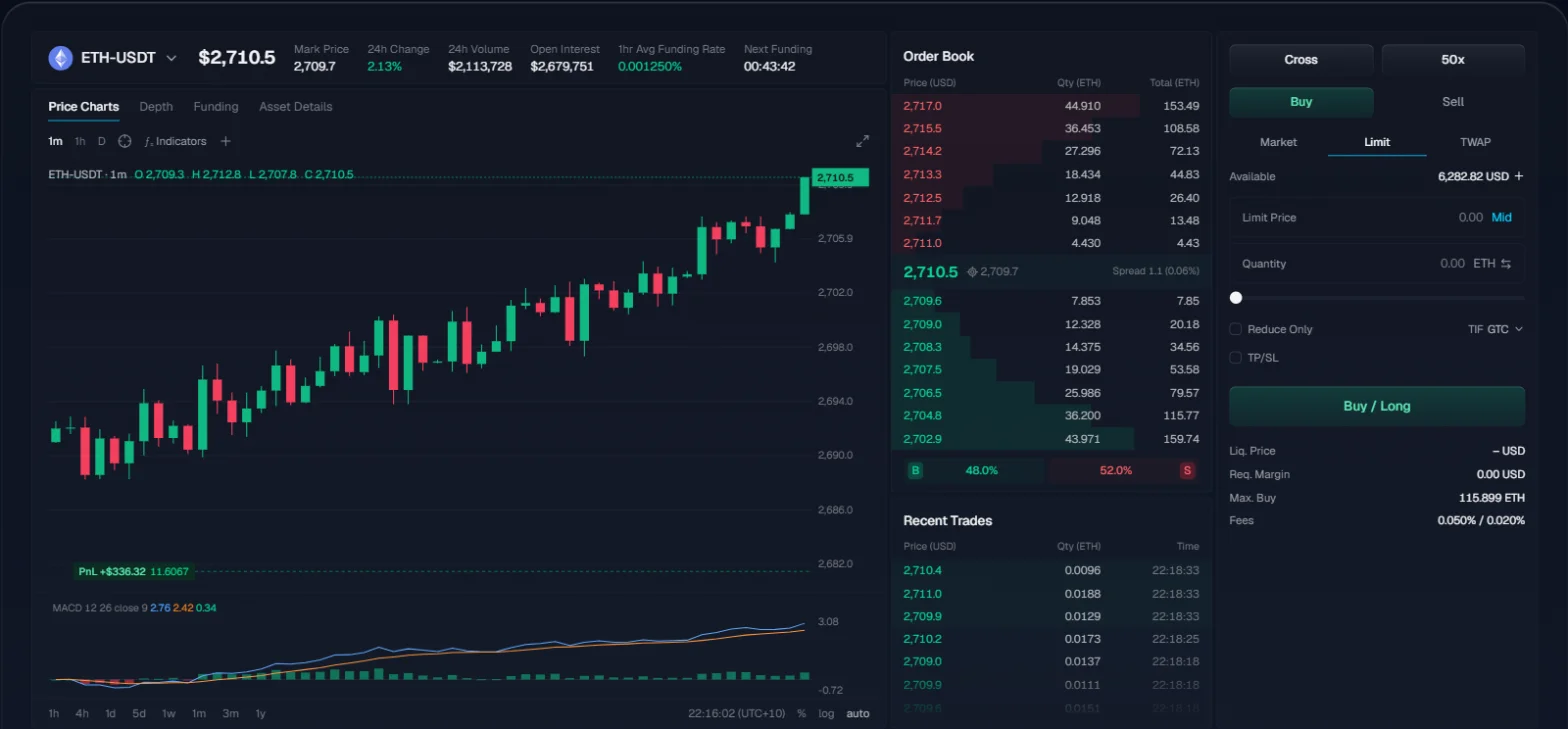
History of Synthetix: Key Milestones
The foundations of Synthetix were laid in 2017 with the Havven project. The project conducted its token sale in 2018 and rebranded as Synthetix later that year. The protocol's dollar-pegged stablecoin, sUSD, launched on December 3, 2018. Synthetix v2, released in 2019, helped popularize synthetic asset trading on Ethereum.
DeFi Summer and the Peak Years
Synthetix became one of the most widely discussed protocols during the period known as "DeFi Summer" in 2020. High rewards distributed to SNX stakers attracted numerous investors to the protocol.
Synthetix's liquidity mining program is considered one of the earliest examples of incentive models that later became widespread across DeFi. According to DefiLlama data, the protocol's total value locked (TVL) peaked at approximately $3 billion in 2021. SNX also reached its all-time high of $28.53 that year.
The Layer 2 Era
High transaction fees on Ethereum presented a significant challenge for a derivatives platform that relied on frequent trading. Synthetix became one of Optimism's first major users and fully moved away from Ethereum mainnet in 2022.
Perps v2, launched on Optimism, achieved substantial trading volumes through interfaces such as Kwenta and Polynomial. The subsequent release of Synthetix v3 expanded the protocol to Base and Arbitrum.
In December 2023, the Synthetix community approved SIP-2043, a proposal that ended SNX inflation. The decision replaced weekly SNX rewards with a model that used trading fees to buy back and burn SNX.
2025: SIP-420 and the sUSD Crisis
Introduced in March 2025, SIP-420 fundamentally changed Synthetix's collateral structure. Under the proposal, individual SNX stakers' debt was transferred to a shared pool, while the required collateralization ratio was reduced from 750% to 200%.
However, this change weakened the incentive for stakers to purchase discounted sUSD and repay their debt. In April 2025, sUSD fell to $0.66, trading more than 30% below its intended $1 peg.
That same year, Synthetix acquired Kwenta, its longtime primary trading interface, and TLX, allowing the protocol to take direct control of the user experience.
On December 19, 2025, Synthetix announced the closed beta of its new Ethereum mainnet perps exchange. The beta was limited to 500 users and offered up to 50x leverage across BTC, ETH, and SOL markets.
2026: The Retirement of sUSD
In its roadmap published on March 13, 2026, Synthetix announced that trading revenue would be used for SNX and sUSD buybacks. Buybacks began in the first quarter of 2026. In June 2026, ETH collateral support and a referral program were added to the exchange.
However, sUSD's depegging problem remained unresolved. SIP-423, introduced on June 12, 2026, proposed retiring the stablecoin that had originally inspired the creation of Havven.
Following the proposal's approval in late June, the sUSD contract was frozen, holders' balances were recorded, and the token became permanently non-transferable. Holders at the time of the snapshot became eligible to receive 4 SNX for every 1 sUSD.
These SNX tokens will remain locked for one year before gradually vesting over another year. The proposal also shut down the shared debt pool established under SIP-420.
On October 29, 2026, Synthetix's protocol DAO used its privileged permissions within the SNX contract to transfer approximately 8.4 million SNX from a wallet associated with the Binance attack to its own wallet. Synthetix stated that it would return the tokens to Binance upon request.
According to DefiLlama data, Synthetix's current TVL stands at just approximately $863,000, while its 30-day perpetual futures trading volume is around $66.7 million.
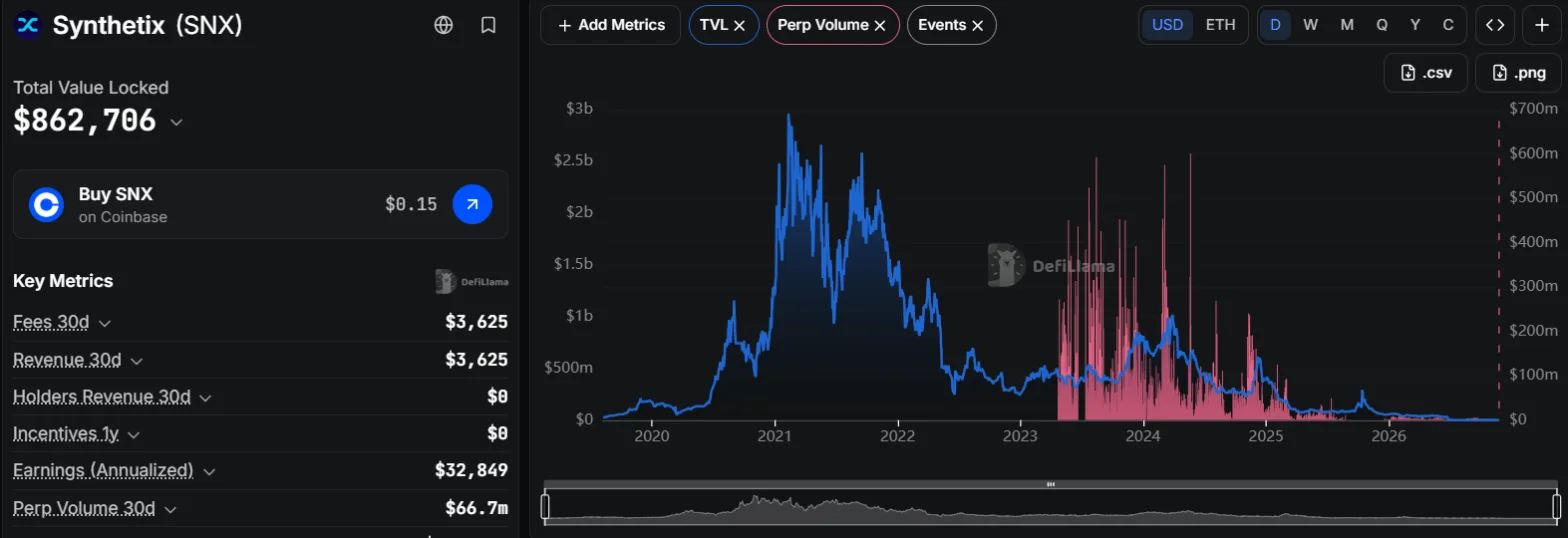
How Does the SNX Token Work?
SNX is Synthetix's governance and collateral token. Issued under the ERC-20 standard on Ethereum, the token is also available on Layer 2 networks such as Optimism. SNX's role within the ecosystem has evolved alongside the protocol's various transformations.
Staking and Collateral
During Synthetix's early years, SNX primarily served as collateral. Users staked SNX to mint sUSD and participate in the protocol's shared debt pool. In return, they received a share of trading fees and newly issued SNX tokens. Under this model, demand for SNX was directly linked to the amount of sUSD minted within the system.
With SIP-420, users gained the ability to stake their SNX in a shared pool while delegating their debt to the protocol. According to Synthetix's 2026 roadmap, more than half of the circulating SNX supply was staked.
However, this pool was closed following the retirement of sUSD. Under SIP-423, existing debt participants can choose a four-year lockup followed by a one-year vesting period or exit early by fully repaying their outstanding debt. A new SNX staking structure will be determined through a separate initiative.
Governance
Synthetix's governance operates through councils elected by SNX holders. The most prominent of these councils, the Spartan Council, votes on Synthetix Improvement Proposals (SIPs).
Decisions that fundamentally changed the protocol's direction, including SIP-420 and SIP-423, were made through this governance process.
Buybacks
After ending SNX inflation in 2023, Synthetix adopted a model that uses protocol revenue to fund SNX buybacks. According to its 2026 roadmap, trading revenue generated by the perps exchange is directed toward SNX buybacks.
However, DefiLlama data shows that the protocol generated only approximately $3,500 in revenue over the past 30 days. This figure includes the new Ethereum mainnet perps exchange, which recorded approximately $66 million in trading volume during the same period.
As a result, buybacks currently have no meaningful impact on the token's price.
SNX Supply and Tokenomics
SNX has no fixed maximum supply. According to JR Kripto data, its circulating supply stands at approximately 344.5 million tokens.
For many years, SNX had an inflationary supply structure driven by weekly rewards distributed to stakers. SIP-2043, approved in December 2023, ended this inflation. Since then, changes in supply have been determined by buybacks, token burns, and governance decisions.
The SNX tokens allocated to former sUSD holders under SIP-423 will also affect future supply. The conversion rate of 4 SNX for every 1 sUSD valued SNX at $0.25.
According to reports, the approximately $17.5 million worth of circulating sUSD translates into around 70 million SNX. These tokens will remain locked until June 2027 before gradually entering circulation over the following year.
SNX Coin Price and Market Data
According to market data, SNX's market performance as of November 24, 2026, is as follows:
Metric | Value |
Current price | $0.1457 |
Market cap ranking | #314 |
Market capitalization | $50.19 million |
Fully diluted valuation | $84.43 million |
24-hour trading volume | $7.92 million |
Circulating supply | 344,516,234 SNX |
All-time high | $28.53 |
All-time low | $0.0348 |
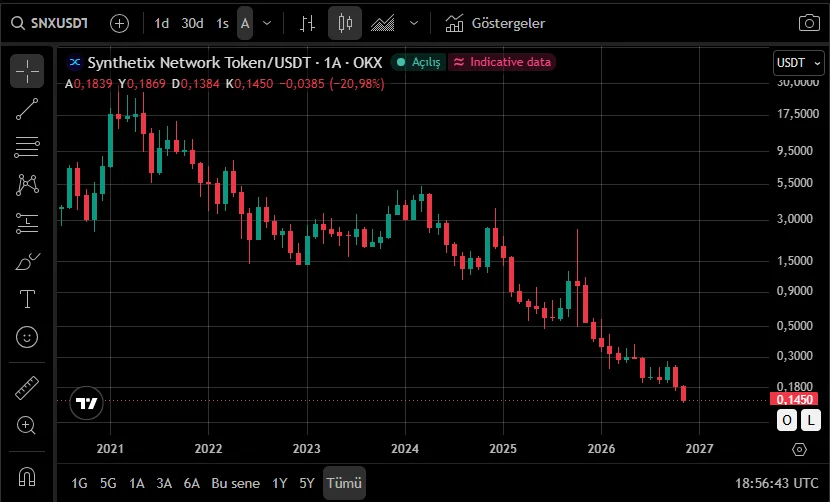
The SNX coin price has declined by 6.91% over the past 24 hours, 5.02% over the past seven days, and 26.23% over the past 30 days. The token is currently trading 99.49% below its all-time high. However, it remains approximately four times above the all-time low recorded during the project's early years.
SNX's price history closely reflects the periods of growth and decline within DeFi. During DeFi Summer in 2020 and the subsequent bull market in 2021, the token climbed from a few dollars to more than $28. In the 2022 bear market, it fell below $2.
SNX approached $5 in late 2023 following the end of inflation and a broader market recovery. However, the token entered a downward trend in 2024. The introduction of SIP-420 and sUSD's depegging crisis in 2025 weakened confidence in the token.
Although the announcement of Synthetix's return to Ethereum mainnet triggered a short-lived rally, SNX continued to lose value throughout 2026, falling below $0.15. The gradual release of SNX allocated to former sUSD holders under SIP-423, beginning in 2027, could create additional supply pressure in the coming years.
Why Is Synthetix Important?
Synthetix was among the earliest adopters of several concepts now considered standard in DeFi. On-chain synthetic asset trading, liquidity mining incentives, oracle-based trading, and the early adoption of Layer 2 networks are among the innovations Synthetix introduced to the industry.
Numerous projects, including Kwenta and Polynomial, were built on Synthetix's liquidity infrastructure. Synthetix's current strategy focuses on operating a perpetual futures exchange directly on Ethereum mainnet. Competition among decentralized perpetual futures exchanges has intensified with projects such as Hyperliquid, which operates its own blockchain.
Synthetix highlights direct transaction settlement on Ethereum as a security advantage. Whether this approach succeeds will become clearer as the exchange develops its trading volume and user base in the coming years.
Where to Buy SNX Coin
SNX is traded on four major cryptocurrency exchanges accessible from Türkiye. BtcTurk, Paribu, and Binance TR offer the SNX/TRY trading pair. Binance's global platform supports trading through the SNX/USDT pair.
The token is also listed on global cryptocurrency exchanges such as Coinbase, OKX, and Bybit.
Follow these steps to purchase SNX:
- Create an account on a licensed cryptocurrency exchange in Türkiye and complete identity verification.
- Deposit Turkish lira into your account via bank transfer or EFT.
- Locate the SNX/TRY trading pair on the exchange.
- Enter the amount you wish to purchase and place a market or limit order.
If you intend to use SNX to participate in governance, you will need to withdraw your tokens to a personal cryptocurrency wallet. Since SNX is available on both Ethereum mainnet and Optimism, make sure you select the correct network when withdrawing your tokens.
Synthetix Team and Community
Synthetix founder Kain Warwick is an Australian entrepreneur. In addition to Synthetix, Warwick founded a cryptocurrency platform called Infinex. During the sUSD crisis, he attracted attention through his public statements to the community and calls for stakers to take action.
Synthetix operates as a decentralized autonomous organization (DAO) governed by councils elected by SNX holders rather than a centralized company. According to the protocol's 2026 roadmap, Synthetix has more than 125,000 SNX holders, with only two individuals known to hold more than 1% of the total supply each.
What Are the Risks of Synthetix?
- Low adoption: According to DefiLlama data, Synthetix's TVL and revenue remain significantly below historical levels. The growth prospects of its new perps exchange remain uncertain.
- Competition: Decentralized perpetual futures exchanges such as Hyperliquid, Aster, and Lighter generate considerably higher trading volumes.
- Supply pressure: SNX tokens allocated to former sUSD holders under SIP-423 will gradually enter circulation starting in 2027.
- Governance risk: The SIP-420 experience demonstrated that major protocol changes can have unexpected consequences. The DAO's privileged permissions within the SNX contract also raise questions about centralization.
- Smart contract risk: As with any DeFi protocol, the possibility of vulnerabilities or errors in smart contract code cannot be completely eliminated.
Frequently Asked Questions (FAQ)
Below are some of the most frequently asked questions about Synthetix and the SNX token.
- What is Synthetix?: Synthetix is a DeFi protocol that initially launched as a synthetic asset platform and now operates as a perpetual futures exchange on Ethereum mainnet.
- What is SNX coin used for?: SNX is Synthetix's governance and collateral token. It grants holders voting rights in the election of governance councils.
- What is sUSD?: sUSD was Synthetix's dollar-pegged stablecoin minted using SNX as collateral. It was retired in June 2026 under SIP-423, with holders becoming eligible to receive 4 SNX for every 1 sUSD.
- What is Synthetix Perps?: Synthetix Perps is an order book-based perpetual futures exchange operating on Ethereum mainnet and offering leverage of up to 50x.
- What is the supply of SNX?: SNX has no fixed maximum supply. According to JR Kripto data, its circulating supply stands at approximately 344.5 million tokens.
- Which Turkish cryptocurrency exchanges list SNX?: SNX is available for trading against the Turkish lira on BtcTurk, Paribu, and Binance TR.
- Is SNX a good investment?: SNX is a high-risk asset trading more than 99% below its all-time high, with its future performance dependent on the success of the protocol's new strategy. Before making an investment decision, it is important to conduct your own research and consider your risk tolerance. This content does not constitute investment advice.
If you are a former sUSD holder, make sure to check the SNX claim deadlines and lockup schedule under SIP-423. Follow the JR Kripto Guide series to stay informed about the growth of Synthetix Perps on Ethereum mainnet, SNX buybacks, and the new staking model, as well as competing decentralized perpetual futures exchanges such as Hyperliquid.

