
Ethereum remains the most widely used smart contract network thanks to its security and decentralization. However, rising transaction fees during busy periods and limited capacity push users toward faster, cheaper alternatives. Starknet is one of the Layer 2 networks addressing this problem through zero-knowledge proofs. At the center of the network is STRK, a token used for transaction fees, staking, and governance.
Starknet’s Definition and Origins
Starknet is a Layer 2 network built on Ethereum. It processes transactions outside the mainnet and submits their results to Ethereum alongside cryptographic proofs. This structure is known as a “ZK rollup.” Users benefit from Ethereum’s security while paying significantly lower fees.
StarkWare, the company developing the network, uses its STARK (Scalable Transparent Argument of Knowledge) proof system to verify transactions. STARKs can demonstrate that thousands of transactions were processed correctly through a single compact proof. Ethereum only needs to verify that proof, without executing each transaction again.
STRK is Starknet’s native token. It pays transaction fees, supports network security through staking, and enables participation in governance decisions.
How Does Starknet Work?
A component called the “sequencer” first orders transactions submitted by users and packages them into blocks. The “prover” then generates a STARK proof demonstrating that these blocks were processed correctly. The proof and state updates are submitted to a verifier smart contract on Ethereum.
Once the contract accepts the proof, Starknet’s transactions become finalized under Ethereum’s security.
This model differs significantly from optimistic rollups. Networks such as Arbitrum and Optimism assume transactions are valid by default and provide a challenge window of approximately seven days. ZK rollups establish validity through mathematical proofs, eliminating the need for this challenge period.
Another distinctive feature is Starknet’s programming language. Smart contracts on the network are written in Cairo, which StarkWare developed for provable computation.
Starknet also supports account abstraction natively. Every wallet is a smart contract account, enabling features such as multisignature authorization, social recovery, and fee payments in different tokens directly at the wallet level.
How Can You Transfer Assets to Starknet?
Users can transfer assets from Ethereum to Starknet through the official StarkGate bridge. In the StarkGate interface, they select Ethereum as the source network and Starknet as the destination, then enter the token and amount they want to transfer. Withdrawals from Starknet to Ethereum are completed after the proof is verified on Ethereum.
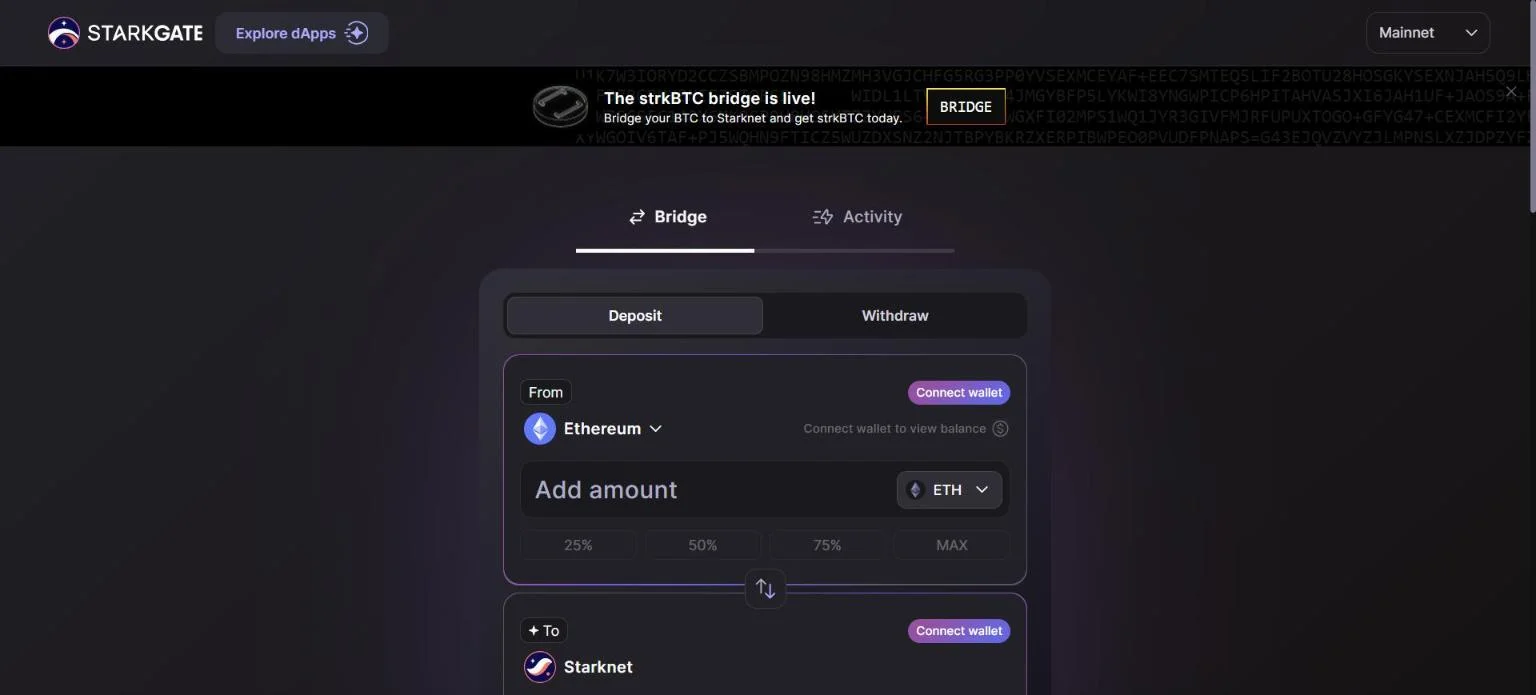
The announcement at the top of StarkGate indicates that the strkBTC bridge, used to bring Bitcoin to Starknet, is also live. Assets transferred to Starknet can be held in compatible wallets such as Ready, formerly Argent, and Braavos. MetaMask users can connect to the network through the Starknet Snap extension.
Starknet’s History: Key Milestones
Eli Ben-Sasson, Uri Kolodny, Alessandro Chiesa, and Michael Riabzev founded StarkWare in Israel in 2018. Ben-Sasson is among the researchers who established the academic foundations of the STARK proof system. The company’s first product was StarkEx, which provides application-specific scaling.
Projects such as dYdX, Immutable X, and Sorare used StarkEx infrastructure in its early years.
StarkWare developed Starknet to create an open, general-purpose network. Starknet Alpha launched on Ethereum mainnet in November 2021. The company reached a $2 billion valuation in its Series C round that same month.
In May 2022, StarkWare completed a $100 million Series D funding round at an $8 billion valuation.
STRK’s Launch and Airdrop
STRK entered circulation on February 20, 2024. In the initial phase, the Starknet Foundation distributed more than 700 million STRK to approximately 1.3 million wallets. The distribution program aims to deliver a total of 1.8 billion STRK to users and community members over the longer term.
The airdrop extended beyond Starknet users. Early users of StarkEx applications, Ethereum stakers, Protocol Guild members, and authors of Ethereum Improvement Proposals (EIPs) were also included. The claiming process attracted strong interest within its first few minutes.
After launch, the unlock schedule for investor and team tokens sparked debate. Following community criticism, StarkWare spread the first major unlock across monthly installments.
Staking and Bitcoin Integration
Starknet launched the first phase of STRK staking in November 2024. With the second phase, introduced in June 2025, validators began actively participating in network operations.
In August 2025, the community approved the SNIP-31 proposal with 93.6% support. The proposal paved the way for Bitcoin to participate in Starknet’s consensus process. Approved BTC assets, including Wrapped Bitcoin, Liquid Bitcoin, tBTC, and SolvBTC, can be staked alongside STRK.
In early October 2026, Starknet announced new incentives for its Bitcoin-pegged asset, strkBTC. These included covering bridge fees for the first 100 BTC and offering STRK staking rewards.
Privacy and the Layer 1 Debate
In 2026, StarkWare introduced STRK20, a privacy framework enabling confidential transfers and shielded token balances. “Shadow Accounts,” a feature working with STRK20 pools, launched in late October 2026. It allows users to conduct DeFi transactions without directly linking them to their main wallets.
However, balances and transactions remain visible on-chain; the privacy provided is limited to the identity level.
One of the most significant recent developments is the Layer 1 debate. On October 8, 2026, StarkWare CEO Eli Ben-Sasson announced that the company was considering turning Starknet into a Layer 1 network independent of Ethereum. Ben-Sasson argues that Ethereum’s 2029 target for addressing quantum computing threats is too late and has set 2027 as Starknet’s target for quantum resistance.
In a community vote held between October 15 and 22, more than 93.5% of voting power supported launching a research process. This vote covered only research into the transition. STRK holders would need to vote again before an actual transition could proceed.
The Starknet Foundation stated that STRK would remain the native token regardless of the outcome and that no new token would be issued.
How Does the STRK Token Work?
STRK has three primary functions on Starknet:
- Transaction fees: Gas fees on Starknet are paid in STRK.
- Staking: Validators stake STRK to help secure the network. Token holders can also earn rewards by delegating to validators.
- Governance: STRK holders vote on protocol upgrades and improvement proposals known as SNIPs.
How Does STRK Staking Work?
Becoming a validator on Starknet requires locking at least 20,000 STRK and running a synchronized full node. Validators submit an attestation during each epoch to confirm network activity. A validator that fails to submit this attestation receives no rewards for that epoch.
Users who do not want to operate infrastructure can delegate STRK or approved BTC assets to a validator of their choice. Validators charge a commission on delegation rewards at a rate they set. Withdrawing staked tokens on mainnet requires a seven-day waiting period, during which no rewards accrue.
STRK accounts for 75% of the network’s consensus weight, while BTC accounts for 25%. This cap aims to preserve STRK’s central role while allowing Bitcoin to contribute to network security. Staking rewards are paid in newly minted STRK, with the issuance rate varying according to the proportion of supply staked.
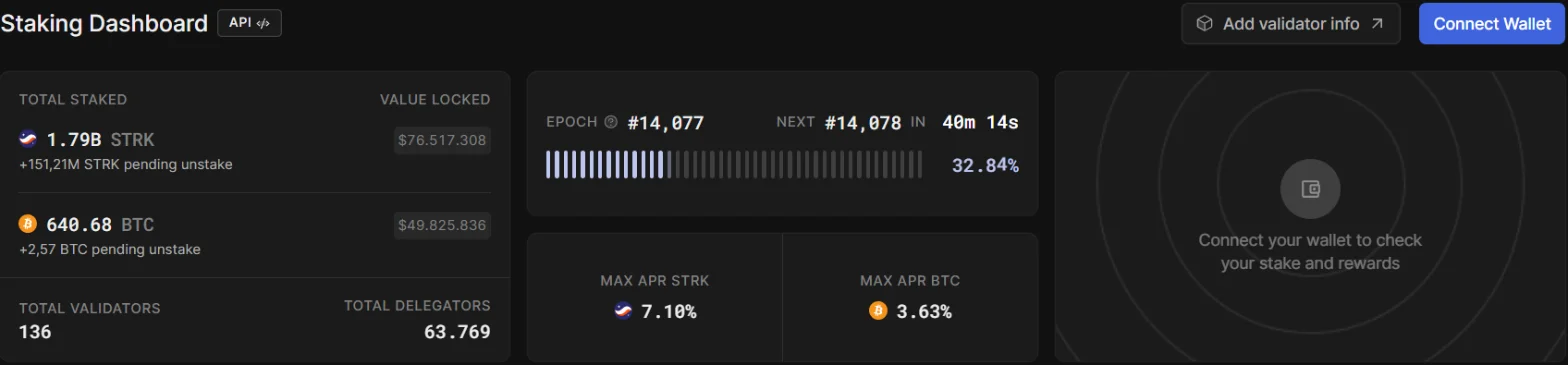
According to the Voyager staking dashboard, approximately 1.79 billion STRK and 640.68 BTC were staked on the network as of November 2, 2026. A total of 136 validators and 63,769 delegators were participating in network security.
The dashboard showed a maximum annual yield of 7.10% for STRK staking and 3.63% for BTC staking. Returns vary depending on the validator, commission rate, and total amount staked.
Users can connect their wallets to Voyager to compare validators by commission rate and staked amount, as well as track their own stakes and rewards.
STRK Supply and Tokenomics
STRK’s initial supply was set at 10 billion tokens. Because staking rewards are paid through new token issuance, supply increases over time. According to market data, total supply stood at approximately 10.18 billion STRK as of November 2, 2026, with 7.66 billion STRK in circulation.
The initial allocation was as follows:
| Group | Allocation |
Early contributors | 20.04% |
Investors | 18.17% |
Grants and development partners | 12.93% |
StarkWare | 10.76% |
Foundation strategic reserves | 10% |
Community provisions (airdrop) | 9% |
Community rebates | 9% |
Foundation treasury | 8.10% |
Donations | 2% |
Tokens allocated to investors and early contributors unlock gradually. Between April 2024 and March 2025, 64 million STRK unlocked each month. The monthly amount increased to 127 million STRK in April 2025, with this schedule set to continue until March 15, 2027.
These tokens enter circulation on the 15th of each month. They could put pressure on the price if demand fails to grow at the same pace.
During the lockup period, these tokens cannot be transferred, sold, or used as collateral. However, their holders can delegate their voting power in governance processes.
STRK Coin Price and Market Data
STRK was trading at $0.0427 as of November 2, 2026, ranking 100th by market capitalization. The token declined 3.18% over the preceding 24 hours and 6.08% over the previous seven days.
| Metric | Value |
Current price | $0.0427 |
Market capitalization | $327.5 million |
Fully diluted valuation | $434.8 million |
24-hour trading volume | $31.7 million |
Circulating supply | 7.66 billion STRK |
All-time high | $4.41 |
All-time low | $0.0222 |
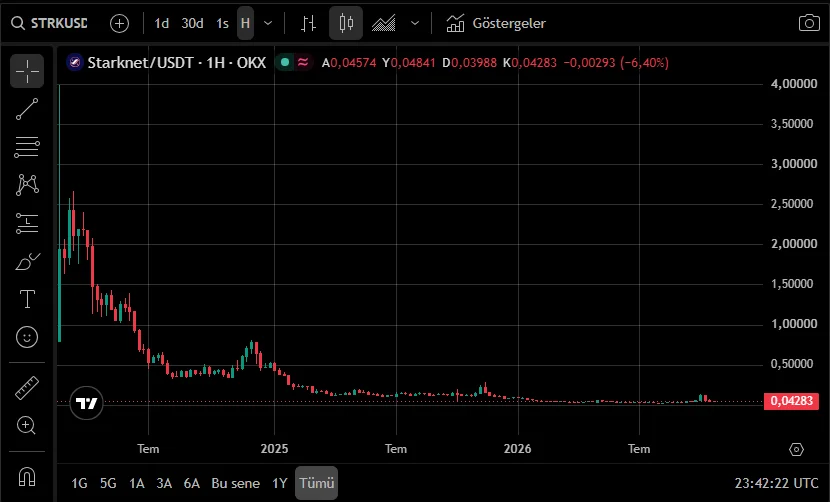
The all-time chart shows that STRK reached its record high of $4.41 on its launch day in February 2024 before entering a prolonged downtrend. The token briefly recovered above $0.70 in late 2024. It then gradually declined throughout 2025, falling below $0.10.
After reaching an all-time low of $0.0222 in 2026, STRK experienced a brief, sharp rally in October amid strkBTC incentives and the Layer 1 debate. The token subsequently surrendered a substantial portion of those gains. Its current price is approximately 99% below its all-time high and around 92% above its all-time low.
Monthly unlocks of 127 million STRK and further votes concerning the Layer 1 transition are among the main developments that could influence the price in the coming period.
Why Does Starknet Matter?
Starknet stands out as one of the first projects to use zero-knowledge proofs in a general-purpose network. STARK proofs do not require a trusted setup ceremony. Because they rely on hash functions, they are considered more resistant to quantum computers than other proof systems.
Native account abstraction also provides an important advantage for the user experience. Features such as social recovery, session keys, and batched transactions, which are not yet widespread on Ethereum, are available by default in Starknet wallets.
Bitcoin staking, strkBTC, and the STRK20 privacy framework represent efforts to expand Starknet’s role. Alongside scaling Ethereum, the network aims to provide infrastructure for Bitcoin liquidity and privacy-focused applications.
Where Can You Buy STRK?
STRK trades on all four major exchanges accessible to users in Türkiye: Binance, Binance TR, BtcTurk, and Paribu. OKX, Bybit, Coinbase, and Gate are among the other major exchanges offering STRK trading.
STRK is available on both Starknet and Ethereum. When withdrawing from an exchange, make sure the selected network matches a network supported by the destination wallet. Withdrawals to Starknet require a compatible wallet such as Ready or Braavos.
Starknet’s Team and Community
Eli Ben-Sasson is StarkWare’s CEO and co-founder. Before StarkWare, he worked as a computer science professor at the Technion, Israel Institute of Technology, and co-authored the Zerocash paper that laid the foundations for Zcash. Uri Kolodny, Alessandro Chiesa, and Michael Riabzev are also members of the founding team.
StarkWare develops the network, while the independent Starknet Foundation oversees token distribution, ecosystem grants, and governance processes.
Paradigm led StarkWare’s $30 million Series A round in 2018 and its $75 million Series B round in 2021. Sequoia Capital, Pantera Capital, Intel Capital, and Coinbase Ventures were also among its early investors. The Series D round, led by Greenoaks Capital and Coatue, brought the company’s total funding to $262 million.
Token Unlock, Competition, and Transition Risks
STRK’s biggest risk lies on the supply side. A total of 127 million STRK enters circulation each month until March 2027. Newly minted staking rewards also increase the total supply.
The token’s 99% decline from its all-time high indicates that this supply pressure has been reflected in its price.
The Layer 2 market is also highly competitive. Arbitrum, Base, Optimism, ZKsync, and Linea compete directly with Starknet for users and liquidity. Fewer developers are familiar with Cairo than with Ethereum’s Solidity, which is seen as a factor limiting the ecosystem’s growth.
Centralization is another important issue. Starknet’s sequencer and prover components are still largely operated by StarkWare. The gradual development of the staking system aims to decentralize this structure.
The Layer 1 debate presents both opportunities and uncertainty. Moving to an independent network could change the security assumptions Starknet inherits from Ethereum. The scope, timing, and technical details of any decision remain unclear.
Frequently Asked Questions (FAQ)
Below are answers to some frequently asked questions about Starknet (STRK).
- What is Starknet, and when did it launch? Starknet is an Ethereum Layer 2 network that uses STARK proofs. It launched on Ethereum mainnet in November 2021. The STRK token entered circulation on February 20, 2024.
- What is STRK coin used for? STRK pays transaction fees on Starknet, supports network security through staking, and enables participation in governance votes.
- What is a ZK rollup? A ZK rollup is a scaling solution that processes transactions outside the mainnet and submits zero-knowledge proofs to establish their validity on the mainnet. Starknet is one of the networks using this model.
- How can you stake STRK? STRK holders can delegate their tokens to a validator through the Voyager staking dashboard or wallet applications. Withdrawing staked tokens requires a seven-day waiting period.
- What is STRK’s supply? STRK’s initial supply was 10 billion tokens. Because staking rewards are paid through new issuance, total supply reached approximately 10.18 billion STRK as of November 2, 2026. Circulating supply stood at 7.66 billion STRK.
- Will Starknet become a Layer 1? In October 2026, the Starknet community approved research into a transition to an independent Layer 1. No decision has been made on the transition itself, and another vote would be required.
- Which Turkish exchanges list STRK? STRK trades on Binance TR, BtcTurk, and Paribu. Binance’s global platform also offers the STRK/USDT trading pair.
- Is Starknet a suitable investment? Whether STRK is a suitable investment depends on your risk profile and research. Bitcoin staking, privacy solutions, and work on quantum resistance are potential positive developments to monitor. Monthly token unlocks, Layer 2 competition, and uncertainty surrounding the Layer 1 proposal should also form part of your assessment.
Follow the JR Kripto Guide series for updates on the Starknet ecosystem and the Layer 1 research process.

