
What Is LayerZero (ZRO)?
Blockchains operated like disconnected islands for a long time. An application on Ethereum could not read data on Solana, while a token on BNB Chain could only move to Arbitrum through bridges. LayerZero provides infrastructure that carries messages between these networks, allowing applications on different chains to communicate. At the center of its ecosystem is ZRO, a token with roles ranging from governance to securing the upcoming Zero network.
LayerZero’s Definition and Origins
LayerZero is an interoperability protocol that enables data and value transfers between different blockchains. Applications built on LayerZero allow developers to send messages from a smart contract on one chain to a contract on another.
These messages carry more than tokens. They can contain transfer instructions, voting results, price data, or any other contract call. For this reason, LayerZero describes itself as a cross-chain messaging layer.
ZRO is the native token of the LayerZero ecosystem. It supports protocol governance and will serve staking, transaction fee, and governance functions on the Zero blockchain, whose mainnet is scheduled to launch on November 30, 2026.
What Problem Does LayerZero Solve?
The crypto ecosystem did not grow on a single network. Liquidity, users, and applications spread across dozens of chains. This fragmentation often forces users to use multiple bridges, wallets, and transactions to move their assets between networks.
Bridges have also been among the most frequently targeted infrastructure components in crypto. Many relied on a single validator group or a centralized key structure, creating a single point of failure. LayerZero aims to distribute this risk by allowing each application to configure its own verification process.
How Does LayerZero Work?
LayerZero’s core architecture consists of smart contracts called endpoints, deployed on each chain. When an application wants to send a message, it submits it to the endpoint on the source chain. Two separate roles handle verification and execution before the message completes its journey:
- DVN (Decentralized Verifier Network): Independent verifier networks that confirm a message originated on the source chain. Each application selects which DVNs it uses and how many must approve a message.
- Executor: The component that executes the verified message on the destination chain and covers the gas fee.
This modular structure launched with LayerZero V2 in January 2024. Applications can combine DVNs operated by organizations such as Google Cloud, Polyhedra, and Nethermind. Because security depends on these choices, the model also introduces configuration risks. The KelpDAO attack in April 2026 provided a concrete example.
Every message sent through LayerZero can be tracked using the protocol’s official explorer, LayerZero Scan. Users can check the status of a bridge transaction by entering a transaction hash or wallet address.
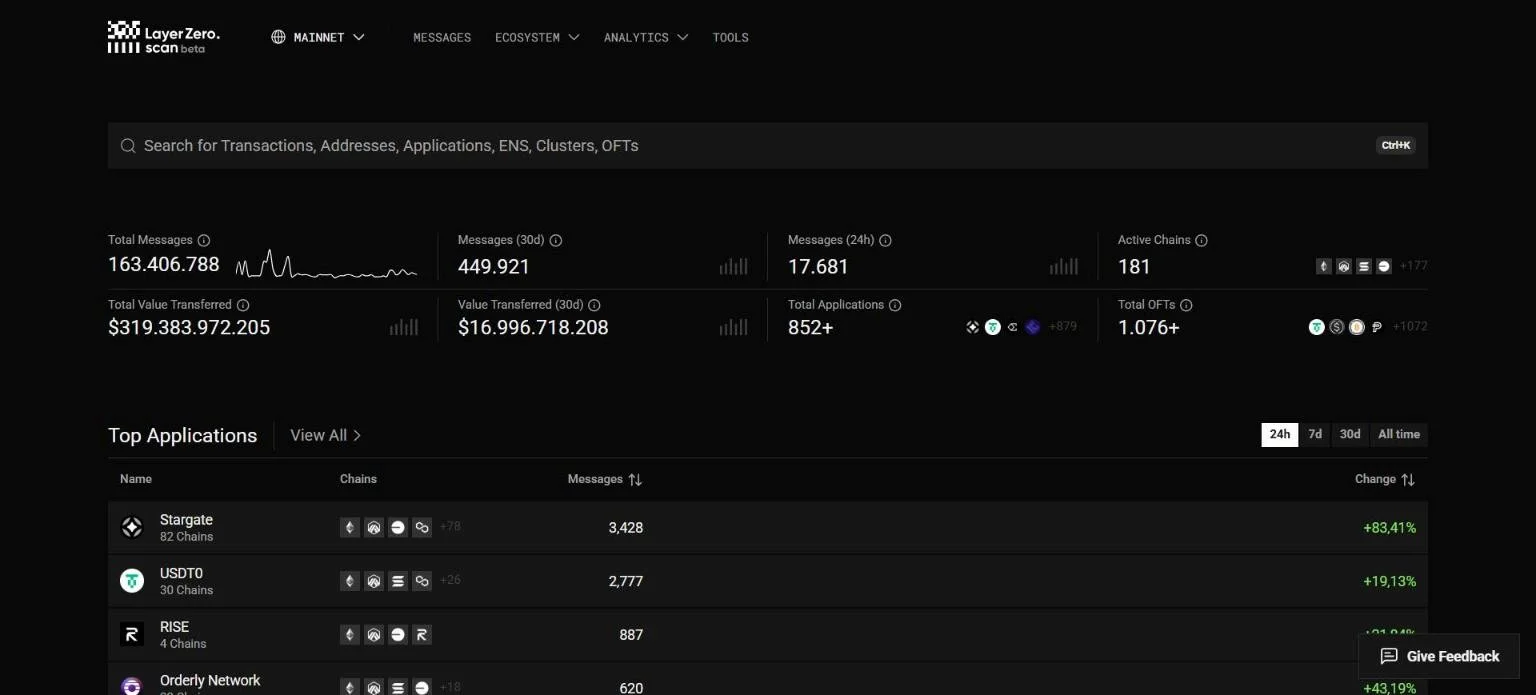
According to LayerZero Scan, the protocol had processed more than 163.4 million messages and transferred $319.4 billion in total value as of October 31, 2026. It operates across 181 active chains, with more than 852 applications and over 1,076 omnichain tokens using its infrastructure.
What Is an Omnichain Fungible Token (OFT)?
OFT, short for Omnichain Fungible Token, is LayerZero’s token standard. Traditional bridges lock a token on the source chain and mint a wrapped version on the destination chain. Under the OFT model, tokens are burned on the source chain and minted again on the destination chain. This keeps the total supply consistent and avoids creating separate wrapped versions of the same token across networks.
Tether’s multichain USDT0, Ethena’s USDe, and many project tokens use this standard. On LayerZero Scan, USDT0 ranks immediately behind Stargate among the applications generating the most messages.
LayerZero’s History: Key Milestones
Bryan Pellegrino, Ryan Zarick, and Caleb Banister founded LayerZero Labs in 2021. The protocol launched its mainnet in March 2022. Its first major application, the cross-chain liquidity bridge Stargate, went live that same month.
The company completed a $135 million funding round in 2022, followed by a $120 million round at a $3 billion valuation in April 2023. Investors included Andreessen Horowitz (a16z) and Sequoia Capital. LayerZero V2, released in January 2024, introduced its modular, DVN-based security architecture.
ZRO’s Launch and the Proof-of-Donation Airdrop
ZRO launched on June 20, 2024. The LayerZero Foundation allocated 85 million ZRO, equivalent to 8.5% of the total supply, to the first airdrop. Approximately 1.28 million wallets qualified.
The airdrop’s most controversial feature was its “proof of donation” model. Users had to donate $0.10 for every ZRO they claimed. Donations went to Protocol Guild, which supports Ethereum core developers, and the LayerZero Foundation pledged to match contributions up to $10 million.
Before the airdrop, the team also invited users to self-report sybil wallets as part of its efforts to identify them. The process drew mixed reactions from the community.
ZRO began trading on major centralized exchanges, including Binance, at launch.
The Stargate Acquisition
The LayerZero Foundation submitted a proposal to acquire Stargate in the summer of 2025. Despite last-minute interest from Wormhole, Axelar, and Across, the proposal passed a Stargate DAO vote in August 2025 with approximately 95% support. The deal was valued at between $110 million and $120 million at the time.
Under the agreement, Stargate DAO was dissolved, and STG holders became eligible to exchange their tokens at a rate of 1 STG = 0.08634 ZRO. For the first six months, Stargate revenue was split between veSTG holders and ZRO buybacks. According to LayerZero, all Stargate revenue has gone toward ZRO buybacks since April 2026.
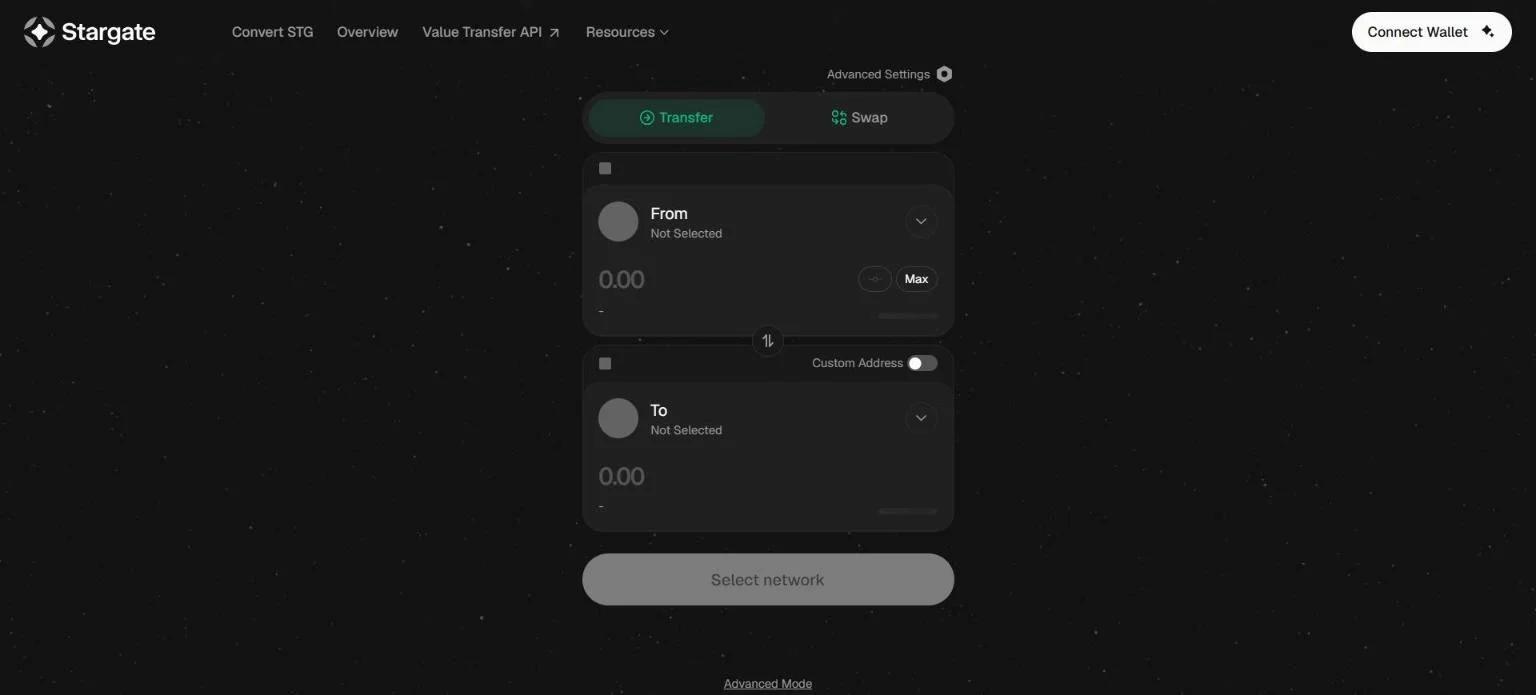
Stargate is the application generating the most messages on LayerZero Scan. Through its interface, users can select source and destination networks and move assets such as USDC, USDT, and ETH between chains.
The Zero Blockchain and ATLAS
LayerZero announced its own Layer 1 blockchain, Zero, on February 10, 2026. The company claims the network’s heterogeneous architecture can scale to as many as 2 million transactions per second. This remains a pre-mainnet claim; actual performance will only become clear after launch.
The list of collaborators attracted particular attention. Citadel Securities, U.S. clearing and settlement organization DTCC, NYSE parent company Intercontinental Exchange (ICE), and Google Cloud are working with LayerZero to explore how Zero could support traditional market infrastructure. Citadel Securities and Ark Invest also made strategic investments by purchasing ZRO, while Tether announced an investment in LayerZero Labs on the same day.
On October 20, 2026, LayerZero announced that Zero’s mainnet and its first application, ATLAS, would launch on November 30. ATLAS is designed as “headless exchange” infrastructure without its own user interface. It combines order matching, clearing, settlement, and risk management in a single engine, leaving the interface to third-party trading platforms.
Initially, Open ATLAS, which targets crypto applications, is expected to support more than ten trading platforms.
How Does the ZRO Token Work?
ZRO’s primary use today is governance. Token holders can vote in referendums on important issues, including protocol fees. Its role will expand with the launch of the Zero mainnet.
According to LayerZero, ZRO will serve three functions on Zero:
- Staking: Users will stake ZRO to help secure the network.
- Transaction fees: ZRO will pay gas fees for transactions on Zero.
- Governance: ZRO holders will vote on network parameters and protocol decisions.
The token also has a direct role in ATLAS. Trading platforms will be eligible for fee rebates ranging from 20% to 65%, depending on the amount of ZRO they stake and their trading volumes. After rebates, 75% of the remaining fees will go toward ZRO buybacks and burns, while 25% will go to market creators.
ZRO Supply and Tokenomics
ZRO has a total and maximum supply of 1 billion tokens. According to market data, approximately 405.2 million ZRO were in circulation as of October 31, 2026. This represents slightly more than 40% of the total supply.
The allocation announced at launch was as follows:
| Group | Allocation |
Community (LayerZero Foundation) | 38.3% |
Strategic partners | 32.2% |
Core contributors | 25.5% |
Repurchased tokens | 4% |
The distribution has changed over time. In September 2025, the LayerZero Foundation repurchased 50 million ZRO from strategic partners. These tokens, together with the Foundation’s other remaining locked tokens, were locked again until the Zero mainnet launch. The Foundation also announced that it had no plans for another airdrop from its token allocation.
According to Tokenomist, the community’s share of the current distribution has risen to 43.3%, while the strategic partners’ share has fallen to 27.2%. Locked tokens are entering circulation through monthly unlocks until 2027.
The most recent unlock took place on October 20, 2026, releasing approximately 23.6 million ZRO. The next unlock, scheduled for November 20, 2026, is expected to release around 23.3 million ZRO. These monthly additions to circulating supply could put pressure on the price if demand fails to grow at a similar pace.
The Fee Switch and Buyback Mechanism
One of the most widely discussed aspects of LayerZero’s tokenomics is its “fee switch” voting process. If activated, the protocol would charge a fee on every message sent, using the revenue to buy back and burn ZRO.
Three referendums have taken place so far, in December 2024, June 2025, and December 2025. More than 96% of participants voted in favor each time. However, turnout reached only 10.96%, 13.01%, and 3.71%, respectively.
Since the second referendum, a dynamic quorum with a minimum threshold of 20% has applied. Low participation has prevented the mechanism from being activated.
Meanwhile, two separate sources have supported ZRO buybacks. All Stargate revenue has gone toward ZRO buybacks since April 2026. LayerZero Labs also announced that it had purchased $10 million worth of ZRO on the market, although it has not provided a fixed schedule for future purchases.
ZRO Coin Price and Market Data
According to JR Kripto, ZRO was trading at $1.71 as of October 31, 2026, ranking 77th by market capitalization. The token gained 4.62% over the preceding 24 hours.
| Metric | Value |
Current price | $1.71 |
Market capitalization | $693.8 million |
Fully diluted valuation | $1.71 billion |
24-hour trading volume | $193.9 million |
Circulating supply | 405.2 million ZRO |
All-time high | $7.47 |
All-time low | $0.707 |
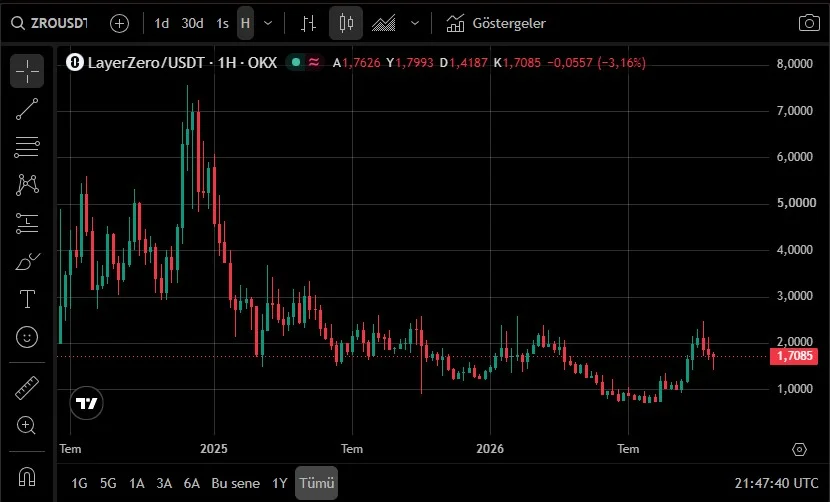
The all-time price chart shows that ZRO fluctuated between $3 and $5 after launch. The token reached an all-time high of $7.47 in December 2024 before gradually declining throughout 2025. After falling below $1 in mid-2026, the price recovered toward $1.70 in recent weeks.
The current price sits approximately 77% below its all-time high and around 142% above its all-time low. Monthly token unlocks and the Zero launch on November 30 are among the main developments that could influence its price in the coming period.
You can track ZRO’s live price, technical analysis, and exchange trading pairs on JR Kripto’s LayerZero page.
Why Does LayerZero Matter?
LayerZero turns cross-chain communication into general-purpose infrastructure on which developers can build applications. Stablecoin issuers, DeFi protocols, and gaming projects can use the same messaging layer to circulate their tokens across dozens of networks while maintaining a unified supply.
The OFT standard plays an important role here. Its burn-and-mint model reduces the need for users to distinguish between separate wrapped versions of the same token on different networks.
With Zero, the project is expanding from connecting other blockchains to operating its own network. Its work with traditional financial institutions such as Citadel Securities, DTCC, and ICE shows that LayerZero is also seeking a role in tokenized assets and around-the-clock trading infrastructure.
Where Can You Buy ZRO?
ZRO trades on all four major exchanges accessible to users in Türkiye: Binance, Binance TR, BtcTurk, and Paribu. According to market data, Binance’s ZRO/USDT pair has the highest trading volume. Gate, Bybit, OKX, and Coinbase are among the other major exchanges offering ZRO trading.
Because ZRO is designed as an OFT, it can exist across multiple networks, including Ethereum, Arbitrum, Base, and BNB Chain. When withdrawing from an exchange, make sure the selected network matches a network supported by the destination wallet. Available trading pairs and withdrawal networks can vary by exchange.
LayerZero’s Team and Investors
Bryan Pellegrino is the CEO of LayerZero Labs, while Ryan Zarick serves as CTO. The third co-founder, Caleb Banister, also contributed to the development of its technical infrastructure. The project operates through two separate entities: LayerZero Labs, which develops the protocol, and the LayerZero Foundation, which oversees the token and ecosystem.
Andreessen Horowitz and Sequoia Capital were among its early investors. In 2026, Citadel Securities and Ark Invest joined by purchasing ZRO, while Tether invested in LayerZero Labs.
Security, Token Unlock, and Competition Risks
LayerZero’s biggest risk lies in its security configuration. The protocol allows applications to choose their own verifiers. Misusing this flexibility can result in substantial losses.
On April 18, 2026, KelpDAO’s rsETH bridge suffered an attack involving approximately $292 million. Kelp’s LayerZero configuration relied on a single DVN, operated by LayerZero Labs, to approve messages. Attackers manipulated the RPC nodes used by that DVN and succeeded in getting a fraudulent message approved.
Following the incident, LayerZero stopped signing messages for single-verifier, or 1-of-1, configurations and introduced a requirement for multiple independent DVNs in its default settings.
Monthly token unlocks are another factor to monitor closely. Approximately 23 million ZRO entering circulation each month could create selling pressure during periods when buyback programs remain limited.
Competition is also a significant risk. Wormhole, Axelar, Chainlink CCIP, and Circle’s CCTP infrastructure operate in the same market. KelpDAO’s decision to move rsETH to Chainlink infrastructure after the attack demonstrated how competitors can gain users during a crisis.
Zero, meanwhile, has yet to launch its mainnet. Performance targets such as 2 million transactions per second, along with the commercial results of its work with traditional financial institutions, will need to be assessed after launch.
Frequently Asked Questions (FAQ)
Below are answers to some frequently asked questions about LayerZero (ZRO):
- What is LayerZero, and when did it launch? LayerZero is an interoperability protocol that enables messages and value to move between different blockchains. Its mainnet launched in March 2022. The ZRO token launched on June 20, 2024.
- What is ZRO coin used for? ZRO currently serves as LayerZero’s governance token. It will support staking, gas payments, and governance on the Zero network, which is scheduled to launch on November 30, 2026.
- Is LayerZero a bridge? LayerZero describes itself as a cross-chain messaging layer. Bridge applications such as Stargate operate on top of LayerZero’s infrastructure.
- What is the Zero blockchain? Zero is the Layer 1 blockchain announced by LayerZero in February 2026. Its mainnet and first application, ATLAS, are scheduled to launch on November 30, 2026.
- What is ZRO’s supply? ZRO has a total and maximum supply of 1 billion tokens. Approximately 405.2 million ZRO were in circulation as of October 31, 2026. The remaining tokens are entering circulation through monthly unlocks until 2027.
- Which Turkish exchanges list ZRO? ZRO trades on Binance TR, BtcTurk, and Paribu. Binance’s global platform also offers the ZRO/USDT trading pair.
- Is LayerZero a suitable investment? Whether ZRO is a suitable investment depends on your risk profile and research. The Zero launch, ATLAS fee model, and buybacks are potential positive developments to monitor. Monthly token unlocks, security risks, and competition should also form part of your assessment.
Follow the JR Kripto Guide series for updates on the LayerZero ecosystem and the Zero launch.
#what is layerzero #zro coin #layerzero zro #zro coin price #zero blockchain #omnichain token #stargate #cross-chain bridge

