
Developing artificial intelligence requires more than good models and large datasets. Training, inference, and verification demand substantial computing power, while much of this capacity remains under the control of a small number of cloud companies. Gensyn is trying to change this by bringing devices from around the world together in an open machine learning network.
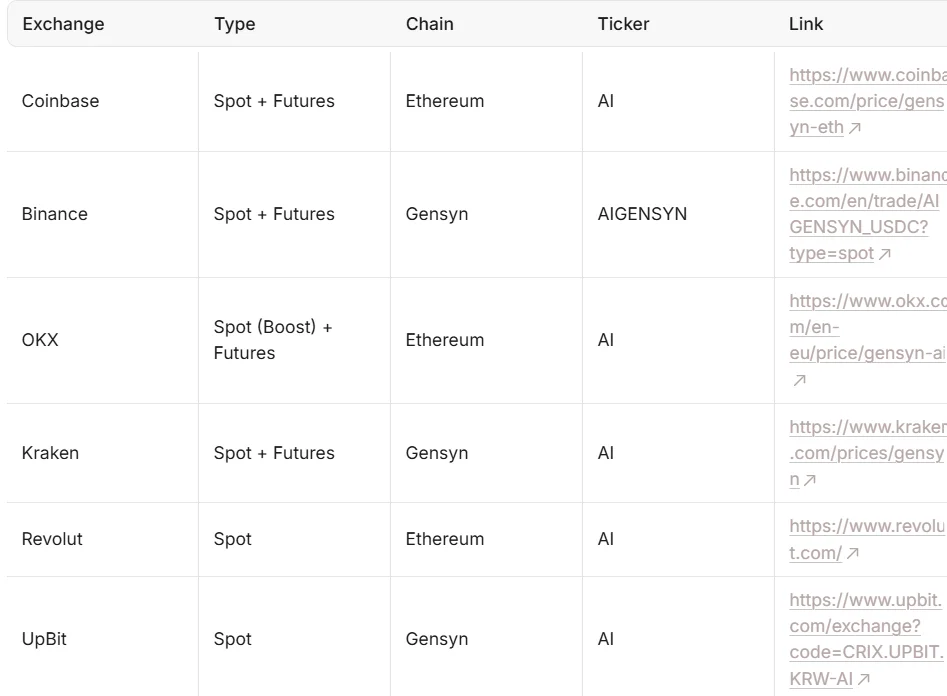
The Gensyn network enables participants to share computing resources, verify AI workloads, and handle payments through blockchain infrastructure. The project uses AI as the symbol of its native asset in official documentation, while Binance lists the token under the AIGENSYN ticker to avoid confusion with other assets.
Gensyn’s Definition and Origins
Gensyn is a decentralized infrastructure network created to train, verify, trade, and improve artificial intelligence systems. The project distributes machine learning workloads across different devices while seeking to verify and reward the work completed by those devices.
AIGENSYN is the ticker Binance uses for the AI token within the Gensyn ecosystem. The token plays a role in network payments, verification, staking, and governance.
Gensyn’s central idea is to open idle computing power to a global market. A GPU in a data center, a graphics card in a personal computer, or another compatible device can contribute to machine learning tasks when it meets the necessary technical requirements.
This model aims to help AI developers access computing resources without relying exclusively on major cloud providers. Participants who supply these resources can receive economic incentives for their work.
Gensyn was designed as more than a GPU rental marketplace. Its network includes separate layers for executing tasks, verifying results, enabling communication between participants, and coordinating payments.
Which Network Does Gensyn Run On?
Gensyn uses a dedicated rollup connected to Ethereum. According to the project’s official network description, this infrastructure is built with the OP Stack, while the AI token serves as the network’s native asset.
The OP Stack is an open-source framework used to develop Ethereum-compatible rollup networks within the Optimism ecosystem. Gensyn uses this technology to create a coordination layer dedicated to artificial intelligence and machine learning workloads.
The network supports tools compatible with the Ethereum Virtual Machine. This allows users and developers to interact with Gensyn through wallets, smart contracts, and other EVM tools.
The rollup architecture enables transactions to take place outside the Ethereum mainnet at a lower cost. Transaction results can later be secured through an Ethereum-connected settlement structure.
Why Was Gensyn Created?
Gensyn emerged in response to the AI industry’s growing need for computing power. As models become larger, training and inference costs increase, while access to advanced GPU clusters becomes especially difficult for independent developers and small research teams.
Existing cloud services provide powerful infrastructure, but supply, pricing, and access remain dependent on decisions made by a handful of large companies. Gensyn wants to create an alternative marketplace by combining distributed computing resources around the world within a single open network.
Trust is one of the biggest challenges facing this model. In an environment without a centralized service provider, the network needs a way to prove that a device genuinely completed the machine learning task assigned to it.
Gensyn addresses this problem through verification mechanisms. The network is developing a system that can check completed work and resolve disagreements between participants.
The project’s broader goal is to build open infrastructure where machines can communicate and engage in economic activity. Its plans extend beyond model training to inference, information markets, and transactions between AI agents.
Gensyn’s History: Key Milestones
Gensyn was founded in London in 2020 by Ben Fielding and Harry Grieve. According to the Entrepreneur First company profile, Fielding serves as CEO and Grieve as CTO.
The two founders set out to develop infrastructure at the intersection of machine learning and blockchain technology. Their goal was to build a protocol in which different types of hardware could contribute to shared AI tasks and completed work could be verified without a central authority.
Gensyn received backing from venture investors during its early development. Its funding rounds included participants such as Eden Block, Galaxy Digital, Maven 11, CoinFund, and Protocol Labs.
In 2023, Gensyn completed a $43 million Series A round led by a16z crypto. In its investment announcement, a16z highlighted Gensyn’s goal of bringing idle machine learning capacity into a global marketplace.
The round took the project’s total funding above $50 million. The capital supported protocol development, research, and the expansion of its testnet infrastructure.
Testnet, Mainnet, and Exchange Listings
Before launching its mainnet, Gensyn tested user participation through several testnet applications. RL Swarm and BlockAssist were among the most prominent products from this period.
RL Swarm allows machine learning models to work together over a peer-to-peer network. Participants can run models on local devices, share training results with other nodes, and contribute to the performance of the wider group.
BlockAssist relies on users providing feedback to AI models in a game-like environment. Along with testing the technical infrastructure, these applications helped expand the Gensyn community.
Gensyn opened its public testnet in March 2025. Participants could create network identities and contribute to machine learning tasks. Expectations emerged that points earned through testnet activity might lead to a token distribution, although the project stressed that not every testnet reward carried economic value.
The project held a public sale for the AI token in December 2025. This sale became an important step in the mainnet preparations, introducing the token’s roles in payments, staking, network security, and governance.
The Gensyn mainnet went live in 2026. The AI token subsequently began trading across centralized and decentralized markets.
Binance introduced the AIGENSYNUSDT perpetual futures contract on April 29, 2026. Spot trading followed on May 14, 2026, with the AIGENSYN/USDT, AIGENSYN/USDC, and AIGENSYN/TRY pairs.
The start of spot trading was postponed by several hours because of an issue with the project team’s deposit node. Binance later opened trading at 17:00 UTC and applied its Seed Tag, which is used for early-stage projects. The exchange also added AIGENSYN to Simple Earn, Convert, Margin, and VIP Loan.
Gensyn’s Current Status
As of August 2026, Gensyn continues working toward an open economic infrastructure for machine intelligence. Its development centers on its blockchain network, verifiable machine learning, peer-to-peer communication, and information markets.
Delphi is one of the network’s main products. Introduced in April 2026, it allows users to create information markets whose results can be evaluated through AI-powered mechanisms.
Market creators on Delphi can launch markets where models and users participate around a particular subject. Transactions take place onchain, while the platform aims to determine market outcomes through verifiable AI systems instead of a centralized company.
AXL is another important product. This open-source communication tool allows AI agents running on different devices to reach one another without relying on a central server.
AXL makes it easier for devices behind NAT or firewalls to establish peer-to-peer connections. Its support for AI communication standards such as MCP and A2A turns it into an infrastructure component that can serve applications beyond the Gensyn ecosystem.
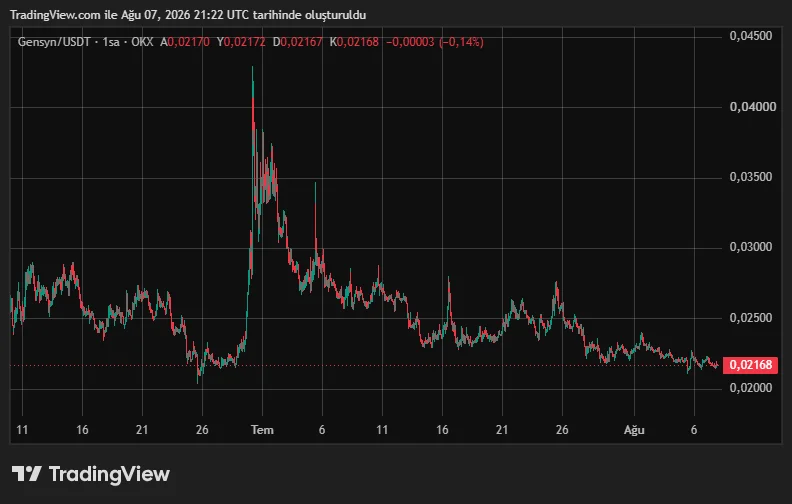
As of August 2026, the AIGENSYN coin price is trading at around $0.02.
How Does the AIGENSYN Token Work?
Official project sources identify Gensyn’s native token with the AI symbol. CoinGecko and several other cryptocurrency platforms also display the asset as Gensyn (AI).
Binance lists the token under the AIGENSYN ticker. This helps reduce the risk of a short and widely used symbol such as AI being confused with other assets or products on the exchange.
AI and AIGENSYN therefore do not represent two separate Gensyn tokens. Both names refer to the same economic asset; only the ticker used by the platform changes.
Users should not rely solely on a token’s name when depositing or withdrawing funds. They should verify the network, contract address, and transfer standard supported by the exchange before completing a transaction.
Fraudulent tokens using similar symbols present an additional risk. The project’s website, official documentation, and the relevant exchange’s deposit page are among the most reliable places to verify the asset.
Token Utility and Economics
The AI token sits at the center of payments and economic incentives within the Gensyn network. It is used for machine learning verification, staking, protocol payments, and governance.
Validators stake AI to check artificial intelligence workloads on the network. Participants who behave honestly can earn rewards, while incorrect or malicious behavior may result in economic penalties.
AI also functions as a payment asset within the Gensyn ecosystem. Users can pay with the token when accessing network services, information markets, and AI applications.
Over time, token holders are expected to participate in decisions involving protocol upgrades, core network parameters, and the use of the Community Treasury. The scope of governance may expand as the network moves toward greater decentralization.
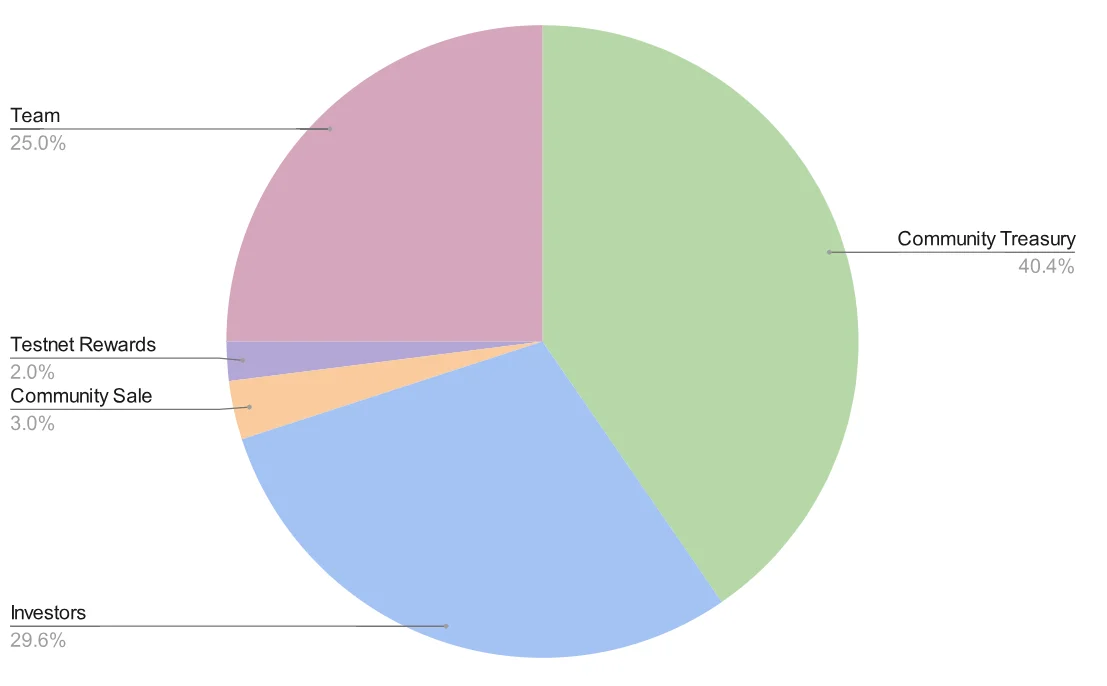
The total and maximum supply of AI is capped at 10 billion tokens. According to the official documentation, 40.4% of the supply is allocated to the Community Treasury. These funds are intended for ecosystem spending, liquidity, grants, research and development, and incentive programs.
Investors received 29.6% of the supply. The team was allocated 25%, while 3% went to the community sale and 2% to testnet participant rewards.
Twenty percent of the tokens allocated to the Community Treasury unlocked at the token generation event. The remaining portion enters circulation linearly over 36 months.
Team and investor tokens have an initial 12-month lock, followed by linear vesting over 24 months. Tokens sold in the community sale were generally available at launch, although a 12-month lock applies to US-based participants.
This schedule prevents most of the supply from entering the market on the first day. Future unlocks can still increase the circulating supply and create selling pressure on AIGENSYN.
Gensyn also has a programmatic buy-and-burn mechanism that connects network revenue to the AI token economy. A portion of protocol revenue is directed to a smart contract vault that buys AI on the open market.
Seventy percent of the purchased tokens are permanently burned. Another 29% is transferred to the Community Treasury, while the remaining 1% rewards the party that executes the vault transaction.
The mechanism aims to establish a direct relationship between network use and token supply. Greater activity and protocol revenue may lead to more AI purchases, although the amount burned will only become economically meaningful if the network generates sustained real-world use.
Transaction and Security Structure
The Gensyn protocol is organized around four main components: execution, verification, communication, and coordination. These layers allow machine learning tasks running on different hardware to be completed within a shared system.
The execution layer provides a standardized framework for running tasks consistently across different devices. It aims to make results comparable even when the underlying hardware varies.
The verification layer checks the results submitted by participants. It focuses on identifying incorrect or manipulated results without requiring the network to rerun the entire computation at a high cost.
The communication layer allows nodes to share tasks and results over a peer-to-peer network. Tools developed by Gensyn, including AXL, help establish these connections without dependence on centralized servers.
The coordination layer combines identity, incentives, and payments on the blockchain. Participants can have persistent onchain identities, allowing performance records and reputation to accumulate over time.
Gensyn’s Ethereum rollup separates payment and identity transactions from the machine learning computations themselves. Resource-intensive AI workloads take place offchain, while their economic results and required proofs can be recorded onchain.
This structure improves efficiency, but it does not eliminate every risk. Smart contract vulnerabilities, bridge security, incorrect verification results, and coordination problems between network participants remain potential threats.
Gensyn’s Team, Community, and Ecosystem
Gensyn was founded by Ben Fielding and Harry Grieve. Fielding serves as CEO, while Grieve serves as CTO.
Fielding has an academic and technical background in machine learning. Grieve’s work across economics, blockchain, and decentralized systems contributes to the project’s protocol and economic design.
The team includes more than blockchain developers. Machine learning researchers, distributed systems engineers, and specialists in crypto economics also contribute to development.
Gensyn’s research focuses on decentralized machine learning and algorithmic economics. The project publishes some of its tools as open-source software, allowing independent developers to inspect the code and contribute.
The open-source approach supports transparency, but it does not provide a security guarantee on its own. The frequency of audits, the speed at which identified issues are fixed, and the network’s performance under real conditions remain important.
Community and Network Participants
The Gensyn community expanded around applications such as RL Swarm and BlockAssist during the testnet period. Users tested the network by running nodes on personal computers or contributing to model-training processes.
RL Swarm’s relatively low barrier to entry allowed users without powerful data centers to take part in some experiments. However, not every piece of hardware can provide sufficient performance for every task, and technical requirements vary by model.
The community consists of more than computing-resource providers. Researchers, application developers, model creators, validators, and users of information markets also form part of the ecosystem.
Gensyn’s persistent onchain identity system seeks to associate contributions with a particular user or machine. Successful task histories, model performance, and other contributions can therefore be measured over time.
The system needs resistance to Sybil attacks to operate effectively. Attempts by one user to collect rewards through numerous false identities are a common problem across decentralized networks.
Governance may become another important part of the community structure. The influence token holders gain over protocol changes and ecosystem resources will help indicate how decentralized the network ultimately becomes.
Products, Partnerships, and Use Cases
The Gensyn ecosystem covers model training, distributed inference, communication between AI agents, and information markets. These areas share a common goal: coordinating machine activity openly and connecting it to economic value.
RL Swarm provides a community-driven example of distributed model training. Multiple participants can contribute to the same learning process, while successful results are shared throughout the network.
AXL provides a peer-to-peer communication layer for AI agents running on different devices. It aims to let agents reach one another without public IP addresses or centralized cloud servers.
Delphi brings AI together with information markets. Users can create markets, models can compete in specific tasks, and results can be processed through onchain mechanisms.
The project also prioritizes compatibility with tools across the wider Ethereum and AI ecosystems. EVM support makes it easier for developers to use existing wallets and smart contract development tools.
Gensyn’s investors include a16z crypto, CoinFund, Galaxy Digital, Eden Block, Maven 11, and Protocol Labs. These relationships may provide technical or financial support, but they do not guarantee widespread adoption of the products.
The ecosystem’s development will depend on external developers building applications on Gensyn. A network supported only by products created by its core team may struggle to achieve its goal of becoming open infrastructure.
Why Is Gensyn Important?
Demand for computing power across the artificial intelligence industry continues to increase. Limited GPU supply and the cost of cloud services widen the resource gap between small teams and large technology companies.
Gensyn is working to bring unused or underutilized hardware into a single marketplace. If successful, researchers could access a broader computing pool while hardware owners earn revenue from idle capacity.
The central challenge facing decentralized AI networks is establishing trust in completed computations. A blockchain can verify that a payment took place, but it cannot independently determine whether a model was trained correctly.
Gensyn’s machine-learning-specific verification mechanisms become important at this point. The project aims to check results and settle disputes without repeating an entire computation.
The network also seeks to provide identity and payment infrastructure for AI agents. The ability of an agent to carry its performance history, communicate with other agents, and receive payment for services may become a core requirement of a future autonomous software economy.
Gensyn’s Position Among Similar Projects
Decentralized artificial intelligence and physical infrastructure networks now include a growing number of projects. Bittensor, io.net, Akash Network, Render, and Aethir are working on computing markets, model incentives, or the sharing of GPU resources.
Gensyn distinguishes itself through its emphasis on verifying machine learning work. Instead of focusing solely on hardware rental, it aims to combine execution, communication, identity, and economic coordination within one protocol.
Bittensor is better known for a subnet structure that incentivizes different AI models. Render expanded from graphics processing and GPU-based workloads, while Akash focuses on general-purpose decentralized cloud services.
Gensyn’s broader approach also increases execution risk. Developing distributed training, verification, agent communication, and information markets at the same time requires significant technical complexity.
The project’s place in the industry cannot be measured solely through token price or the number of exchange listings. Active developers, completed machine learning tasks, demand for computing power, and application revenue provide more meaningful indicators.
Competition, Token Supply, and Key Risks
Strong competition represents one of Gensyn’s first major risks. Centralized cloud providers hold advantages in scale, reliability, and technical support, while other decentralized projects are pursuing the same group of users.
Coordinating distributed hardware is difficult. Differences in connection speeds, GPU models, and device performance may slow training or affect the consistency of results.
The verification system is another critical risk area. Malicious participants may submit incorrect results, attempt to manipulate identity systems, or exploit weaknesses in the reward mechanism.
The ratio between circulating and total token supply also requires close attention. With approximately 1.3 billion tokens in circulation against a maximum supply of 10 billion, a substantial amount of AI may enter the market in the future.
The 12-month lock on team and investor tokens is followed by linear vesting over 24 months. The remaining Community Treasury allocation also follows a 36-month schedule, meaning that circulating supply may increase regularly.
Investors should therefore consider monthly unlocks and whether buy-and-burn activity can offset new supply, rather than looking only at the maximum supply.
The AIGENSYN price is also influenced by the broader cryptocurrency market and interest in AI-related tokens. Low liquidity, high leverage, and sudden news flows can produce sharp price movements in early-stage assets.
Binance’s Seed Tag highlights that Gensyn remains an early-stage asset with elevated risk. The label does not mean the project will fail, but its price and product risks may be higher than those of more established crypto assets.
Regulatory uncertainty should also be considered. Token sales, staking services, decentralized computing marketplaces, and outputs generated by AI models may face different rules across jurisdictions.
Frequently Asked Questions
Below are answers to some frequently asked questions about Gensyn.
- What is Gensyn, and when was it launched?
- Gensyn is decentralized AI infrastructure that allows machine learning tasks to run across devices around the world and verifies the completed work. Founded by Ben Fielding and Harry Grieve in 2020, the project opened its public testnet in 2025 and advanced its mainnet rollout in 2026.
- What is the AIGENSYN token used for?: AIGENSYN is the Binance ticker for Gensyn’s native AI token. It was designed for network payments, staking, machine learning verification, and governance.
- Which network does Gensyn run on?: Gensyn operates a dedicated Ethereum-connected rollup developed with the OP Stack. The network is EVM-compatible, while an ERC-20 version of the AI token also exists on Ethereum.
- Who founded Gensyn?: Gensyn was founded by Ben Fielding and Harry Grieve. Fielding serves as CEO and Grieve as CTO.
- What is the AIGENSYN supply?: AI, known as AIGENSYN on Binance, has a maximum supply of 10 billion tokens. According to market data, approximately 1.3 billion tokens were in circulation as of August 7, 2026. Supply figures and unlock schedules can change and should be checked through current sources.
- What is the difference between AI and AIGENSYN?: Both symbols refer to the same Gensyn token. The project and several data platforms use AI, while Binance lists the asset as AIGENSYN.
- Is Gensyn suitable as an investment?: Gensyn targets a technical use case within decentralized artificial intelligence, but it carries early-stage project risk, competition, token unlocks, and high volatility. Any investment decision should consider the latest token distribution, network use, developer activity, and personal risk tolerance. Gensyn is trying to combine idle computing power within an open AI infrastructure. Products including RL Swarm, AXL, and Delphi support its approach to verifiable machine learning, while real demand for computing power, developer participation, and the sustainability of its token economy will determine its long-term outcome.
Follow the JR Kripto Guide series for the latest information about Gensyn and emerging projects across the AI and cryptocurrency ecosystems.

