
Following Ethereum’s transition to proof of stake (PoS), ETH holders gained the ability to stake their tokens, contribute to network security, and earn rewards. However, staked ETH often remained locked and unavailable for other uses.
ether.fi emerged as one of the projects addressing this issue through liquid staking and restaking. Today, alongside its position as one of Ethereum’s largest staking protocols, the project is working to become a crypto neobank through its card and banking-like services. At the center of the ecosystem is the ETHFI token, which serves several functions, from governance to rewards.
What Is ether.fi, and How Did It Start?
ether.fi is a decentralized liquid restaking protocol that allows users to stake ETH, earn a share of network rewards, and maintain liquidity. When users deposit ETH, they receive eETH tokens representing their staked assets. These tokens can be traded or used as collateral in DeFi applications.
One of the project’s defining features is its decentralized structure, which aims to give users control over their validator keys. ether.fi distributes staked ETH across 14 node operators and seeks to reduce reliance on any single operator through solutions such as distributed validator technology (DVT).
ETHFI is the governance token of the ether.fi ecosystem. It is used to vote on protocol decisions, receive a share of protocol revenue through staking, and participate in the Cash card’s rewards system.
What Is Liquid Restaking?
Liquid staking involves issuing a freely usable token that represents a staked asset. Users can stake their ETH while continuing to transact in DeFi with the token they receive.
Restaking involves reusing staked ETH to secure additional protocols, a model pioneered by EigenLayer. ether.fi stakes users’ ETH on Ethereum and directs it to restaking protocols such as EigenLayer to generate additional rewards. Liquid restaking combines these two models.
The Difference Between eETH and weETH
ether.fi has two primary tokens:
- eETH: A rebasing token representing staked ETH, with a balance that automatically increases as rewards accrue.
- weETH: The wrapped version of eETH. Its balance remains fixed while its value relative to ETH increases over time.
weETH is widely preferred because it is easier to use across DeFi protocols and different blockchains. Lending platforms such as Aave and numerous Layer 2 networks accept weETH as collateral.
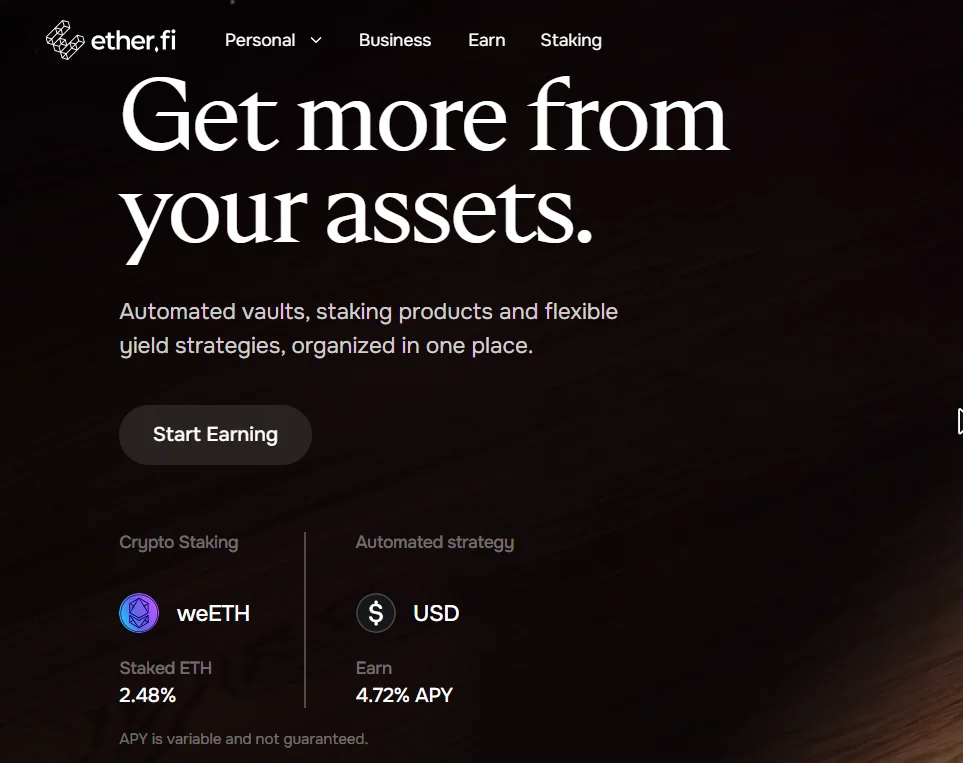
As of November 6, 2026, ether.fi’s Earn page shows an annual yield of 2.48% for weETH and 4.72% for its automated USD strategy. The platform states that yields are variable and are not guaranteed. Users can select “Start Earning” to open the application and initiate a staking or vault transaction.
ether.fi’s TVL and Revenue Data
According to DefiLlama, the total value locked (TVL) across ether.fi’s products stood at approximately $4.62 billion as of November 6, 2026. The protocol generated $12.32 million in fees and $3.84 million in revenue over the previous 30 days.
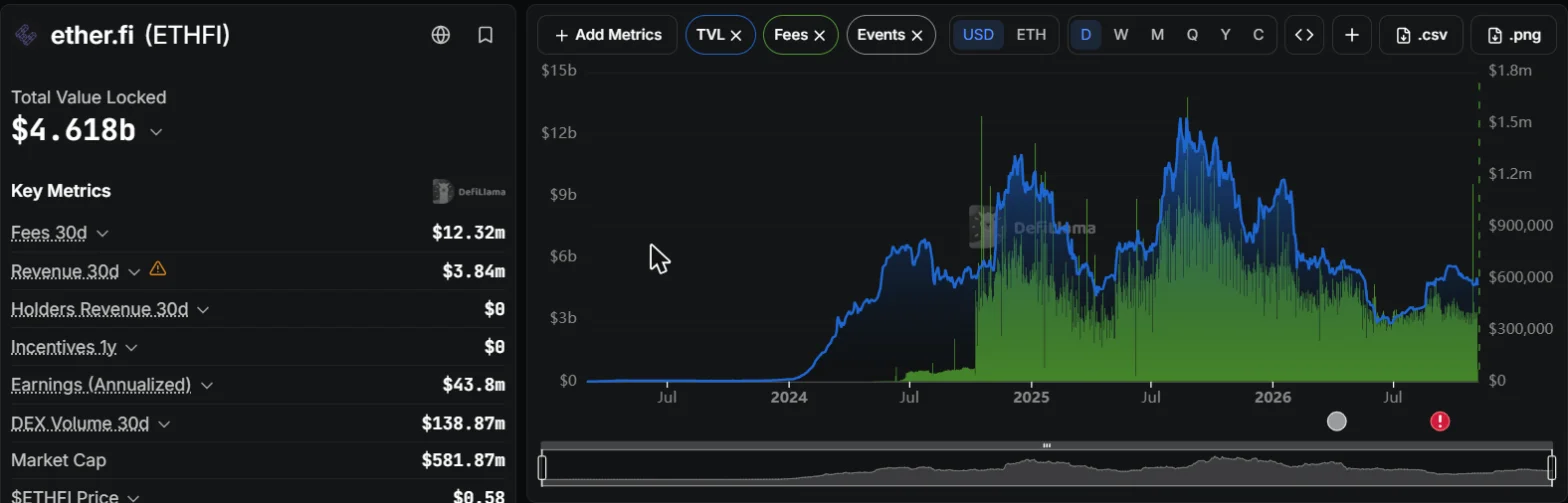
The blue line in the chart represents TVL, while the green bars show daily fees. ether.fi’s TVL grew rapidly throughout 2024 and exceeded $12 billion in the summer of 2025. It declined throughout 2026, falling into a range of $4 billion to $6 billion.
ether.fi’s History: Key Milestones
ether.fi was founded by Mike Silagadze, the founder of education technology company Top Hat. The project launched on Ethereum in 2023 as a decentralized liquid staking protocol and became one of the leading players in restaking as EigenLayer gained traction.
The company raised $4 million in seed funding in late 2023. On February 28, 2024, it completed a $23 million Series A funding round led by Bullish Capital and CoinFund. At the time, the protocol’s TVL stood at approximately $1.64 billion.
The ETHFI Launch and Airdrop
The ETHFI token launched in March 2024. ether.fi allocated 60 million ETHFI to its first airdrop season and planned to distribute another 50 million ETHFI following the second season. A further 20 million ETHFI was distributed to users participating in Binance’s token distribution program.
The token began trading at $4.13 on March 18, 2024, with an initial circulating supply of 115.2 million ETHFI. Following community criticism during the first phase of the airdrop, ether.fi revised its token distribution. ETHFI reached an all-time high of $8.53 in late March 2024.
The Cash Card and the Transition to a Neobank
In 2025, ether.fi announced a strategy to expand beyond staking and become a crypto neobank. The company launched the ether.fi Cash card in the United States in April 2025. The card allows users to spend against their crypto holdings as collateral without selling them.
The “Summer” update, announced on August 13, 2026, added trading in tokenized stocks and precious metals through xStocks. Users can also borrow against their entire portfolios through an Aave market on Optimism.
The update supports more than 30 currencies and payment methods and offers up to 3% cashback on Cash card purchases. According to CEO Mike Silagadze, ether.fi has approximately 500,000 users and 150,000 cards.
According to Chainspect, total spending through the Cash card has reached approximately $918 million since launch. The card recorded its highest weekly spending volume on November 1, 2026, at approximately $31.7 million.
The Buyback Program and Recent Developments
ether.fi launched a $50 million ETHFI buyback program on October 31, 2025. In September 2026, it introduced substantial changes to its tokenomics. Cash card cashback payments switched from USDC to ETHFI, and the ETHFI staking requirements for membership tiers increased.
In October 2026, the company partnered with MoonPay to bring crypto trading and virtual bank accounts into a single infrastructure. Payment Tags, a feature enabling payments through usernames, also went live that month. ether.fi also applied for a MiCA license to operate in Europe.
How Does the ETHFI Token Work?
ETHFI has three main functions within the ether.fi ecosystem:
- Governance: ETHFI holders can vote on proposals concerning protocol development, treasury spending, and new products.
- Staking: Users stake their ETHFI to receive sETHFI and earn a share of the buyback program.
- Membership and rewards: Staking ETHFI is required to access higher Cash card membership tiers. Cashback on card purchases is also paid in ETHFI.
The Buyback and Burn Mechanism
Since September 2026, ether.fi has used protocol revenue to purchase ETHFI on the market through automated, contract-based transactions. Some of the purchased tokens are burned, while others are distributed to sETHFI holders. Cash card cashback rewards are also funded through these buybacks.
This model links demand for ETHFI to the protocol’s actual revenue. However, buybacks shrink when revenue declines. According to DefiLlama, approximately $78.1 million worth of ETHFI was staked as of November 6, 2026, equivalent to approximately 13.4% of its market capitalization.
ETHFI Supply and Tokenomics
ETHFI’s total and maximum supply was set at 1 billion tokens. All tokens were minted at launch, and no new tokens are being created. According to JR Kripto, approximately 965.4 million ETHFI was in circulation as of November 6, 2026, representing 96.5% of the total supply.
The allocation outlined in the official governance documentation is as follows:
| Group | Allocation |
Investors | 33.74% |
Treasury (Ecosystem Fund) | 21.62% |
Core team | 21.47% |
User airdrops | 19.27% |
Partnerships and liquidity | 3.9% |
Investor tokens unlock gradually over two years, while core team tokens unlock over three years. All locked allocations were subject to a one-year cliff. One percent of the partnership and liquidity allocation was set aside for Protocol Guild, which supports Ethereum core developers.
With approximately 96.5% of the supply already circulating, the remaining unlocks are expected to have a limited impact on price. Going forward, protocol revenue, buyback volumes, and Cash card usage will be the main factors shaping the token’s price.
ETHFI Coin Price and Market Data
As of November 6, 2026, ETHFI is trading at $0.5814 and ranks 79th by market capitalization. The token gained 9.23% over the previous 24 hours but declined 18.50% over the previous 30 days.
| Metric | Value |
Current price | $0.5814 |
Market capitalization | $561.3 million |
Fully diluted valuation | $580.9 million |
24-hour trading volume | $41.8 million |
Circulating supply | 965.4 million ETHFI |
All-time high | $8.53 |
All-time low | $0.2665 |
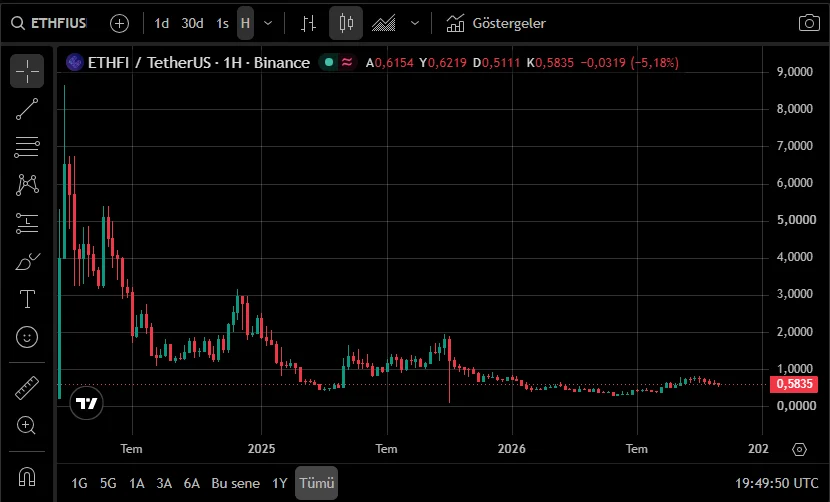
The all-time chart shows that ETHFI reached its record high of $8.53 shortly after its March 2024 launch. The token fell to around $1.50 by the summer of 2024 and tested the $3 level again during the December 2024 rally.
ETHFI fluctuated between $0.50 and $2 throughout 2025 and continued to decline in 2026. Following the September 2026 tokenomics changes, it recovered above $0.70 but gave back some of those gains in recent weeks.
The current price is approximately 93% below its all-time high and around 118% above its all-time low. Trends in Cash card spending and the size of buybacks are among the main developments that could influence the price in the coming period.
Why Does ether.fi Matter?
ether.fi stands out as one of the largest decentralized protocols in Ethereum staking and restaking. weETH is among the most widely used liquid restaking tokens in DeFi and is accepted as collateral on numerous lending platforms.
The project is also working to bridge the gap between DeFi and everyday finance. Its Cash card allows users to spend without selling their crypto assets. Trading in tokenized stocks and metals, alongside portfolio-backed borrowing, brings ether.fi closer to the structure of a traditional neobank.
On the tokenomics side, ETHFI’s connection to protocol revenue is a key feature. Buybacks, burns, and staking rewards offer a model designed to give token holders a direct share in the protocol’s growth.
Where Can You Buy ETHFI?
ETHFI trades on all four major exchanges accessible to users in Türkiye: Binance, Binance TR, BtcTurk, and Paribu. Paribu offers an ETHFI/TRY pair. OKX, Bybit, MEXC, and WhiteBIT are among the other exchanges offering ETHFI trading.
ETHFI is an ERC-20 token on Ethereum and is also available on certain Layer 2 networks, such as Arbitrum. When withdrawing from an exchange, users should ensure that the selected network matches a network supported by the destination wallet.
The ether.fi Cash card and certain products are not available in every country. Tokenized stock trading, in particular, is unavailable in some markets, including the United States.
ether.fi’s Team and Investors
ether.fi’s founder and CEO is Mike Silagadze. He previously founded Top Hat, an education technology company focused on higher education.
Bullish Capital and CoinFund led the company’s $23 million Series A funding round in February 2024. The protocol’s node infrastructure is operated by the 14 node operators listed in ether.fi’s “Operator Atlas” report.
Smart Contract, Restaking, and Regulatory Risks
Smart contract vulnerabilities are one of ether.fi’s primary risks. A flaw in the code of the protocol or its connected restaking platforms could result in the loss of staked assets.
Restaking introduces additional risks. Using staked ETH to secure additional protocols increases exposure to slashing in the event of validator errors or malicious behavior. The market prices of eETH and weETH can also fall below the value of their underlying ETH during periods of heavy withdrawal demand.
The neobank strategy increases regulatory exposure. Card, payment, and tokenized stock services face licensing requirements across different countries. The outcome and timing of ether.fi’s MiCA application remain uncertain.
On the competitive side, liquid staking and restaking protocols such as Lido, Renzo, and Kelp compete for the same users, alongside other crypto card providers. ETHFI’s 93% decline from its all-time high shows that TVL and user growth alone have not been enough to support the token’s price.
Frequently Asked Questions (FAQ)
Below are some frequently asked questions and answers about ether.fi (ETHFI):
- What is ether.fi, and when did it launch? ether.fi is a decentralized liquid restaking protocol and crypto neobank application built on Ethereum. The protocol launched in 2023, while the ETHFI token began trading on March 18, 2024.
- What is ETHFI coin used for? ETHFI is used in governance voting, staking that provides a share of buybacks, and the Cash card’s membership tiers and cashback system.
- What is the difference between eETH and weETH? eETH is a token whose balance automatically increases with staking rewards. weETH is the wrapped version of eETH; its balance remains fixed while its value relative to ETH increases.
- What is the ether.fi Cash card? The Cash card is a payment card that allows users to spend against their crypto assets as collateral. It offers up to 3% cashback, depending on the membership tier.
- What is ETHFI’s supply? ETHFI has a total and maximum supply of 1 billion tokens. Approximately 965.4 million ETHFI was in circulation as of November 6, 2026.
- Which Turkish exchanges list ETHFI? ETHFI trades on Binance TR, BtcTurk, and Paribu. The global Binance platform also offers an ETHFI/USDT trading pair.
- Is ether.fi a suitable investment? ETHFI’s suitability depends on an individual’s risk profile and research. Revenue-funded buybacks, Cash card growth, and the high proportion of circulating supply are among the potentially positive factors to monitor. Smart contract risks, regulatory uncertainty, and competition should also be considered.
Follow the JR Kripto Guide series for the latest updates on the ether.fi ecosystem and Cash card.

