
Using crypto assets extends beyond trading on a centralized exchange. DeFi applications allow you to swap tokens, lend your assets, and borrow against collateral through your wallet.
Smart contracts manage a substantial part of these activities. Alongside convenience, transparency, and accessibility, users face risks such as contract vulnerabilities, price fluctuations, and user errors.
What Does Decentralized Finance Mean?
DeFi is short for “decentralized finance.” The term covers financial applications and protocols that operate on blockchains.
In these systems, software rules can govern activities such as trading, borrowing, and collateral management. Users connect to many of these applications through their own crypto wallets.
Why did DeFi emerge?
Traditional finance, or TradFi, generally delivers services through banks, payment providers, and brokerage firms. Account requirements, transfer schedules, geographic restrictions, and transaction costs can affect access.
Blockchain technology enabled digital assets to move across a shared network. Smart contracts added programmable financial transactions to that infrastructure.
One of DeFi’s founding goals is to give users access to more open and interoperable financial tools. However, internet access, technical knowledge, transaction fees, and local rules can still limit participation.
Is every DeFi application equally decentralized?
An application’s DeFi label does not mean that all its components are decentralized. Teams may retain the ability to upgrade contracts, administrators may pause operations, or the system may depend on particular data providers.
The web interface and the underlying protocol should also be assessed separately. An interface’s access conditions may differ from the technical possibilities of interacting directly with a contract.
Decentralization cannot therefore be measured by a single label. Examine who holds authority, how changes are made, and which parties users must trust.
How Does DeFi Work?
The DeFi ecosystem relies on blockchain networks, wallets, tokens, and smart contracts working together. Each component performs a different role.
The role of blockchains and smart contracts
A blockchain provides the infrastructure for recording transactions under shared rules. Smart contracts execute defined operations when specified conditions are met.
For example, a swap contract can calculate the asset amount you will receive in exchange for the tokens you send. A lending contract can determine your borrowing limit based on your collateral.
The user signs the transaction in their wallet, and the network checks whether it follows the rules. Once confirmed, the transaction changes balances or records maintained by the contract.
Verifiable records do not mean that the contract is free of errors. Some contracts are also upgradeable, so historical transaction records must be distinguished from the rules that may apply in the future.
Liquidity pools, oracles, and token standards
A liquidity pool is a contract structure that holds assets for specific activities. Depending on the application, these funds may support token swaps or lending.
An oracle supplies external data that smart contracts need. For example, a lending protocol requires price information to calculate the value of collateral.
A contract’s use of this information does not automatically make it accurate. The data source’s reliability, timeliness, and resistance to attacks also matter.
Token standards help applications interact with assets through common rules. ERC-20 on Ethereum and BEP-20 on BNB Smart Chain are examples.
Remember that tokens with the same name may exist on different networks. The network and contract address are important for verifying the identity of the asset you are using.
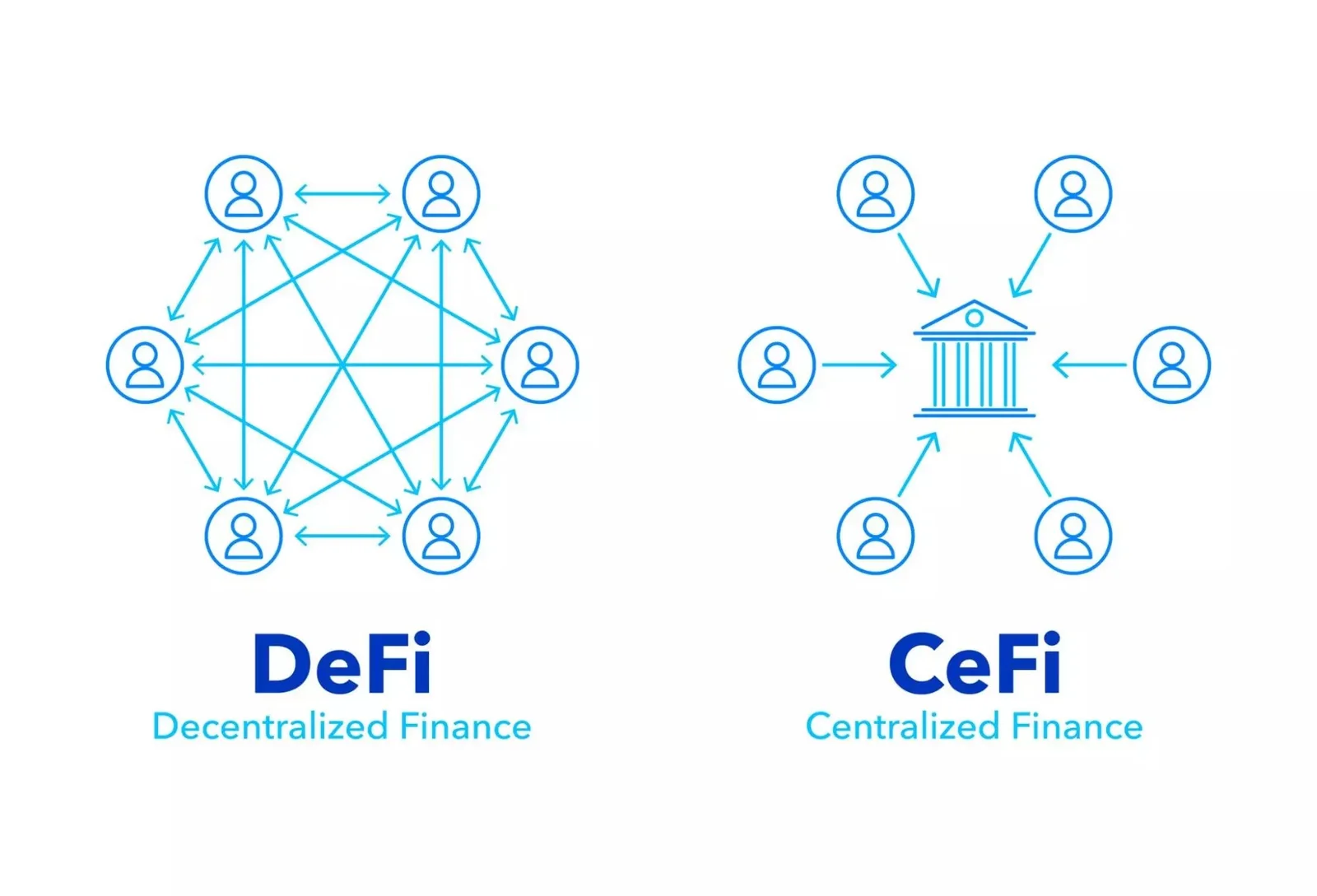
The Differences Between DeFi and Traditional Finance
Decentralized finance delivers certain financial functions through a different infrastructure. Significant differences exist in custody, transaction execution, and the distribution of responsibility.
| Topic | Traditional finance | DeFi |
Access | Depends on an institution’s account requirements | Many applications allow access through a wallet |
Transaction management | Institutional systems and procedures | Smart contracts and protocol rules |
Custody | Usually handled through an institution | Personal wallets and interactions with contracts |
Transparency | Information may be limited to institutional disclosures | On-chain records can be inspected |
Operating hours | Vary by product and institution | Generally continuous while the network operates |
Error resolution | Institutional support and legal processes | Reversing transactions may be difficult or impossible |
Costs | Commissions and service fees | Network, protocol, swap, and other usage fees |
DeFi can reduce some intermediary functions. Users consequently take on greater responsibility for wallet security, transaction verification, and protocol selection.
Transparency is also different from anonymity. Transactions on public networks can be traced; linking an address to an identity can reveal the transaction history associated with that person.
What Are the Main Uses of DeFi?
DeFi applications serve different needs. Swapping tokens, borrowing, and providing liquidity involve different risk profiles.
Decentralized exchanges and token swaps
A decentralized exchange, or DEX, enables token swaps through smart contracts. Uniswap, PancakeSwap, and Curve are examples.
Some systems use order books, while others rely on automated market makers. In an AMM model, users trade against pools funded by liquidity providers.
Check the estimated amount you will receive and the expected slippage before swapping. Low liquidity can lead to worse prices than expected, particularly for larger transactions.
Crypto lending and borrowing
Lending protocols allow users to supply assets to a market and potentially earn interest. Borrowers generally provide crypto collateral worth more than the amount borrowed.
On Aave, borrowing capacity depends on collateral, available liquidity, and protocol parameters. A position may become eligible for liquidation if its collateral coverage becomes insufficient.
Consider a user who borrows stablecoins against ETH. If ETH’s price falls, the collateral loses value; the risk increases if the debt does not decline by the same proportion.
Not every deposited asset earns interest in every protocol. In Compound III, a positive supply balance of the market’s base asset earns interest, while assets supplied solely as collateral do not earn Compound interest.
Stablecoins and “synthetic” assets
A stablecoin is a crypto asset designed to maintain a value close to a reference, such as the US dollar. Within DeFi, stablecoins can support pricing, transfers, borrowing, and liquidity provision.
However, the word “stable” does not guarantee an absence of risk. Reserves, the issuer, collateral arrangements, and redemption mechanisms influence how well the asset maintains its value.
Synthetic assets can provide economic exposure to another asset’s price. Tracking that price may not grant the same rights as directly owning the relevant stock or commodity.
The tokenization of real-world assets is another area to assess separately. The legal rights represented by a token, its custody arrangements, and redemption conditions depend on the product’s structure.
Yield farming and liquidity mining
Yield farming aims to generate returns by deploying crypto assets across DeFi strategies. Income may come from borrowing interest, swap fees, or token incentives.
Liquidity mining involves distributing additional token rewards to liquidity providers. These incentives can encourage participation, but the reward token’s price and the program’s duration affect returns.
Do not treat an advertised annual yield as a fixed profit. Transaction costs, changing rates, and asset prices can alter the actual outcome.
Staking and DAO governance
On Proof of Stake networks, staking is a mechanism for participating in network security. DeFi applications may use tokens representing staking positions in other activities.
However, every action labeled “staking” does not involve network validation. Depositing tokens into a rewards contract may also carry that label.
DAOs are governance structures intended to involve communities or token holders in protocol decisions. Participants may vote on fees, incentives, or risk parameters.
Concentrated voting power across a small number of addresses can influence decisions. Owning a governance token does not automatically grant company ownership or a right to revenue.
What Are the Benefits of DeFi?
DeFi’s benefits vary with the design of the network and application. Potential advantages include:
- Access to different financial applications through a wallet.
- The ability to inspect on-chain transactions and contract activity.
- Applications that can interact with one another.
- Around-the-clock access to many services.
- More direct user control over assets.
Interoperability can help developers build new products using existing protocols. However, a problem in one application may also affect products that depend on it.
Costs vary as well. Some networks offer low transaction fees, while congestion or complex contracts can increase the total expense.
DeFi Risks and Key Considerations
Using decentralized finance adds technical and operational risks to market risk. Problems can arise in an application even when the price of the underlying asset remains unchanged.
Contract vulnerabilities and connected systems
Smart contract errors, abused administrative privileges, or attacks can cause losses. Incorrect oracle data can also lead a contract to execute transactions using faulty inputs.
Bridges used to move assets between networks introduce additional risks. A security assessment should cover the application and the systems on which it depends.
An audit report is useful, but insufficient on its own. Its scope, date, and relevance to the contract version in use all matter.
Impermanent loss and liquidity problems
Liquidity providers may achieve a lower return than they would by holding the same assets in a wallet. Known as impermanent loss, this difference is associated with changes in the relative prices of assets in the pool.
Earned trading fees may or may not offset the difference. For concentrated liquidity positions, moving outside the selected price range can also stop fee earnings.
Liquidity risk includes being unable to withdraw assets at the expected time or price. Reduced available funds in a lending market, higher costs when exiting a pool, or withdrawal restrictions can affect the outcome.
User errors and transaction costs
Choosing the wrong network, using a fraudulent token address, or granting a malicious approval can result in losses. Sharing a recovery phrase can give someone else control of a wallet.
Review the spending permissions granted to applications. Disconnecting from a website does not automatically revoke previously granted token approvals.
When calculating transaction costs, include swap fees and slippage alongside network fees. For smaller transactions, the total expense can consume a significant share of the expected return.
Before You Start Using DeFi
Understand the purpose of a transaction and its exit conditions before trying a DeFi application. Buying a token, using a protocol, and providing liquidity are different decisions.
The following checklist can help you get started:
- Verify the application’s official website through reliable sources.
- Check the supported network and token contract address.
- Find out which asset you will need to pay transaction fees.
- Review administrative privileges and security reports.
- Read the amount and contract details on the approval screen.
- Understand withdrawal, loan repayment, and potential liquidation conditions.
- Regularly monitor your positions and granted permissions.
A platform’s high TVL is not proof of security on its own. Total value locked measures the value of assets held within a protocol; it does not guarantee quality or protection from losses.
What Could Shape the Future of DeFi?
The future of DeFi will depend on usability and legal frameworks alongside technical development. Clearer wallet interfaces, lower-cost networks, and security checks could reduce some barriers to use.
Tokenized assets and institutional applications are important areas for connections with traditional finance. These connections may also introduce institutional components such as custody and identity verification.
The impact of regulation varies by country and the nature of the service. A claim of decentralization does not automatically exempt an activity from legal obligations.
Frequently Asked Questions (FAQ)
Below are answers to some common questions about DeFi:
- Why did DeFi become popular?: Wallet-based access to financial applications, new ways to earn returns, and token incentives attracted interest. Popularity does not mean that applications offer the same level of security.
- How can you invest in DeFi projects?: Buying a project’s token, providing liquidity, and supplying assets to a lending market are different options. The sources of returns, costs, and risks of each should be assessed separately.
- Is decentralized finance safe?: Security depends on contracts, administrative privileges, data sources, and user behavior. Audits help assess risk, but they do not eliminate the possibility of loss.
- Which cryptocurrencies do I need to use DeFi?: You need assets supported by the network and application you intend to use. You will generally also need the network’s native asset to pay transaction fees; on Ethereum mainnet, that asset is ETH.
- What is yield farming, and does it involve risks?: Yield farming covers strategies that aim to earn interest, a share of fees, or token rewards using crypto assets. Price declines, contract vulnerabilities, impermanent loss, and transaction costs can affect returns.
When evaluating DeFi applications, consider how transactions work, their costs, and how you can withdraw your funds. Follow JrKripto’s guides to explore decentralized finance and make informed decisions when managing your crypto assets.

