
Bitcoin emerged as a decentralized digital currency, but its use in everyday shopping remained limited because of transaction times and fees. Dash is one of the first projects built to answer that problem with a payments-focused design. Named after the phrase "digital cash," the network was built on fast payments, optional privacy and a self-funding governance model. At the center of this structure sits DASH, which serves both as a means of payment and as collateral for network security.
Definition and Origins of Dash
Dash is a cryptocurrency network derived from Bitcoin's codebase and focused on everyday payments. Evan Duffield launched the project in January 2014 under the name "XCoin." It was soon renamed "Darkcoin" and adopted the Dash name in March 2015.
What sets Dash apart from Bitcoin is its two-tier network structure. The first tier consists of miners who produce blocks, as in Bitcoin. The second tier consists of masternodes, which lock up a set amount of DASH as collateral. Masternodes run additional services such as fast payments, privacy and governance.
DASH is the network's native cryptocurrency. It is used for payments, masternode collateral and governance processes.
What is a masternode?
A masternode is a special node that provides extra services to the network and receives a share of the block reward in return. Running a standard masternode on Dash requires locking 1,000 DASH as collateral. Evonodes, introduced in 2023, require 4,000 DASH in collateral and run Dash Platform in addition to the standard services.
Masternodes handle four core tasks:
- InstantSend: Locks transactions within roughly one to two seconds to prevent double spending. The recipient can be confident the payment is final without waiting for block confirmations.
- ChainLocks: Locks blocks produced by miners through a masternode majority, protecting the chain against attempts to rewrite it.
- CoinJoin: Offers an optional privacy feature that mixes the transactions of several users to make the origin of funds harder to trace.
- Governance: Votes on projects to be funded from the treasury.
As of November 6, 2026, collateral is locked for 370 Evonodes on the network, and 362 of them are actively running.
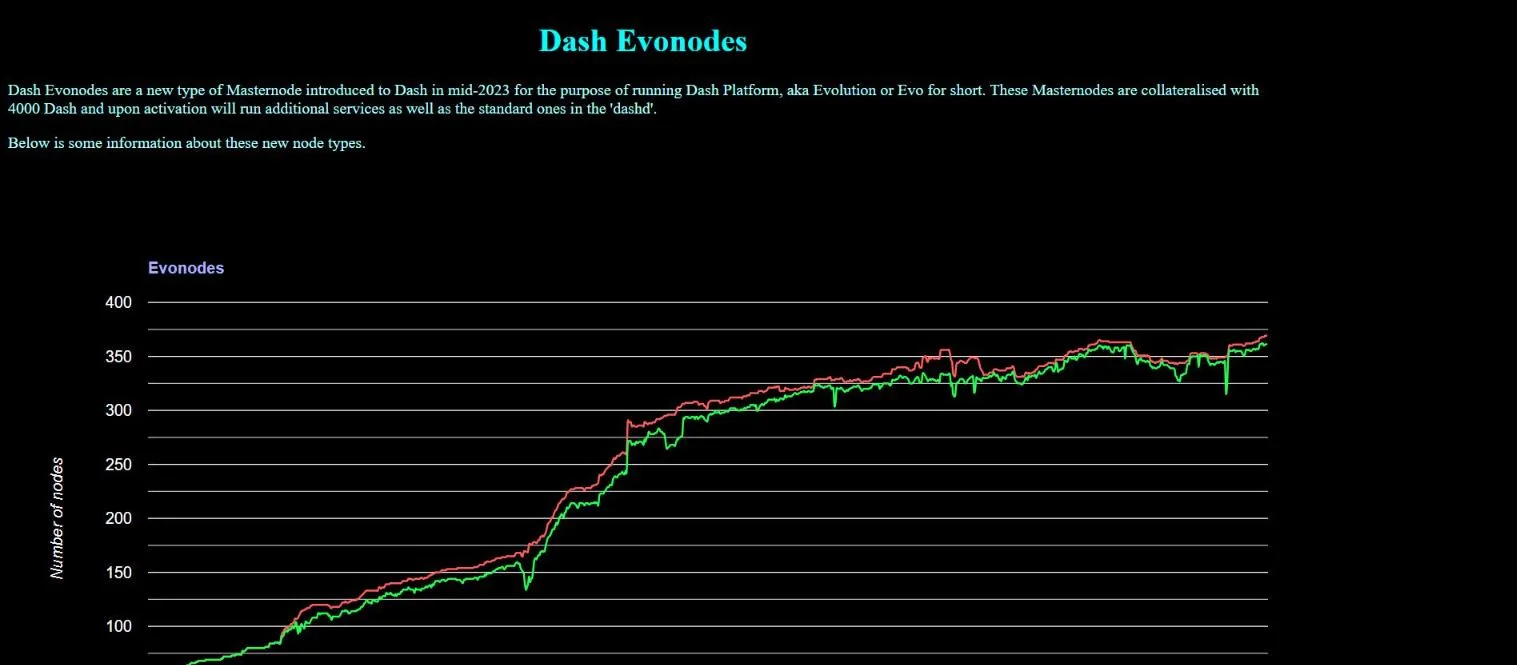
The red line in the chart shows the number of Evonodes with 4,000 DASH in locked collateral, while the green line shows Evonodes that are running and therefore eligible for rewards. The Evonode count rose quickly with the Platform launch in 2024 and has held between 330 and 370 since 2025.
What is Dash Platform (Evolution)?
Dash Platform, also known as Evolution, is a second layer built on top of Dash Core, Dash's payments network. The platform makes it possible to pay by username, store data in a decentralized way and build applications. Instead of long wallet addresses, users can send money using usernames they register through the Dash Platform Name Service (DPNS).
Only Evonodes run the Platform. In addition to rewards from Dash Core, Evonodes earn rewards for the blocks they produce on the Platform.
Differences between Dash and Bitcoin
Although Dash was derived from Bitcoin's codebase, the two networks developed with different priorities. Bitcoin gradually positioned itself as a store of value, while Dash aimed to highlight speed and cost advantages in everyday payments. That difference is reflected directly in the technical choices of the two networks.
The clearest difference shows up in transaction time. Bitcoin produces a block roughly every 10 minutes, and large transfers usually wait for several confirmations. Dash produces blocks roughly every 2.5 minutes, and InstantSend finalizes transactions within seconds.
The network structure is also different. On Bitcoin, security is provided by miners alone. On Dash, masternodes that lock collateral work alongside miners, and ChainLocks gives the chain an additional layer of protection.
The funding model is another point that separates the two networks. Bitcoin's development is sustained largely by donations and corporate support. Dash, by contrast, sets aside 20 percent of the block reward for the treasury and funds development directly through the protocol.
The two networks also use different supply models. Bitcoin's supply is capped at 21 million, and its block reward halves roughly every four years. Dash's maximum supply is about 18.92 million, and its reward falls by about 7 percent each year.
On privacy, Dash offers optional features through CoinJoin and the shielded pool on Evolution. On Bitcoin, such features are not part of the protocol; users mostly turn to third-party wallets and tools for privacy.
History of Dash: Key Milestones
Evan Duffield launched XCoin, derived from Bitcoin's codebase, on January 18, 2014. The project used X11, a proof-of-work (PoW) algorithm that runs eleven different hash functions in sequence. A bug in the first days after launch caused far more coins than expected to be produced in a short time. As a result, supply became concentrated in the hands of a small group early on, and the project was dogged by "instamine" criticism for years.
The project was soon renamed Darkcoin. After criticism that its privacy focus evoked the dark web, it switched in March 2015 to the name Dash, derived from "digital cash." A treasury and governance system was added to the network the same year.
During the 2017 crypto rally, Dash rose into the ranks of the largest projects by market capitalization and reached its all-time high of $1,493.59 in December 2017. In 2019, it became the most popular cryptocurrency in Venezuela among users seeking protection from hyperinflation.
ChainLocks and Evolution
Dash introduced ChainLocks in 2019. The feature lets masternodes sign and lock blocks, creating an additional layer of protection against 51 percent attacks.
The project's long-awaited Evolution vision began to take shape with the activation of Evonodes in July 2023. On July 29, 2024, Dash Core Group released Evolution v1.0, the first mainnet version of Dash Platform. This release opened up user identities, usernames, data contracts and basic NFT support.
Zcash Orchard integration
In 2026, Dash took an important step in its privacy infrastructure. The project integrated Zcash's Orchard protocol, which is based on zero-knowledge proofs, into the Evolution layer. This lets users move funds into a shielded pool and make transactions that hide the sender, recipient and amount.
The shielded pool is optional. Funds entering and leaving the pool remain visible, and standard transactions on Dash Core continue to be transparent. Wallet and application support is still needed for the feature to reach everyday use.
Dash Core Group released Evolution Platform v5 on October 29, 2026. The release brought a framework for shielded tokens and reworked data contracts. No date has been announced for when shielded tokens will go live on the network.
How Does DASH Work?
DASH has three core functions on the network:
- Payments: DASH was designed for low-cost, fast transfers. InstantSend finalizes transactions within seconds.
- Collateral: Running a masternode or an Evonode requires locking 1,000 and 4,000 DASH, respectively. The collateral gives node operators a stake in the network's healthy operation.
- Governance: Masternode owners vote on projects to be funded from the treasury. Evonodes carry four times the voting weight, in proportion to their collateral.
How is the block reward distributed?
Dash produces a new block roughly every 2.5 minutes. Twenty percent of the block reward is set aside for the treasury. The remaining 80 percent is split between miners and masternodes, with masternodes receiving the larger share.
Since an adjustment in August 2024, 37.5 percent of the masternode share has gone to the reward pool for the Evonodes that run the Platform. The remaining 62.5 percent is paid equally to all masternodes and Evonodes through Dash Core.
According to mnowatch data, as of November 6, 2026, the estimated annual yield is 6.88 percent for a standard masternode and 8.12 percent for an Evonode. These figures exclude transaction fees and are calculated in DASH; a decline in DASH's dollar value can wipe out this yield entirely.
Treasury and governance system
One of Dash's most distinctive features is a treasury system that funds its own development. The share set aside from block rewards accumulates every month and is distributed to project proposals submitted by community members. For a proposal to receive funding, it needs enough net positive votes from masternodes.
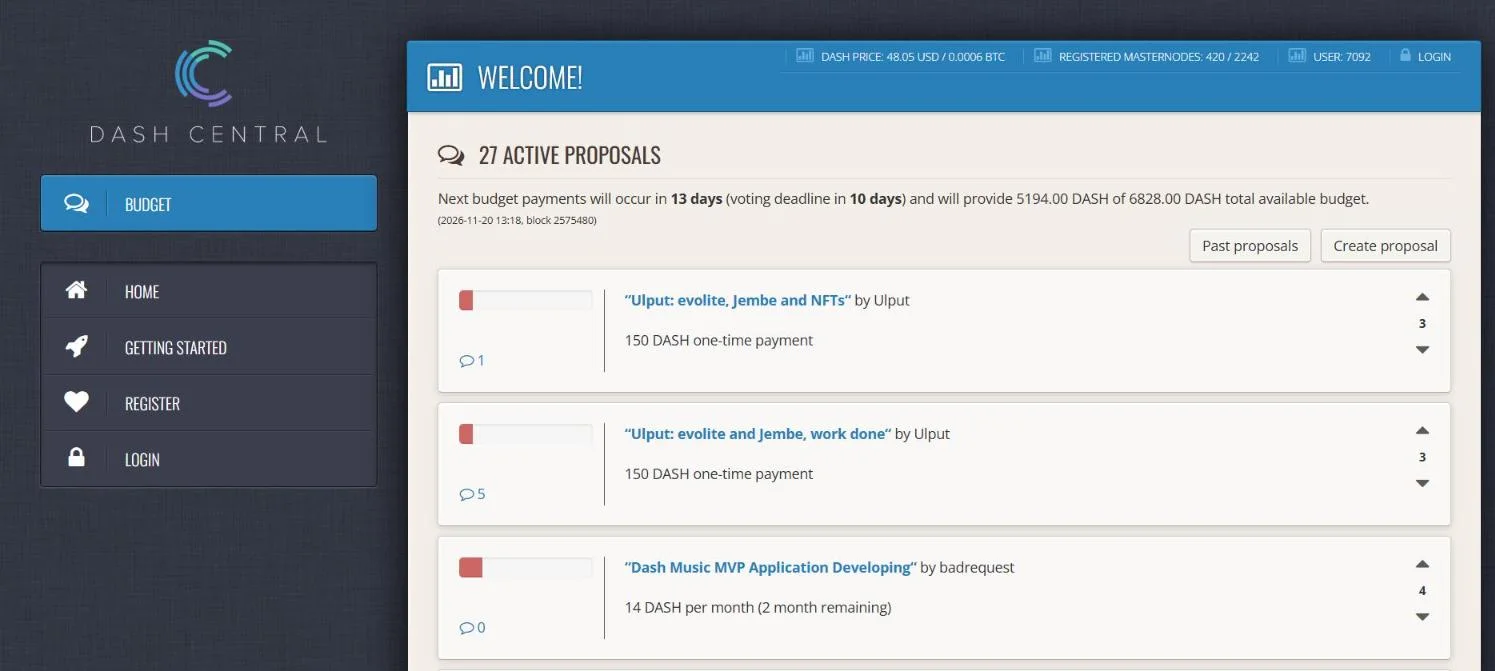
According to DashCentral data, as of November 6, 2026, there are 27 active proposals up for a vote. The next budget payment will be made on November 20, and 5,194 DASH of the total 6,828 DASH budget will go to approved proposals. Users can click on each proposal on the page to review the requested amount, the payment period and the masternode votes.
Core development teams such as Dash Core Group also cover most of their costs from this treasury. The model aims to let the project develop without depending on outside investors or a company.
DASH supply and emission model
DASH's maximum supply is estimated at about 18.92 million. According to JR Kripto data, as of November 6, 2026, about 12.89 million DASH are in circulation. That equals roughly 68 percent of the maximum supply.
Instead of Bitcoin's halving every four years, Dash uses a more gradual model. The block reward falls by 7.14 percent every 210,240 blocks, or roughly every 383 days. This model makes new supply decline more smoothly from year to year rather than in sudden drops.
Dash has no locked tokens set aside for investors or the team. All new DASH enters circulation through mining and masternode rewards.
DASH Coin Price and Market Data
As of November 6, 2026, DASH coin price is at $47.79 and ranks 78th by market capitalization. The token gained 8.54 percent over the past 24 hours but is down 10.26 percent over the past 30 days.
Metric | Value |
Current price | $47.79 |
Market capitalization | $616.1 million |
Fully diluted valuation | $617.8 million |
24-hour trading volume | $66.4 million |
Circulating supply | 12.89 million DASH |
Maximum supply | 18.92 million DASH |
All-time high | $1,493.59 |
All-time low | $0.214 |
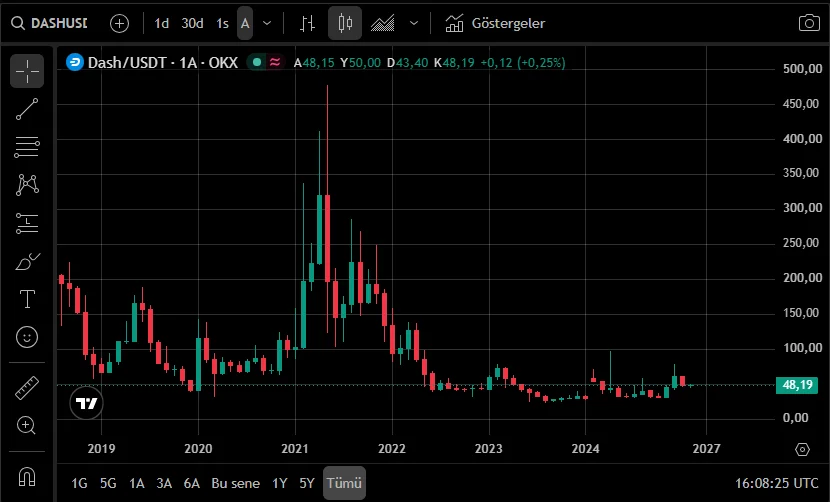
The chart data begins in late 2018, when the DASH/USDT pair opened on OKX. As a result, DASH's all-time high of $1,493.59 in December 2017 and its all-time low of $0.214 in 2014 do not appear on the chart.
The chart shows that after the 2018 bear market, DASH fluctuated between $50 and $200 through 2019 and 2020. The token climbed above $450 during the rally in the first half of 2021. After the sharp decline in 2022, it stayed mostly between $25 and $75.
In 2026, DASH posted several sharp rallies amid growing interest in privacy coins. The current price is about 97 percent below its all-time high.
Why Does Dash Matter?
Dash stands out as one of the first projects aimed at using cryptocurrency as an everyday means of payment. Transactions that finalize within seconds through InstantSend, combined with low fees, make DASH notable for use cases that require fast payments.
The masternode model also left a lasting mark on the crypto ecosystem. The structure of nodes that lock collateral, serve the network and earn rewards in return later inspired the staking and validator systems of many projects.
The treasury system, meanwhile, is one of the earliest and longest-running examples of blockchain governance. For nearly a decade, Dash has funded development, marketing and integration work through community votes.
Where to Buy DASH?
DASH trades on major global exchanges such as Binance, KuCoin, WhiteBIT, Poloniex and LBank. The most common trading pair is DASH/USDT, and some exchanges also offer DASH/BTC pairs.
Because DASH runs on its own blockchain, withdrawals from an exchange require selecting the Dash network and using a Dash-compatible wallet. The official Dash Wallet mobile app, developed by Dash Core Group, supports features such as CoinJoin and paying by username. Some exchanges may restrict withdrawals or deposits of privacy-enabled coins because of regulatory requirements.
Dash's Team and Community
Dash's founder is Evan Duffield. Duffield led development in the project's early years but later stepped back from an active role.
Today, development of Dash Core and Dash Platform is largely carried out by Dash Core Group. The team covers its costs through proposals it submits to the treasury. Dash has no initial allocation tied to a company or a venture capital fund; the project is developed by independent teams funded through community votes.
Regulatory, competition and adoption risks
One of Dash's biggest risks lies on the regulatory side. CoinJoin and Orchard-based shielded transactions expose Dash to the risk of being classified as a privacy coin in some countries. Restrictions on privacy coins, including the European Union's anti-money laundering rules, could lead to exchange delistings.
Competition in payments is another serious risk. Stablecoins such as USDT and USDC offer fast transfers without price volatility, so they are often preferred for everyday payments. Litecoin, Bitcoin Cash and Bitcoin's Lightning Network also compete with Dash in the same use case.
The masternode structure also draws criticism over centralization. The high collateral requirement can concentrate governance power in the hands of a small group holding large amounts of DASH. The supply concentration that emerged early on because of the distribution bug at launch reinforces these criticisms.
Price history also shows the scale of the risk. DASH's 97 percent decline from its all-time high may suggest that technical progress alone has not been enough to support the price.
Frequently Asked Questions (FAQ)
Below are some frequently asked questions and answers about Dash (DASH):
- What is Dash, and when did it launch?: Dash is a cryptocurrency network focused on everyday payments. The project launched as XCoin on January 18, 2014, was then renamed Darkcoin and adopted the Dash name in March 2015.
- What is DASH coin used for?: DASH is used for payments, masternode collateral and treasury governance votes.
- What is a Dash masternode?: A masternode is a node that locks 1,000 DASH as collateral and provides InstantSend, ChainLocks, CoinJoin and governance services to the network. Evonodes, with 4,000 DASH in collateral, also run Dash Platform.
- Is Dash a privacy coin?: Dash offers optional privacy through CoinJoin and the shielded pool on Evolution. Standard Dash transactions remain transparently visible on the blockchain.
- What is DASH's supply?: DASH's maximum supply is about 18.92 million. As of November 6, 2026, about 12.89 million DASH are in circulation.
- Which exchanges list DASH?: DASH trades on global exchanges including Binance, KuCoin, WhiteBIT, Poloniex and LBank, mostly against USDT.
- Is Dash a good investment?: Whether DASH is suitable as an investment depends on each person's risk profile and research. The absence of locked tokens, the gradual emission model and developments on Evolution are among the positives worth watching. Regulatory risks, stablecoin competition and price history should also be factored in.
Follow the JR Kripto Guide series for the latest on developments in the Dash ecosystem and Evolution updates.

