
Participating in cryptocurrency mining does not necessarily require installing equipment at home, getting used to fan noise, or upgrading your electrical system. Cloud mining allows you to participate by renting computing power from remote hardware. However, having another company manage the physical setup does not eliminate mining costs or risks.
In this model, the outcome depends on more than the price of Bitcoin or the performance of the rented equipment. The computing power actually delivered, contract duration, deductions, and payment terms also matter. When evaluating cloud mining, you need to look beyond the daily earnings displayed on a dashboard.
What Is Cloud Mining, and How Does It Work?
Crypto cloud mining is a service model that provides access to remote mining infrastructure under specific terms. Users can rent computing power or arrange for their own equipment to operate in a data center instead of running it themselves. The provider handles some or all operational tasks, including electricity, cooling, connectivity, and maintenance.
Mining supports the block production process on networks that use Proof of Work. In Bitcoin mining, devices perform large numbers of calculations to find a hash that meets the target set by the network. Producing a valid block generates revenue through the block subsidy and transaction fees; when a pool is involved, its payout model determines how earnings are distributed.
What does the user actually purchase?
A hash power contract generally gives you the right to use a specified amount of computing capacity for a certain period. This does not mean you own the physical equipment, and your access may end when the contract expires. Hardware ownership, capacity allocation, and revenue sharing are different rights, so the product description should explain them clearly.
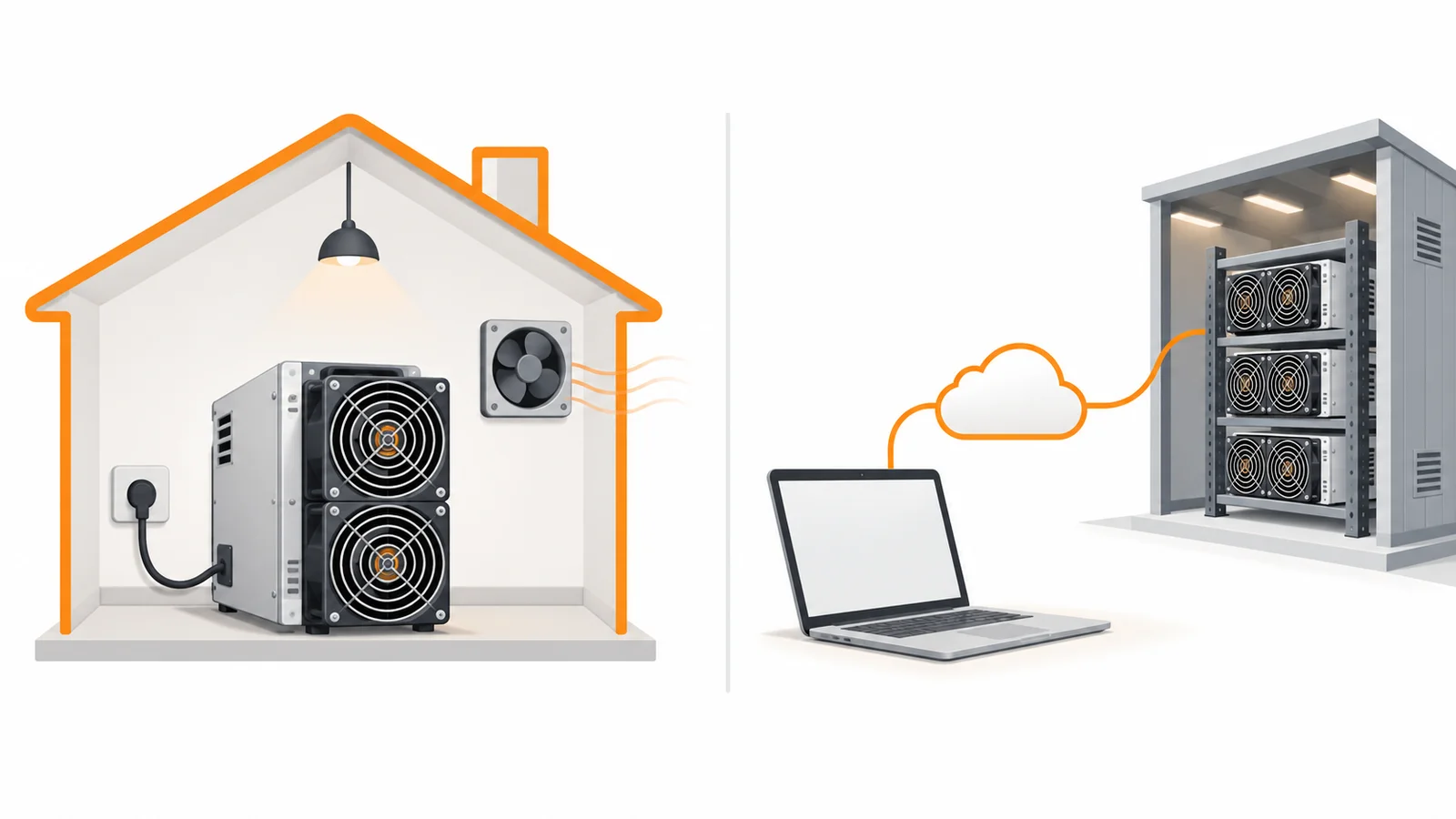
In some models, the provider chooses the mining pool and pays users after deducting fees. On hash power marketplaces, users may direct their rented capacity to a compatible pool of their choice. The company supplying the computing power and the pool paying the mining rewards are therefore not always the same organization.
What Are the Different Types of Cloud Mining?
Services marketed as cloud mining do not all follow the same structure. Hosted mining and hash power rental differ considerably in terms of ownership and responsibility. Comparing prices without first understanding the service model can be misleading.
Hosted mining
Hosted mining typically involves operating user-owned equipment at a provider’s facility. Users may purchase the hardware separately or buy equipment and hosting as a package. Depending on the contract, the provider supplies electricity, cooling, monitoring, and maintenance, while the user pays for these services.
This model allows you to own mining hardware without making room for it at home, although collecting the equipment or moving it to another facility depends on the contract. Out-of-warranty repairs, shipping, and early exit costs may apply separately. For example, Compass’s published terms show that hardware ownership and ending a hosting agreement are separate matters; requesting early delivery of your equipment may require paying the remaining contract balance.
Hash power rental
With hash power rental, users pay to access computing capacity rather than purchase a particular device. Offers generally specify the algorithm, capacity, duration, and pricing method. You do not own the hardware throughout its economic life; your rights are limited to the rental terms.
This approach can reduce the burden of physical setup and make it possible to start with a smaller amount of capacity. However, you may have no direct control over the equipment, and verifying that the service is actually being delivered can be difficult. Fixed-term packages and hash power marketplaces with variable pricing should also be treated as different products.
| Feature | Hosted mining | Hash power rental |
Service purchased | Operation of equipment at a facility | A specified amount of computing capacity |
Hardware ownership | Usually belongs to the user | Usually does not belong to the user |
Upfront cost | May include hardware and setup fees | Rental or contract fee |
Operating costs | Electricity, hosting, and additional services | May be included in the price or deducted separately |
End of service | Equipment collection or a new agreement may be required | Access to the capacity ends |
Main points to check | Ownership, maintenance, and equipment delivery terms | Actual capacity, duration, and deductions |
What Are the Benefits of Cloud Mining?
The benefits of cloud mining primarily relate to operational convenience. A suitable service allows users to participate without directly handling equipment installation or routine technical work. However, easier access alone does not establish that the service offers good financial value.
Potential benefits include:
- Reducing the need to prepare space for equipment, wiring, and cooling at home.
- Keeping mining-related noise and heat out of living spaces.
- Allowing specialist teams to handle technical maintenance.
- Providing remote performance and payment monitoring.
- Offering access to computing capacity without purchasing physical equipment in some models.
Do electricity and maintenance costs disappear?
Not operating the equipment yourself does not mean you avoid paying for electricity and maintenance. These costs may be included in the contract price, billed separately, or deducted from mining revenue. In hosting arrangements, for example, electricity, basic maintenance, and facility operating expenses may form part of the monthly service fee.
Large facilities may sometimes secure better energy contracts or use more efficient cooling systems. However, the provider’s profit margin and additional charges affect how much of that advantage reaches the user. Compare the total amount you will pay over the contract term, including all charges associated with the service.
Key Terms to Understand Before Starting Cloud Mining
Understanding an offer requires considering computing capacity, energy efficiency, and the reward mechanism together. High hash power alone does not mean high net earnings. Similarly, a seemingly inexpensive package may produce a different result once maintenance charges and payment deductions are included.
Hash rate and energy efficiency
Hash rate measures the number of hash calculations hardware performs per second. Bitcoin mining commonly uses units such as TH/s, while other algorithms may use different scales. Hash rates across different algorithms cannot be compared directly; capacity must be assessed alongside the target network and algorithm.
Energy efficiency also affects the cost of ASIC mining. For Bitcoin equipment, the J/TH metric measures the energy required for a given amount of computation, with a lower value indicating greater efficiency. The price users pay for hash power also includes hardware costs, operating expenses, and the provider’s fee.
Mining difficulty and block rewards
Mining difficulty relates to the target that must be met to produce a valid block. Bitcoin adjusts this target every 2,016 blocks based on the time taken during the preceding period, aiming to maintain an average block interval of approximately ten minutes. All else being equal, higher difficulty reduces the expected BTC output from a fixed amount of hash power.
When assessing mining revenue, distinguish between the block subsidy and transaction fees. Bitcoin’s halving reduces the subsidy, which determines the amount of newly issued BTC, by half every 210,000 blocks; transaction fees are not subject to this reduction. Revenue estimates for a long-term contract should therefore account for changes beyond today’s reward conditions.
Pool fees and payment terms
A mining pool tracks participants’ computing contributions within a shared operation and distributes payments according to its own rules. Using a pool can reduce the income variability associated with finding blocks independently, but it does not guarantee fixed earnings. Check for service charges, withdrawal fees, and minimum payout thresholds in addition to the pool’s commission.
Payout thresholds are particularly important for smaller contracts. Funds accumulating on a dashboard may not reach your wallet immediately if the balance remains below the withdrawal minimum. The terms should also explain what happens to any balance below that threshold when the contract ends.
How Is Cloud Mining Profitability Calculated?
Receiving daily payments from cloud mining does not necessarily mean making an overall profit. The actual result emerges after subtracting every cost, including the upfront fee, from the revenue earned. Tracking both the amount of cryptocurrency received and its value in your chosen currency helps clarify the impact of price movements.
An example contract calculation
Consider a hypothetical 180-day hash power contract costing $600 upfront. Assume the initial estimate shows $5 in daily gross revenue and $2 in daily maintenance and operating deductions. If there are no other expenses and these figures remain unchanged, the calculation looks like this:
| Item | Amount |
Upfront contract fee | $600 |
Daily gross revenue | $5 |
Daily operating deduction | $2 |
Daily payment after deductions | $3 |
Total payments over 180 days | $540 |
Result after the upfront fee | $60 loss |
In this example, the user receives payments every day but fails to recover the initial cost. At $3 per day, the calculated payback period is 200 days, exceeding the contract’s 180-day duration. A positive dashboard balance therefore does not prove that the service has generated an overall profit.
Evaluate several scenarios
In practice, daily production and cryptocurrency prices do not remain constant. Network difficulty, pool performance, interruptions, and equipment downtime can affect the amount earned. Preparing several scenarios, including unfavorable conditions, provides a clearer picture than relying on a single estimate.
Test your calculations with these questions:
- How would the outcome change if the cryptocurrency’s price fell by 30%?
- Would the upfront fee still be recovered if the same capacity produced less cryptocurrency?
- Would charges continue if the service stopped for several days?
- Could maintenance or energy fees increase during the contract?
- Could the contract be suspended or terminated if revenue no longer covered expenses?
Some contracts may allow the provider to suspend service when mining becomes uneconomical. In that situation, your capacity might stop operating while you wait for prices to recover, even as the contract term continues to run. Include suspension, termination, and refund provisions in your profitability assessment.
What Are the Risks of Cloud Mining?
Cloud mining risks extend beyond cryptocurrency price fluctuations. Users also depend on the provider’s operations, financial position, and ability to fulfill the contract. Even the existence of a functioning mining facility does not guarantee that a package will be profitable or trouble-free.
Fake mining and Ponzi schemes
Some fraudulent operations display regular earnings despite lacking enough actual mining capacity. Payments to earlier participants may come from money deposited by new users, allowing the scheme to resemble a legitimate operation for a time. Receiving early payments or finding payout screenshots online is therefore insufficient evidence of reliability.
The GAW Miners and ZenMiner case provides a historical example of this risk. According to the U.S. Securities and Exchange Commission, the companies lacked sufficient computing power to perform the mining they promised, and some payments came from new sales. A final court judgment was entered against the companies in 2017.
Warning signs that deserve particular attention include:
- High, guaranteed daily returns regardless of market conditions.
- A system focused more on referral rewards than mining activity.
- Unverifiable company information and unclear service agreements.
- Repeated demands for additional payments or package upgrades before withdrawals.
- Failure to disclose the mining algorithm and computing capacity.
- Requests for a recovery phrase or private key.
Transparency and provider risk
A photograph of a facility does not prove that the company owns it or has allocated capacity to you. Review company records, the legal entity named in the contract, independent assessments, and, where possible, performance data that can be verified through the pool. Also check whether an audit covers only financial statements or includes hardware and computing capacity.
A provider shutting down, experiencing financial difficulties, or blocking access to your account creates another layer of risk. Even when you own the hardware, you need to know where it is located and how to retrieve it. With hash power rental, there may be no physical asset for you to claim after the contract ends.
Misleading product names
The service should clearly identify the network and algorithm it targets. Ethereum moved to Proof of Stake in September 2022, so ETH mining no longer takes place on Ethereum mainnet. If a product marketed as “ETH cloud mining” uses a different model, such as mining another asset and converting the proceeds into ETH, the provider should explain that arrangement.
How Do You Get Started With Cloud Mining?
The first step in starting cloud mining is verifying the service on offer before making a payment. Research the provider, then examine the contract’s financial and technical terms. Testing a service with a small amount may help you understand the process, but it does not establish long-term reliability.
- Verify the company: Check its legal name, registration details, contact channels, and the entity entering into the contract.
- Identify the service: Establish whether you are buying hardware, renting hash power, or participating in revenue sharing.
- Examine the capacity: Confirm the algorithm, hash rate, service start date, and performance measurement method.
- Calculate all expenses: Include upfront, maintenance, pool, withdrawal, and potential termination fees.
- Read the payment terms: Verify the payout asset, network, frequency, and minimum withdrawal amount.
- Consider unfavorable scenarios: Assess price declines, service interruptions, and the possibility of the provider shutting down.
Wallet and account security
Make sure the wallet receiving your payments supports the relevant asset and network. For a self-custody wallet, store the recovery phrase securely offline and consider a hardware wallet where appropriate. A mining provider does not need your private key or recovery phrase to send you a payment.
Use a unique password for your platform account and strong two-factor authentication where supported. Check the entire withdrawal address when saving it and keep address-change notifications enabled. Remember that wallet security does not protect funds still held by the provider or payments it has not yet sent.
Cloud Mining vs. Traditional Mining
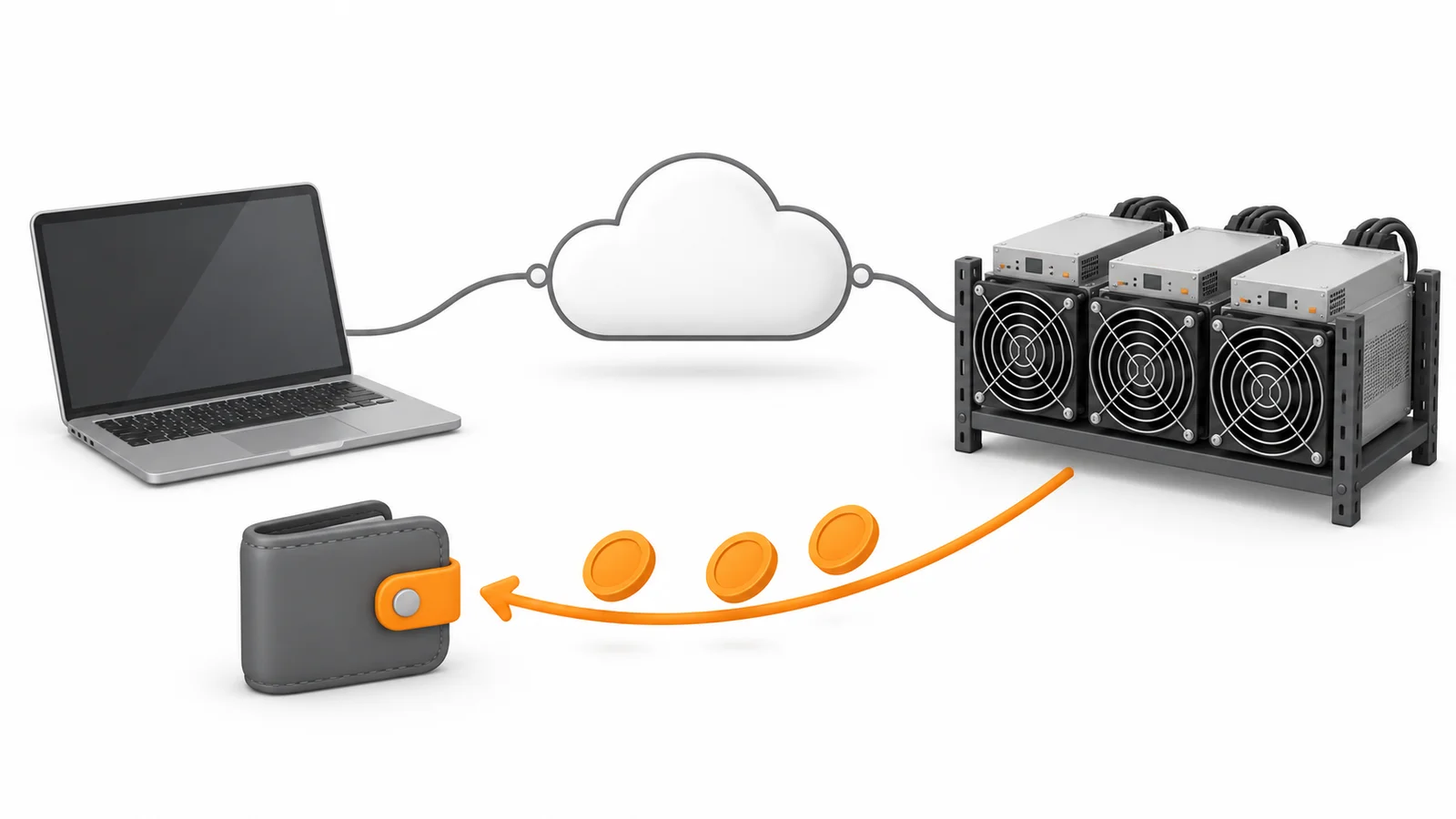
Operating your own equipment gives you more control while also creating more operational responsibilities. Cloud mining transfers some of those responsibilities to a provider, but makes you dependent on the service terms. The suitable option depends on electricity costs, technical resources, and the risks you are willing to accept.
| Criterion | Operating your own hardware | Renting hash power |
Getting started | Hardware and infrastructure setup | Contract or rental fee |
Electricity and cooling | Managed by the user | Managed by the provider, with costs passed on |
Maintenance | User’s responsibility | Depends on the service agreement |
Control | Greater control over hardware and settings | Control limited by the contract |
Scaling up | Requires additional hardware and infrastructure | Depends on available capacity and pricing |
Exiting | Equipment can be sold; its value may change | Transfer or refund may not be available |
Additional risk | Hardware failure and local operating problems | Provider, contract, and payment risk |
How does it compare with buying crypto directly?
Buying cryptocurrency directly gives you a specific amount of a digital asset. With cloud mining, you pay for a service expected to produce a variable amount of cryptocurrency in the future. It therefore makes sense to compare how much you could buy today with the amount the contract is expected to deliver after expenses.
This comparison does not establish that cloud mining is always better or worse. However, it highlights the additional risks of a mining contract for someone primarily seeking exposure to an asset’s price. Investing across different assets also does not eliminate losses caused by a fraudulent provider or one that fails to meet its obligations.
Frequently Asked Questions
Common questions about cloud mining focus on earnings, reliability, and contract terms. Services offered under the same name can involve different rights and obligations. The answers below can help you identify the main distinctions when evaluating an offer.
- Can you make money with cloud mining?: Yes, but receiving regular payments does not establish that you have made an overall profit. The upfront fee and all deductions must be included in the calculation. Results can change as prices, difficulty, and service conditions evolve.
- Are free cloud mining services trustworthy?: Being free does not establish reliability. Some services offer limited promotional credit, while others use balances that cannot be withdrawn to encourage users to deposit money. Examine offers particularly carefully if they demand additional payments to release your earnings.
- Is cloud mining legal?: This depends on the countries where the user and provider are based, as well as the product’s legal structure. Mining services, hardware hosting, and pooled investment products may fall under different rules. Check current official regulations in the relevant jurisdictions for tax and contractual obligations.
- What should you look for in a cloud mining contract?: Capacity, algorithm, duration, deductions, and payment terms should be clearly stated. Provisions covering compensation for interruptions, early termination, refunds, and suspension due to unprofitability also matter. For hosted mining, examine hardware ownership and delivery terms separately.
- Is cloud mining better than buying crypto directly?: There is no single answer that applies to everyone. A direct purchase gives you a specific amount of an asset, while a mining contract depends on variable production and introduces additional service risks. Compare what the same budget provides under each option, including every cost.
When evaluating cloud mining offers, examine how the promised earnings are generated and the conditions under which they will be paid to you. Follow JrKripto’s guides to better understand hash power, contract costs, and security risks.
Secondary keywords: what is cloud mining, how to start cloud mining, cloud mining benefits, cloud mining risks, crypto mining, hash power, mining pool, bitcoin mining, cloud mining platforms

