
Anyone looking to earn yield on crypto assets soon encounters dozens of protocols, different networks, and constantly changing rates. Concrete aims to simplify this fragmented landscape through automated yield vaults and shared asset management infrastructure. Its CT token supports governance participation and access to certain protocol settings; understanding Concrete requires considering the token’s role, how its vaults operate, and the risks involved together.
Concrete’s Definition and Origins
Concrete is an onchain finance platform that allocates digital assets across different yield strategies. Its infrastructure serves individual users accessing vaults and institutions building their own financial products.
Vaults sit at the center of the project. Users deposit supported assets into these vaults and receive tokens representing their share, while the underlying strategies seek to generate returns.
Concrete’s website highlights Earn, Enterprise, and AssetCX. Earn provides access to yield strategies, Enterprise helps other organizations develop vault products, and AssetCX aims to connect assets held with custodians to onchain uses.
The approach addresses the time and technical knowledge that DeFi requires. Searching for opportunities across protocols, moving positions, and reinvesting returns creates a much more complex process than simply holding an asset. Concrete automates some of these tasks.
Which networks does it run on?
CT launched as an ERC-20 token on Ethereum. The project’s token launch announcement also provides a CT contract on BNB Smart Chain alongside Ethereum mainnet.
The networks hosting the token need to be distinguished from Concrete’s wider product offering. CT’s presence on a network does not mean every vault operates there or that all strategies accept the same assets.
Network details matter particularly when transferring tokens. An exchange supporting CT trading does not necessarily enable deposits and withdrawals on both Ethereum and BNB Smart Chain. Comparing the destination platform’s network options and contract details before a transfer helps prevent confusion with other tokens using the same ticker.
Founding team and early development
Blueprint Finance is the development company behind Concrete. Key figures include Nic Roberts-Huntley and Dillon Liang; Concrete’s Enterprise page lists Roberts-Huntley as CEO and Liang as chief strategy officer.
Blueprint Finance’s early announcements focused on onchain borrowing, lending, and liquidation risk management. The company’s $7.5 million funding announcement in 2024 marked one of the early steps supporting Concrete’s development.

Over time, the product’s scope expanded around yield vaults and institutional asset management. Technical goals described in older Concrete introductions should therefore not automatically be treated as fully operational features in today’s products.
The development company, foundation, and token issuer also have different responsibilities. These distinctions help clarify who oversees technical development and what rights token holders receive.
Concrete’s History and Ecosystem
Concrete’s development began before its token launch. Blueprint Finance first developed its DeFi infrastructure; vault products, different strategies, and institutional applications subsequently became more prominent.
Polychain Capital led a $9.5 million funding round announced in 2025. YZi Labs, VanEck, and other investors participated; the company said its total funding had exceeded $17 million.
The introduction of Concrete Foundation and CT marked the next major stage. The foundation’s responsibilities include coordinating governance and managing the CT treasury, while Concrete Network, Ltd. was named as the token issuer.
CT’s token generation event, or TGE, took place on September 30, 2026. This date marks the key milestone in CT’s market launch.
Token listings and recent developments
OKX announced that CT/USDT spot trading would begin on September 30, 2026, at 1 p.m. Türkiye time (UTC+3). CT also began trading on Binance Alpha that day; Binance Futures launched its CTUSDT perpetual contract on October 1, with leverage of up to 20x.
Daily closing data showed CT rising from $0.4123 on September 30 to $0.4927 on October 1, a gain of approximately 19.5%. However, the entire move could not be attributed to the Binance listings.
On October 19, 2026, South Korean exchanges Upbit and Bithumb announced new trading support for CT. Upbit announced KRW, BTC, and USDT pairs, while Bithumb said it would add the token to its KRW market. Upbit scheduled trading to begin at noon Türkiye time, and Bithumb at 1 p.m.
According to market data published after Upbit’s announcement, CT rose 32.84% within 15 minutes, briefly reaching 0.44 USDT. The token then gave back some of those gains, retreating to around 0.39 USDT when the report appeared.
As of October 19, CT token price is at approximately $0.3663, up 15.39% over the past 24 hours and 16.81% over the past seven days. Despite these gains, the token remains approximately 40.9% below its all-time high of $0.6195.
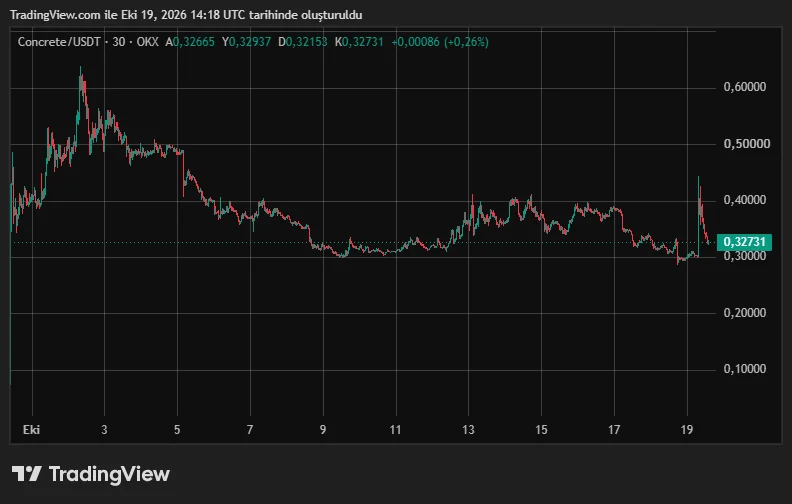
At the time of writing, CT’s total and maximum supply are both listed as 1 billion. The deposited asset and trading volume figures on Concrete’s own pages also measure different things. Cumulative trading volume does not show how much capital is in the system at any one time; directly comparing figures updated on different dates can produce misleading conclusions.
Partnerships, community, and governance
BitGo is one of Concrete’s institutional partners. According to the project, the partnership aims to develop yield products compatible with institutions’ existing custody arrangements.
The model aims to bring custody, strategy execution, and reporting together. An institution’s access to a product still depends on the service’s terms, supported assets, and its own operational requirements.
The collaboration with Ceffu centers on AssetCX. The existence and value of eligible assets held in custody can be represented onchain, connecting those assets with DeFi strategies.
The details vary depending on the custodian, strategy, and agreements involved. In its Ceffu partnership announcement, Concrete also states that it is not a custodian.
For the community, CT is designed to support participation in certain protocol decisions. The team says governance will develop gradually.
How Does the CT Token Work?
CT’s main functions center on governance and protocol configuration. Eligible users are expected to lock their tokens to participate in certain decision-making processes.
These areas include strategy approvals, collateral classifications, and fee frameworks. For users staking CT, supported modules provide adjustments to certain protocol fees applied to their own transactions.
These functions need to be considered separately from potential returns generated by Concrete vaults. Depositing assets into a vault means participating in a particular strategy; holding CT creates a different economic exposure tied to the token’s price and uses.
Concrete Foundation’s current interface also offers the option to stake CT and earn Concrete points. A reward in a points program does not, by itself, promise fixed cash income or tokens with a specific future value.
Holding CT does not confer company equity, dividends, or a claim on protocol assets. There is therefore no automatic link between the scale of activity on the platform and a token holder’s economic rights.
Supply, allocation, and tokenomics
CT’s announced total supply is 1 billion tokens. The project says its supply model has no inflation mechanism and divides the allocation into four main categories.
The ecosystem receives 35% of CT’s supply, or 350 million tokens. Investors receive 28%, equivalent to 280 million CT, while the team receives 22%, or 220 million CT. The remaining 15%, equivalent to 150 million CT, is allocated to Concrete Foundation.
The ecosystem allocation supports community distribution, participation, liquidity, and growth. The foundation allocation aims to fund activities such as development, security, and governance; team and investor allocations are subject to long-term vesting arrangements.
A fixed total supply does not mean additional tokens cannot enter the market. Previously created tokens held under lock can increase the circulating supply when they are released.
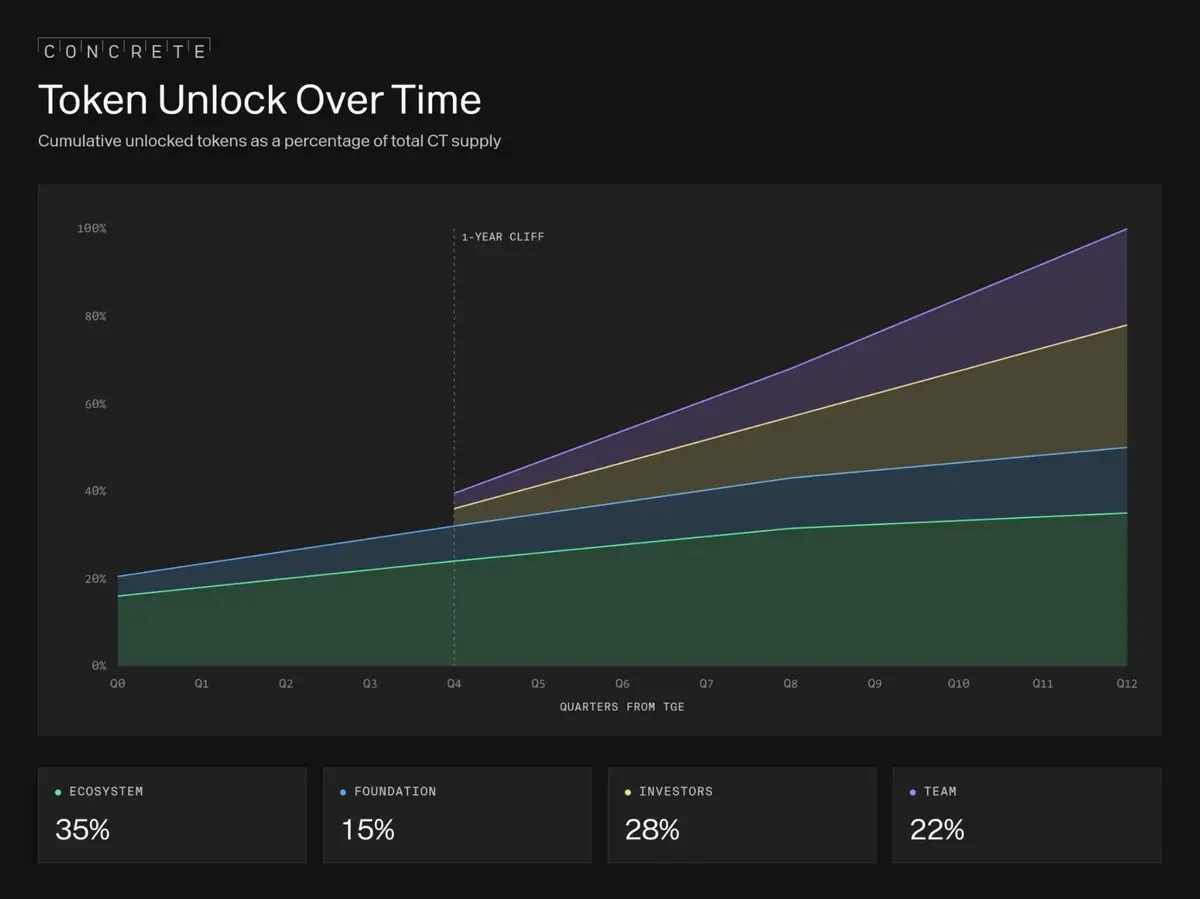
According to the allocation breakdown, the team and investors together account for 50% of the supply. This percentage does not prove that selling will occur, but it makes token unlocks and ownership concentration important to monitor.
Assessing supply requires three separate pieces of information: total supply, circulating supply, and future unlocks. Without one of these, the token’s price alone cannot provide a sound basis for deciding whether the project is cheap or expensive.
For example, fully diluted valuation is calculated by multiplying the current price by the total supply. This calculation does not mean all tokens can be sold today or that the market would buy that quantity at the same price.
Protocol operations and security
Concrete vaults use the ERC-4626 tokenized vault approach. Under this standard, users receive shares representing their proportional exposure to the vault’s underlying assets; deposits and withdrawals follow a common technical framework.
Concrete’s explanations cite share tokens such as ctDefiUSDT as examples. Their value relates to the vault’s assets and total share count, using a different calculation from the market price of the CT governance token.
A hypothetical example helps illustrate this. If a user receives 1,000 vault shares for 1,000 units of an asset, and the value per share later rises to 1.03 units, the position could reach approximately 1,030 units, with relevant costs taken into account.
The same mechanism can also produce losses. An unchanged share count does not mean the deposited assets will retain their value.
Concrete says many of its vaults process withdrawal requests through a queue. Unwinding positions can take time, creating a delay between requesting a withdrawal and receiving assets in a wallet.
Net asset value, or NAV, plays an important role in accounting. According to Concrete, valuation updates pass through separate validation steps, and smart contract checks can block changes that exceed defined limits.
In asynchronous vaults, NAV when a withdrawal settles may differ from NAV when the user submitted the request. Capital remains exposed to gains or losses while it stays in the strategy, so this difference can affect the amount received.
The security approach extends beyond audits. The Enterprise page describes work with firms such as Halborn and Cantina, a bug bounty program, transaction monitoring, and controls that can pause operations under certain conditions; these measures do not eliminate the possibility of losses.
Why Does Concrete Matter?
Accessing an attractive DeFi yield often requires managing several different operations at once. Users need to choose protocols, move assets, pay transaction costs, and adjust positions as market conditions change.
Concrete’s automation approach aims to reduce this operational burden. Vault strategies can use methods such as lending, liquidity provision, restaking, and balancing different market positions.
The key consideration is where the yield comes from. Interest paid by borrowers and returns generated through temporary incentive tokens may not be equally sustainable.
For example, a vault’s displayed annual yield may fall when a rewards program ends. Higher transaction costs or reduced liquidity in the markets used by a strategy can also change the net outcome.
Comparing vaults solely by their APY is therefore insufficient. The underlying asset, fees, withdrawal period, and circumstances in which a strategy could lose money all need consideration.
These details also determine how effective automation is. Fewer transactions can save users time, but the decisions of the system allocating capital and the protocols it relies on remain important.
Its place in the DeFi ecosystem
Concrete’s products serve both end users and organizations building other financial products. Through Enterprise, organizations can create vaults using their own strategies, wallet arrangements, and data sources.
The platform offers integration options through interfaces or software development tools. It aims to address shared needs such as accounting, position tracking, and withdrawal management through a single infrastructure.
Under this model, Concrete’s growth may extend beyond the number of users visiting its own application. The number of other products using its infrastructure and their continued usage also become meaningful indicators.
The announced Euler partnership is one example of this approach extending into lending markets. Concrete plans to act as a curator that designs and monitors certain lending markets within Euler’s vault structure.
This role includes setting accepted collateral, borrowing rates, price data sources, and position limits. The project also aims to enable Concrete vault shares to be used in different lending products where appropriate.
Using a vault share in another application can give users greater flexibility. However, borrowing against the same position can add credit and liquidation risks to the original vault exposure.
An increase in integrations alone is therefore insufficient as a measure of quality. Actual usage, liquidity, and the conditions under which an integration might stop working also need consideration.
Protocol risks and price volatility
Price volatility is the first risk CT investors face. During periods of limited liquidity, even seemingly small orders can move prices significantly; large trades may execute at prices far from the latest displayed quote.
Concrete’s whitepaper also discusses risks involving smart contract vulnerabilities, bridge systems, custody services, and reliance on third parties. For vault users, the underlying asset presents additional risks. A stablecoin losing its peg or another crypto asset declining in market value can affect a strategy’s outcome.
Withdrawal conditions deserve as much attention as yield. If users cannot close their positions when they need cash, the value shown on paper may differ from the amount they can actually access.
While governance aims for broad token holder participation, the influence of large holders, voter turnout, and how decisions are implemented require monitoring. A voting mechanism does not mean every participant has equal influence over decisions.
There is also no guaranteed relationship between project development and token performance. Concrete offering more products may indicate growing activity; CT’s price remains subject to supply, demand, and broader market conditions.
Frequently Asked Questions (FAQ)
Below are answers to some frequently asked questions about Concrete (CT).
- What is Concrete, and when did it launch?: Concrete is an onchain asset management platform offering automated yield vaults and tools for institutional products. Development began before CT; the announced TGE date for the CT token was September 30, 2026.
- What is the CT token used for?: CT is intended to support participation in certain governance decisions and protocol fee configuration features within supported modules. Usage depends on locking, staking, and the rules of the relevant module; holding CT does not confer dividend rights.
- Which networks does Concrete operate on?: The project has announced CT contracts on Ethereum and BNB Smart Chain. The networks available for Concrete vaults and the assets they accept vary by product; users need to check the token’s network and the vault’s network separately.
- Who founded Concrete?: Nic Roberts-Huntley and Dillon Liang are the prominent founders associated with Blueprint Finance, the company developing Concrete. Concrete Foundation coordinates governance and treasury matters, while Concrete Network, Ltd. handles token issuance.
- What is the CT token supply?: The announced total supply is 1 billion CT.
- Is Concrete a suitable investment?: That assessment depends on an individual’s risk tolerance, investment horizon, and understanding of the project. CT’s price risk and the vaults’ strategy risks need separate assessment; high yield targets or institutional partnerships do not guarantee capital preservation. Concrete aims to make DeFi yield management more accessible and build shared infrastructure for institutions. Evaluating the project requires monitoring actual vault performance, withdrawal conditions, and governance development together; CT’s role also needs to be understood clearly and separately from these products.
Follow the JR Kripto Guide series to keep track of Concrete’s yield vaults, CT governance, and institutional DeFi connections.

