
The 2022 downturn reshaped the NFT market. Blur challenged OpenSea’s lead by targeting professional traders, offering zero marketplace fees and rewarding active users with token airdrops. Four years later, on November 12, 2026, Blur shut down its website. The history of BLUR, the marketplace’s governance token, traces the platform’s rise and decline.
What Is Blur and How Did It Get Started?
Blur is an Ethereum-based NFT marketplace and aggregator. Its trading interface brought together NFT listings from Blur and other marketplaces, including OpenSea, so users could view listings in one place and trade in bulk. Real-time pricing, advanced charts and tools for executing trades quickly made it particularly appealing to professional NFT traders.
One feature that set Blur apart was its zero-fee model. The platform also made creator royalties optional and rewarded active users with airdrops. These incentives helped Blur become one of Ethereum’s largest NFT marketplaces by trading volume.
BLUR is the platform’s governance token. Token holders control the “fee switch,” which determines whether the Blur protocol charges a fee on trades.
How did Blur work?
Blur had three main components.
- Marketplace and aggregator. Traders could view NFTs listed on Blur and other marketplaces in a single interface and buy multiple NFTs at once.
- Bid pools. Buyers could place collection-wide bids that sellers could accept for any eligible NFT in the collection. Sellers could therefore turn their NFTs into ETH more quickly.
- Blur Pool. Users deposited ETH into this smart contract to place bids and participate in lending.
What is Blend?
Blend is the NFT-backed lending protocol Blur developed with Paradigm in May 2023. It allowed users to borrow ETH against NFTs they owned.
Blend loans had no fixed maturity date. A loan stayed open until one of the parties took action. When a lender wanted to exit, the protocol opened a refinancing auction in which the interest rate started at zero and rose until a new lender agreed to take over the loan.
If no lender stepped in, the borrower’s NFT collateral was liquidated. This mechanism allowed Blend to operate without a price oracle.
Why did Blur shut down its website?
On October 12, 2026, Blur announced that it would close its website. The blur.io trading interface shut down on November 12, 2026, and Blend stopped matching new loans.
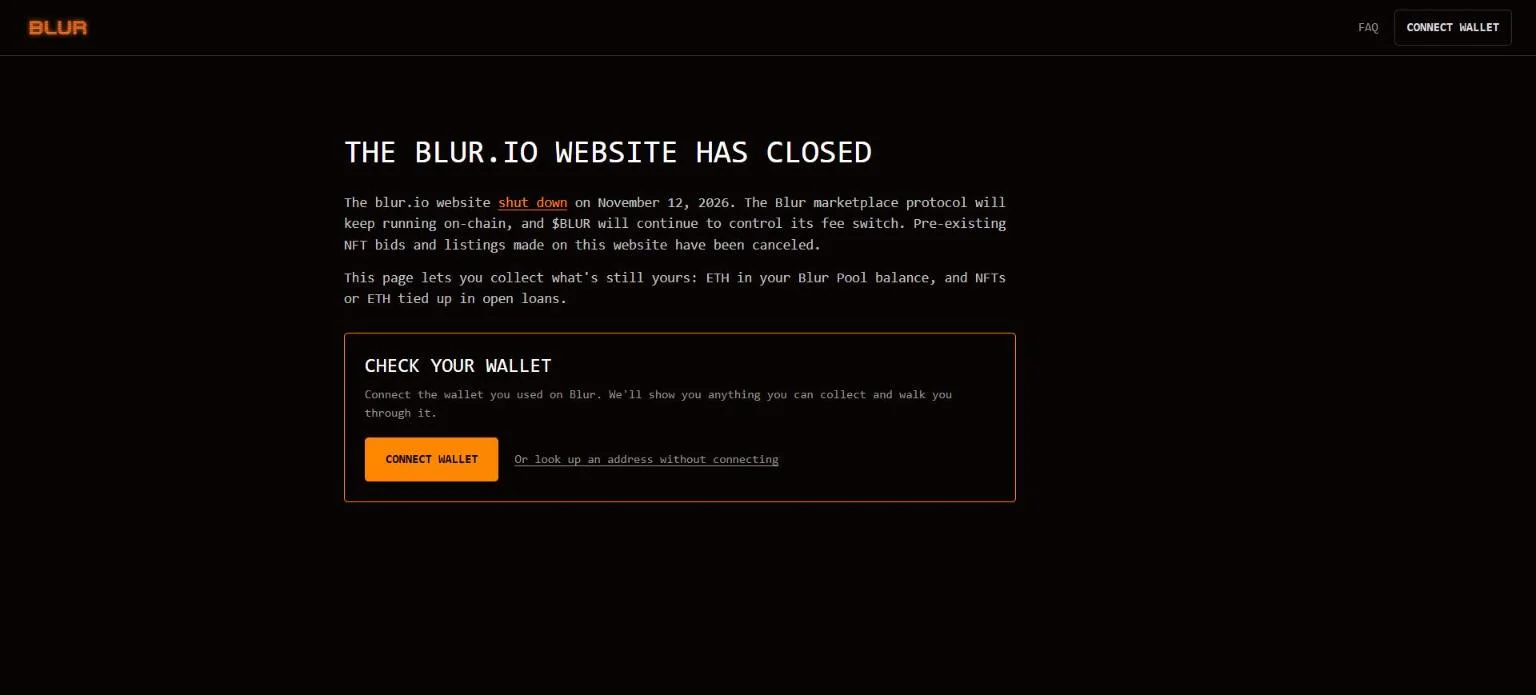
According to Blur’s shutdown notice, the marketplace protocol continues to operate onchain, and BLUR holders retain control of the fee switch. Existing NFT bids and listings were canceled. Users can connect a wallet or enter a wallet address under “Check Your Wallet” to recover ETH held in Blur Pool and any NFTs or ETH tied to outstanding loans.
Blur gave no financial reason for the closure. Reports indicate that the platform handled more than 70% of Ethereum NFT trading volume in March 2023, but its monthly volume had fallen below $7 million by March 2026. Its zero-fee model meant the platform had gone years without generating revenue.
Key Milestones in Blur’s History
Blur opened to the public on October 19, 2022, after four months in closed beta. By then, the project had raised $14 million with backing from crypto venture capital firm Paradigm. At launch, Blur announced an airdrop for users who listed NFTs on the platform.
The BLUR token launch and airdrop seasons
BLUR launched on February 14, 2023, with an airdrop of approximately 360 million tokens from the community allocation. The token briefly reached $5 shortly after trading began, then lost more than 80% of its value.
Blur organized subsequent airdrops into “seasons.” Users earned points by placing bids, listing NFTs and participating in lending on Blend. Those points qualified users for later BLUR distributions.
Competition with OpenSea
Blur’s airdrop incentives put pressure on OpenSea. By March 2023, Blur accounted for more than 70% of Ethereum NFT trading volume. OpenSea responded by cutting marketplace fees and revising its creator royalty policy.
The rivalry also fueled a debate over NFT royalties. Artists and creators criticized Blur for making royalty payments optional. Critics also argued that the airdrops inflated trading volume because users had an incentive to trade solely to earn points.
Blend and Blast
On May 1, 2023, Blur introduced Blend, the lending protocol it had developed with Paradigm. Blend quickly became one of the largest platforms for NFT-backed loans.
In late 2023, Blur’s founding team also launched Blast, an Ethereum Layer 2 network that promised native yield on ETH and stablecoin deposits. On October 2, 2026, Blast announced plans to shut down. Reports indicated that deposits on the network had fallen from more than $2 billion to about $32 million.
The shutdown
On October 12, 2026, ten days after Blast’s announcement, Blur said it would close its website. The BLUR token fell sharply after the news.
Upbit and Bithumb, South Korea’s two largest crypto exchanges, also announced plans to delist BLUR. Trading on both exchanges will end on November 30, 2026. Withdrawals will remain open until December 30, 2026.
The blur.io trading interface closed on November 12, 2026. Earlier that month, some users reported that more than $1 million in NFT royalties remained stuck in Blur’s smart contracts. Blur has yet to confirm the claim.
How Does the BLUR Token Work?
BLUR is the governance token of the Blur ecosystem. Issued on Ethereum as an ERC-20 token, it gives holders a vote on protocol decisions. Holders can participate in governance by staking their tokens or delegating their voting power to another address.
The most significant decision BLUR holders control is whether to activate the protocol’s fee switch. The switch determines whether the marketplace charges a protocol fee on trades and how it distributes any resulting revenue. In its website shutdown announcement, Blur said token holders would retain that authority.
Traders used ETH to transact on Blur. BLUR served primarily as a governance token and as a reward for users who participated in airdrop seasons.
BLUR supply and tokenomics
BLUR has a maximum supply of 3 billion tokens. According to Tokenomist, approximately 97.74% of that supply has unlocked, and around 2.93 billion BLUR are in circulation. The remaining tokens are scheduled to vest through 2027. No tokens have been burned to date.
| Allocation | Share of total supply |
Community treasury | 51% |
Past and future team members | 28.92% |
Investors | 18.85% |
Advisors | 1.23% |
The community treasury funded airdrops and other user incentives. With nearly the entire supply already in circulation, the risk of selling pressure from large future unlocks is low. Demand remains a concern, however, as no new source of demand has emerged to support the token’s value.
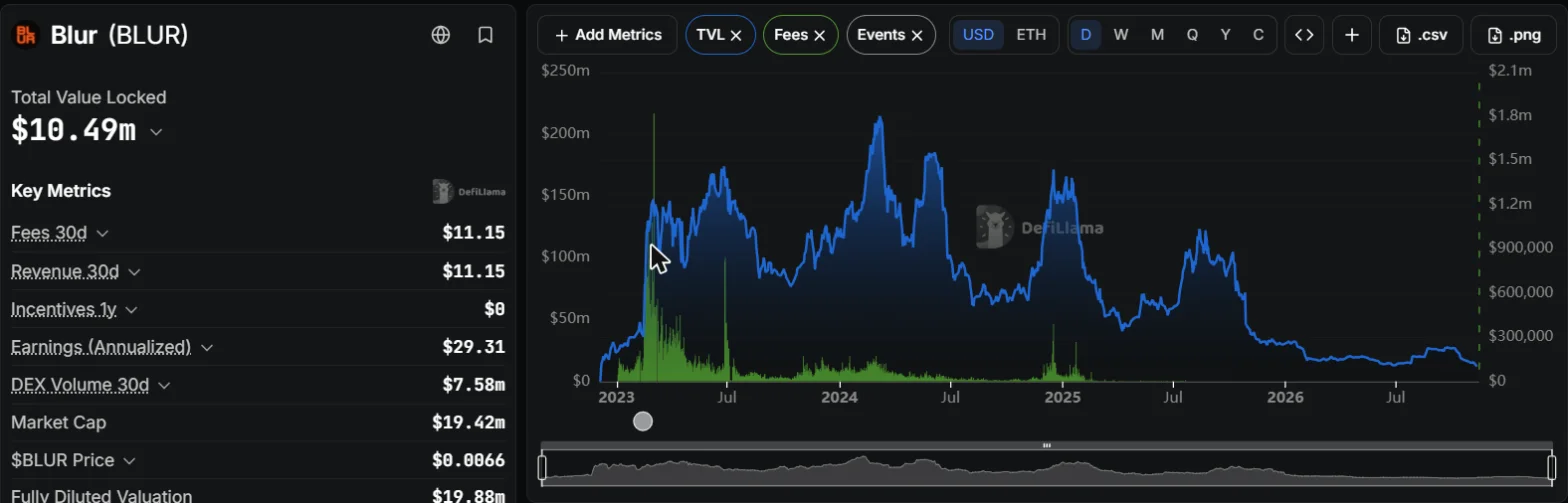
According to DefiLlama, the total value locked (TVL) in Blur’s protocol fell from a peak of about $210 million in early 2024 to approximately $10.5 million. The protocol generated just $11 in fees over the past 30 days.
BLUR Price and Market Data
The following figures show BLUR’s market performance as of November 13, 2026, according to JR Kripto.
| Metric | Value |
Current price | $0.0066397 |
Market cap rank | #674 |
Market capitalization | $19.46 million |
Fully diluted valuation | $19.93 million |
24-hour trading volume | $85.8 million |
Circulating supply | 2,931,093,055 BLUR |
Total supply | 3,000,000,000 BLUR |
All-time high | $5.02 |
All-time low | $0.0063298 |
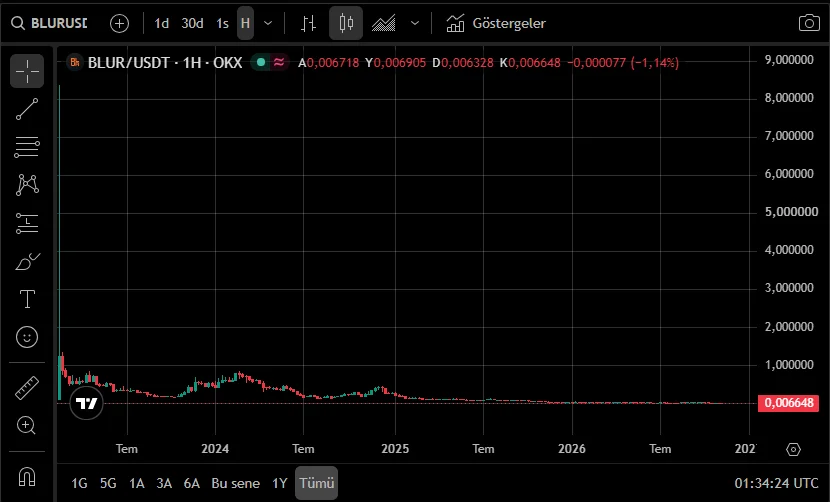
BLUR gained 2.24% over the past 24 hours but fell 10.04% over seven days and 43.03% over 30 days. It traded 99.87% below its all-time high. The token set a new all-time low on November 13 and subsequently traded about 5% above that level.
BLUR reached roughly $5 in its first days of trading after the February 2023 airdrop. The price fell quickly as airdrop recipients sold their tokens. Later airdrop seasons and a broader crypto market recovery brought brief rallies in 2023 and 2024, but the decline continued as the NFT market contracted and Blur lost market share.
The October 2026 shutdown announcement and the delisting decisions by South Korean exchanges accelerated the decline. BLUR’s trading volume over the past 24 hours exceeded four times its market capitalization, suggesting heavy speculative trading.
Why Does Blur Matter?
Blur changed how traders bought and sold NFTs. Its professional trading interface, zero marketplace fees and collection-wide bids helped it challenge OpenSea’s long-standing lead. Its rapid growth pushed marketplaces across the industry to reconsider their fee and royalty policies.
Blend also introduced a different model for NFT-backed lending. Its open-ended loans and refinancing auctions showed how lenders could accept NFTs as collateral without relying on a price oracle. Collectors could borrow against an NFT and retain exposure to its value while the loan remained open.
Blur’s decline shows how quickly a platform built around airdrop incentives can lose activity as rewards diminish and the market contracts. That has made Blur a reference point for assessing how crypto projects design their tokens and attract users.
Where Can You Buy BLUR?
BLUR trades on crypto exchanges accessible from Türkiye. According to JR Kripto’s market data, BtcTurk and Binance TR list the BLUR/TRY pair. The token has also traded on Paribu and Binance’s global platform.
To buy BLUR in Türkiye, follow these steps.
- Open an account with a licensed crypto exchange in Türkiye and complete identity verification.
- Deposit Turkish lira into your account by bank transfer or EFT.
- Find the BLUR/TRY or BLUR/USDT trading pair.
- Enter the amount you want to buy and place a market or limit order.
Following the closure of Blur’s website and the delisting decisions by major South Korean exchanges, other exchanges could take similar steps. Anyone considering buying BLUR should check their exchange’s latest listing and withdrawal announcements.
The Blur Team and Community
Tieshun Roquerre, known online as “Pacman,” co-founded Blur. He revealed his identity in a post on February 22, 2023. After leaving high school, Roquerre joined Y Combinator at 17 and later studied mathematics and computer science at MIT.
Roquerre left MIT after receiving a Thiel Fellowship and founded Namebase, which he later sold to Namecheap. The team behind Blur went on to develop Blast, an Ethereum Layer 2 network. Dan Robinson and transmissions11 of Paradigm co-authored the Blend white paper with Blur team members Pacman, Galaga and Toad.
Blur raised $14 million with backing from Paradigm. Its community consisted largely of NFT traders and users earning points for airdrops. The project’s account on X was its most active communication channel.
Risks associated with Blur
- Website closure. The blur.io trading interface has closed. While the protocol continues to operate onchain, there is no clear reason for users or trading volume to return.
- Exchange delistings. Upbit and Bithumb are delisting BLUR. Additional delistings could substantially reduce liquidity.
- Limited revenue. The protocol generates almost no fee revenue, leaving the practical value of controlling the fee switch uncertain.
- Team commitment. The closure of Blast, which the same team developed, raises questions about the long-term development of Blur.
- High volatility. High trading volume relative to a small market capitalization can contribute to sharp price swings over short periods.
Frequently Asked Questions
- What is Blur? Blur is a zero-fee NFT marketplace and aggregator developed for professional NFT traders. The platform also offered an NFT lending protocol called Blend.
- What is BLUR used for? BLUR is the Blur protocol’s governance token. It gives holders a vote on protocol decisions, including whether to activate the fee switch.
- Has Blur shut down? Blur’s website closed on November 12, 2026. Its smart contracts continue to operate onchain, and the BLUR token still trades.
- How can I recover my NFTs and ETH from Blur? Use the “Check Your Wallet” option on the blur.io shutdown page to check your ETH balance in Blur Pool and identify any NFTs or ETH tied to outstanding loans.
- What is the total supply of BLUR? BLUR has a total supply of 3 billion tokens, approximately 2.93 billion of which are in circulation.
- Which Turkish exchanges list BLUR? BLUR trades on BtcTurk, Paribu and Binance TR. Check each exchange’s announcements for changes to its listing status.
- Is BLUR a suitable investment? The website closure, exchange delistings and low protocol revenue make BLUR a high-risk asset. Do your own research and consider your risk tolerance before making an investment decision. This content is for informational purposes only and does not constitute investment advice.
For more on cryptocurrencies and blockchain projects, follow the JR Kripto Guide series.

