
The Bitcoin network creates new BTC according to predefined rules. Halving is central to these rules, slowing new Bitcoin issuance roughly every four years. Understanding Bitcoin halving makes it easier to assess both its supply structure and mining economics. However, its effects extend beyond price movements; miner revenue, transaction fees, and market expectations also matter.
What Is Bitcoin Halving, and What Does It Do?
Bitcoin halving cuts the amount of new BTC miners can receive for a valid block in half. The event is also known as a reward halving. The Bitcoin network applies this reduction every 210,000 blocks. Since the network targets an average block time of ten minutes, halvings occur approximately every four years.
Technically, the component that halves is new BTC issuance, known as the “block subsidy.” Transaction fees collected by miners do not halve under the same rule.
Why is halving part of Bitcoin’s design?
Bitcoin’s supply model creates new coins in progressively smaller amounts. When the network launched, the subsidy was 50 BTC per block. Each halving reduces the amount of new BTC available per block during the following period. This gradually slows the rate of new issuance. The structure allows Bitcoin to approach its supply limit of approximately 21 million coins. Under the current protocol rules, new BTC issuance is expected to end around 2140.
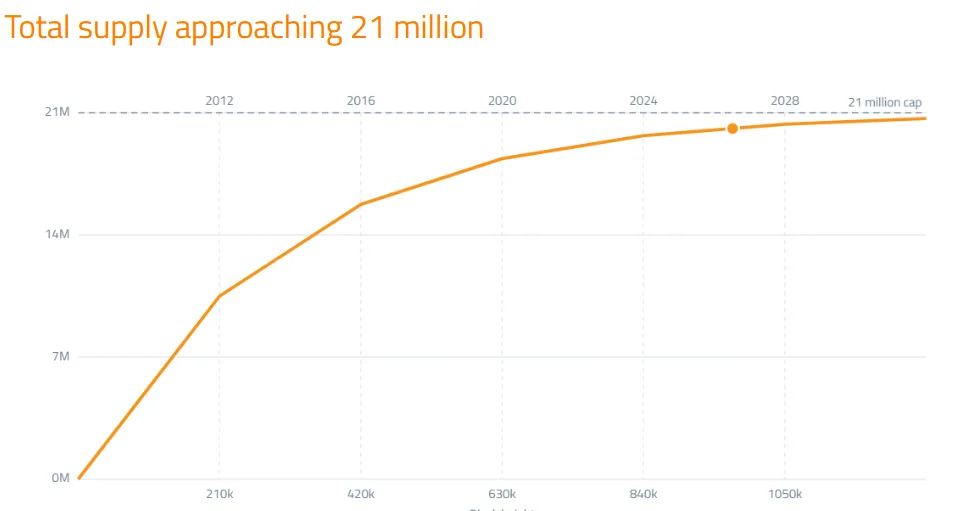
However, limited supply alone does not determine market value. Demand, liquidity, and users’ expectations also influence an asset’s price. For example, production of a product may decline while buyer interest also falls. A reduction in issuance should therefore not automatically be equated with a price increase.
What does halving change, and what stays the same?
Halving does not reduce the amount of Bitcoin in your wallet. If you hold 0.2 BTC before the event, your balance does not change solely because of halving.
The protocol also does not require Bitcoin’s price to halve or double. Trading activity in the market determines its price.
The main distinctions are:
| Component | Direct effect of halving |
New BTC per block | Falls by half |
Existing wallet balances | Remain unchanged |
Total existing BTC | Does not halve |
Bitcoin’s market price | No automatic price adjustment |
Transaction fees within a block | Do not automatically halve |
Target average block time | Remains ten minutes |
Bitcoin halving should therefore not be understood as an event that divides existing holdings. It changes the amount of new Bitcoin that subsequent blocks can create.
How Does Bitcoin Halving Work?
Bitcoin halving depends on block height. The network uses the number of blocks rather than a particular calendar date. Block height identifies a block’s position in the chain. When the network reaches a halving threshold, the permitted subsidy decreases.
Block height and the halving schedule
The first halving occurred at block 210,000. Subsequent halvings took effect at blocks 420,000, 630,000, and 840,000.
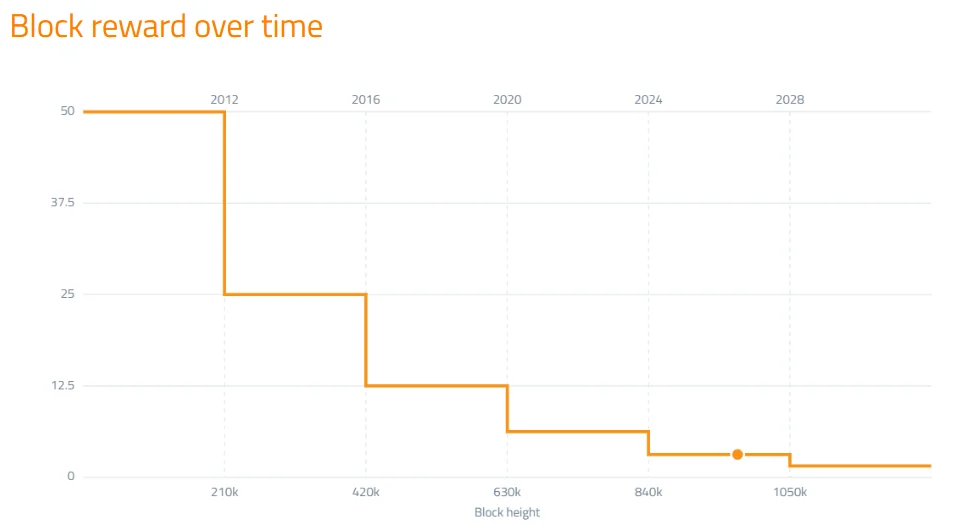
The next threshold is block 1,050,000. From that block onward, new BTC issuance per block will fall to half the current subsidy. Miners cannot create any amount of new BTC they choose. Full nodes validate blocks against the protocol rules and reject blocks that exceed the permitted reward.
This mechanism shows that the supply schedule rests on more than an announcement. The rules operate within the software that checks block validity.
Block subsidies and transaction fees
A miner’s revenue from a block has two main components:
- The amount of new BTC permitted by the protocol.
- Fees from the transactions included in the block.
Miners can operate independently or combine their computing power in a pool. Within pools, revenue distribution depends on the payment model. For a simplified example, suppose the block subsidy is 3.125 BTC. Assume the block also contains 0.2 BTC in transaction fees. The total reward associated with that block would be 3.325 BTC. At the next halving, the subsidy falls to 1.5625 BTC.
If transaction fees remain at 0.2 BTC, the total becomes 1.7625 BTC. Total revenue therefore does not fall by exactly half in this example.
| Revenue component | Example before halving | Example after halving |
Block subsidy | 3.125 BTC | 1.5625 BTC |
Transaction fees | 0.2 BTC | 0.2 BTC |
Total | 3.325 BTC | 1.7625 BTC |
The transaction fee amount in the table is hypothetical. Actual total fees can differ from one block to another.
How does halving affect daily Bitcoin issuance?
A target average block time of ten minutes corresponds to approximately 144 blocks per day. This provides a calculation assumption for explaining daily issuance.
At 3.125 BTC per block, daily new supply would be approximately 450 BTC. After the next halving, the same number of blocks would produce approximately 225 BTC.
The calculation works as follows:
- Current period: 144 × 3.125 = 450 BTC.
- Next period: 144 × 1.5625 = 225 BTC.
However, the network does not produce exactly 144 blocks every day. Block discovery times vary, so actual daily issuance also fluctuates. These figures do not represent the amount of Bitcoin that will be sold on exchanges each day. Miners may hold new BTC, sell part of it, or draw on earlier reserves.
Bitcoin Halving Dates and the Next Halving
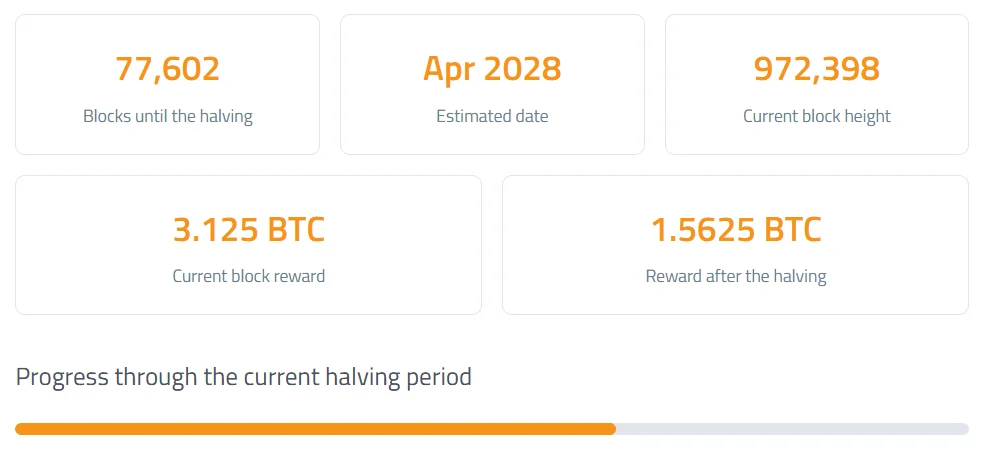
As of October 2026, Bitcoin has undergone four halvings. The most recent occurred on April 20, 2024, at block 840,000. That event reduced the block subsidy from 6.25 BTC to 3.125 BTC. The next halving is expected around 2028.
Historical Bitcoin halving dates
The table below shows previous Bitcoin halvings and the next threshold:
| Halving | Date | Block height | Previous subsidy | New subsidy |
First | November 28, 2012 | 210,000 | 50 BTC | 25 BTC |
Second | July 9, 2016 | 420,000 | 25 BTC | 12.5 BTC |
Third | May 11, 2020 | 630,000 | 12.5 BTC | 6.25 BTC |
Fourth | April 20, 2024 | 840,000 | 6.25 BTC | 3.125 BTC |
Fifth | Approximately 2028 | 1,050,000 | 3.125 BTC | 1.5625 BTC |
The historical dates refer to completed events, while 2028 is an estimated year.
When is the next Bitcoin halving?
The next Bitcoin halving will occur when the network reaches block 1,050,000. Although the expected year is 2028, the exact date and time are not fixed in advance. This is because blocks do not arrive at precisely ten-minute intervals. Some take less time to find, while others take longer.
Countdown tools combine the remaining block count with an estimated block time. As the network progresses, the estimated date may change. For example, two countdown websites may display different dates. Differences in their average block time assumptions and update times can explain this. When an article gives a precise date, check when the estimate was calculated. Block height is the determining factor.
At the time of writing, the figures were as follows:
How to follow a halving countdown
When reviewing a countdown, look beyond the number of days remaining. Examine the data behind the estimate as well.
The following information can help:
- The network’s current block height.
- The block threshold for the next halving.
- The number of blocks remaining until that threshold.
- The average block time used in the calculation.
- The time of the latest data update.
For example, suppose 10,000 blocks remain between the current height and the threshold. Using ten minutes per block produces an estimate of approximately 69.4 days. This is a hypothetical example explaining the method. The actual duration may change depending on how quickly subsequent blocks arrive.
How Does Bitcoin Halving Affect Price and Miners?
When people discuss Bitcoin halving’s effects, price often comes to mind first. However, the direct change occurs in new BTC issuance.
The price response depends on other variables. For miners, revenue measured in Bitcoin and overall business profitability are also different measures.
Does lower issuance guarantee a price increase?
Halving reduces the flow of new BTC that can enter the market. If demand remains steady or increases, this may support the price. However, existing Bitcoin holders can also sell. Market selling pressure therefore extends beyond newly mined coins.
Other factors that may influence the price include:
- Investor demand for Bitcoin.
- Global liquidity and interest rate conditions.
- Buying and selling by large investors.
- Flows into and out of funds and investment products.
- Regulatory developments and market news.
- Leveraged positions and liquidations.
The halving schedule is also known in advance. Investors may reflect their expectations in prices before the event occurs. Therefore, a 50% reduction in issuance does not imply that the price must double.
How should past halving cycles be interpreted?
Market analyses frequently examine price movements surrounding previous halvings. However, a rally following an event does not establish that the event was its sole cause. Bitcoin’s investor base, market size, and economic conditions have changed across periods. These differences make direct comparisons between cycles difficult.
The chosen start and end dates also affect the result. The month following a halving may present a different picture from the following year.
For example, selecting only a period that ends with gains may conceal sharp declines along the way. Examine volatility alongside returns when reviewing a price chart. Past cycles provide context for research. They do not establish that future cycles will repeat the same timing, gains, or peaks.
Miner revenue and cost pressures
After halving, miners receive less new BTC per block. Electricity, maintenance, and equipment expenses do not automatically fall by half. This can pressure businesses with particularly high operating costs. More efficient equipment and favorable energy costs can widen the differences between operators.
For a simplified calculation, assume Bitcoin trades at $80,000. This is an illustrative figure, not a current market price.
A 3.125 BTC subsidy would be worth $250,000. When the subsidy falls to 1.5625 BTC, its value at the same price drops to $125,000. However, these amounts do not represent net profit. Transaction fees, pool distributions, energy expenses, and other costs also enter the calculation.
Changes in Bitcoin’s price affect dollar-denominated revenue as well. A decline in BTC production and a decline in a business’s total revenue may therefore occur at different rates.
What to Monitor Around Halving and Common Misconceptions
A single countdown screen does not provide a complete understanding of halving. Reviewing the supply schedule, network data, and market conditions together offers a clearer picture.
Do not confuse precise price targets or guaranteed return claims with the technical halving rule. The protocol specifies the subsidy amount; it does not determine investment outcomes.
Which data can be useful?
Different data points answer different questions in halving research. Block height helps explain timing, while miner revenue helps assess economic effects.
| Data | What it helps assess |
Block height | Distance to the halving threshold |
Average block time | Why the estimated date changes |
Hash rate | The network’s estimated total computing power |
Mining difficulty | Competitive conditions for block production |
Transaction fees | The fee component of miner revenue |
Trading volume and liquidity | Market trading conditions |
Avoid drawing major conclusions from a single day’s changes. For example, the measurement window can affect a short-term hash rate estimate.
Similarly, high transaction fees do not necessarily mean persistently high miner revenue. Distinguish temporary congestion from longer-lasting demand when assessing fees.
Transaction fees and long-term security
As new BTC issuance declines, transaction fees become increasingly important to miner revenue. Once the subsidy ends, the current design allows miners to continue earning fees.
However, future fee levels cannot be known with certainty today. Demand for block space and users’ payment preferences influence how this revenue develops.
Bitcoin’s long-term security budget is therefore a subject of research. Academic studies examine the importance of sufficient miner revenue as the subsidy declines.
Halving does not include a rule that directly doubles users’ transaction fees. Network congestion and competition for transaction priority affect fees separately.
Do users need to take any action?
Bitcoin holders do not need to move their coins or visit a special link for halving. The event takes place under the network’s existing rules.
Messages such as “connect your wallet to claim your halving reward” do not reflect how the protocol works. Halving is not a campaign that automatically distributes additional coins to Bitcoin holders.
You also do not need to share your wallet’s recovery phrase. A page requesting those words should not be trusted simply because it mentions halving.
Common misconceptions include:
- Thinking the BTC balance in your wallet will halve.
- Assuming the price will automatically double.
- Believing every halving has a fixed calendar date.
- Thinking transaction fees also halve.
- Expecting previous price cycles to repeat exactly.
Frequently Asked Questions (FAQ)
Below are some frequently asked questions and answers about Bitcoin halving.
How often does Bitcoin halving occur?
It occurs every 210,000 blocks. This corresponds to approximately four years, although the exact calendar interval depends on block production speed.
When did the last Bitcoin halving take place?
The most recent halving occurred on April 20, 2024, at block 840,000. The block subsidy fell from 6.25 BTC to 3.125 BTC.
When is the next Bitcoin halving?
It is expected around 2028, at block 1,050,000. The exact date and time may vary depending on the network’s progress.
Will Bitcoin’s price definitely rise after halving?
No. Halving reduces new issuance, but it does not guarantee market demand. Economic conditions and investor behavior can affect the price.
Does halving reduce the Bitcoin in my wallet?
No. Halving changes the amount of BTC that new blocks can create. Your existing wallet balance does not decrease solely because of halving.
Will mining end once all bitcoins have been issued?
The end of new BTC issuance does not mean block production stops. Under the current design, miners can continue earning transaction fees by including transactions in blocks.
Explore JrKripto’s Bitcoin mining, Proof of Work, and Lightning Network guides to better understand how Bitcoin and cryptocurrencies work.

