
When sending or receiving cryptocurrency, you encounter a long string of letters and numbers. Known as a crypto wallet address, this information identifies the destination of a transfer on the blockchain. However, copying the address correctly is only one part of a safe transfer; the network, asset, and any additional transfer details must also match. Understanding how addresses work makes everyday transactions easier and helps prevent mistakes that can be difficult to reverse.
What Does a Crypto Wallet Address Mean?
A crypto wallet address is a string of characters used to receive payments or interact with a particular account on a blockchain. In everyday terms, it can be compared to a bank account number; the sender uses it to identify where to send assets. However, an address does not necessarily contain the owner’s name or identity. One person can also have multiple addresses across different networks and within the same wallet.
Crypto assets do not physically sit inside a wallet application. The relevant blockchain’s records track balances and spending conditions. A wallet application lets you view these records and create transactions with the required authorization. Deleting the application therefore does not automatically mean losing your assets; restoring access depends on your wallet’s recovery method.
The difference between a wallet, an address, and a private key
Wallets, addresses, and private keys are related, but each serves a different purpose. A wallet is the tool you use to manage transactions; an address identifies a payment destination. A private key provides the authority to sign transactions for accounts controlled by that key. Understanding this distinction helps you recognize which information you can share and which information you must keep secret.
| Concept | Main function | Sharing considerations |
Wallet application | Manages accounts and transactions | You can share the application’s name; protect access credentials |
Wallet address | Identifies where to receive payments | Can be shared to receive payments |
Public key | Used to verify signatures | Does not need to remain secret like a private key |
Private key | Enables transaction signing | Must not be shared with others |
Recovery phrase | Allows keys to be derived again in compatible wallets | Should be stored securely offline |
How Do Crypto Wallet Addresses Work?
In key-based wallets, the process begins with securely generated private keys. Cryptographic operations produce public keys, while the method used to create an address depends on the network’s design. For example, a standard Ethereum user account’s address derives from a particular portion of the public key’s hash. Smart contract addresses use different methods, so you should not assume that every address has a private key directly associated with it.
During a transfer, your wallet prepares a transaction using the recipient’s address, the amount, and other required information. The relevant key or account authorization mechanism approves the transaction, and the network checks whether it follows the rules. A correctly formatted address does not prove that it belongs to the intended recipient. Error-detection mechanisms in some address formats can catch typing mistakes, but they cannot prevent you from using another person’s valid address.
Do not confuse your receiving address with a token contract address
A token’s contract address and the address you use to receive that token serve different purposes. The contract address identifies the token and its rules on the relevant network; your receiving address identifies the account to which the balance should be credited. Your wallet may request a contract address when you add a token to its interface, but sending assets directly to that address can make them inaccessible. When making a transfer, use the deposit or receiving address provided by the recipient.
What Are the Different Types of Crypto Wallet Addresses?
Address formats vary because blockchains follow different technical rules. Some addresses begin with specific characters, while others combine uppercase and lowercase letters. These features can help identify a network or address type, but they do not replace a proper compatibility check. The Bitcoin examples below refer to mainnet addresses; test networks may use different prefixes.
Bitcoin wallet addresses
The Bitcoin network supports several address types introduced at different stages of its development. These can affect spending conditions and how transaction data is represented. Although newer formats can improve space efficiency for certain transactions, the fee you pay also depends on the transaction’s size and your selected fee rate. Before sending, check that your service supports the recipient’s address format.
| Address type | Prefix | Main feature |
Legacy, P2PKH |
| One of Bitcoin’s older, widely used payment formats |
P2SH |
| Script-based spending conditions, including uses such as multisignature or nested SegWit |
Native SegWit, Bech32 |
| Address format used for native SegWit transactions |
Taproot, Bech32m |
| Format supporting Taproot spending conditions |
Not every address beginning with 3 is exclusively a multisignature address. Likewise, the bc1 prefix alone does not distinguish Native SegWit from Taproot; the following character also matters. Taproot can offer privacy and efficiency benefits for certain transactions, but it does not make transactions fully anonymous. Although associated with applications such as Ordinals, Taproot addresses have uses beyond them.
Ethereum addresses and EVM compatibility
Ethereum addresses begin with 0x, followed by 40 hexadecimal characters, for a total of 42 characters. Many networks compatible with the Ethereum Virtual Machine use the same address format. When using a standard key-based account on networks such as Ethereum, Base, Arbitrum, or Polygon, you may see the same address. However, this does not mean that balances are shared across those networks.
For example, sending a token on Ethereum does not automatically increase the Base balance at the same address. The transfer takes place on your selected network; moving assets between networks requires a separately supported method. When depositing into an exchange, check that it supports both the asset and the network. For smart contract wallets, also verify whether the same address is usable in the same way on another network.
Address formats on other networks
Classic XRP Ledger account addresses begin with r, while addresses commonly displayed in TRON wallets begin with T. XRP Ledger also supports the X-address format, which combines an address with destination tag information. These differences reflect variations in network encoding and account design. Recognizing an address’s appearance can help, but you should still check the network and asset information on the transfer screen.
How Do You Create a Crypto Wallet Address?
Start by choosing a wallet that suits how you plan to use your assets. A hot wallet offers convenient access for everyday transactions, while cold wallet setups focus on keeping private keys offline. An address itself is neither hot nor cold; the distinction concerns how the keys are stored. The service provider generally controls the deposit address displayed in an exchange account.
Creating a self-custody wallet usually involves the following steps:
- Obtain the wallet application or device from a verified official source.
- Follow the steps to create a new wallet.
- If provided, record the recovery phrase in the correct order and store it securely.
- Select the asset you want to receive and the correct network.
- Display the address in the “Receive” section.
- If you use a hardware wallet, verify the address on the device’s screen.
Some wallets use alternative backup or account recovery methods instead of a conventional recovery phrase. During setup, learn which information restores access and who holds responsibility for it. Do not trust anyone who gives you a prewritten recovery phrase. Creating a new address usually does not directly incur a network fee, although conditions may differ where account activation, reserves, or contract deployment are required.
Why might your wallet address change?
Bitcoin wallets, in particular, may display a new receiving address for each payment request to support privacy. These addresses can derive from keys managed by the same wallet and appear under one combined balance. Displaying a new address does not automatically invalidate the previous one. For exchange deposits, however, always use the service provider’s current deposit screen.
What Should You Check Besides the Address When Transferring Crypto?
Even with the correct address, missing or incompatible information can prevent a transfer from appearing in your account. Network selection, token type, minimum deposit amounts, and required confirmations matter especially when using exchanges. Some services receive payments for multiple users through the same address. An additional memo or tag then identifies the user to whom the payment belongs.
Why might a memo or destination tag be necessary?
For XRP transfers, some exchanges require a destination tag alongside a shared receiving address. The address identifies the account receiving the funds, while the tag tells the service provider which customer’s balance to credit. A missing or incorrect tag can prevent an automatic credit even if the transaction completes on the blockchain. You may then need to contact the platform’s official support team; the resolution process depends on the service’s rules.
Track the transaction through a block explorer
The transaction hash provided after a transfer helps you locate the transaction in the relevant network’s block explorer. There, you can inspect the recipient, amount, transaction status, and confirmation details. If a successful on-chain transfer does not appear in the application, the wallet may be displaying the wrong network or may not list the token in its interface. For exchange deposits, the platform must also credit the balance after the required blockchain confirmations.
Security Tips for Using Wallet Addresses
Safe crypto transfers require the same basic checks each time. Copying an address or using a QR code instead of typing it manually can reduce typing errors, but neither provides a guarantee. Malware can replace an address in your clipboard, and a fake QR code can point to a different destination. Compare the final confirmation screen with the information the recipient shared through a trusted channel.
Watch out for address poisoning attacks
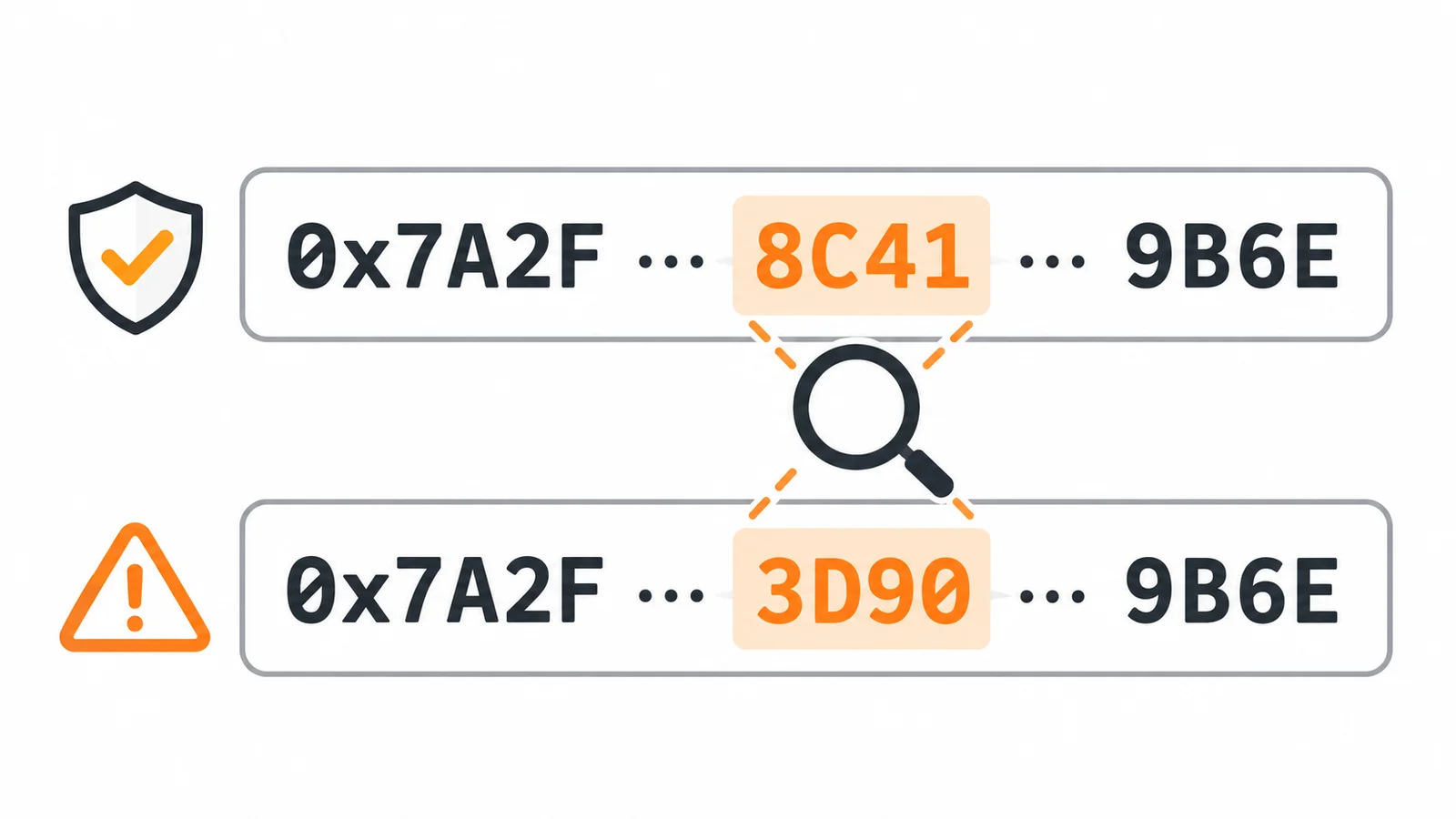
In an address poisoning attack, scammers create an address resembling one you have used before. They make it appear in your transaction history through small or zero-value transfers. Their goal is to trick you into copying the wrong address from your history for a later payment. Check the entire address rather than only its first and last characters, and save frequently used recipients in your address book after verifying them.
Make test transfers under the right conditions
Before sending a large amount, a small test transfer can help confirm address and network compatibility. However, the test amount must meet the platform’s minimum deposit requirement. Confirm that the recipient can actually see the credited balance rather than relying solely on a “transaction successful” message. Check the address and network again for the main transfer, because a previous successful transaction does not guarantee that the next transfer’s details are correct.
Verify human-readable address names
Services such as ENS connect long addresses with human-readable names. A supported wallet can read a name’s records to find the destination address. This convenience does not remove the need to check the spelling and confirm that the name resolves to the appropriate address record for the intended network. Watch for lookalike names and, where possible, inspect the resolved address before confirming the transaction.
Consider privacy when sharing an address
You can share your wallet address to receive payments; knowing the address alone does not grant permission to spend its assets. However, balances and transactions associated with your address may be visible on public networks. Linking the address to your real identity makes it easier to connect your financial activity to you. Never share your private key or recovery phrase to receive payments, verify a transfer, or obtain support.
Frequently Asked Questions
Wallet addresses may seem complicated at first, but understanding the basic distinctions makes everyday use easier. Knowing the difference between an address, a network, and a private key can prevent many mistakes. Below, we answer frequently asked questions about cryptocurrency addresses:
- Is my public key the same as my wallet address?: Not on every network. On networks such as Ethereum, the address derives from the public key; other networks may use different relationships. Use the receiving address displayed by your wallet to receive payments.
- What happens if I send crypto to the wrong address?: Senders generally cannot reverse confirmed transactions. Access may be possible in some situations, such as certain wrong-network transfers, but this depends on the recipient account’s structure and the service provider. Recovery is not guaranteed.
- Can I share my wallet address with anyone?: You can share it to receive payments. However, consider that it may be linked to your transaction history and identity.
- Can someone steal my crypto if they know my address?: Knowing the address alone is insufficient. However, scammers may use it to target you with fraudulent messages, malicious signing requests, or address poisoning attempts.
- Can I use the same address for multiple transactions?: On many networks, yes. Using a new address for each incoming Bitcoin payment is preferable for privacy; when using exchanges, follow the current deposit instructions.
- Do different cryptocurrencies require different addresses?: Multiple tokens on the same network can be held at the same account address. Address formats and support conditions vary across networks; especially on exchanges, do not assume that one address accepts every asset.
Before every transfer, check the asset, network, recipient address, and any required memo or tag together. Follow JrKripto’s guides to make wallet security a daily habit and manage your crypto assets with greater awareness.

