
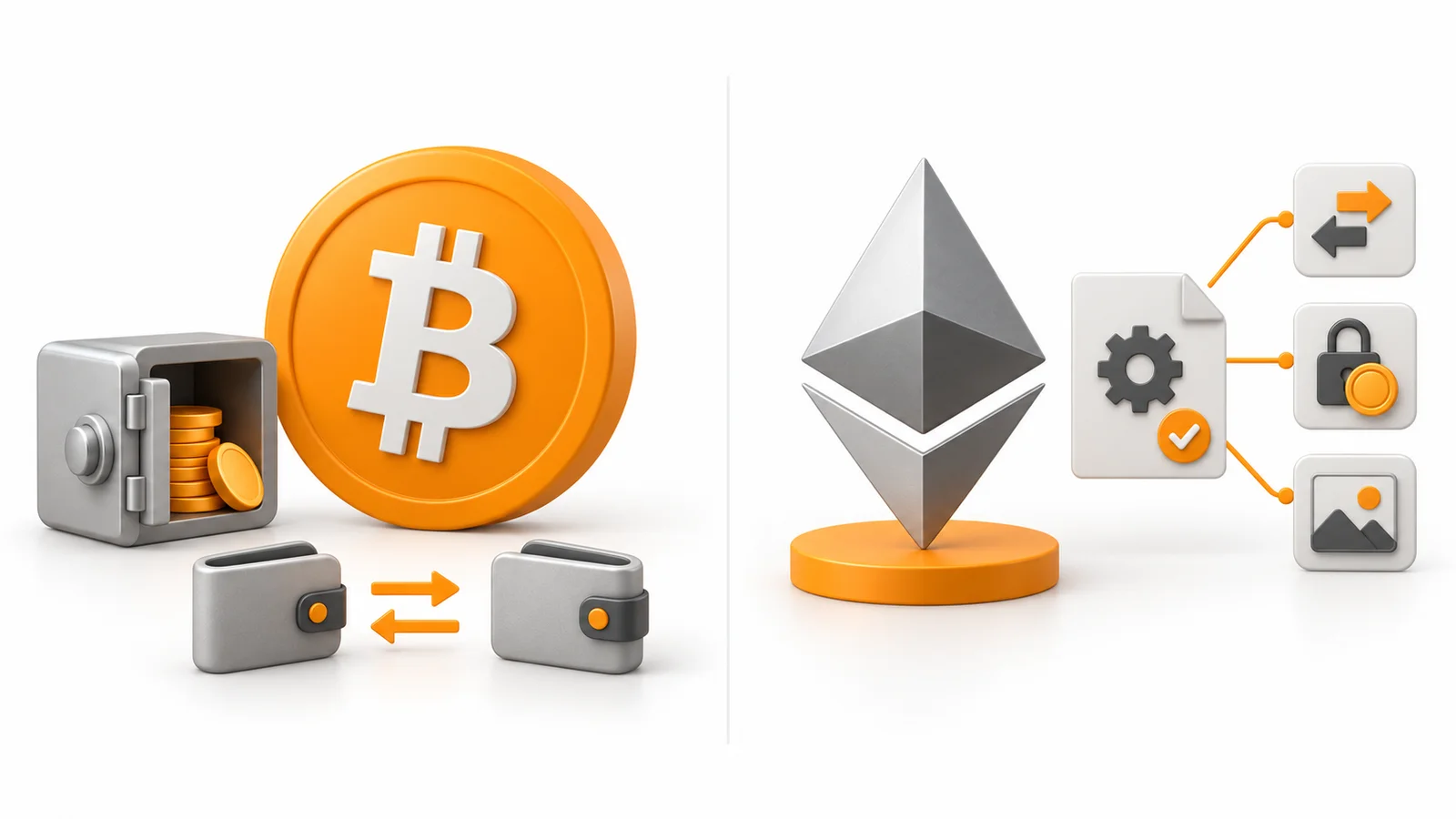
The differences between Bitcoin and Ethereum extend beyond their prices or logos. Bitcoin focuses on transferring value without a central institution and maintaining a predictable monetary supply, while Ethereum provides infrastructure for developers to build smart contracts and decentralized applications. Both use blockchain technology, but their methods for securing the network, processing transactions, and issuing new assets differ. Understanding these distinctions makes it easier to assess what each network offers and the risks it carries.
What Is Bitcoin?
Bitcoin is a decentralized payment network that began operating in 2009, following the publication of a white paper under the name Satoshi Nakamoto. Its native asset, BTC, allows users to transfer value without requiring a bank to approve the transaction. Its limited supply has earned it the description “digital gold,” although this comparison does not mean its price remains stable or that it preserves its value under all conditions.
Bitcoin uses Proof of Work for block production, with miners contributing computing power to the process. The network’s current rules limit the total supply to 21 million BTC, while new issuance decreases through halving cycles. Nodes independently check the blocks miners produce and reject records that violate the rules.
What Is Ethereum?
Ethereum is a programmable blockchain that developed from Vitalik Buterin’s proposal and launched in 2015 through the work of its founding team. Developers can use the network to build smart contracts, decentralized finance applications, and digital asset projects. Ethereum is the name of the network, while Ether is its native asset, traded under the symbol ETH.
Smart contracts and the role of ETH
Smart contracts are programs that execute on a blockchain according to specified conditions. The Ethereum Virtual Machine, or EVM, allows network nodes to run these programs under a common set of rules. ETH can be used to pay transaction fees, participate in network security through staking, and provide collateral in various applications.
Ethereum transitioned from Proof of Work to Proof of Stake through The Merge in September 2022. Following this transition, mining on Ethereum mainnet ended, and a validator system based on staked ETH took over block production. Staking has therefore replaced mining as a core feature of Ethereum’s operation.
Key Differences Between Bitcoin and Ethereum
A BTC vs ETH comparison should distinguish between the networks’ design goals, native assets, and application layers. Directly comparing a payment solution built on Bitcoin with a complex financial transaction on Ethereum mainnet can be misleading. The table below summarizes the two networks’ core approaches.
| Feature | Bitcoin | Ethereum |
Native asset | BTC | ETH |
Primary focus | Value transfer and digital money with a limited supply | Smart contracts and decentralized applications |
Consensus mechanism | Proof of Work | Proof of Stake |
Block production participants | Miners | Validators |
Supply model | Maximum supply of 21 million BTC | No fixed cap; supply depends on issuance and burning |
Programmability | More limited transaction conditions and scripting | General-purpose smart contracts through the EVM |
Fee structure | Transaction size and demand for block space | Gas consumed and network fee conditions |
Scaling example | Lightning Network | Rollup-based layer 2 networks |
Purpose and use cases
Bitcoin’s features include predictable issuance, peer-to-peer transfers, and the ability for users to control their assets through their own keys. BTC can be used for payments or held as a long-term store of value. However, the store-of-value argument is an investment thesis; it does not eliminate short-term price fluctuations.
Ethereum allows different services to operate on shared infrastructure. Decentralized finance applications, NFT projects, stablecoin transfers, and DAOs are examples of its use cases. An application running on Ethereum does not, by itself, establish that it is trustworthy or will generate returns for users.
Programmability and account structure
Bitcoin’s scripting capabilities support conditions such as multisignature requirements and time locks. Ethereum provides a general-purpose execution environment capable of running more complex application logic. It would therefore be inaccurate to say that Bitcoin has no programmable features; the distinction lies in their scope and design.
The networks also use different models to record asset ownership and spending. Bitcoin uses the UTXO model, which tracks unspent transaction outputs, while Ethereum tracks account balances and contract states. This distinction affects how wallets construct transactions, how developers design applications, and how fees are calculated.
How Do PoW and PoS Provide Security?
Bitcoin and Ethereum use different consensus mechanisms to agree on transaction order and the valid state of the network. Bitcoin miners contribute computing power, while Ethereum validators take on responsibilities backed by their staked ETH. Both systems include rewards that encourage honest participation and economic conditions that make attacks costly.
Mining on Bitcoin
Bitcoin miners continuously perform calculations to find a hash that meets the target set by the network. A miner that produces a valid block can collect the block subsidy and the associated transaction fees. Mining pools combine participants’ computing contributions, while nodes check whether the resulting blocks comply with protocol rules.
This structure requires specialized hardware and electricity expenditure. The concentration of mining capacity in particular pools or regions is another factor worth evaluating. However, possessing substantial hash power does not give a participant the authority to force others to accept coin issuance that violates the network’s rules.
Staking on Ethereum
Ethereum validators use their staked ETH to participate in proposing blocks and voting on them. The protocol rewards validators for performing their duties and applies different penalties for being offline or committing specific rule violations. Certain violations can trigger slashing, which removes part of a validator’s staked assets.
Proof of Stake does not require the intensive computational competition involved in mining. However, the concentration of staking services among large providers, or many validators relying on the same software, can introduce different risks. Assessing security therefore requires considering participant distribution and software diversity alongside energy consumption.
How Do Supply and Monetary Policy Differ?
Supply policy is one of the central differences between Bitcoin and Ethereum. Bitcoin’s new issuance decreases according to a predefined schedule, while Ethereum’s net supply change depends on the relationship between newly issued ETH and ETH burned. These mechanisms can influence price, but they do not determine its direction on their own.
Bitcoin’s limited supply and halvings
Bitcoin’s block subsidy is cut in half every 210,000 blocks. This event occurs roughly every four years, reducing the amount of new BTC entering circulation as the total supply approaches its limit. A halving does not burn existing BTC or halve the circulating supply; it reduces the rate of new issuance.
Ethereum’s balance between issuance and burning
Ethereum does not have a fixed maximum supply like Bitcoin. Validator rewards create new ETH, while EIP-1559 removes the base-fee portion of transaction fees from circulation through burning. Net supply can increase or decrease depending on the size of these two flows.
It is therefore inaccurate to describe ETH as permanently deflationary. Supply can fall when burning exceeds issuance and grow during periods of lower burning. Assessing ETH supply requires monitoring network usage, fee conditions, and validator rewards together.
How Do Transaction Speeds and Fees Compare?
Transaction speed can refer to different stages, from a transaction appearing on a screen to reaching finality. Time to block inclusion, the network’s finality mechanism, and the number of confirmations required by an exchange are different measures. Block times alone therefore cannot tell you exactly how long every transfer will take.
The difference between block time and finality
Bitcoin targets an average block interval of ten minutes, although an individual block may be found sooner or later. Ethereum divides time into 12-second slots for block proposals, and some slots may remain empty. A transaction’s inclusion in an Ethereum block does not mean it has simultaneously reached protocol-level finality.
What determines transaction fees?
Bitcoin transaction fees relate more closely to a transaction’s virtual size and demand for block space than to the amount of BTC transferred. Spending several transaction outputs can create a larger transaction and increase its cost. Network congestion also affects the fee rate users choose to pay for faster confirmation.
On Ethereum, fees depend on the amount of gas a transaction consumes and the applicable gas price. A simple ETH transfer and a transaction interacting with several smart contracts do not require the same amount of computation. Generalizations such as “Ethereum is always cheaper” or “Bitcoin is always more expensive” therefore do not provide a reliable comparison.
The Lightning Network and Ethereum Layer 2s
Both ecosystems develop additional solutions to expand beyond the capacity of their main networks. Bitcoin’s Lightning Network focuses on payments, while Ethereum rollups can support a range of applications. These solutions change the user experience but introduce their own liquidity, operational, and security considerations.
Bitcoin’s Lightning Network
The Lightning Network enables Bitcoin transfers to take place off the main chain through payment channels. Operations such as opening and closing channels interact with the main chain, while payments within channels can be fast and inexpensive. The user experience depends on the payment route, channel liquidity, and the wallet’s custody model.
Ethereum’s rollup approach
Rollups play an important role in Ethereum’s approach to scaling. These networks execute transactions outside mainnet and submit data or proofs relating to the results to Ethereum. Users can access applications under different cost and speed conditions, although bridges, sequencers, and upgrade permissions require separate evaluation.
The separate “shard chains” described in older roadmaps no longer form the basis of the current plan. Instead, blob and data availability solutions that expand rollups’ ability to publish data have become central to the approach. Blob transactions, introduced with Dencun in March 2024, are one part of this strategy.
Differences in Market Roles and Investment Considerations
Bitcoin is commonly assessed as a digital asset with a limited supply and a potential store of value. Ethereum’s value proposition combines application usage, network security, transaction fees, and ETH’s role within the ecosystem. When examining institutional adoption, it is also important to distinguish between holding an asset, offering investment products, and developing blockchain applications.
Unit price and market capitalization
A lower price per ETH than per BTC does not automatically mean Ethereum is better value or has greater potential. Market capitalization is calculated by multiplying the unit price by the circulating supply. Comparing the two assets also requires considering supply structure, demand for their use, liquidity, and risk.
Growth in the number of applications on Ethereum may not translate into a proportional increase in ETH’s price. The networks those applications operate on, the assets they use, and the fees they pay to mainnet all affect the outcome. Similarly, Bitcoin’s limited supply does not prevent its price from falling when demand declines.
What Risks Should Users Consider?
BTC and ETH are digital assets that can experience substantial price movements over short periods. Custody mistakes, selecting the wrong network, and fraudulent links can also cause losses independently of market conditions. Assess the risks of the specific service and transaction separately from the network’s overall security.
Key points to check include:
- Review the platform’s withdrawal and access terms if you use a custody service.
- Store your recovery phrase securely offline when using your own wallet.
- Verify the address, network, and any additional information required for a transfer.
- Read token approval requests and transaction details when interacting with smart contracts.
- Assess additional provider risks when using staking or layer 2 services.
- Check current regulations and tax obligations in your jurisdiction.
Frequently Asked Questions
Questions about price, speed, and security frequently arise when comparing Bitcoin and Ethereum. A useful assessment starts with identifying the specific use case being compared. The answers below can help clarify the main distinctions.
- Is Bitcoin or Ethereum a better investment?: There is no single answer that applies to everyone. Bitcoin’s limited supply and Ethereum’s application-based ecosystem support different investment theses. Consider your time horizon, tolerance for losses, and the risks of each asset together.
- Could Ethereum’s value exceed Bitcoin’s?: First, distinguish between unit price and total market capitalization. Market capitalization rankings can change with supply and demand conditions. However, it is not possible to say with certainty whether Ethereum will or will not overtake Bitcoin.
- Do Bitcoin and Ethereum use the same technology?: Both rely on cryptography and distributed records. Their consensus mechanisms, accounting models, and programmability differ. These differences affect how transactions are constructed and how applications operate.
- Which network processes transactions faster?: Ethereum mainnet has shorter block proposal intervals than Bitcoin’s average block time. However, block inclusion, finality, and the time it takes an exchange to credit a deposit are different measures. Using Lightning or rollups also changes the conditions of the comparison.
- Do smart contracts only run on Ethereum?: No, many blockchains support smart contracts. Bitcoin also allows certain transaction conditions to be programmed. Ethereum provides an EVM-based application environment for general-purpose contracts.
- How do Bitcoin and Ethereum differ in their environmental impact?: Bitcoin’s Proof of Work system consumes electricity through computational competition. Ethereum’s transition to Proof of Stake substantially reduced its energy requirements. Energy sources, hardware manufacturing, and electronic waste should also be considered when assessing environmental impact.
When evaluating the differences between Bitcoin and Ethereum, start with your intended use: payments, long-term storage, applications, and staking involve different needs. Follow JrKripto’s guides to learn more about how these networks work and the responsibilities that come with each choice.

