Altcoin
На этой странице собраны свежие материалы раздела «Altcoin»: новости и аналитика рынка. Читайте статьи, мнения экспертов и обновления этой категории на JrKripto и будьте в курсе трендов и событий на рынке криптовалют.
Новости
Новости альткоинов
Новости альткоинов
Все статьи и новости об альткоинах. Свежие новости, аналитика и мнения об альткоинах.
What Is Zerobase (ZBT)?
Some blockchain transactions can only be verified when the underlying data is made publicly available. Zerobase aims to reduce this requirement by combining zero-knowledge proofs with trusted execution environments; sensitive calculations are performed off-chain while their results can still be verified on-chain. ZBT, the project’s native utility token, is used for proof generation, node incentives and certain governance processes within the ecosystem.The Definition and Origins of ZerobaseZerobase, officially written as ZEROBASE in the project’s documents, is a cryptographic computing network focused on producing real-time zero-knowledge proofs. The project aims to make the results of off-chain calculations verifiable, particularly when the data involved needs to remain private.At the core of Zerobase is a proof-generation network known as a “prover network.” This network performs calculations on behalf of users or applications and then generates cryptographic proofs showing that the operation was completed according to predefined rules.ZBT was designed as the utility token of this infrastructure. It can be used to pay for proof-generation services, reward node participants, access certain products and participate in governance processes related to network parameters.Holding ZBT does not provide ownership or revenue rights in the company developing Zerobase. The project’s official economic model specifically states that the token does not represent equity, debt, dividend rights or a direct claim on project revenue.Which Networks Does Zerobase Operate On?Zerobase does not operate its own independent layer-1 or layer-2 blockchain. Proof generation and some calculations take place off-chain, while token transactions, staking contracts and proof-verification processes connect to Ethereum and other EVM-compatible networks.ZBT primarily uses the ERC-20 token standard on Ethereum. Zerobase’s MiCA-compliant technical document also states that the token is compatible with EVM networks such as BNB Smart Chain and Polygon.The token contract is also based on LayerZero’s Omnichain Fungible Token standard. This structure allows ZBT to move between supported networks while aiming to coordinate the total supply across different blockchains.Various exchange-listing announcements have shown support for both Ethereum ERC-20 and BNB Smart Chain BEP-20 deposits. Some exchanges, however, only accept deposits through Ethereum. Users should therefore check which network an exchange supports before transferring ZBT.The Purpose of ZK Proofs and TEE InfrastructureA zero-knowledge proof allows someone to prove that a particular statement is true without revealing the underlying information. For example, the risk level of a trading strategy can be verified as remaining within a defined range without disclosing every detail of that strategy.Although this approach improves privacy, generating proofs can require significant computing power. Zerobase uses Trusted Execution Environments, or TEEs, to speed up this process.A TEE creates an isolated workspace at the hardware level for data used during a calculation. According to the project’s technical documents, sensitive data is processed inside this environment, preventing node operators from directly accessing the raw inputs.Once the calculation is complete, a zero-knowledge proof is generated for the result. This proof is submitted to smart contracts on the blockchain, allowing users to verify whether the calculation followed the required rules without seeing all of the underlying data.The Zerobase architecture relies on three main layers. The TEE layer carries out calculations privately, the ZKP layer converts the result into a proof and Proof Mesh aims to establish a standard connection between different proof systems and applications.Proof Mesh provides a shared interface for formatting, combining and reusing proofs across different applications.The History and Ecosystem of ZerobaseAccording to Zerobase’s official materials, the project emerged in March 2024 from cryptography work conducted within Salus Security. The team had previously completed various assignments for Privacy and Scaling Explorations, a group connected to the Ethereum Foundation’s cryptography research.As demand for proof-generation services increased, the work developed into an independent project. At this stage, Zerobase positioned itself as a fast, decentralized and compliance-oriented ZK proof network.Vortex Tech Ltd. is identified as the token issuer and the legal entity behind the network. The company was incorporated in the Cayman Islands on July 18, 2024.Zerobase’s official MiCA document lists Xueyan Tang as the company’s CEO, Koppany Smith as its COO and Li Chen as its CMO. In other official project materials, Xueyan Tang is introduced as Mirror Tang and serves as one of the most visible public representatives of Zerobase.Mirror Tang describes herself as a cryptography professor at Shanghai Jiao Tong University. However, project documents do not present Zerobase as a company founded by a single individual. Instead, it is described as a team-based project that developed out of Salus Security.Zerobase announced a $5 million funding round in October 2024. Official documents list Binance Labs, which was later renamed YZi Labs, Lightspeed Faction, dao5 and Matrix Partners among the project’s backers.According to the MiCA document, the project raised approximately another $1 million in April 2025 through a funding round aimed at community members and key opinion leaders. The document states that the team had 26 full-time employees as of the final quarter of 2025, although this figure may have changed since then.ZBT Launch and Exchange ListingsBefore ZBT entered the market, a Pre-TGE sale was held through Binance Wallet. According to the official document, the subscription period took place on September 24, 2025, with 10 million ZBT allocated to the sale at a price of 0.02 USDT per token.This amount represented 1 percent of the total supply. Tokens purchased during the sale could not be transferred until the token generation event scheduled for October 17, 2025.ZBT completed its Token Generation Event on October 17, 2025. On the same day, Binance listed ZBT as the 54th project in its HODLer Airdrops program and opened trading pairs against USDT, USDC, BNB, FDUSD and TRY.According to Binance Research, ZBT’s initial circulating supply at the time of listing was approximately 220 million tokens. A total of 30 million ZBT, equivalent to 3 percent of the total supply, was allocated to the HODLer Airdrops program.During the same period, the token also began trading on platforms including Kraken, KuCoin, Bybit, Bitget, OKX and Gate. Upbit opened KRW, BTC and USDT trading pairs for ZBT, while Kraken launched spot trading on October 17, 2025.The large number of listings improved the token’s accessibility. However, being listed on major exchanges does not guarantee a project’s technical success, adoption rate or future price performance.Products, Partnerships and Current StatusZerobase is not only developing a general-purpose proof-generation network. The project also aims to reach the finance, identity-verification and computing sectors through different products built on the same infrastructure.zkStaking is introduced as a product in which users deposit stablecoins and returns are generated through off-chain strategies. The goal is to verify yield and risk data through zero-knowledge proofs even when the full details of the strategies are not disclosed.ProofYield focuses on measuring off-chain resources such as bandwidth and computing capacity. Participants can prove cryptographically that they supplied resources and may receive ZBT rewards according to the protocol’s conditions.zkLogin aims to allow users to access specific accounts or services without directly sharing their identity information. The project lists gaming accounts, social platforms, voting systems and educational records among its potential use cases.The official website also features other products, including zkDarkpool, zkFi and zkCEX. zkDarkpool focuses on private and compliance-oriented trading environments, zkFi targets stablecoin staking strategies and zkCEX focuses on verifiable staking models connecting centralized and decentralized finance.As of July 2026, the ZBT coin price was trading at around $0.12. How Does the ZBT Token Work?One of ZBT’s main use cases is providing access to cryptographic services on Zerobase. Developers can use the token to generate proofs or query results through Proof Mesh.The Zerobase network includes two main types of nodes: HUB Nodes and Proving Nodes. HUB Nodes direct users’ proof requests to suitable Proving Nodes, help distribute network traffic and provide unused bandwidth to the system.Operating a HUB Node does not require collateral. Rewards are distributed in ZBT based on factors such as routing performance, uptime and the amount of traffic contributed to the network.Proving Nodes handle the computationally intensive side of proof generation. These nodes execute calculations inside TEEs and generate zero-knowledge proofs.According to the official economic model, Proving Node operators must provide at least $1 million worth of stablecoin collateral. Rewards may be paid in ZBT or stablecoins based on the number, quality and transaction volume of completed tasks.This high collateral requirement may encourage professional infrastructure providers to participate. However, it may also make it difficult for smaller participants to operate Proving Nodes, raising questions about how decentralized the network can become.ZBT can also be used in proposals and votes related to protocol parameters. These rights do not provide participation in company management or revenue sharing; they serve as a procedural governance mechanism for technical network decisions.ZBT Supply and Token DistributionZBT has a maximum supply of 1 billion tokens. The official economic model describes the supply as fixed and non-inflationary.A total of 43.75 percent of the supply was allocated to node staking rewards. This represents the largest portion of the ZBT economy, with the tokens scheduled to enter circulation through a linear distribution program beginning one month after the TGE.The team and advisers received an allocation of 20 percent. These tokens are subject to a one-year lock-up period, followed by a 48-month linear vesting schedule. Investor allocations account for 11.25 percent of the total supply. These tokens are also subject to a one-year lock-up, followed by a 24-month linear vesting schedule.The ecosystem fund received 15 percent, airdrops and early mining received 8 percent and initial liquidity received 2 percent. The ecosystem fund and liquidity allocations were reported to have been fully unlocked at the TGE.A total of 5 percent of the airdrop and early-mining allocation entered circulation at the TGE. A separate distribution schedule was announced for the remaining 3 percent, which was released over the following month.Node rewards and tokens allocated to the team and investors will gradually increase the circulating supply. If demand does not grow at the same pace, these unlocks may create selling pressure in the market.Zerobase’s economic model page states that a buyback-and-burn mechanism could be introduced through a DAO decision. However, the MiCA document states that there is no active supply-adjustment mechanism and that the protocol does not allow minting or burning outside the vesting program.These two statements do not fully align. It is therefore more cautious to view token burning as a potential economic mechanism that could be proposed through governance in the future rather than an active and confirmed feature of ZBT.Multichain Structure and Security AuditsThe ZBT contract uses the ERC-20 standard and LayerZero’s OFT infrastructure. Although separate contracts may exist on supported chains, the cross-chain messaging system helps maintain the total token supply.The Zerobase token contract was reviewed by OpenZeppelin in August 2025. The audit did not identify any critical, high-severity or medium-severity vulnerabilities. It reported three low-severity findings along with several technical notes.A total of 13 issues were recorded during the audit. Most were resolved, while some were only partially addressed. The report covered areas such as testing coverage, deployment scripts, administrative privileges and cross-chain configuration.The administrator address in the contract can control LayerZero connections and certain administrator-only functions. The project stated that this address would be configured as a multisignature wallet.According to the MiCA document, the zkStaking contracts were audited by PeckShield and Salus Security, while the ZBT contract was reviewed by OpenZeppelin and Salus Security. The document states that no critical vulnerabilities were identified.Smart contract audits may help reduce risk, but they do not guarantee that every vulnerability has been discovered. Zerobase also depends on TEE hardware, off-chain servers, EVM networks and LayerZero’s messaging infrastructure, meaning that security assessments should not be limited to the ZBT contract alone.Why Is Zerobase Important?Blockchains provide transparent records, but commercial strategies, customer information and institutional calculations cannot always be conducted in public. In fully off-chain systems, users must trust the service provider to calculate results correctly.Zerobase aims to connect these two environments. Sensitive calculations are performed privately inside a TEE, while the result can be verified on-chain through a zero-knowledge proof.This model may be particularly useful for algorithmic trading strategies. A fund could prove information such as its leverage ratio, risk range or compliance with specific rules without disclosing its trading model and positions.Similar methods could also be used to verify artificial intelligence outputs, perform calculations on private data, provide authorization without revealing identity information and measure bandwidth contributions.Zerobase’s success will depend on whether these use cases generate real demand for proofs. Technical capability alone will not be enough; developers need to integrate the infrastructure, and users must choose the network over traditional alternatives.Zerobase’s Position in the EcosystemZerobase focuses on a different area from blockchain projects developing ZK rollups. Instead of creating a new general-purpose blockchain, the project aims to provide proof-generation and verifiable off-chain computing services to other applications.For this reason, the project is close to a “proof as a service” model. Applications can use Zerobase’s node network, circuit templates and APIs without building their own extensive proof infrastructure.The Proof Mesh layer aims to simplify integration by standardizing different types of proofs. Proof aggregation, recursive proofs and proof transfer between different protocols are among the layer’s objectives.Zerobase also combines ZK infrastructure with staking and yield products. This approach aims to create utility for the token beyond technical proof fees by incorporating it into user-facing financial products.However, the ZK proof market is highly competitive. Specialized prover networks, rollup teams, hardware-acceleration projects and centralized cloud providers all offer different solutions for the same computing demand.Zerobase’s combination of TEEs, zero-knowledge proofs and a multichain token economy may help differentiate the project. Long-term competitiveness, however, will depend on measurable factors such as proof-generation cost, speed, uptime, developer experience and real customer usage.Technical, Economic and Market RisksZBT is a crypto asset exposed to high volatility. Its price may experience sharp movements due to market sentiment, exchange liquidity, broader crypto trends, token unlocks and demand for Zerobase products.A significant portion of the total supply was allocated to node rewards, the team and investors. Long-term vesting schedules may reduce sudden supply increases, but they still gradually increase the number of tokens in circulation.On the technical side, TEE systems depend on hardware manufacturers and remote-attestation mechanisms. Hardware vulnerabilities, configuration errors or new attack methods targeting trusted execution environments could affect the system’s privacy assumptions.The high stablecoin collateral requirement for Proving Nodes creates another risk. It may allow a small number of large operators to gain significant influence over the network and limit the project’s decentralization goals.Products such as zkStaking use off-chain yield strategies. This model does not eliminate conventional DeFi risks such as strategy failure, liquidity problems, counterparty risk, stablecoin depegging or smart contract vulnerabilities.The differences between the project’s economic documents regarding token burning should also be monitored. Important changes to token economics need to be verified through official governance decisions, updated smart contracts and newly published documents.The regulatory environment represents another source of uncertainty. Privacy technologies, crypto-asset services and yield-generating products may be subject to different rules in different jurisdictions, and some features may be restricted by region.Zerobase’s listings on major exchanges improve access to liquidity. However, these listings do not guarantee technical adoption, sustainable revenue or the preservation of the token’s value.Frequently Asked QuestionsBelow are answers to some frequently asked questions about Zerobase.What is Zerobase and when was it launched?: Zerobase is a cryptographic infrastructure network that uses zero-knowledge proofs and trusted execution environments to make off-chain calculations verifiable. The project emerged from Salus Security’s cryptography work in March 2024, while the ZBT Token Generation Event and exchange listings took place on October 17, 2025.What is the ZBT token used for?: ZBT is used to pay for proof-generation services, reward node participants, access products such as ProofYield and zkStaking and participate in certain protocol-governance processes. The token does not provide ownership or profit-sharing rights in the company developing Zerobase.Which network does Zerobase operate on?: Zerobase does not have its own blockchain. ZBT was issued as an ERC-20 token on Ethereum, while the project uses a multichain structure designed to work with BNB Smart Chain, Polygon and other EVM-compatible networks.Who founded Zerobase?: Official sources identify Xueyan Tang, also known as Mirror Tang, as Zerobase’s CEO and project leader. However, Zerobase is described in its official history as an independent project that emerged from the cryptography team within Salus Security rather than a company founded by a single person.What is the ZBT supply? ZBT has a fixed maximum supply of 1 billion tokens. The circulating supply changes over time according to vesting schedules, node rewards and previously announced distribution programs. Figures published by data providers may differ depending on their calculation and update methods.Follow the JR Crypto Guide series for the latest information about Zerobase and new projects across the crypto ecosystem.

Bitcoin Holds $64,400: Is This the Time Resistance Finally Breaks?
The cryptocurrency market saw a second wave of gains on Friday. Bitcoin has climbed 2% since midnight, reaching $64,400 and returning to the same level it failed to break on Monday. If this resistance gives way, attention will shift to the June 15 high of $67,250. Ethereum outperformed Bitcoin this time. It rose 2.6% to $1,790 and is attempting to break the lower highs and lower lows pattern that has been in place for weeks.There was also notable activity across altcoins ahead of the weekend, despite weekends typically being associated with lower liquidity and fewer sharp price moves. Zcash and Aave both gained around 5%. Market appetite, which had been subdued for months, appears to be gradually returning to more speculative bets.Meanwhile, crypto diverged from U.S. equities. S&P 500 futures slipped 0.1%, while Nasdaq 100 futures fell 0.4%.What the derivatives market is signalingSpeculative trading activity is easing in derivatives markets, while longer-term positioning continues to build. Twenty-four-hour trading volume fell 7% to $140 billion, while open interest increased 3% to $110.52 billion. That suggests the current recovery is being driven by investors holding positions rather than short-term traders moving in and out of the market.Across major exchanges, total open interest in Bitcoin USD- and USDT-margined futures rose from 262,000 BTC to 272,000 BTC as the spot price moved above $64,000. Combined with positive funding rates and a positive cumulative volume delta, the data suggests bullish positioning is strengthening.Ethereum has yet to see the same trend. Futures open interest remains largely unchanged, indicating traders are still hesitant to increase leverage.Across the broader market, most tokens are showing a positive cumulative volume delta, meaning buyers are executing market orders instead of waiting with passive limit orders. That is generally viewed as a supportive signal for continued price appreciation.Implied volatility indexes tied to both Bitcoin and Ethereum continue to decline, a pattern often associated with steady bullish markets. Bitcoin’s volatility index, BVIV, fell to 38.5 on Friday, its lowest level since June 6.On Deribit, demand for put options is weakening as rising prices reduce downside concerns. The most actively traded contracts include $62,000, $65,000, and $67,000 call options, along with a $56,000 put option. Call options are typically favored by traders expecting further upside.Tokens in focusLighter remains one of the standout tokens of recent weeks. The token gained more than 5% on Friday and has rallied over 200% since May 16. Lighter is a decentralized derivatives exchange that recently signed a partnership with Robinhood Chain, aiming to bring its product to the brokerage's 28 million customers.Rival Hyperliquid has been one of the biggest beneficiaries of the perpetual futures trading boom in 2026. After reaching a record high of $76 last month and pulling back, the HYPE token climbed 2.8% on Friday to $68. The series of higher lows suggests buyers remain firmly in control.AI-related tokens, on the other hand, have lagged behind after their strong performance during the first half of the year. Bittensor traded flat on Friday even as the broader crypto market moved higher.
Binance Futures Lists Four New Stock Perpetual Contracts
Binance Futures is expanding its range of trading products by introducing four new perpetual futures contracts. The GEVUSDT, VRTUSDT, SNOWUSDT, and APPUSDT contracts will go live sequentially on July 10.Four new contracts arrive on BinanceThe first contract, GEVUSDT, will begin trading at 08:30 UTC and will track the share price of GE Vernova (NYSE: GEV). Five minutes later, at 08:35 UTC, VRTUSDT will launch, following the stock price of data center infrastructure company Vertiv Holdings (NYSE: VRT). SNOWUSDT, based on the share price of cloud data company Snowflake (NYSE: SNOW), will go live at 08:40 UTC, while APPUSDT, tracking mobile advertising technology company AppLovin (Nasdaq: APP), will begin trading at 08:45 UTC. All four contracts have been listed with identical trading specifications. The tick size is set at 0.01, the minimum order quantity is 0.01 units, and the minimum notional value is fixed at $5. Traders will be able to use leverage of up to 25x, while funding fees will be calculated every eight hours. The funding rate cap and floor are set at 2%, the funding interest rate is zero, and the contracts will be available for trading 24/7. They will also support Multi-Assets Mode.Binance stated in its announcement that these four contracts are exempt from the funding interval adjustment rule (Rule 8.1). Under normal circumstances, if a contract's funding rate repeatedly reaches its upper or lower limit, the exchange automatically shortens the funding interval from eight hours to one hour. This automatic adjustment will not apply to GEVUSDT, VRTUSDT, SNOWUSDT, or APPUSDT.The exchange also noted that it may adjust funding fees, tick size, maximum leverage, initial margin, and maintenance margin requirements over time depending on market risk conditions. The announcement was published as a notice under Binance Exchange Rule 17, and Binance said that this notice will prevail in the event of any inconsistency.Synthetic stock contracts have become increasingly popular among traders seeking exposure to publicly listed companies through cryptocurrency exchanges. Companies such as GE Vernova and Vertiv have attracted strong investor interest in recent months due to growing discussions around rising electricity demand driven by artificial intelligence investments. Snowflake and AppLovin have also remained closely watched in the cloud computing and advertising technology sectors.Binance's funding rate mechanism is designed to keep the price difference between the crypto-based perpetual contract and its underlying stock within a controlled range. However, exempting these contracts from Rule 8.1 means the funding interval will remain fixed at eight hours even if funding rates stay at their ceiling or floor for an extended period. As a result, traders holding heavily crowded long or short positions could face elevated funding costs for longer than they would under the standard adjustment mechanism.With leverage of up to 25x available, even relatively small price movements can have a significant impact on positions. Traders are advised to carefully review margin requirements and funding rate conditions before opening positions.
Binance Futures to Launch 7 New Futures Contracts
Binance Futures is launching seven new perpetual futures contracts. The contracts will go live on July 9, 2026, starting at 17:00 Türkiye time, with each contract opening at five-minute intervals.The list is as follows: BOTUSDT (RoboStrategy Inc.), WENUSDT (Wendy’s Company), INTWUSDT (GraniteShares 2x Long INTC Daily ETF), SNXXUSDT (Tradr 2X Long SNDK Daily ETF), XBIUSDT (SPDR S&P Biotech ETF), BNCUSDT (CEA Industries Inc.) and FWDIUSDT (Forward Industries Inc.). The opening times are 17:00, 17:05, 17:10, 17:15, 17:20, 17:25 and 17:30 Türkiye time, respectively.Some of the contracts directly track stock prices: BOT, WEN, XBI, BNC and FWDI. Others are based on leveraged ETFs. INTWUSDT tracks the GraniteShares ETF that provides 2x daily long exposure to Intel shares. SNXXUSDT is based on a Tradr product that offers similar 2x leveraged exposure to Sandisk shares. XBIUSDT is built on the SPDR ETF tracking the biotechnology segment of the S&P Total Market Index, meaning it represents a sector-wide basket rather than a single company.The other names on the list also represent different sectors. CEA Industries is a small-cap industrial company operating in compressed air and gas technologies. Forward Industries is known for carrying solutions and accessory manufacturing. RoboStrategy is positioned as a robotics and automation-themed investment vehicle. The addition of niche-sector companies alongside more familiar names such as Wendy’s and XBI shows that Binance is not limiting its futures product range to large companies only.All contracts use USDT as the margin asset, with a minimum order size of $5. The tick size is 0.01 for BOT, WEN, INTW, SNXX and XBI, while it is 0.001 for BNC and FWDI. Leverage goes up to 25x for the first five contracts, while BNC and FWDI are limited to 10x. This difference is likely related to the trading volume and price volatility of the two assets. Binance generally sets more cautious leverage caps for assets with relatively lower liquidity or higher volatility.The funding rate is calculated every eight hours and has a cap of plus or minus 2%. In perpetual contracts, the funding rate is a fee exchanged between long and short positions to keep the futures price close to the spot price. If the rate is positive, long position holders pay shorts. If it is negative, the opposite happens.Seven Contracts Exempt From Eight-Hour Funding Interval AdjustmentOne exception stands out. Binance normally shortens the eight-hour funding interval to one hour when the funding rate repeatedly hits the upper or lower cap. This mechanism is designed to curb excessive one-sided positioning. However, these seven contracts have been exempted from that rule, meaning the interval will remain fixed even under extreme funding conditions. In practice, this means that even if the market becomes heavily positioned in one direction, the funding cost will be calculated less frequently rather than every hour. This increases cost predictability for both long and short sides, while also allowing price deviations to last slightly longer.All contracts support multi-assets mode, meaning users can combine different collateral assets in a single margin pool. The contracts trade 24/7, just like other crypto futures products. This means users can open positions through these stock-linked contracts even when U.S. stock markets are closed.

Hyundai Tests Stablecoin Transfers With Tether and Avalanche
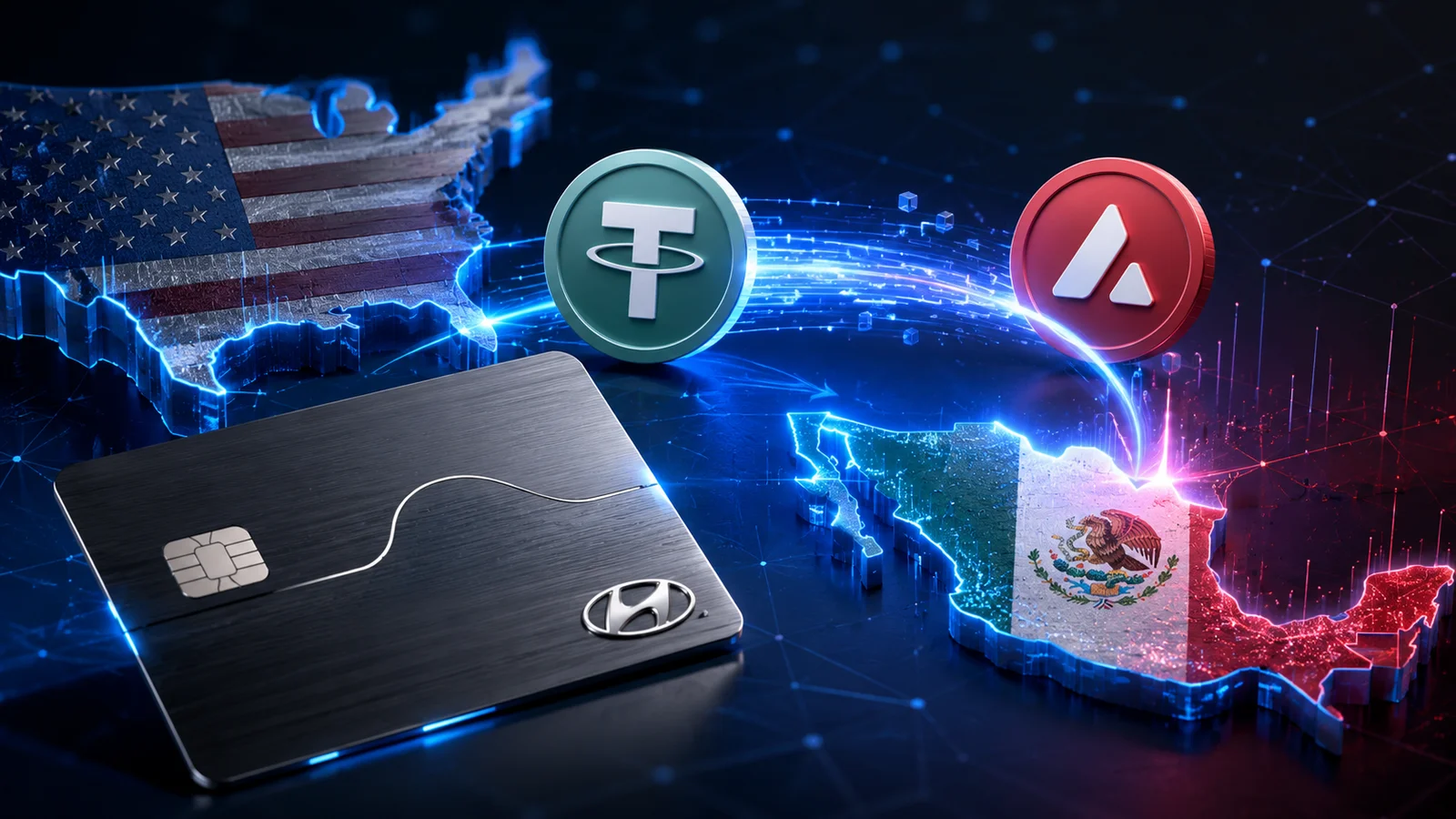
Hyundai Card has completed the first phase of a cross-border stablecoin remittance test carried out in cooperation with Tether and Avalanche. According to the announcement made on Thursday, the test was not conducted on paper. It involved a real money transfer between Hyundai Motor’s U.S. and Mexico units.Hyundai Motor America converted a $20,000 amount into USDT on the Avalanche network. The amount was then sent to the Mexico office and converted back into dollars there. The transaction took about seven minutes. The same transfer would take three to four hours if processed through traditional interbank channels.In traditional cross-border transfers, this delay is usually caused by the transaction passing through multiple intermediary banks. Each intermediary bank carries out its own control and settlement process, which extends the total transfer time. In a stablecoin-based transfer, the number of intermediaries decreases because the transaction takes place directly on the blockchain.Hyundai Card emphasized that the test was not a theoretical trial and was designed around a real settlement need between the company’s overseas units. The company handled the regulatory review, legal and tax checks, and the design of the remittance structure itself. Blockchain payment infrastructure company Axiym also took part in the process.Hyundai Card is one of South Korea’s leading credit card companies and operates under Hyundai Motor Group. The company’s test came at a time when Korean financial institutions are increasing their experiments with blockchain infrastructure. As a similar example, KB Card had also carried out a stablecoin-focused project with Avalanche in recent months.Second Test in EuropeHyundai will launch a second test between its European units later this month. Visa and USDC issuer Circle will also participate in this round.In the second test, real stablecoin transfers will be tested using various local currencies besides the dollar. The goal is to see how much cost advantage stablecoin-based money transfers can provide.While USDT and the Avalanche network were preferred in the first test, the involvement of Circle’s USDC and Visa’s payment infrastructure in the second phase shows that Hyundai Card wants to test different stablecoin and network combinations. This will allow the company to compare which infrastructure is more suitable at an institutional scale using its own data.Institutional stablecoin use has recently attracted growing interest in sectors such as automotive, retail and logistics. For companies, the main appeal is cost as much as speed. In the traditional banking system, commissions and foreign exchange costs can accumulate even in intra-group transfers. Hyundai Card’s two-phase test approach aims to measure these costs with concrete data.The company will decide in the coming period whether to open stablecoin-based payment infrastructure to broader use based on the results of the PoC process.
Coinbase Suspends Trading for 5 Altcoins, Adds 1 Altcoin to Its Roadmap
Coinbase announced that it will suspend trading for IDEX, Loopring (LRC), Omni Network (OMNI), Pirate Nation (PIRATE), and StaFi (FIS). On the same day, the exchange added the GRVT token to its listing roadmap.Countdown Begins for Five TokensCoinbase Markets will suspend spot trading for five assets on August 7, 2026, at around 2:00 p.m. ET. The exchange described the move as the result of a routine review, but did not specify which criteria each asset failed to meet. The market reaction was not evenly distributed. StaFi (FIS) and Pirate Nation (PIRATE) fell by more than 20%, while LRC and OMNI dropped between 10% and 15%. IDEX, however, did not see a sharp move. In low-volume tokens, it is not surprising that selling pressure is reflected in prices more quickly.There is also a separate detail on the Loopring side. Shortly before Coinbase’s announcement, the project shut down its own decentralized exchange, Loopring DEX, citing low usage. The two developments came back to back, and part of the decline in LRC likely stems from this.Coinbase stated that the suspended tokens will remain in users’ wallets and that withdrawals will not be blocked. Orders will move to limit-only mode: market orders will be disabled, users will only be able to place and cancel limit orders, and matching orders will still be executed.GRVT Added to the RoadmapOn the same day, Coinbase added the GRVT token to its official listing roadmap. GRVT is a hybrid derivatives exchange built on zkSync infrastructure, offering self-custody. It aims to combine the speed of a centralized exchange with the transparency of decentralized finance, while enabling trading without gas fees. The GRVT token was launched after the second season ended in late June 2026. Its total supply is fixed at 1 billion tokens, while the community and airdrop allocation was increased to 28%. The token unlocks membership benefits such as trading fee discounts, margin efficiency, and priority access to investment vaults.The platform’s growth figures also appear to support the listing decision. During its second season, GRVT’s total value locked (TVL) rose from $11.3 million to $107.1 million, marking an 847% increase. Open interest climbed to $484.1 million, while cumulative two-sided trading volume reached $393 billion. In January 2026, monthly trading volume rose to $51.6 billion, while the number of active users increased by 76% to more than 10,000. This picture summarizes GRVT’s transformation from a niche perp DEX into a platform that caught Coinbase’s attention.Being added to the roadmap does not automatically mean a listing. However, GROVE, which was added to the same list last week, gained more than 25% after spot trading opened. A similar scenario is expected for GRVT.Coinbase also shared GRVT’s Ethereum network (ERC-20) contract address: 0xAD29F2723fcdBcF665F210F25E06f97477e417cF.
What Is Turtle (TURTLE)?
DeFi yield opportunities often appear scattered, technical, and difficult to follow. Turtle aims to bring liquidity providers, protocols, and the distribution channels that deliver these opportunities to users under one structure. The TURTLE token is positioned as the crypto asset that plays a role in governance, incentives, and network participation within this ecosystem.Turtle’s Definition and OriginTurtle operates as a distribution protocol that connects DeFi yield opportunities with different platforms and users. In its official documentation, the project is described as a three-sided marketplace that matches yield opportunities with the wallets, exchanges, neobanks, and other platforms that distribute them. On the other side of this structure are protocols looking to attract liquidity.In this model, Turtle does not work merely like a yield dashboard. The protocol links which user provided liquidity to which opportunity through which distribution channel on-chain. This allows distributors that bring liquidity to earn revenue share, while protocols pay only for the liquidity that is actually provided.TURTLE is the token of the Turtle ecosystem. According to Binance Research, TURTLE is listed as an ERC-20 token that represents participation in Turtle Protocol and is used in the network’s governance and incentive mechanisms. The token appears to have been designed especially to support alignment between the protocol’s liquidity distribution network, the community, and stakeholders.Which network does it run on?The official contract page for TURTLE shares addresses on Ethereum, BNB Smart Chain, and Linea. The same page also includes addresses for sTURTLE, the staking contract, CCIP bridge pool, DAO multisig, and Governor. This shows that the token is handled together with multi-chain usage and governance infrastructure.The project’s launch purposeTurtle’s launch purpose is to make liquidity distribution in DeFi more traceable and more efficient. In traditional liquidity mining campaigns, protocols often allocate large incentive budgets. However, it is not always easy to measure whether this budget goes to lasting liquidity or to short-term yield-seeking capital.Turtle tries to solve this problem with an attribution model. When a user deposits into a vault, this transaction is recorded on-chain together with the identity of the distributor that referred the user. This allows the protocol to see the source of incoming liquidity; the distributor can also receive revenue share based on the TVL it brings.The project’s documents also emphasize that user assets are not held by Turtle. The user signs the transaction from their own wallet, the funds go to the selected vault contract, and Turtle does not provide custody during this process. This structure places the project closer to a distribution and coordination layer than to a centralized yield platform.Turtle’s History: Key MilestonesTurtle’s early phase took shape around a structure that connected liquidity providers with specific DeFi opportunities. According to the Binance Research roadmap, Turtle’s MVP launch began in the second quarter of 2024. During this period, the project moved forward with its dashboard and Deals Boost product in the first stage, called the “bootstrap phase.”At the center of this first model was the goal of attracting more efficient liquidity to protocols and offering better-structured opportunities to liquidity providers. Turtle aimed to make opportunities that large liquidity providers could access available to a broader user base. For this reason, the project is positioned differently from a classic DEX or lending protocol.By 2025, Turtle v1 and then the v2 process came to the forefront. According to Binance Research, the new dashboard, app, and brand design were introduced in the first half of 2025. In the second half of 2025, products such as the Leaderboard, Portfolio Page, Discovery Page, Earn Widget, Turtle API, and partner analytics were introduced for the first time within a broader structure.Listings and developmentsOne of the most visible developments on the TURTLE token side was Binance’s HODLer Airdrops announcement. In October 2025, Binance announced the HODLer Airdrops program for TURTLE and stated that 10 million TURTLE rewards, equal to 1% of the maximum total supply, had been allocated under this program.After the token entered the market, it began trading on different platforms such as Gate, KuCoin, Binance, MEXC, and Uniswap.The project also attracted attention on the funding side. It was announced that Turtle received an additional $5.5 million investment in October 2025, bringing its total funding to $11.7 million. The same announcement stated that Turtle had reached more than 358,000 connected wallets and over $5.5 billion in routed liquidity.Current statusToday, Turtle positions itself as an on-chain liquidity distribution infrastructure. On the official website, product-side features such as opportunity discovery, analysis, investing, monitoring, and position management stand out. The project aims not only to help users find DeFi opportunities, but also to follow risk and performance in a more organized way.As of July 2026, the TURTLE coin price is hovering around $0.03. How Does the TURTLE Token Work?The main use case of the TURTLE token is built around governance and ecosystem participation. According to the official governance documentation, users can stake TURTLE and receive sTURTLE. sTURTLE holders can either vote directly or delegate their voting power to another delegate.This structure shows that the token is designed not only as a market asset that can be bought and sold, but also as a tool that can play a role in protocol decisions. It is stated that issues such as treasury management, protocol direction, and integrations may be influenced through the governance process. However, the governance structure may take time to mature, and its practical impact depends on community participation.There is also an additional use case on the staking side. According to the official documentation, users can stake TURTLE and receive up to a 10x boost on the Turtle Shells leaderboard. This boost is applied linearly based on the ratio between the value of staked sTURTLE and the value of the user’s position in certain opportunities.The Turtle team also states that token use cases may expand in the future. In the documentation, broader access to liquidity opportunities, fee discounts, yield boost mechanisms, buyback or redistribution models, and advanced staking layers are listed among possible future use cases. These should not be read as currently guaranteed features, but as areas that may develop depending on governance and ecosystem decisions.Supply and token economyTURTLE’s maximum and total supply is announced as 1 billion tokens. Binance Research gives the initial circulating supply during the Binance listing process as 154.7 million TURTLE. This corresponds to 15.47% of the total supply.On the official tokenomics page, the supply distribution is divided into several main categories. Private rounds, meaning investor rounds, receive 27.50% of the supply; the airdrop receives 12.10%; and the team, advisors, and contributors receive 23.10%. Liquidity, market makers, and exchange reserves account for 8.00%, while the ecosystem and community category stands out as one of the largest allocations with 29.30%. On the vesting side, investor tokens have a 6-month cliff and a 36-month linear unlock. The team, advisors, and contributors have a 12-month cliff and again a 36-month linear vesting schedule. On the airdrop side, a claim and partial linear unlock mechanism is used. This structure makes two points important for investors. First, there is a significant gap between circulating supply and total supply. Second, future token unlocks may create pressure on the price. This situation is not unique to TURTLE; similar risks exist for many tokens that enter the market with a low circulating supply ratio.Network, transaction, and security structureTurtle’s security approach is divided into several layers. According to the official documentation, Turtle does not custody user assets, does not access private keys, and does not have the authority to move or freeze user funds. The user signs through the interface where the transaction is created, while the assets go directly to the selected vault contract.Turtle runs opportunities through a review process before adding them to its catalog. This review covers areas such as technical risk, smart contract risk, operational risk, and curator assessment. The project also states that featured vaults undergo independent solvency checks, while some smart contracts are audited by independent security firms.Still, these mechanisms do not completely remove risk. DeFi vaults, bridges, incentive campaigns, market volatility, and third-party protocols can carry different risks. Turtle mainly acts here as an infrastructure layer that reviews, distributes, and attributes opportunities. The selected vault’s own contracts and risk profile should also be assessed separately.Attracting liquidity in DeFi is an expensive and complex process. When a protocol launches a new product, starts an ecosystem campaign, or wants to grow TVL, it usually allocates an incentive budget. However, it is not easy to measure whether these incentives reach the right users, whether they create lasting liquidity, and which channel actually delivers results.This is where Turtle’s core problem area appears. The project makes the relationship between liquidity providers and protocols more data-driven. Recording which distributor each deposit came through helps measure campaign performance more transparently.This model also opens a new revenue area for distributors. Wallets, exchanges, or different platforms can offer DeFi yield opportunities to their own users through Turtle Earn integration. If those users provide liquidity to a vault, the distributor can earn revenue share based on the TVL it brings.Its place in the ecosystemTurtle does not directly fit into one of the classic protocol categories in DeFi. It is not a lending protocol, DEX, stablecoin project, or only a yield aggregator. It works more like a distribution and attribution infrastructure that organizes liquidity flow between these areas.From this perspective, Turtle’s place in the ecosystem can be summarized as a coordination layer between capital owners and protocols seeking capital. Protocols can create campaigns through Turtle, distribution partners can deliver these opportunities to their own users, and liquidity providers can access pre-reviewed vaults.The project’s official announcements refer to ecosystem campaigns such as Avalanche, Katana, Linea, and TAC. Binance Research also lists Avalanche, MetaMask, Binance, and more than 60 protocol integrations among business developments. These types of partnerships support Turtle’s goal of becoming an infrastructure that works not only for individual users, but also at the protocol and ecosystem level.Turtle’s Community and EcosystemOn its official website, Turtle lists Essi as Founder & CEO and Nick as Founder & CTO in the team section. The same page also includes different team members working across CMO, COO, business development, product, liquidity desk, and marketing roles. The press release also identifies Essi Lagevardi as CEO. Since Nick’s surname is not clearly stated on the official homepage, this guide uses only the naming provided on the official website. The team structure shows that Turtle is building not only a technical product, but also a model that grows through business development and liquidity relationships. This is because the project’s success does not depend only on contracts working properly. Agreements with protocols, integrations with distribution partners, and relationship management with liquidity providers also play important roles.On the investor side, Turtle has a fairly broad list of backers. The official website and press releases refer to SIG, Amber, Consensys, FalconX, GSR, Flowdesk, Theia, Trident Digital, and different crypto investors. This support shows that the project has gained visibility on the institutional and professional liquidity side; however, investor backing alone does not mean guaranteed success.Community and governanceOne of the most important community-side topics for TURTLE was the Genesis Airdrop process. According to the official documentation, airdrop eligibility was determined through wallets that made real and measurable contributions to the Turtle ecosystem. It was stated that Sybil and bot activity were filtered, while verification was carried out through on-chain data and partner payouts.The airdrop mechanism is not based only on passive NFT ownership. The documents state that users with an NFT or Discord role also had to make measurable contributions to the DAO. Some campaigns, leaderboard rankings, and referral activities were also included in the distribution scope.On the governance side, TURTLE holders stake their tokens and receive sTURTLE. To vote, sTURTLE must be delegated. The official documents also explain parameters such as proposal threshold, quorum, voting delay, and voting period. This structure shows that the Turtle DAO may gradually play a more visible role in protocol decisions.Partnerships and use casesTurtle’s partnerships are shaped around liquidity campaigns, ecosystem integrations, and distribution partnerships. The official press release highlights campaigns such as TAC, Linea Ignition, Katana, and Avalanche. These campaigns aim to show Turtle’s capacity to gather and direct liquidity around specific goals across different networks.Turtle Earn is one of the important products on the distribution side. Through this structure, wallets, exchanges, or other platforms can integrate Turtle opportunities into their own interfaces. Turtle API documentation also states that products such as Earn, Streams, and portfolio data can be used through a single REST API.On the use case side, Turtle’s focus stands out as DeFi yield, liquidity campaigns, vaults, incentive distribution, revenue share, and governance. The TURTLE token is associated with functions such as decision-making, staking, boost, and contribution incentives within this ecosystem. However, the impact of all these functions will become clearer over time depending on the protocol’s level of usage.Frequently Asked Questions (FAQ)Below, we have included some frequently asked questions and answers about Turtle:What is Turtle, and when did it launch?: Turtle is a liquidity distribution protocol that connects DeFi yield opportunities with liquidity providers and distribution channels. According to the Binance Research roadmap, Turtle’s MVP launch began in the second quarter of 2024. Throughout 2025, the project moved into a broader structure with products such as the dashboard, Earn, API, leaderboard, and partner analytics.What is the TURTLE token used for?: The TURTLE token is a crypto asset used for governance and participation within the Turtle ecosystem. Users can stake TURTLE to receive sTURTLE, delegate their voting power to themselves or another delegate, and participate in the governance process. The token is also associated with staking boosts and ecosystem incentives.Which network does Turtle run on?: According to the official contract page, the TURTLE token exists on Ethereum, BNB Smart Chain, and Linea. The same page also shares addresses for staking, the bridge pool, DAO multisig, and Governor contracts. Turtle’s product infrastructure aims to provide access to yield opportunities and vaults across different EVM networks.Who is the founder of Turtle?: On the official Turtle website, Essi is listed as Founder & CEO, while Nick is listed as Co-Founder & CTO. Turtle’s October 2025 press release states that the CEO is Essi Lagevardi. Since Nick’s surname is not clearly given on the official homepage, this information should not be presented as fully confirmed.What is the TURTLE supply?: TURTLE’s maximum and total supply is announced as 1 billion tokens. Binance Research gave the circulating supply at the time of listing as 154.7 million TURTLE. On the official token economy page, 27.50% of the supply is allocated to investor rounds, 12.10% to the airdrop, 23.10% to the team and contributors, 8.00% to liquidity and exchange reserves, and 29.30% to the ecosystem and community category.Is Turtle suitable for investment?: Turtle presents a notable model in the DeFi liquidity distribution field. However, TURTLE is a crypto asset with a low market capitalization, high volatility, and future token unlocks. For this reason, any investment decision should consider the price chart, supply unlocks, real usage, liquidity conditions, project revenues, and personal risk profile together. This guide is not investment advice.Follow the JR Kripto Guide series for the latest information about Turtle and new projects in the crypto ecosystem.

Vanguard, Managing $12 Trillion, Builds Crypto Department
Vanguard, the world’s second-largest asset manager, has started looking for an executive who will build its cryptocurrency strategy from the ground up. According to a job posting published on the company’s careers page on July 6, the role will be responsible for creating a digital asset roadmap for Vanguard’s personal wealth management clients.For the company, which manages a $12 trillion portfolio, this marks the first example of a senior-level appointment specifically focused on crypto. The posting was listed under job code 179858 and offers a hybrid working model across Vanguard’s Malvern, Dallas, Scottsdale and Charlotte offices. Executive Will Engage With RegulatorsThe person hired for the role will work as a senior subject matter expert on digital assets within Vanguard’s personal wealth division. The scope of responsibility will not be limited to product development. Risk management and communication with regulatory authorities will also be part of the job description. According to internal sources, the executive’s main goal will be to build a scalable, end-to-end strategy.The move stands in contrast to Vanguard’s previous stance on crypto. When spot Bitcoin ETFs launched in January 2024, the company did not allow these products to be traded on its own platform. For a long time, executives described crypto assets as speculative.Shift Began After New CEO Took OverThe picture changed in December 2025. Vanguard opened its platform to third-party crypto ETFs and mutual funds. The decision gave more than 50 million brokerage clients access to funds that include Bitcoin, Ethereum, XRP and Solana.Behind this shift was Salim Ramji, who became CEO in July 2024 and was the first person appointed to lead the company from outside Vanguard. Ramji previously ran BlackRock’s iShares unit, which launched the iShares Bitcoin Trust. That fund had reached nearly $54 billion in assets under management as of March 31. Vanguard also became the largest shareholder of Strategy, the biggest Bitcoin treasury company, last year.No Plan Yet for Its Own ETFStill, Vanguard has not yet filed for its own crypto ETF. The company’s published investment guidance continues to prioritize assets with transparent cash flows and offers crypto exposure only through third-party products, similar to gold. BlackRock and Fidelity, meanwhile, operate their own spot Bitcoin funds. Competition among issuers has pushed fee rates down to as low as 0.14%.Client demand is also supported by concrete data. U.S.-based spot Bitcoin ETFs reached $74.37 billion in net assets as of July 2. On the same day, the funds recorded $221.72 million in inflows after a 10-day outflow streak. At the time of writing, total net assets had risen to $77.32 billion.

Binance Delists Five Trading Pairs as 10 New Assets Enter Collateral List
Binance published two separate announcements today. While the exchange said it will remove five low-volume spot trading pairs on July 10, it also added 10 new bStocks tokens as collateral assets in margin accounts.Five spot pairs to be removed on July 10Binance announced that it will remove five spot trading pairs from the platform following its periodic review process. The decision will take effect on July 10, 2026, at 06:00 TRT.The pairs to be delisted are GMX/USDC, PARTI/FDUSD, RUNE/BTC, SEI/BTC and T/USDC. Binance cited low liquidity and weak trading volume in these pairs as the reason for the decision. The removal of a trading pair does not mean that the relevant token is being fully delisted from the exchange. GMX, PARTI, RUNE, SEI and T will remain listed on Binance; users will still be able to buy and sell these assets through other trading pairs already available on the platform.There is also a separate warning for users running Spot Trading Bots on the affected pairs. Binance will terminate bot services linked to these pairs at the same time, on July 10 at 06:00 TRT. The exchange urged users to update or cancel their bots before the deadline to avoid potential losses.10 bStocks tokens added as margin collateralOn the same day, Binance issued a second announcement. The exchange added 10 new bStocks tokens to the list of collateral assets available for Cross Margin, Portfolio Margin and Portfolio Margin Pro accounts. The change went into effect on July 7, 2026, at 16:30 TRT.The newly added tokens include Alphabet (GOOGLB), Qualcomm (QCOMB), Coinbase (COINB), State Street SPDR S&P 500 ETF Trust (SPYB), Western Digital (WDCB), Corning (GLWB), Nebius (NBISB), Semicon Bull 3X ETF (SOXLB), Roundhill Memory ETF (DRAMB) and Cerebras (CBRSB). The corresponding bStocks trading pairs for these tokens were also opened for margin trading.For now, these 10 assets can only be used as collateral, while borrowing is not supported. The feature is also not available to everyone. Only users at VIP 3 level or above, and in permitted regions, can use these assets as collateral.bStocks is Binance’s tokenized stock product offered under a prospectus approved by ADGM, the Abu Dhabi Global Market. These products are offered only within the scope of ADGM and are not publicly offered in any other jurisdiction. Access to tokenized securities is available only to eligible users in permitted regions and only through the secondary market.

$20 Million Attack on BONK: 3 Exchanges Start Investigate
The decentralized governance structure of BONK, a Solana-based meme coin project, became the target of a notable attack in the crypto market. Around $20 million worth of BONK tokens were removed from the BONK DAO treasury. The most striking part of the incident was that the funds were not moved through a classic hack, but through the project’s own onchain governance system.The incident reopened the debate around the security of decentralized autonomous organizations. The attacker did not force their way into the system or break the code by exploiting a smart contract vulnerability. Instead, they bought enough voting power, submitted a proposal, passed the vote and enabled the treasury transfer to be executed automatically.This exposed a long-discussed weakness in onchain governance models. If a DAO treasury can be controlled by an actor who temporarily secures a majority, its security depends not only on technical infrastructure but also on the cost of buying voting power.The Attack Came After a Week of PreparationThe process dates back to June 30. According to information cited by Chainalysis, an anonymous wallet submitted a proposal to transfer the BONK DAO treasury’s tokens to an address under its own control. For the proposal to take effect, it had to meet a minimum participation threshold equal to 1% of BONK’s supply.This threshold became the central point of the attack. It was not enough for the attacker to submit the proposal; they also needed enough BONK tokens to pass the vote. For this reason, the attacker began accumulating a large amount of BONK from the market through a different wallet on July 4 and 5.According to Lookonchain data, the attacker spent around $4.4 million on Bybit and Binance to purchase enough BONK. Some estimates suggest that additional funds were also obtained through DeFi lending platforms. As a result, the attacker built voting power almost exactly at the level needed to pass the proposal.Seven Wallets Voted, More Than 18,000 Members Did Not ParticipateThe proposal, titled “BIP #76 - Sowellian BonkDAO,” passed with very low participation. Only seven wallets voted in the process. By contrast, more than 18,000 BONK DAO members did not take part in the vote.The turnout remained at 2.9%. Despite this, the proposal cleared the minimum participation threshold, known as quorum, by a very narrow margin. The number of votes in favor reached 882.38 billion BONK. The required threshold stood at 879.95 billion BONK.This margin almost exactly matched the voting power the attacker had accumulated over several days. The final result showed 99.9% “yes” votes. However, this high approval rate reflected a single powerful actor approving its own proposal rather than a broad community consensus.The proposal text also drew attention. It included phrases about restructuring the treasury, using assets to generate revenue and stopping losses. It also stated that “yes” voters would be eligible to receive tokens. However, the real outcome of the proposal was the transfer of 4.43 trillion BONK to the attacker’s wallet.The $20 Million Transfer Was Executed AutomaticallyOn July 6, the attacker used their entire voting power in favor of the proposal. After the proposal passed, around $20 million worth of BONK tokens were automatically transferred from the DAO treasury to the attacker’s wallet.At this point, no manual approval process came into play. Due to the design of the onchain governance system, the proposal was executed directly because it met the required conditions. This also showed why the attack was so technically controversial.According to Chainalysis, around $188,000 worth of assets were sent to an exchange roughly nine hours after the transfer. This transaction was likely intended for cashing out. The remaining assets, worth around $19 million, were moved to a multisig wallet.The attacker also began selling the BONK tokens they had accumulated to carry out the attack. Around one hour after the treasury was drained, they sold approximately $5.3 million worth of BONK. In this way, the attacker offloaded the tokens used to gain voting power while keeping the treasury tokens in a separate wallet.South Korean Exchanges Launch BONK ReviewFollowing the attack, risk perception also rose quickly in the South Korean market. The country’s three major crypto exchanges, Upbit, Bithumb and Coinone, placed BONK on their review lists. This decision means the exchanges may reassess their trading support for the token following the security incident.BONK Price Came Under PressureBONK also saw a price decline after the attack. According to available data, the token lost around 7% over the past 24 hours. This drop reflected both the confidence shock caused by the treasury loss and the attacker’s market sales. BONK DAO later confirmed the incident. The project team described it as a malicious governance proposal that drained the treasury. In its statement, the DAO said it had identified the exchange wallets used to purchase tokens before the vote.BONK DAO also said it was working with exchanges, bridge protocols and the Solana Foundation to manage the situation. It remains unclear how the legal and technical follow-up process will unfold.
What Is Giggle Fund (GIGGLE)?
Some crypto projects enter the market with ambitious technology promises, while others stand out with a strong story. Giggle Fund sits closer to the second group. GIGGLE is a cryptocurrency built on BNB Chain that combines meme coin culture with the idea of supporting children’s education through donations, while growing through community interest.Giggle Fund’s Definition and OriginsGiggle Fund (GIGGLE) is a donation-focused meme coin project built on BNB Smart Chain. Its core idea is based on directing part of GIGGLE transaction activity toward Giggle Academy to support children’s education. According to CoinMarketCap’s project summary, GIGGLE is designed around a structure that aims to turn a share of each transaction into an education donation.In this sense, Giggle Fund differs slightly from the classic meme coin narrative. Many meme coins gain value mainly through community interest, social media visibility and speculative trading volume. GIGGLE, however, positions itself around a social impact theme. Still, this does not make GIGGLE a low-risk asset or a token with strong fundamental value.GIGGLE still belongs to the meme coin category. That means its price action can be highly volatile. The project’s value can change quickly depending on community interest, exchange listings, trading volume, the donation narrative and the broader market mood.At the center of Giggle Fund is the idea of “creating donations through transactions.” As users buy and sell GIGGLE, the system directs a certain percentage into the donation mechanism. This structure aims to turn the high trading volume often seen in the meme coin market into social impact.BNB Chain connectionGIGGLE operates on BNB Smart Chain as a BEP-20 token. This network has become one of the commonly used chains for meme coin projects thanks to its low transaction fees and fast transfers.Choosing BNB Chain helps GIGGLE keep transaction costs relatively low. This becomes especially important in the meme coin market, where frequent buying and selling are common. When transaction fees are high, it becomes harder for smaller investors to enter the market.GIGGLE’s presence on BNB Chain also makes it easier to track donations on-chain. Users can examine token movements, the contract address and transfer history through blockchain explorers. GIGGLE’s BEP-20 token page is available on BscScan.However, on-chain visibility does not mean the project is risk-free. The fact that token transfers can be tracked does not guarantee that the price will be sustainable or that the project will remain successful in the long run. Market interest can shift very quickly, especially in meme coins.Giggle Academy distinctionOne of the most important points to understand about Giggle Fund is its relationship with Giggle Academy. Giggle Academy is introduced as a free online education platform founded by former Binance CEO Changpeng Zhao, also known as CZ. The platform aims to provide free and gamified educational content for children.However, the GIGGLE token is not an official token issued by Giggle Academy. In a statement made in November 2025, Giggle Academy said that the Giggle Fund token was not issued by the academy and that it was a community-launched meme coin.This distinction matters. Although GIGGLE’s donation narrative is built around Giggle Academy, the token should not be seen as the academy’s official cryptocurrency. Giggle Academy accepts donations, but it does not position GIGGLE as a token it created.For this reason, investors should be careful with claims such as “CZ-backed official token.” Giggle Fund can be described as a community-driven meme coin that generates donations for Giggle Academy. Presenting it as Giggle Academy’s official token would be misleading.Giggle Fund’s History: Key MilestonesGiggle Fund emerged in 2025 as one of the new-generation meme coins in the crypto market. Coinbase’s asset page states that GIGGLE was launched in 2025 and operates on BNB Smart Chain.The project initially started as an anonymously launched meme coin. Later, the “community takeover” narrative came to the forefront.This process resembles a model often seen in the meme coin market. In some projects, the initial development team steps back or does not reveal its identity. Early investors and community members then take over the project’s social media presence, marketing and overall narrative.GIGGLE follows a similar community story. The project presents itself with a simple community-driven message such as “by the people, for the people.” This type of messaging creates an identity that can spread quickly among meme coin investors.Community takeoverCommunity management plays an important role in Giggle Fund’s development. CoinMarketCap’s project description states that after its anonymous launch, GIGGLE came under the management of a CTO team formed by early investors. In this context, CTO does not mean “chief technology officer”; in the meme coin market, it refers to “community takeover.”A community takeover shows that the project relies more on volunteer or semi-organized community work than on a formal company structure. This can appeal to some investors. Instead of a centralized company, community energy and social media attention move to the front.However, the same structure also brings serious uncertainty. An anonymous or semi-anonymous team can raise questions around accountability. The project’s sustainability depends heavily on community interest, social media visibility and trading volume.Giggle Fund’s donation model offers a different narrative at this point. The community does not only support the project for price appreciation, but also for its contribution to education donations. Still, this narrative alone should not be seen as enough when making an investment decision.Binance listingOne of the most important milestones for GIGGLE was its Binance listing. In its announcement dated October 24, 2025, Binance said it would open spot trading for Giggle Fund (GIGGLE) and SynFutures (F) on October 25, 2025, at 06:00. Trading pairs included GIGGLE/USDT, GIGGLE/USDC and GIGGLE/TRY.The Binance listing significantly increased GIGGLE’s visibility. Meme coins listed on major exchanges can reach a much broader investor base. Liquidity rises, trading volume increases and price movements attract more attention.However, Binance used a Seed Tag for GIGGLE. Seed Tag is generally used for newer, more volatile and higher-risk projects.Binance later announced separate donation support related to GIGGLE trading fees. According to the statement dated November 3, 2025, Binance planned to donate 25% of the trading fees generated from GIGGLE spot and margin trades to support Giggle Academy starting from December 2025. Source: Binance This development made GIGGLE’s donation side more visible. Still, the distinction needs to remain clear. Binance’s donation decision does not mean GIGGLE was issued by Giggle Academy. Giggle Academy also emphasized that the token was community-driven.By July 2026, Giggle Academy had released its 1.33.0 update, adding new features such as the Top Learners Leaderboard, Feature Plaza, course localization and a translation switch. The update also brought improvements to the login process, voice recognition, rewards experience, interface performance and overall stability. How Does the GIGGLE Token Work?GIGGLE’s most discussed feature is its donation mechanism. According to CoinMarketCap, the token applies a 5% tax on buy and sell transactions and converts this share into BNB before directing it to Giggle Academy’s donation wallet.The goal of this system is to turn trading volume into an automatic source of donations. In other words, the more the token is traded, the more funds may flow into the donation pool. This model tries to connect the speculative energy of the meme coin market with education funding.The donation mechanism separates GIGGLE from many other meme coins. Normally, trading volume in meme coins matters mostly to traders, market makers and exchanges. In GIGGLE’s case, volume also turns into a funding channel that supports children’s education, according to the project’s narrative.Transaction fee modelGIGGLE’s transaction model is built around a tax applied to buys and sells. According to CoinMarketCap data, this tax is set at 5%, while wallet-to-wallet transfers are reportedly not taxed.This model creates a two-sided effect. On one hand, it keeps the donation mechanism active. On the other hand, it increases entry and exit costs for short-term traders.In the meme coin market, investors often trade quickly. For this reason, transaction tax becomes important, especially for users trading on shorter time frames. The investor needs the price to rise not only above the purchase level, but also enough to cover transaction costs.GIGGLE’s system aims to make donations through BNB. This choice carries the claim that it reduces additional sell pressure linked to the project constantly selling its own token. Still, market price action continues to depend on liquidity, demand, broader risk appetite and meme coin trends.Burns and transparencyToken burns also stand out as part of the Giggle Fund narrative. CoinGecko states that the project participates in transparent token burn events supported by transaction fees and that these transactions are recorded on the blockchain.A token burn refers to permanently removing part of the circulating supply from use. Crypto projects generally use this method to reduce supply and support token economics.In GIGGLE’s case, the burn mechanism moves together with the donation narrative. After Binance’s donation support, Giggle Academy’s plan to burn half of the GIGGLE trading fees it received and convert the remaining half into BNB also came into focus. According to Bitget’s report, Giggle Academy announced this step for transparency and accountability.Why Is Giggle Fund Important?Giggle Fund’s importance does not come only from being a new meme coin. The project has become an example showing that meme coin culture is no longer limited to jokes, communities and price movements.In recent years, meme coins have become one of the fastest-spreading areas of the crypto market. After early examples such as Dogecoin and Shiba Inu, many new meme coins appeared on Solana, Base and BNB Chain. Most of these projects grew entirely through community narratives and viral attention, without offering a strong technical product.GIGGLE adds a social impact layer to this picture. The token uses the “meme + donation” idea to move investor interest onto a more emotional ground.Social impact narrativeGiggle Fund’s social impact narrative is shaped around Giggle Academy. Giggle Academy is presented as a platform that aims to offer free online education for children. Its official website includes storybooks, songs, language learning content, basic literacy materials and learning resources for children.This connection strengthens GIGGLE’s story. Education is a social cause that can gain broad acceptance in the crypto world. In addition, Giggle Academy being founded by a well-known industry figure such as CZ gives the project indirect visibility.However, the official relationship issue appears again at this point. Giggle Academy has clearly stated that it did not issue GIGGLE. Therefore, GIGGLE should not be described as Giggle Academy’s official financing tool. A more accurate expression would be “a community-launched meme coin that aims to send donations to Giggle Academy.”According to market data, GIGGLE reached an all-time high above $274. Binance’s price page also shows an all-time high above $281 for GIGGLE. As of July 2026, the GIGGLE coin price trades far below that peak, around $28. Giggle Fund’s Community and EcosystemGiggle Fund’s ecosystem is more community-centered than a classic company or foundation structure. The identity of the project’s original developer is not clearly known. It is reported that the original developer remains unknown and that the name “Giggloshi” is used in the project.This type of anonymity is common in meme coins. For some projects, it is considered part of the culture. From an investor’s perspective, however, an anonymous team creates additional risks around trust and responsibility.The advantage of community management is its ability to move quickly. Social media campaigns, exchange applications, meme production and community activities can be organized in a short time. GIGGLE also tries to combine this energy with its donation narrative.On the other hand, the project may lose momentum if community interest weakens. In meme coins, if technical development or revenue models are limited, keeping the narrative alive becomes even more critical. For GIGGLE, community strength appears as both one of its biggest advantages and one of its biggest vulnerabilities.Education-focused donationsGIGGLE’s ecosystem narrative revolves around education-focused donations. The project aims to turn trading volume into a funding source for Giggle Academy. As of March 2026, there is information that more than 11,500 BNB had been generated through GIGGLE’s donation mechanism.This figure is notable because it shows that meme coin trading volume can be used for social impact. However, donation amounts can change over time. When trading volume declines, donation flow may also decrease.Three elements stand out for the sustainability of the donation model. The first is trading volume. The second is community trust. The third is transparent reporting of donations.Giggle Academy’s plan to publicly share revenue and expenses is important for this reason. Users want to see whether donations are actually used for educational content, platform development or resources for children. If transparency weakens, the social impact narrative may also suffer.Frequently Asked Questions (FAQ)Here are some of frequently asked questions about Giggle Fund (GIGGLE):What is Giggle Fund and when was it launched?: Giggle Fund (GIGGLE) is a donation-focused meme coin built on BNB Smart Chain. The project launched in 2025 and attracted attention with its narrative of generating donations for Giggle Academy through transaction tax. Coinbase’s asset page also states that GIGGLE was launched in 2025 and operates on BNB Smart Chain.What does the GIGGLE token do?: The GIGGLE token is used as the tradable crypto asset of the Giggle Fund ecosystem. The project’s main mechanism is based on taking a certain share from GIGGLE buy and sell transactions and turning it into an education-focused donation. According to CoinMarketCap, this structure aims to convert the transaction share into BNB and send it to Giggle Academy’s donation wallet.Is Giggle Fund the official token of Giggle Academy?: No. Giggle Academy has stated that it did not issue the GIGGLE token and that the token was launched by the community as a meme coin. For this reason, GIGGLE should be seen as a community-launched token that aims to generate donations for Giggle Academy; it should not be presented as Giggle Academy’s official token.Which network does GIGGLE operate on?: GIGGLE is a BEP-20 token built on BNB Smart Chain. This structure allows transfers and some donation movements to be tracked on-chain.How does Giggle Fund’s donation mechanism work?: Giggle Fund’s donation mechanism is based on a transaction tax applied to buy and sell transactions. According to CoinMarketCap, GIGGLE transactions carry a 5% tax, and this amount is converted into BNB before being directed to Giggle Academy’s donation wallet.Follow the JR Kripto Guide series to stay updated on Giggle Fund and other social impact-focused meme coin projects.

$6 Million Attack Hits DeFi Protocol: Breach Detected
DeFi yield optimization protocol Summer Finance suffered a $6 million attack through an accounting flaw in its automated vault management system. The attacker used a $65.4 million flash loan to manipulate Fleet Commander’s asset calculation and secured a $70.9 million redemption. The protocol has not yet officially confirmed the incident.Attack on Summer FinanceAccording to on-chain analysts, DeFi yield optimization protocol Summer Finance was hit by a $6 million attack. Blockaid detected the breach early Monday morning. Security firms including Cyvers and CertiK later shared technical details of the incident. The protocol, also known as Summer.fi, automatically allocates and rebalances user deposits across various high-yield lending platforms through AI-powered keepers. These automated yield strategies have become more popular in DeFi recently. However, the complex smart contract structures that connect multiple protocols also create new attack surfaces for exploiters.How did the attack happen?According to Cyvers, the attacker targeted a share accounting flaw through price manipulation. The stolen $6 million was converted into the DAI stablecoin and transferred to an address controlled by the attacker. In these types of attacks, rapidly converting funds into stablecoins and moving them elsewhere is a common method used to make tracking more difficult.The details shared by CertiK show more clearly how the attack was structured. The attacker used a $65.4 million flash loan and manipulated how Summer.fi’s Lazy Summer Protocol calculated total assets in its vaults. As a result, the attacker managed to receive a $70.9 million redemption, withdrawing far more than the amount initially deposited into the system.According to CertiK, the attacker manipulated Fleet Commander’s totalAssets() calculation across multiple vaults, especially the Silo: Varlamore USDC Growth vault, where they had previously accumulated funds and made intermittent donations to Ark. This allowed the attacker to withdraw $70.9 million after making a $64.8 million deposit. Fleet Commander is defined as the smart contract that manages the vaults, while Ark is described as the contract that connects a vault to a lending protocol.Why did the flash loan mechanism work?Flash loans provide millions of dollars in unsecured liquidity, as long as the loan is borrowed and repaid within the same transaction. This allows attackers to temporarily disrupt a protocol’s pricing or accounting logic without needing large amounts of capital of their own.In this case, the attacker appears to have manipulated Fleet Commander’s total asset calculation for each vault through a real-time donation mechanism. This caused the system to think it held more assets than it actually did. As a result, the attacker was able to request a redemption amount that would not normally have been possible.These types of share accounting flaws are not new in DeFi. In vault-based protocols, total asset calculations often rely on price feeds or balance checks that can be manipulated externally. This continues to create repeated opportunities for attackers in similar scenarios.

Outflows Hit Bitcoin and XRP ETFs, While Ethereum and Solana See Inflows
The first trading day of July brought a mixed picture for spot crypto ETFs traded in the United States. While Bitcoin and XRP funds saw outflows, investors preferred to increase their positions in Ethereum and Solana. This divergence across the four assets suggests that investors entered July with mixed risk appetite. The size of the outflow from Bitcoin was especially notable, as it showed that the inflow trend seen in recent weeks had been interrupted, at least in the short term.Third Daily Outflow for BitcoinSpot Bitcoin ETFs closed July 1 with net outflows of $294.62 million. This marked one of the largest single-day outflows seen in recent weeks. Considering that institutional investors had largely added money to these funds throughout June, the pullback at the start of the month stood out. It is also worth noting that Bitcoin fell as low as $58,000 toward the evening yesterday. As shown in the chart below, the price move was sharp: Daily swings of this kind are not exactly new for the market. Since their launch, Bitcoin ETFs have experienced several similar days of sharp outflows, only to recover within a few days. Still, a figure approaching $300 million shows that short-term investors entered July with a more cautious stance.Ethereum Returns to Positive TerritoryEthereum ETFs recorded $14.89 million in net inflows on the same day. Unlike the outflows seen in Bitcoin, interest in Ethereum funds has remained relatively steady recently. This has also led to comments that some investors may be shifting their portfolios from Bitcoin toward Ethereum, although it is still too early to speak of such a rotation based on a single day of data.A Modest but Positive Picture for SolanaSolana ETFs ended the day with $521,000 in net inflows. The figure is small, but given Solana’s relatively new position in the spot ETF market, a consistently positive trend remains an important signal. Although total fund size is still far behind Bitcoin and Ethereum, the fact that daily flows have not turned negative shows that demand for Solana funds remains alive.Limited Outflow in XRPXRP ETFs saw net outflows of $1.86 million. This figure remains quite small compared with the outflow from Bitcoin and does not point to a trend reversal on its own.Looking at the broader picture for the day, the key takeaway is clear: some of the capital leaving Bitcoin and XRP funds was likely pulled from the market due to profit-taking or short-term risk reduction. The positive flows into Ethereum and Solana, meanwhile, show that interest in these two assets remains alive, at least for now.
What Is SynFutures (F)?
Futures trading in the crypto market remained largely the stronghold of centralized exchanges for a long time. When users wanted to trade with leverage, take positions against price declines, or try more active strategies, they mostly turned to platforms such as Binance, Bybit, or OKX. SynFutures is one of the projects that aims to bring this habit onchain. The protocol allows users to open perpetual futures contracts, meaning futures products with no expiry date, on different assets, create new markets, and provide liquidity, meaning they can add capital to trading pools and help those markets function.The F token aims to ensure that this structure does not remain limited to trading alone and gradually evolves into a more community-focused model. In this guide, we will look at what SynFutures is, what the F token does, how the project works, and why it stands out in the decentralized derivatives market.Definition and Origin of SynFuturesSynFutures is a DeFi protocol developed for decentralized derivatives trading. DeFi refers to financial applications that operate without the need for a central intermediary. SynFutures focuses on perpetual futures. These products differ from traditional futures contracts because they do not have a fixed expiry date. A user’s position can remain open as long as they do not close it, maintain enough collateral, and avoid liquidation.Thanks to this structure, users can take long or short positions on the price of an asset. A long position refers to a trade opened with the expectation that the price will rise. A short position represents the expectation that the price will fall. Since leverage can also be used, the trading experience is different from spot trading, meaning instant buying and selling, and carries higher risk. Leverage can increase potential gains, but it can also amplify losses at the same pace.SynFutures’ main claim is that it can open trading markets not only for major coins such as Bitcoin or Ethereum, but also for many assets that have price data. These assets may include altcoins, indices, real-world assets, or tokenized financial products. In this respect, the project highlights the idea of a “futures market for every asset.” This allows users to trade more niche assets onchain, including assets that are not always listed on centralized exchanges.At this point, it would be incomplete to think of SynFutures as a simple DEX. DEX stands for decentralized exchange and generally allows users to swap tokens with their wallets. SynFutures expands this experience with derivatives, leveraged trading, an order book, liquidity provision, and new market creation. The user is not only the trading side; they can also contribute to the functioning of certain markets by providing liquidity.On the technical side of SynFutures, the Oyster AMM model stands out. AMM stands for automated market maker, and instead of directly matching buyers and sellers, it allows trades to take place through liquidity pools. Oyster AMM also uses order book logic in addition to this classic model. An order book refers to a system where buy and sell orders are arranged according to price levels. In this way, SynFutures tries to combine the continuously available liquidity of an AMM with the more targeted trading experience of an order book.Another important topic in the perpetual futures structure is the funding mechanism. Since perpetual futures do not have an expiry date, the system uses funding payments to balance the difference between the trading price and the spot market price. This mechanism helps prevent the futures price from drifting too far away from the underlying asset price. SynFutures documents state that Oyster AMM uses a continuous funding mechanism for perpetual futures markets. The strongest side of this model is user control. On centralized exchanges, users deposit their funds into the platform account, and trades proceed through the exchange’s internal system. On SynFutures, users trade through their wallets, positions are managed by smart contracts, and much of the data can be tracked onchain. This structure offers a more transparent experience, but it is not completely risk-free.Users also need to consider wallet security, smart contract risk, liquidation risk, and network costs. Collateral levels become especially critical in leveraged trading. If the market moves sharply in the opposite direction, the position may be forcibly closed. For this reason, protocols such as SynFutures offer decentralized trading freedom, but they also require users to manage risk more consciously.The Role of the F Token in the EcosystemF is the native token of the SynFutures ecosystem. The token was designed to increase community participation during the project’s decentralization process. F token holders can take part in governance processes. In addition, use cases such as trading fee discounts, staking rewards, and future airdrop advantages strengthen the token’s position within the ecosystem.The short answer to the question “What is the F token?” is this: it is the ecosystem token used for governance, incentives, and community participation in the SynFutures protocol. For this reason, the F token should not be evaluated only through its price movements. SynFutures’ trading volume, number of users, liquidity quality, and position in the DeFi derivatives market also play an important role in the token’s story.History of SynFutures: Key MilestonesSynFutures’ public story gained momentum in 2021. The project raised $14 million in a Series A funding round led by Polychain Capital in June 2021.Framework, Pantera Capital, Bybit, Wintermute, CMS, Kronos, and IOSG Ventures also participated in this round. Even at that stage, SynFutures was highlighting the idea of “a derivatives market for every asset with price data.”On the founding side, Rachel Lin stands out. Before SynFutures, Lin was among the co-founders of Matrixport and worked in structured derivatives at Deutsche Bank.This background makes it easier to understand why the project focuses directly on derivatives markets. SynFutures is trying to grow not only with a crypto developer reflex, but also by using derivatives knowledge from the traditional finance side.V1, V2, and V3 ProcessThe SynFutures V1 beta version was launched in October 2021. In this first phase, the project focused on allowing users to create futures markets across a broader range of assets.On the V2 side, the user experience was made simpler. Trading processes for liquidity providers and traders were moved into a more understandable structure.The real turning point came with V3. SynFutures V3 introduced the Oyster AMM model and tried to bring both AMM and order book logic together under the same roof in the perpetual futures market.This model helped SynFutures position itself as a more serious player in the DeFi derivatives market. The project was no longer highlighting only the idea of permissionless market creation, but also more efficient liquidity and a more professional trading experience.F Token Launch DateThe F coin launch date is one of the most searched topics about SynFutures. The SynFutures Foundation and F token announcement came in November 2024, while the airdrop claim process began on December 6, 2024. In its first phase, the F token stood out with an airdrop structure designed to reward early users and community contributions. A total of 7.5% of the supply was allocated for the Season 1 airdrop.The token’s first listings included Bybit, Bitget, Gate.io, and KuCoin. Later, Binance also announced spot trading support for F. Like other new crypto assets, the F token price can experience sharp fluctuations. For this reason, when tracking the F coin price, it is important to look not only at the current chart, but also at circulating supply, total supply, the token unlock schedule, and trading volume.At the time of writing, the F coin price is around $0.003. How Does SynFutures Work?The most prominent concept in SynFutures’ technical structure is Oyster AMM. This model brings the automated market maker system and the order book structure together within a single liquidity model.In classic AMM models, liquidity is generally spread across the pool. This structure may be useful for spot trading, but capital efficiency and risk management become more complex in derivatives markets.Oyster AMM allows liquidity to be concentrated within certain price ranges. In this way, the goal is to provide deeper liquidity with the same amount of capital.Another difference in the model is that it allows liquidity to be provided with a single token. The user can provide liquidity in certain markets without having to supply both assets as in the classic two-sided liquidity model.Onchain Order BookSynFutures V3 also uses an onchain order book structure. An order book refers to a system where buy and sell orders are arranged according to price levels. This structure has been used by centralized exchanges for years. A user enters a limit order, the system keeps that order waiting, and the trade is executed when a suitable matching order appears.SynFutures focuses on running this logic onchain. This allows orders, matches, and trades to be tracked within a more transparent structure. The onchain order book reduces the need for a central intermediary. However, transaction costs, network speed, and user experience become more important in this area.Liquidity and Market CreationOne of the most notable sides of SynFutures is that users can create new trading markets. The project centers on the idea of opening derivatives markets for assets that have price data. This feature is especially important for long-tail assets. Large centralized exchanges may not open futures markets for every token. Liquidity, risk management, and listing policies limit this process.SynFutures builds a more open model. Users or market participants can create new trading pairs for certain assets. This flexibility fits the spirit of DeFi. Still, not every open market is necessarily safe or liquid enough. Especially in smaller assets, price volatility, manipulation risk, and liquidation risk can appear more sharply.Why Is SynFutures Important?Derivatives trading creates a large volume in the crypto market. Despite this, a significant part of this volume remained on centralized exchanges for a long time. Centralized exchanges offer fast execution, deep liquidity, and easy interfaces. However, users entrust their funds to the exchange and take on platform risk.On the DeFi side, the user acts through their own wallet. Transparency increases as trades are carried out through smart contracts, but liquidity and trading experience may not always reach the same level as centralized exchanges.SynFutures is among the projects trying to close this gap. With V3 and Oyster AMM, the goal is to make decentralized derivatives trading more usable and more efficient.The Idea of a Market for Every AssetSynFutures’ distinguishing feature is its “market for every asset” approach. The project aims to make it easier to create new futures markets for assets with price feeds. This approach also softens the boundaries between traditional finance and crypto. In theory, the subject of this model can include not only crypto assets, but also indices, commodities, and real-world assets.This structure gives users a wider trading area. It also creates new opportunities for liquidity providers and market makers. The risk side grows at the same scale. In newly opened markets, the quality of the price feed, liquidity depth, and market security must be examined carefully.Trader and LP SideSynFutures offers traders a decentralized leveraged trading area. Users can take positions on price direction, open long or short trades, and try to benefit from market movements. This structure may look attractive for active traders. However, leveraged trading can lead to very fast losses when risk management is poor.For liquidity providers, SynFutures offers a different use case. Users can aim to earn income from trading fees by providing liquidity within certain price ranges.For professional market makers, the onchain order book opens the door to more advanced strategies. This shows that SynFutures is trying to appeal not only to individual users, but also to more experienced market participants.F Token SupplyThe total supply of the F token was set at 10 billion. The token distribution includes community, foundation treasury, backers and advisors, core contributors, protocol development, and liquidity categories. The community allocation is 28.5%. Of this, 7.5% was allocated for the Season 1 airdrop, with 750 million F tokens planned for distribution to early users. This distribution focused on rewarding addresses that used the protocol during SynFutures’ V1, V2, and V3 periods. Airdrop criteria included trading activity, liquidity provision, onchain activity, and community contribution. The token unlock schedule is important in the F token economy. Since the full total supply did not enter circulation on the first day, new supply entries can create pressure on the price.Use CasesThe use cases of the F token include governance, staking, trading fee discounts, and future airdrop advantages.On the governance side, the goal is for SynFutures to become more community-focused over time. Token holders are expected to gain more say in protocol decisions.Staking stands out in terms of ecosystem incentives. Users can stake their F tokens to gain advantages in certain campaigns or reward programs.Trading fee discounts are also one of the token’s practical use cases. This feature becomes more meaningful especially for traders who actively use the protocol.SynFutures’ Developers and CommunityRachel Lin and Matthew Liu stand out on the founding side of SynFutures. Before the project, Rachel Lin worked in derivatives at Deutsche Bank and was among the co-founders of Matrixport. This background makes it easier to understand why SynFutures was built directly around futures trading and derivatives markets.Matthew Liu is one of the names that stands out on the project’s strategy and growth side. Liu’s experience in traditional finance, banking markets, and blockchain contributes to SynFutures’ positioning not only as a technical DeFi product, but also as a broader financial infrastructure project.SynFutures has been among the projects that received strong investor support from an early stage. The project raised $14 million in a Series A round led by Polychain Capital in 2021. Pantera Capital, Framework Ventures, Bybit, Wintermute, CMS, Kronos, and IOSG Ventures also participated in this round. SynFutures' partners The Series B round in 2023 became a larger turning point for SynFutures. The $22 million investment round led by Pantera Capital included participation from SIG DT Investments and HashKey Capital. This financing provided important resources for SynFutures V3, the Oyster AMM model, multi-chain expansion, and new product development.With the F token, SynFutures Foundation also took on a more visible role in the project’s decentralization process. The foundation is positioned around ecosystem growth, community initiatives, developer support, partnerships, and governance processes.On the community side, airdrop campaigns, trading rewards, staking incentives, and ecosystem programs play an important role. Use cases such as governance rights, trading fee discounts, staking rewards, and future airdrop advantages were planned for F token holders.The SynFutures community played a role in the project’s growth especially through early user activity. Users who traded, provided liquidity, and participated in campaigns during the V1, V2, and V3 periods were rewarded in the F token airdrop process.Frequently Asked Questions (FAQ)Below, you can find some frequently asked questions and answers about SynFutures:What is SynFutures, and when did it launch?: SynFutures is a decentralized perpetual futures and derivatives trading protocol. The project became more visible during its V1 beta phase in 2021. The F token entered the market on December 6, 2024, through the airdrop and initial listings.Who developed SynFutures?: Rachel Lin stands out on the founding side of SynFutures. Lin previously served as one of the co-founders of Matrixport and worked in structured derivatives at Deutsche Bank. The project team includes people with backgrounds in traditional finance, fintech, and blockchain.What does the F token do?: The F token is the governance and utility token of the SynFutures ecosystem. The token can be used for governance, staking, trading fee discounts, and future ecosystem incentives.What problems does SynFutures aim to solve?: SynFutures focuses on the problem that derivatives trading remains largely dependent on centralized exchanges. The protocol allows users to trade with leverage onchain through their wallets, create new markets, and provide liquidity.Is SynFutures suitable for investment?: There is no clear answer that applies to everyone. SynFutures has strong investor support, a notable technical model, and an active DeFi derivatives vision. On the other hand, the F token price can be affected by market conditions, token unlocks, competition, and protocol usage. Before making an investment decision, current price, circulating supply, total supply, trading volume, and the unlock schedule should be examined together.Which network does SynFutures operate on?: The Base network stands out on the SynFutures V3 side. The F token is supported on Ethereum Mainnet and Base. Some exchanges support deposits and withdrawals through these networks.What is the difference between SynFutures and centralized exchanges?: On centralized exchanges, users deposit their funds into a platform account. On SynFutures, trades proceed through wallets and smart contracts. This structure provides more transparency and user control, but it also increases responsibilities such as wallet security and smart contract risk.Follow the JR Kripto Guide series for the latest explainers on SynFutures and DeFi derivatives markets.

British Investors Sue Binance and CZ
Nearly 1,700 British investors have filed a group lawsuit against Binance, its founder Changpeng “CZ” Zhao, and Abu Dhabi-based Nest Exchange at the High Court in London. According to the claim form filed on June 29, the exchange allegedly sold crypto derivative products to retail investors for years without obtaining regulatory approval.The claim form, submitted by law firm KP Law on behalf of 1,692 claimants, including lead claimant Tomas Sutas, alleges that the defendants sold leveraged tokens, crypto futures, options, and margin trading products to British consumers from around September 13, 2019. The filing claims this violated the Financial Services and Markets Act.What does the legal basis say?The claim argues that the sales violated the general prohibition on carrying out regulated activities without authorization. It also alleges that the promotion of these products breached rules on unauthorized financial promotions.The claimants are seeking the return of money and property they paid, as well as damages and interest under the Senior Courts Act 1981.CZ and Binance Holdings are named as additional defendants in the case on the grounds that they allegedly acted in “common design” with the entities operating the platform. A fourth defendant, covering other entities that operated the Binance trading platform, is listed only as “Persons Unknown.”The gap between the figures stands outAccording to court documents, the amount claimed in the claim form is listed as “exceeding £200,000” ($264,900). This figure is actually the threshold that triggers a court fee of £10,067 when filing the case.KP Law, however, told media outlets including Reuters that the group is seeking more than £150 million ($200 million) in total. That figure does not appear in the claim form itself.In a statement, Binance said full compliance with UK regulations remains a priority for the company. A spokesperson said the exchange remains committed to its obligations to users and will defend itself against the allegations through the appropriate legal process when the time comes.Past records add weight to the caseThe lawsuit comes after Binance pleaded guilty in the United States in 2023 to anti-money laundering and sanctions violations. That case resulted in a $4.3 billion fine for the exchange and a four-month prison sentence for CZ. CZ was later pardoned by President Donald Trump.The development also came just days after Binance withdrew its MiCA license application in Greece. In comments to The Block, CZ claimed the application had been “fully compliant” and close to approval before unnamed political forces intervened.The case is still at an early stage. It is not yet clear when Binance will file its formal defense.