Altcoin
Halaman ini berisi berita Altcoin terbaru dan analisis pasar. Jelajahi artikel, wawasan pakar, dan update di kategori ini di JrKripto. Tetap update dengan liputan mendalam tentang tren dan perkembangan mata uang kripto.
Berita
Berita Altcoin
Berita Altcoin
Jelajahi semua artikel dan berita tentang altcoin. Berita, analisis, dan wawasan terbaru seputar altcoin.
Bitcoin ETFs See $1 Billion in Outflows as Capital Flows Into HYPE and XRP
A major shift took place in crypto fund flows last week. Bitcoin ETFs recorded more than $1 billion in outflows, while investors did not move their capital completely out of the market. Instead, they turned toward a more selective rotation. Hyperliquid’s HYPE token, XRP and SOL emerged as the standout assets in this process.According to SoSoValue data, Bitcoin ETFs ended last week with more than $1 billion in net outflows, while Ethereum funds also posted losses of around $215 million. The simultaneous outflows from both assets suggest that institutional appetite for broad crypto exposure has cooled.However, the HYPE spot ETFs launched by Bitwise and 21Shares managed to attract a total of $72.38 million in just one week of trading. XRP ETFs closed the week with $22 million in inflows, while SOL ETFs drew $15.6 million. In other words, capital is not leaving the crypto market; it is simply moving elsewhere.BRN research director Timothy Misir said in his assessment of the situation, “Capital is not uniformly leaving crypto. It is rotating away from crowded large-cap coin exposure and into new narratives.”HYPE’s riseHYPE’s ability to attract this level of interest is no coincidence. The price of HYPE jumped from $38 to $63 in the last 10 days. On a monthly basis, HYPE gained 59 percent, creating a sharp contrast with Bitcoin’s modest 1 percent increase over the same period. The Hyperliquid platform generated $13.2 million in fee revenue over the past seven days. In DeFiLlama’s rankings, it climbed to fifth place, behind Tether, Circle and Pump.fun. Canton Network ranks fourth, although this is largely driven by incentives.The new partnership with Coinbase and Circle, which integrates USDC as a core asset within the platform, is also increasing revenue expectations.The real-world assets narrativeHyperliquid’s rise is not driven by price action alone. The platform is positioning itself as an alternative to traditional trading venues, especially through HIP-3 markets, which offer perpetual futures contracts tied to oil, gold and U.S. stock indices. Since the Iran war began in late February, trading volumes in these markets have repeatedly reached new records.Market tracking platform Artemis said in its weekly newsletter that open interest in HIP-3 markets reached $2.6 billion in RWA perpetual futures markets, marking a new weekly high. Stock perpetual futures, pre-IPO markets and prediction markets are still at a very early stage; however, Artemis emphasized that Hyperliquid holds a significant positioning advantage in these areas.The picture is not fully clear yet. It remains uncertain how much of the institutional capital leaving Bitcoin and ETH represents a lasting rotation, and how much is merely short-term positioning. Still, the fact that a new product like HYPE attracted $72 million in its first week shows that the narrative shift has become concrete for at least some investors.

What Is Fogo (FOGO)?
In the DeFi world, speed is not always just a matter of convenience. If an order is processed a few seconds late, the price can change, a liquidation opportunity can be missed, or the user can end up with a much worse transaction result than expected. That is why blockchain projects in recent years have been competing not only with the promise of “more transactions,” but also with lower latency and a smoother user experience.Fogo stands out as one of the next-generation Layer-1 blockchains positioned right in the middle of this competition. The project uses Solana’s architecture and works in a way that is compatible with SVM, the Solana Virtual Machine. This allows developer tools, applications, and infrastructure from the Solana side to be moved to Fogo more easily.The main idea behind Fogo is to make blockchain more useful for financial applications that require fast transactions. On-chain order books, real-time auctions, liquidation processes, and reducing the impact of MEV are among the key parts of this goal.Fogo’s Definition and OriginsFogo is a high-performance Layer-1 blockchain developed for DeFi-focused applications. While the network benefits from Solana’s architectural approach, it also makes some different choices in line with its own performance goals. Low latency, fast block production, and a simplified user experience sit at the center of Fogo.SVM compatibility is one of Fogo’s core building blocks. SVM refers to the environment where smart contracts and transactions on Solana are executed. Fogo’s compatibility with this structure allows projects and developers in the Solana ecosystem to move faster on Fogo.The need for speed in the DeFi market plays a decisive role in Fogo’s emergence. On centralized exchanges, users are used to their orders being processed within milliseconds. On the blockchain side, network congestion, transaction fees, and confirmation times can slow this experience down. Fogo offers an infrastructure that aims to reduce this gap.Fogo’s History: Key MilestonesLate 2024: Seed RoundThe project closed a $5.5 million seed round led by Distributed Global in December 2024. During this period, Fogo clearly positioned itself as an infrastructure project focused on solving the speed problem in DeFi. The main goal was to take Solana’s TPS capacity and push it even further toward lower latency.January 2025: Echo Round and Community-Focused GrowthIn the first month of 2025, the community round held through Cobie’s Echo platform brought not only funding to the project, but also more than 3,000 crypto-native angel investors. This broad investor base strengthened Fogo’s awareness and community ownership at an early stage.October 2025: Validator DesignThe validator design article published in October 2025 showed how Fogo tries to balance network security and speed. Topics such as high hardware standards, physical proximity, and performance-based validator selection were emphasized. While this model supports faster network performance, it also brings centralization debates with it.July 2025: Testnet LaunchThe testnet went live in July 2025 and quickly rose to the top of Chainspect’s performance leaderboard. According to Chainspect data, Fogo reached 136,866 transactions per second in the maximum TPS measurement over the last 30 days.January 2026: Mainnet and Token LaunchOn January 15, 2026, the Fogo mainnet went live. At the same time, a $7 million token sale took place through Binance Wallet. The FOGO token started trading on exchanges such as Binance, OKX, Bybit, Bitget, Gate.io, MEXC, and Backpack. “Fogo Flames” point holders were also able to convert their accumulated points into FOGO tokens. On launch day, around 10 applications went live on the mainnet, including the DEX Valiant, token launchpad Moonit, liquid staking protocol Brasa, and lending protocols Pyron and Fogolend.FOGO Price History and Market DataFOGO began trading on January 15, 2026, alongside the mainnet launch. The FOGO coin price made a strong start on launch day and reached its all-time high of around $0.063. This initial excitement did not last long; the token saw a sharp correction in the following weeks. The Binance IEO price was set at $0.035. Its all-time low was around $0.0149 on May 20, 2026. As of May 2026, the price is moving in the $0.016–$0.021 range; its market capitalization is around $61–81 million, while its FDV is around $160 million. FOGO can be accessed through Binance, OKX, Bybit, Bitget, Gate.io, MEXC, and Backpack.The price, down around 74% from its ATH, follows the post-launch selling cycle often seen in new projects. The large token unlock scheduled for September 2026 stands out as the closest major test ahead of the market.Why Is Fogo Important?To understand Fogo’s importance, it is necessary to look at what speed means in DeFi applications. In traditional financial markets, even milliseconds can matter. On the blockchain side, however, transaction confirmation, order sequencing, and the transmission of price data to the system often move much more slowly.This is exactly where Fogo makes its claim. The network operates with a block time below 40 milliseconds, which means it can be up to 18 times faster than high-throughput chains such as Solana and Sui. This speed advantage creates a tangible difference in order book-based exchanges, liquidations, and high-frequency DeFi applications.SVM compatibility is another advantage. Offering a familiar technical environment for Solana developers makes it easier for existing applications to move to Fogo. This initial momentum is important for a new network that wants to attract developers.The fact that Fogo’s team comes from traditional finance and high-frequency trading backgrounds also stands out. A blockchain founded by people who directly understand TradFi’s speed standards approaches this problem from a practical perspective, not just a theoretical one.How Does Fogo Work?Fogo works by using many of the core components of Solana’s architecture. Structures such as Proof of History, Tower BFT, Turbine, leader rotation, and SVM form the technical foundation of the network. These components are used for sequencing transactions, spreading blocks across the network, and running smart contracts.The Firedancer-based client approach plays a decisive role in its performance target. Firedancer is a high-performance Solana-compatible client developed by Jump Crypto. Fogo aims to achieve faster and more consistent network performance by building on this structure. The single canonical client approach creates some debates around security and diversity; however, Fogo makes this choice knowingly, with low latency as the priority.Multi-Local Consensus StructureOne of Fogo’s most distinctive features is its multi-local consensus model. In this system, validators operate in physically close regions during certain periods. The aim is to reduce communication time between validators and speed up block production.In blockchain networks, validators being distributed across different parts of the world is seen as valuable for decentralization. But this distribution also causes messages to move more slowly within the network. Fogo tries to establish a different balance here: validators can be positioned near the same data center region during certain periods. This physical proximity significantly reduces network latency.To avoid permanent dependence on a single region, the network performs regional rotation at certain intervals. These transitions aim to prevent the network from being tied only to one country, data center, or infrastructure provider. Still, this model leaves an area that needs to be carefully monitored in terms of decentralization.What Is Fogo Sessions?Fogo Sessions is a structure that eliminates the need for users to sign every transaction separately or pay transaction fees directly when interacting with applications. It brings together account abstraction and the fee sponsor model. A typical Sessions interaction sequencing diagram. Source: Fogo Docs Account abstraction is an approach that makes the wallet experience more flexible for users. The fee sponsor model allows transaction fees to be paid by the application instead of the user. A DeFi application can cover the user’s gas fees itself; this way, the user can use the application without calculating gas at every step.On the security side, sessions are kept limited. They can be restricted by certain time periods, specific tokens, or specific application areas. This allows users to grant narrower and more controlled usage permission instead of opening access to their entire wallet. These kinds of experiences are becoming increasingly critical for DeFi to reach wider audiences.What Is the FOGO Token Used For?FOGO is the native token of the Fogo network. Transaction fees, staking processes, and ecosystem value flow revolve around FOGO.Transaction fees are the first use case. Transactions on Fogo are paid with FOGO. However, applications can cover these fees on behalf of the user; the end user can use the application without directly paying gas fees.Staking and network security form the second use case. Token holders can contribute to the network through validators and earn rewards in return. This structure builds the network’s economic security through the FOGO token.Ecosystem value flow forms the third dimension. Fogo Foundation aims to support projects built on the network through grants and investments. Some projects are expected to return value to the Fogo ecosystem through revenue sharing or similar models.FOGO TokenomicsFOGO’s initial supply was set at 10 billion tokens. There is no fixed total supply cap; the protocol creates new FOGO with 2% annual inflation, and these tokens are distributed as validator block rewards.CategoryDetailsInitial Supply10 billion FOGOTotal Supply CapNone, flexible supplyAnnual Inflation2%, validator block rewardsCirculating Supply~3.82 billion FOGO, May 2026Distribution CategoriesCommunity, investors, core team, foundation, advisors, liquidityAirdropConversion for “Fogo Flames” point holdersMajor Unlock~15.4% of total supply unlocks in September 2026On the distribution side, there are categories such as community ownership, institutional investors, core contributors, foundation, advisors, and launch liquidity. At launch, a significant portion of the genesis supply was locked. The gradual unlocking of locked tokens aims to support the long-term contribution of the team, investors, and advisors.For investors, the unlock schedule is an important point to watch. Around 1.54 billion FOGO will unlock in September 2026, equal to roughly 15.4% of the total supply. Depending on market conditions, large unlocks of this kind can create selling pressure.Fogo Ecosystem and Use CasesThe Fogo ecosystem is mainly shaped around DeFi use cases. On-chain order books, fast swap applications, derivatives, lending protocols, liquidation systems, and auctions are among the leading scenarios for this network. The common point across these use cases is the need for speed. Especially in order book-based applications, latency directly affects transaction quality. If a user’s order reaches the network late, a gap can form between the expected price and the executed price.The applications that went live with the mainnet launch include DEX Valiant, token launchpad Moonit, liquid staking protocol Brasa, and lending protocols Pyron and Fogolend. Doug Colkitt’s Ambient Finance is also planned to be deployed on Fogo and is positioned as the network’s flagship DEX.For the network to build a lasting ecosystem, infrastructure tools such as oracle solutions, bridges, explorers, and data services also need to mature alongside these applications. Douro Labs’ connection with Pyth Network provides a natural advantage on the oracle side.Fogo’s FutureFogo’s future depends on whether it can turn its technical performance into real user demand. The project makes a clear claim around low latency, fast transaction processing, and a simpler DeFi experience. But for this claim to be sustainable, strong applications and lasting liquidity need to form on the network.SVM compatibility offers an important starting advantage. Providing a familiar technical environment for Solana developers can make application migration and new experiments easier. On the other hand, Fogo should not be perceived only as “a fast network similar to Solana”; developing its own unique use cases and applications is essential for long-term success.Fogo Sessions is one of the structures that could play a decisive role in the project’s future. An experience where users deal less with gas fees, wallet approvals, and technical details can increase the usage rate of DeFi applications. This difference can become more visible, especially in applications where users transact frequently.In the coming period, the large unlock in September 2026, ecosystem growth, and the maturation of liquid staking protocols are among the key topics to watch for Fogo. The technical infrastructure is ambitious; the ecosystem and market tests are still at an early stage.Who Are the Founders of Fogo?When looking at Fogo’s background, the first thing that stands out is that almost the entire team has experience in TradFi, meaning traditional finance, and high-frequency trading. This is a profile that is somewhat unusual for crypto projects.Doug Colkitt: Co-FounderColkitt leads the technical side of the project. He worked at Citadel Securities for around 10 years as a high-frequency trader focused on Japanese equities. Later, he founded Crocodile Labs and developed the decentralized exchange protocol Ambient Finance, formerly known as CrocSwap. He has clearly stated that he wants to design Fogo as a chain close to the latency profile of modern electronic markets. He personally experienced infrastructure problems while trading on blockchain at Citadel and founded Fogo to solve them.Robert Sagurton: Co-Founder / Director of Fogo FoundationSagurton manages the commercial and institutional side. He served as Global Head of Digital Asset Sales at Jump Crypto; before that, he worked in institutional sales and digital assets at JPMorgan, State Street, Deutsche Bank, Morgan Stanley, and the institutional blockchain company R3. He says Fogo was created to fill the gaps that make existing crypto infrastructure unusable for professional traders and institutional clients.Michael Cahill: CEO and Co-FounderCahill worked at Morgan Stanley for more than seven years as Vice President of Foreign Exchange Trading, then spent four years at Jump Crypto. He is also the CEO of Douro Labs, the company behind Pyth Network. This connection also explains the technical relationship between Fogo and the Pyth ecosystem.Advisors and ContributorsThere is a strong group of advisors around the team. These include Robert Leshner, founder of Compound and Superstate; Tarun Chitra, founder of Gauntlet, who works on risk and mechanism design; and Dan Reecer from Wormhole Foundation. Ambient Finance is planned to be deployed as Fogo’s flagship DEX.Funding ProcessFogo raised around $20.5 million in total funding. In December 2024, it completed a $5.5 million seed round led by Distributed Global. In January 2025, a community round was held through Cobie’s, or Jordan Fish’s, Echo platform; more than 3,000 angel investors contributed $8 million in under two hours. CMS Holdings, Big Brain Collective’s Larry Cermak, Kain Warwick, and other crypto-native names took part in this round. In January 2026, a $7 million token sale took place through Binance Wallet alongside the mainnet launch.Frequently Asked QuestionsWhat is Fogo?: Fogo is an SVM-compatible Layer-1 blockchain developed for DeFi applications. It uses Solana’s architecture and aims to provide infrastructure for low-latency financial transactions.What is FOGO coin?: FOGO is the native token of the Fogo network. It is used for transaction fees, staking processes, and network security. It also sits at the center of the economic value flow in the Fogo ecosystem.Is Fogo the same as Solana?: No. Fogo is a separate Layer-1 blockchain that benefits from Solana’s architecture. Thanks to SVM compatibility, it can work closely with Solana tools and applications, but it continues as a separate network with its own validator structure and performance targets.What does Fogo Sessions do?: Fogo Sessions makes it easier for users to interact with applications. Users can use applications without signing every transaction separately and without directly dealing with gas fees.What is the FOGO token supply?: The initial supply is 10 billion tokens. There is no fixed total supply cap; new FOGO is created through 2% annual inflation in the protocol.What is Fogo’s biggest advantage?:Its focus on low-latency DeFi transactions. SVM compatibility, the Firedancer-based client approach, and the multi-local consensus model support this goal. In addition, the team’s high-frequency trading background allows it to approach the problem from a practical perspective.What is Fogo’s biggest risk?: The performance-focused design can create debate around decentralization. Having validators operate in certain regions and on high-performance infrastructure provides speed, but it needs to be monitored carefully in terms of distribution. The large unlock in September 2026 is also a short-term risk factor.To explore next-generation Layer-1 projects like Fogo, their tokenomics, and their use cases in the DeFi ecosystem more closely, you can check out the latest guides on JrKripto.
Polymarket Hit by Attack: 5,000 POL Withdrawn in 30 Seconds
An attack uncovered by on-chain investigator ZachXBT led to the theft of more than $700,000 worth of POL tokens from an operational wallet linked to Polymarket’s UMA CTF Adapter contract on the Polygon network. The attack remained active for hours. How the attack unfoldedZachXBT detected that 5,000 POL tokens were being withdrawn every 30 seconds from a wallet connected to Polymarket’s UMA CTF Adapter infrastructure. The loss was initially reported at $520,000, but quickly rose above $660,000. In the following hours, the figure was confirmed to have exceeded $700,000.According to PeckShield, which identified two drained addresses, the attacker transferred part of the stolen funds to a crypto swap service called ChangeNOW. The attacker’s wallet was labeled “Polymarket Adapter Exploiter 1” on PolygonScan.The stolen funds were later distributed across at least 15 separate wallet addresses. The main attacker address was recorded as 0x8F98075db5d6C620e8D420A8c516E2F2059d9B91, while the other two drained addresses were identified as 0x871D…9082 and 0xf61e…4805.Not a smart contract exploit, but a private key compromiseIn the first hours after the incident, there were claims that a smart contract vulnerability may have been involved. However, Polymarket’s engineering team clarified the situation in a Discord statement. The company said its findings pointed not to a contract issue, but to the compromise of a private key belonging to an internal operations wallet. In other words, the problem was not in the platform’s core infrastructure, but in access control.Polymarket’s UMA CTF Adapter is used to connect prediction markets to UMA’s Optimistic Oracle. The adapter enables the resolution of markets built on the Conditional Tokens Framework. From a technical standpoint, the attack did not target this integration layer itself, but the credentials of the wallet managing it.Market reactionDuring the attack, the UMA token price fell from $0.477 to $0.462, marking a decline of around 3.3%. POL, meanwhile, saw a more limited impact. This divergence suggests that market participants were able to interpret the scope of the attack correctly: the main risk was related to UMA’s oracle infrastructure, while Polygon’s base layer continued to operate without issues.Polymarket was reported to have closed a $400 million funding round in April 2026 at a valuation of roughly $15 billion. The company was also known to have received a $600 million strategic investment from Intercontinental Exchange, the parent company of the New York Stock Exchange, in recent months. This made the timing of the attack particularly notable.Independent confirmationsAfter ZachXBT’s initial warning, Bubblemaps, Lookonchain and PeckShield independently confirmed the attack. Bubblemaps urged users to suspend all Polymarket-related transactions. Santiment also tracked on-chain data in real time and updated the estimated losses.Are user funds safe?Polymarket emphasized that the attack affected an operational wallet, not the platform’s main infrastructure. User funds were said to be safe. However, the company had not issued a formal written statement, and communication appeared to be limited to Discord channels.On-chain security analysts are advising users not to deposit new funds into the platform until Polymarket releases a comprehensive explanation. They also recommend closely monitoring positions linked to the UMA CTF Adapter.

Binance Adds Monitoring Tag to 9 Altcoins: Prices React
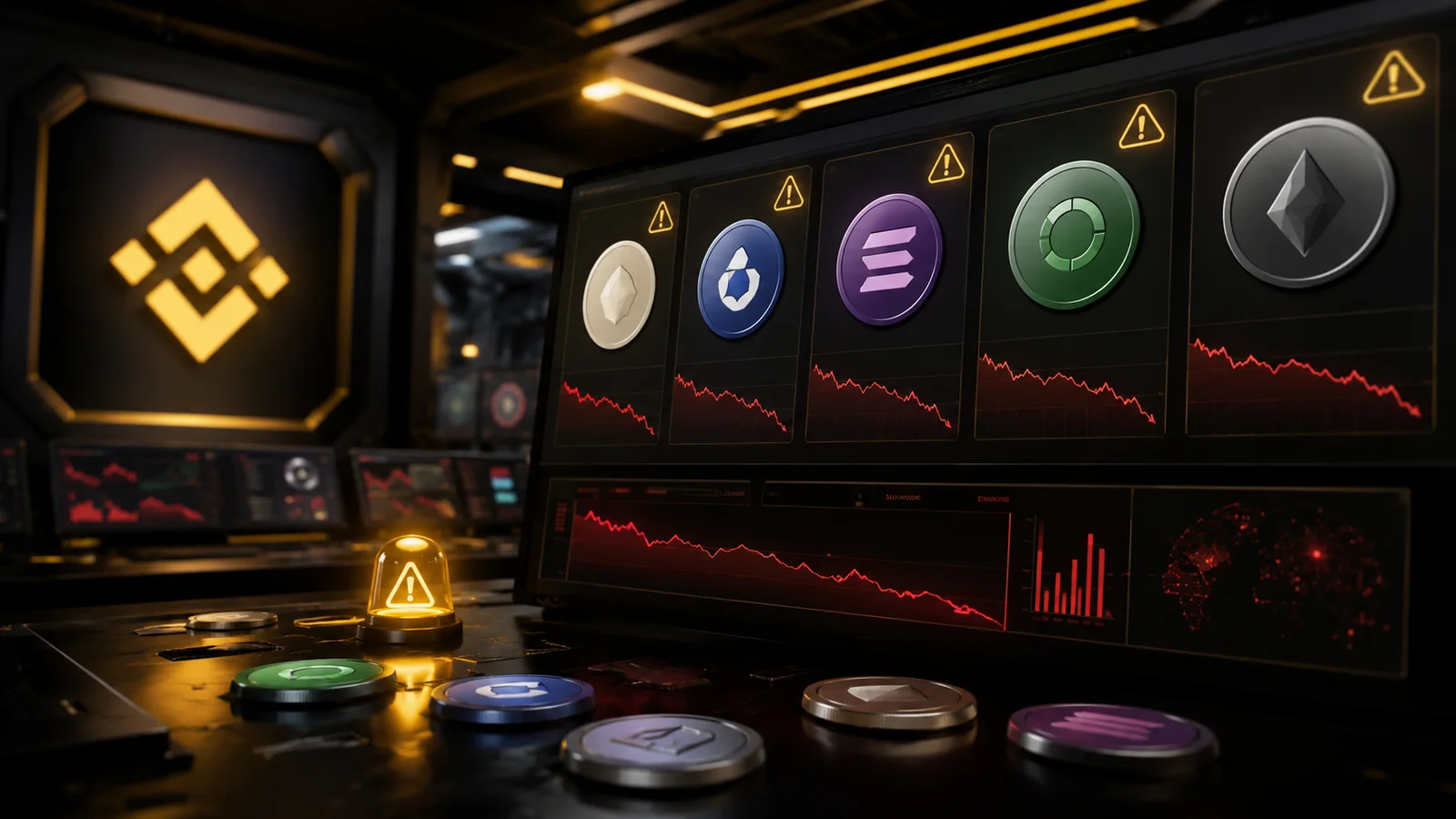
Binance announced that nine tokens were added to the Monitoring Tag category as of May 22, 2026. The tokens included in the list are Alchemix (ALCX), Cookie DAO (COOKIE), DODO (DODO), Epic Chain (EPIC), Heima (HEI), Hashflow (HFT), Storj (STORJ), Synapse (SYN), and Alien Worlds (TLM). The exchange said the decision was made following its periodic project reviews. The announcement was published at 11:00 a.m. on May 22, and the tags were updated shortly after.What Does the Monitoring Tag Mean?Binance uses the Monitoring Tag mechanism to mark projects that carry significantly higher volatility and risk compared to other listed tokens. The tag also means that the exchange has placed the token under close observation and will review it at regular intervals.The evaluation criteria include the team’s commitment to the project, the quality of development activity, trading volume and liquidity, network security, smart contract stability, and the level of public communication. Evidence of unethical behavior, fraud, or negligence is also included in the review process.The addition of the tag does not directly affect the token’s other services on Binance. However, it serves as a serious warning. Tokens with the Monitoring Tag may face delisting risk if they fail to meet Binance’s listing criteria.Quiz RequirementUsers who want to trade tokens with the Monitoring Tag must complete a quiz every 90 days on Binance Spot and/or Binance Margin. This requirement is designed to ensure that users understand the specific risks associated with these tokens. Users who fail or do not renew the quizzes cannot trade these assets.Price MovementsFollowing the announcement, most of the tokens on the list saw sharp declines. The heaviest losses were recorded in Heima (HEI), Synapse (SYN), and Epic Chain (EPIC). HEI fell 16.41% in 24 hours, while SYN dropped 15.82% and EPIC lost 15.32%. Cookie DAO (COOKIE) and Hashflow (HFT) also posted double-digit losses, falling 12.53% and 12.04%, respectively. On the more moderate side, Alien Worlds (TLM) declined 5.83%, Storj (STORJ) fell 3.56%, and DODO dropped 3.22%. The smallest decline on the list was seen in Alchemix (ALCX), which lost 2.09%.As of 12:30 p.m. Turkey time, ALCX was trading at $5.00, COOKIE at $0.01576, DODO at $0.02019, EPIC at $0.2658, HEI at $0.06549, HFT at $0.01233, STORJ at $0.1102, SYN at $0.04390, and TLM at $0.001686.Binance first introduced the Monitoring Tag system in 2023. Since then, the exchange has added the tag to several tokens. Some managed to continue meeting the required standards and remained listed, while others were eventually delisted.The addition of the tag does not always lead to delisting, but it functions as a warning that investors should not ignore. Binance stated in its announcement that the other services related to these tokens would not be affected and that the tags were updated immediately after the announcement was published.
Binance Lists Two New Altcoins on the Spot Market
Binance announced that it will add Genius Terminal (GENIUS) and OpenGradient (OPG) tokens to its spot market on May 22, 2026. Both tokens were listed with the Seed Tag.Genius Terminal is a non-custodial on-chain trading platform that brings spot trading, futures, yield products, and cross-chain transactions together under a single interface. The platform routes orders through the Genius Bridge Protocol (GBP), which allows users to trade across more than 150 DEXs.OpenGradient is a decentralized infrastructure network designed to bridge the gap between artificial intelligence and blockchain. It offers a structure that allows developers to host, run, and verify AI models directly on-chain. The project was founded by names coming from Two Sigma and Palantir, and raised $9.5 million in a funding round led by a16z Crypto and Coinbase Ventures.Trading will open at 14:00 Turkey time. Six pairs will go live at launch: GENIUS/USDT, GENIUS/USDC, GENIUS/TRY, OPG/USDT, OPG/USDC, and OPG/TRY. Withdrawals will become available from May 23, 2026, at 14:00. The listing fee was set at 0 BNB.GENIUS trades on BNB Smart Chain at the address 0x1F12B85aAC097E43Aa1555b2881E98a51090e9A6. OPG has a dual-chain structure. It is available on BNB Smart Chain at 0x5feCcD17C393CaF1001D18164236A37E731FCb9d and on Base at 0xFbC2051AE2265686a469421b2C5A2D5462FbF5eB. On the marketing side, Binance announced that it has allocated 25 million GENIUS tokens and 15 million OPG tokens for future campaigns. Details about these campaigns will be shared in separate announcements.Users need to have a verified Binance TR account to trade TRY pairs. TRY refers to the Turkish lira here, not a crypto asset.Transition process for Binance Alpha usersBoth GENIUS and OPG were traded on Binance Alpha before their spot listings. With the opening of spot markets, both tokens were removed from Alpha Market. However, the transition process is taking place in several stages.Fifteen minutes before spot trading began, users were able to transfer their tokens from their Alpha account to their spot account. After the listing, selling through Alpha is still possible via Alpha Instant during the first hour after spot trading opens. However, these transactions no longer count toward Binance Alpha Points. Binance has a 24-hour window to move balances from users’ Alpha accounts to their spot accounts; during this period, transfers will be carried out automatically by the platform.What is the Seed Tag?Both tokens were given the Seed Tag. This label is a warning mechanism Binance applies to tokens it considers to carry high volatility and risk. It is commonly seen on newly listed or still-maturing projects. Users are advised to conduct their own research before trading tokens with this tag, and to pay particular attention to security risks on platforms outside Binance.Algo orders and trading botsSpot Algo Orders are active for both tokens from the moment of listing. Trading bots and Spot Copy Trading will be enabled within 24 hours following the listing. Users who use Copy Trading can add the new pairs to their portfolios through the Personal Pair Preference settings.

SpaceX Arrives on Binance Before Nasdaq: Trading Begins
Binance has launched a new futures contract product that allows investors to take positions ahead of SpaceX’s anticipated public offering. Listed under the name SPCXUSDT, the “Pre-IPO Perpetual Contract” is USDT-margined and offers leverage of up to 5x.The product is part of Binance’s attempt to bring the infrastructure of crypto derivatives into traditional financial markets. It does not provide actual ownership in the company; trading is based entirely on price movements. In the pre-IPO period, the contract price is based on publicly available data such as private investment rounds and transactions by existing shareholders. Once SpaceX goes public, SPCXUSDT will begin tracking the actual share price directly.SpaceX Trading Begins on BinanceThe first day of trading was highly active. The contract opened at $206, climbed to $224, and was trading around $208 at the time of writing. With a daily low of $197 and a peak of $224, intraday volatility reached 13.8%. The 24-hour trading volume also exceeded $50 million. SpaceX has filed its S-1 registration statement with the SEC. The documents revealed that the company holds 18,712 BTC acquired at an average cost of around $35,000. First-quarter revenue was reported at $4.69 billion, while net loss stood at $4.28 billion. The company is expected to begin trading on Nasdaq under the SPCX ticker in June 2025. Elon Musk’s voting power stands at around 85% through Class A and Class B shares; no other individual or institution holds a stake above 5%.On decentralized prediction platform Polymarket, users are pricing the probability of the IPO closing above a $2 trillion valuation at more than 70%. Reuters, meanwhile, reported that SpaceX’s target valuation is around $1.75 trillion.Binance is not alone in this field. Hyperliquid’s Trade.xyz platform launched SpaceX futures contracts on May 18 at $150, corresponding to a valuation of roughly $1.78 trillion. The product generated $33 million in volume on its first day. OKX and Bitget also offer similar products. What sets Binance apart is scale: the liquidity and retail access provided by the world’s largest crypto exchange are not capacities that smaller platforms can easily match.Pre-IPO futures contracts allow individual investors to gain early exposure to an IPO market that has traditionally been dominated by institutional investors and venture capital circles. However, these products come with their own risks. Contract prices can diverge significantly from the actual share price. Leverage can amplify losses. They also do not provide dividends or voting rights.Historical data shows that major IPOs do not always perform as well as commonly assumed. Jay Ritter of the University of Florida examined around 9,300 companies that listed on major U.S. exchanges between 1980 and 2025. The average first-day gain was 19%. But that momentum often fails to hold. Looking at the 10 largest U.S. IPOs, including Alibaba, Meta, Uber and Rivian, the median decline reached 10% after three months and 31% after one year. The latest example points to the same pattern: AI chipmaker Cerebras Systems surged 68% on its opening day to $185, but by the end of the first week, the stock had fallen to $291.The SpaceX expectation is also affecting crypto markets. Bitcoin came under pressure around the $80,000 level about three weeks ago and has since slipped below $78,000. Gene Munster of Deepwater Asset Management said SpaceX’s S-1 filing pushed Nvidia’s strong quarterly results out of the spotlight; Nvidia closed that day unchanged at $220.60.

Two Exchanges Added to Watchlist: Hack Suspicion Crashes Altcoin
Two long-established South Korean crypto exchanges, Bithumb and Coinone, placed MAP Protocol’s native token MAPO under investment warning status as of May 21 and suspended deposits and withdrawals. Both exchanges cited suspected security issues as the reason behind the decision. Behind the move lies a bridge attack involving one of the strangest figures in crypto history.One Quadrillion Tokens Were MintedThe attack that triggered the incident targeted Map Protocol’s Butter Bridge V3.1 infrastructure on May 20. The attackers exploited a vulnerability in the bridge’s smart contract by combining message replay and address manipulation methods. The process worked like this: the attacker first initiated a legitimate MAP-to-ETH bridge message that passed oracle and multisig verification; then they resent a fake “retry” message that appeared to carry the same hash value. The bridge accepted this message as valid and executed a massive token mint.The result was almost absurd in numerical terms: the attackers minted 1 quadrillion MAPO tokens, an amount 4.8 million times larger than the real circulating supply of around 208 million. The minted tokens were sent from the zero address to the wallet 0x40592025392BD7d7463711c6E82ED34241B64279.The attacker sent around 1 billion of these tokens to Uniswap and drained approximately 52 ETH from liquidity pools, worth around $180,000 at the time. The remaining nearly one quadrillion tokens continue to pose a threat to other pools and potential exchange listings.According to security firm Blockaid, no private key was stolen and no light client was compromised; this was a classic Solidity security vulnerability.Price suffers sharp declineBefore the attack, MAPO price was trading near $0.003. After the incident, the token fell as low as $0.00013, with its 24-hour loss exceeding 95%. During the sharpest phase of the drop, the lower end of the 24-hour range reached $0.0000926. The chart almost turned from a flat line into a steep cliff; the candle marking May 20 breaks exactly at that point. A partial recovery followed afterward. As of May 21, MAPO is trading around $0.0023838, still down 22% on the day. Its weekly loss stands at 31.56%, while its monthly loss is recorded at 27.23%. Daily trading volume exceeded $4.3 million during the period of extreme volatility. It is still too early to say whether the recovery is real or merely a temporary breather after panic selling.Exchange pesponseBithumb announced at 1:55 a.m. local time that it had temporarily suspended MAPO deposits and withdrawals due to suspected security concerns. Coinone took a similar step with its own announcement. Both exchanges said the decision was made under South Korea’s virtual asset user protection regulations; transactions will remain suspended until network stability is restored. Whether trading support will be removed entirely depends on the outcome of the investigation.Response From Map Protocol and Butter NetworkMap Protocol and Butter Network teams moved quickly after the exploit was detected and halted bridge operations to limit potential additional damage. MAP Protocol also shut down the bridge between MAPO ERC-20 tokens and the MAPO mainnet. This is a standard precaution in bridge security incidents; it gives teams time to identify the exact attack vector.The incident further worsened crypto’s security record for May. At least 18 DeFi and blockchain protocols, including THORChain, Verus Protocol’s Ethereum bridge, Transit Finance, TrustedVolumes, Ekubo, Echo Protocol and RetoSwap, were attacked during the month. Cross-chain bridges remain one of the most attractive infrastructure targets for attackers; previous major breaches involving Nomad, Wormhole and Ronin also fell into the same category.Map Protocol positions itself as a cross-chain infrastructure layer using light client and MPC-based threshold signature technology for BTC, stablecoin and tokenized asset transfers. The attack appears to have targeted the bridge’s message verification layer, affecting this specific component rather than the broader network infrastructure.

Three New Altcoins Joined Coinbase’s Radar This Week
Coinbase moved on three different tokens within a short span of time. The exchange first added MetaDAO (META) and Derive (DRV) to its listing roadmap, then later announced direct support for Nexus (NEX).The NEX update came from Coinbase Markets’ official X account. According to the announcement, Nexus will be supported on coinbase.com, the Coinbase app, and Coinbase Exchange. Address generation is already live, but there is one important caveat: deposits will not be possible until the token issuer enables transfers. In other words, the technical setup is ready, but users will have to wait before the token becomes fully usable on the platform.MetaDAO and Derive, on the other hand, are still only on the roadmap. That signal is more cautious. Coinbase is saying that both tokens are under evaluation, but there is no confirmed listing yet.What do these projects do?MetaDAO is a governance protocol built on Solana. Instead of relying on traditional token-weighted voting, it uses conditional markets, meaning decisions are made through market mechanisms tied to predictable outcomes. It is an unusual approach to DeFi governance, though it has built a certain following within the Solana ecosystem.Derive is a rebranded project that was previously known as Lyra. It offers on-chain options and perpetual futures trading. The DeFi derivatives market has reached significant trading volumes lately, and Derive is one of the protocols trying to establish itself in that segment. As interest in decentralized derivatives exchanges continues to grow, projects like this are gaining more visibility.What does the roadmap mean?Being added to Coinbase’s listing roadmap does not guarantee that trading will begin. At this stage, the exchange is still conducting technical integration, compliance checks, and market readiness reviews. Regional restrictions are also part of the process. Even if a token clears all criteria, access may still remain limited in certain geographies.The time it takes to move from the roadmap to an actual listing varies. Some tokens have gone live within days, while others have remained under review for weeks. For META and DRV, there is no confirmed date at this point.That said, announcements like these are known to have an immediate impact on small-cap tokens. Greater visibility often brings speculative interest. Still, that interest can reverse just as quickly if a listing is delayed or falls short of market expectations. This pattern has appeared many times in Coinbase’s previous roadmap cycles.What comes next?For NEX, the key issue now is when the token issuer will enable transfers. Until that happens, deposits and trading will not be available. Coinbase said it will provide a separate update once that changes.As for META and DRV, the next big question is whether they will move from the roadmap to a live listing, which trading pairs may be added, and how regional restrictions will be applied. Both tokens are currently traded mostly on decentralized platforms. If a Coinbase listing goes through, it would mark a meaningful step forward in terms of accessibility and liquidity.

Ripple Joins CNBC Disruptor 50 as the Only Crypto Company on the List
Ripple ranked 16th on CNBC’s 2026 Disruptor 50 list. In a year dominated by artificial intelligence companies, Ripple became the only company representing the crypto sector. CNBC described the company behind XRP as “new money” in its list profile. CNBC cited Ripple’s growth in cross-border payments, stablecoins, digital asset custody, tokenization, and institutional settlement tools as key reasons for its inclusion. Ripple described the ranking as proof that “the infrastructure era has arrived.” In previous years, companies such as Coinbase, Paxos, Circle, and Chainalysis appeared on the list at different points. This year, prediction markets Kalshi and Polymarket ranked 43rd and 48th, respectively.RLUSD and Custody Services Drive GrowthRipple’s recent strategy has moved away from speculative token activity and toward infrastructure tools that banks and payment companies can use directly. At the center of this strategy is RLUSD, a dollar-pegged stablecoin backed one-to-one by cash and cash-equivalent assets and operating on both the XRP Ledger and Ethereum.RLUSD was recently added to OKX’s spot and derivatives markets, expanding its liquidity base. Ripple presented this step as a move that could support broader use of the stablecoin in institutional payment and settlement processes. Around the same period, Ripple also expanded the scope of its custody platform. Tokenization, staking, trading, stablecoin issuance, and digital asset management are now among the services offered to regulated financial institutions. The company positions this platform not merely as a crypto wallet, but as an institutional-grade financial infrastructure layer.Institutional Interest Shifts Toward InfrastructureRipple’s inclusion on the list reflects a broader trend in the crypto sector. Institutional investors and regulators are increasingly focused on the infrastructure behind blockchain finance rather than speculative token returns. Stablecoins, custody, compliance solutions, and tokenized assets are among the main areas attracting this interest.Ripple now sits directly at this intersection. The company is no longer associated only with the XRP ecosystem; it is increasingly mentioned in the same conversations as major artificial intelligence startups and enterprise technology firms.XRP Price Remains a Separate VariableOne notable point in CNBC’s assessment is that Ripple’s institutional growth does not guarantee a direct link to XRP’s market performance. Stronger payment infrastructure, wider institutional use of RLUSD, and deeper integrations may support the ecosystem over the long term. However, the token price can move according to very different dynamics in the short term.This distinction matters, especially at a time when Ripple-related news is often directly tied to XRP price predictions in market commentary.Crypto in the Shadow of AIThis year’s Disruptor 50 list is largely shaped by artificial intelligence companies. Of the 50 companies on the list, 43 define AI as central to their business model. The combined implied valuation of the companies on the list reached $2.4 trillion, while total funding climbed to $337 billion.
What is Sentient (SENT)?
What Is Sentient (SENT)?Artificial intelligence is no longer just a tool developed by technology companies. It is becoming one of the main forces shaping the future of the internet, finance, and digital production. Yet the question of who controls this power, how models are trained, and who receives a share of the economic value they create is becoming more important. Sentient (SENT) is a project positioned directly within this debate. It aims to support open-source artificial intelligence with a blockchain-based economic model, making AI development more transparent, participatory, and sustainable.Sentient’s main goal is to offer an alternative to the current structure in which artificial intelligence develops under the control of a few large technology companies. The project aims to build an open AI network where developers, researchers, data providers, and community members can contribute. SENT, the native token of this network, is used for payments within the ecosystem, rewarding contributions, and governance processes.Sentient is a decentralized AI protocol that aims to bring AI models, data sources, tools, and developer contributions together within the same network. The project positions itself as an open-source artificial general intelligence platform against closed AI systems. This structure brings data, models, and computing power together through a system called Sentient GRID. In the traditional AI field, the most powerful models are often controlled by large companies. These companies can decide how a model is trained, which data it uses, how users can access the system, and in which direction the technology will evolve. Sentient offers a more open, participatory, and sharing-focused model in response to this structure.The project aims to make the contributions of AI researchers, developers, data providers, and community members more visible. It also allows these contributions to create economic value. As a result, open-source AI can move beyond a field driven only by voluntary work and become a more sustainable structure where contributors can also generate income.Sentient Foundation also defines the project as an effort to develop open-source AI that is aligned with humanity and not controlled by a single institution. The foundation aims to bring researchers, developers, and communities together around an open artificial general intelligence ecosystem.Sentient’s Origins and Main PurposeSentient was born out of the concentration of power in the AI industry. Today, advanced AI models often operate within closed systems. Users can benefit from these models, but they usually cannot see how they are trained, what limitations they have, or how the revenue they generate is shared.Open-source AI offers a strong alternative to this picture. However, it also creates another problem. Researchers and teams that develop open-source models cannot always clearly determine how their contributions will be protected in the long term or how they will generate revenue. Once a model becomes publicly available, different people and institutions can create value from that work, while the original developers may not receive a fair share of that value. Sentient aims to solve both problems at the same time. The project wants AI models to remain open while also ensuring that the developers behind these models are economically rewarded. To do this, it uses a structure that brings together blockchain, cryptography, and artificial intelligence techniques.At the center of this approach is the concept of OML. OML stands for open, monetizable, and loyal AI. Here, “loyal” refers to the idea that the model remains connected to the intentions, rules, and economic rights of the community that developed it. The academic study on OML also proposes an interdisciplinary framework that allows open-source AI models to be community-owned, monetizable, and managed in a more open way.Sentient History: Key MilestonesThe Sentient project became more visible to the public in 2024. The project was developed in 2024 to support open-source AI development processes and was created by Sentient Foundation.2024 was also the year when the OML approach became more widely discussed. The study titled “OML: Open, Monetizable, and Loyal AI” proposed a new model for making open-source AI models both accessible and economically sustainable.In 2025, Sentient’s research focused on open AI and community ownership gained more visibility. The academic study titled “Training AI to be Loyal” examined the concept of community-loyal AI through model ownership, alignment, and control. This approach shows that Sentient focuses not only on technical infrastructure but also on community governance.In 2026, the SENT token entered the broader crypto market agenda. Binance listed SENT on January 22, 2026, with USDT, USDC, and TRY trading pairs. This listing became an important milestone in helping the project reach a wider user base.As of May 2026, SENT coin price is trading around the $0.015 level. Why Is Sentient Important?What makes Sentient important is its proposal for a more open and sharing-focused model for AI development. Today, advanced AI systems largely progress under the control of technology companies. These companies can determine how models are developed, who can access them, and how the economic value they generate is distributed. Sentient aims to build a more participatory structure where developers, researchers, and community members can contribute.This approach is especially notable for open-source AI. Open-source models offer a strong foundation in terms of transparency and accessibility. However, their revenue model often remains weak. When a model becomes publicly available, different people and institutions can create value from that work; yet the teams that developed the model may not always receive a fair share.Sentient seeks to solve this issue with a blockchain-based ownership and reward system. Model developers, data providers, infrastructure contributors, and those who improve tools within the network can receive economic incentives based on their contributions. This can help open-source AI move beyond a field based only on voluntary labor and become more sustainable.Another key aspect of the project is its focus on transparency. Sentient proposes a more verifiable, traceable, and community-driven architecture instead of AI development progressing under the control of a single center.How Does Sentient Work?Sentient uses a modular structure that brings different AI components together within the same network. These components can include models, data sources, tools, AI agents, and research outputs. The goal is to create a broader network made up of many interconnected parts rather than a single large AI system.At the center of this network is Sentient GRID. GRID can be seen as the main layer that allows different AI resources to be discovered, used together, and gain economic value. GRID is described as a structure that coordinates data sources, AI models, and computing power. When a user or developer sends a request to the Sentient network, the system can bring together AI components suitable for that need. For example, a research process may use a data search tool, a summarization model, and an AI agent that performs analysis within the same workflow. During this use, the parties that contribute to the network can be economically rewarded.This model aims to increase collaboration in AI development. Small teams or independent developers may struggle to compete with large technology companies on their own. However, within a network like GRID, they can add their models, tools, or data sources to the system and become part of a larger structure.What Is OML?OML is one of Sentient’s most important technical and economic concepts. It stands for open, monetizable, and loyal AI. This concept aims to keep AI models accessible while also protecting model ownership and revenue sharing.The “open” part means that the model can be accessed and examined by the community. This is close to the tradition of open-source AI. Users and developers can better understand the model, improve it, and adapt it to different use cases.The “monetizable” part aims to make the model generate value as it is used and transfer that value to contributors. In this way, people who develop open-source AI models can receive not only reputation or visibility, but also economic income for their work.The “loyal” part is about the model remaining connected to the rules and purpose set by its developer community. In Sentient’s approach, an AI model is seen not only as a technical product, but also as a digital asset connected to the community that created it.On the technical side, OML involves model ownership, usage tracking, verification mechanisms, and cryptographic methods. Academic studies state that this framework brings together AI, blockchain, and cryptography. For the end user, the main idea is simpler: open-source AI development is tied to an economic model that protects contributors.What Is SENT Token Used For?SENT is the native crypto asset of the Sentient ecosystem. A large part of the economic activity within the network is built around SENT. The token’s main role is connected to the use of AI components, developer contributions, reward distribution, and governance processes.When an AI model, data source, or tool is used in the Sentient network, this use can create economic value. SENT acts as the payment tool that allows this value to move within the network. In this model, developers can generate revenue as the AI components they create are used.SENT can also be used in staking processes. Staking allows users or network participants to lock a certain amount of tokens into the system as a signal of trust, access, or contribution. This structure can be used to support the quality and reliability of resources in the network.Governance is another important use case for the SENT token. Token holders can vote on decisions about the future of the network. These decisions may relate to protocol updates, reward mechanisms, ecosystem incentives, or network rules.For this reason, SENT is not only seen as a crypto asset traded on exchanges. The token is positioned as one of the key tools that allows Sentient’s open AI economy to function.SENT TokenomicsSENT tokenomics is built around the idea of rewarding contributions to open-source AI. Model developers, data providers, infrastructure providers, and participants who increase network usage are all part of this economy. The goal is to make the labor behind AI development more visible and measurable.According to Sentient’s official statement, the total supply of SENT is 34,359,738,368. This number equals 2³⁵, and the project team specifically stated that the supply was chosen this way. According to Binance data from May 2026, SENT’s circulating supply is around 7.2 billion. The same page updates SENT price, market capitalization, 24-hour trading volume, and fully diluted valuation in real time. Therefore, investors should check live data providers for current market information.The main point to watch in tokenomics is how the supply will be distributed over time. The difference between circulating supply and total supply may mean that new tokens could enter the market in the future through unlocks or ecosystem incentives. For this reason, SENT should be analyzed not only through price movements, but also through its supply schedule and use cases.Sentient’s long-term success does not depend only on the token being traded on exchanges. The real use of SENT within the network, the creation of revenue from AI components, and contributors receiving regular value from this structure may be more decisive.Sentient Ecosystem and Use CasesThe Sentient ecosystem is not limited to AI models. The network can include data sources, research tools, AI agents, developer contributions, and user applications. This structure aims to make different parts work together in a compatible way.AI agents are an important part of this ecosystem. Agents can be thought of as software-based AI components that can perform specific tasks. An agent can conduct research, classify data, analyze user requests, or use other tools to produce results.Sentient GRID makes it easier to discover these agents and models. Developers can add their own tools to the network. Users can then benefit from these tools according to their needs. As usage grows, payment and reward mechanisms within the network come into play.This structure may be especially important for open-source AI initiatives. Small teams can make their products visible outside large platforms. Researchers can generate economic value from the models they develop. Users can also use different AI resources without depending on a single closed system.Sentient’s use cases may include research, data processing, AI-supported applications, developer tools, model marketplaces, and community-driven AI development. As the project matures, these use cases are expected to turn into more concrete products.The Future of SentientSentient’s future will depend on two major trends in AI and crypto. On one side, AI models are becoming more powerful. On the other, users, developers, and communities are increasingly questioning who controls this technology.Sentient stands out as one of the projects born from this discussion. It aims to bring open-source AI, decentralized ownership, and token economics into the same structure. If this approach succeeds, a new market model may emerge, one that rewards the labor of AI developers more directly.However, for this goal to become reality, the technical architecture needs to generate real use. More models, agents, data sources, and applications need to operate on GRID. Users need to use these tools not only in theory, but also in their daily workflows.A similar point applies to the SENT token. The long-term value narrative of the token depends on stronger use within the Sentient network. If AI components in the network generate revenue, developers receive a share of this revenue, and community governance works actively, SENT may become a more meaningful ecosystem asset.For this reason, Sentient’s future does not depend only on the AI narrative. To become a lasting project, it needs to grow open-source contributions, economic incentives, and real user demand at the same time.Frequently Asked QuestionsBelow, you can find answers to the most frequently asked questions about Sentient.What is Sentient (SENT)?: Sentient is a decentralized AI protocol that supports open-source AI development with a blockchain-based economic model. The project aims to allow AI models, data sources, and tools to work together through Sentient GRID.What is SENT token used for?: SENT is the native token of the Sentient ecosystem. It is used for payments within the network, staking processes, developer rewards, and governance decisions. The token allows the economic value created by AI components to be shared within the network.What problem does Sentient aim to solve?: Sentient aims to solve the issue of centralized control in AI and the difficulty of generating revenue from open-source models. The project seeks to protect the contributions of AI developers and help them create economic value from those contributions.What is Sentient GRID?: Sentient GRID is the core structure that brings AI models, data sources, tools, and agents together within the same network. This system allows different AI components to be discovered, used together, and monetized.What does OML mean?: OML stands for open, monetizable, and loyal AI. Sentient’s OML approach aims to keep open-source AI models accessible while also protecting the economic rights of their developers.Why is Sentient important in the AI field?: Sentient aims to move AI development from closed company systems toward a more open and community-based structure. In this sense, the project highlights transparency, ownership, and revenue sharing in the AI development process.What is the total supply of SENT?: According to the official statement, SENT’s total supply is 34,359,738,368. According to Binance data from May 2026, the circulating supply is around 7.2 billion SENT.Sentient like artificial intelligence-focused crypto projects more closely to know, you can explore the latest guides on JrKripto.

Binance Announces New Delisting Decision: 8 Spot Trading Pairs to Be Removed
Binance has announced a new removal decision targeting several trading pairs in the spot market. According to the notice published by the exchange, the AVAX/ETH, CHZ/BTC, FET/BNB, IOTA/BTC, UNI/ETH, UNI/FDUSD, XLM/BTC and XLM/FDUSD trading pairs will be removed from the platform on May 22, 2026. Trading will stop at 03:00 UTC on the same day, which corresponds to 06:00 Türkiye time.The decision was made as part of Binance’s regular market reviews. The exchange said it periodically reviews trading pairs and may remove certain pairs due to factors such as low liquidity or weak trading volume. Such steps generally aim to protect trading quality on the platform and ensure that users can trade under healthier market conditions.However, there is an important point to note here. Binance’s decision does not mean that the related assets are being completely removed from the platform. Assets such as AVAX, CHZ, FET, IOTA, UNI, XLM, ETH, BTC, BNB and FDUSD will continue to be available for trading on Binance Spot through other supported trading pairs. In other words, users will not completely lose access to these assets; they will only be unable to trade the specific pairs mentioned in the announcement. The removal decision is especially important for users who have open orders on these trading pairs. Binance will end trading for the listed pairs on the announced date. Therefore, investors need to check their open orders before May 22. A separate warning was also issued for users who use Spot Trading Bots on these pairs. Binance stated that spot trading bot services for the affected pairs will also be terminated at the same time.This may create risks for users who run automated trading strategies. If bots are not updated or canceled in time, users may face unexpected trading results or potential losses. For this reason, Binance advised users to update or cancel their relevant bots before trading is halted.Delisting Also Covers Other ProductsMeanwhile, another Binance announcement scheduled for the same date covers margin and loan products related to AEUR and AI. Binance Margin and Binance Loans will begin the delisting process for Anchored EUR (AEUR) and Sleepless AI (AI) in the relevant products as of 09:00 Türkiye time on May 22, 2026. As part of this process, some loan positions will be closed, while open margin positions will be automatically settled and pending orders will be canceled.This second announcement concerns a different area from the removal of spot trading pairs. The process for AEUR and AI is particularly important for users who hold assets or liabilities in their margin accounts. Binance recommends that users close their positions before the delisting process begins, transfer their assets to their spot accounts and monitor their account status against possible liquidation risks.

Another DeFi Project Hacked: $76 Million Worth of eBTC Minted
Bitcoin-focused DeFi project Echo Protocol faced a major security breach. The attack came after a series of exploits that have hit the DeFi market in recent weeks. Initial details began spreading after the incident was reported on X by an account known in the crypto community as DCF GOD.According to security teams examining on-chain data, the attacker minted 1,000 eBTC worth around $76.7 million on the Monad network. While this eBTC supply was reportedly not backed by real collateral, the exact technical vulnerability behind the attack has not yet been identified. Experts are evaluating whether the incident may have stemmed from a private key compromise, a deployment error, or a smart contract-related weakness.The attacker later used part of these assets as collateral through Curvance. According to shared data, the attacker deposited 45 eBTC, worth roughly $3.45 million, into Curvance and borrowed 11.29 WBTC in return. This amount was valued at around $867,000 at the time of the attack.The borrowed WBTC was then transferred to the Ethereum network, converted into ETH, and around 385 ETH was reportedly sent to Tornado Cash. Tornado Cash is known as a mixing service used to obscure the trail of funds. For this reason, the transfer was interpreted as an attempt to launder the assets obtained by the attacker.955 eBTC Still Remains in the WalletAccording to blockchain tracking platform Lookonchain, the attacker still holds around 955 eBTC in their wallet. This amount is said to be worth more than $73 million. OnChain Lens also noted that the attacker still appears to control a significant amount of the minted eBTC. Following the incident, statements came from both Monad and Curvance. Monad co-founder Keone Hon said the attack did not affect the Monad network itself and that the network continues to operate normally. Hon also stated that security researchers are investigating the incident related to Echo Protocol’s eBTC asset on Monad.Curvance, meanwhile, said there was no sign that its own smart contracts had been exploited or compromised. The protocol stated that the affected market had been paused as a precaution and that the investigation was continuing alongside ecosystem partners. Curvance also emphasized that, thanks to its fully isolated market architecture, other markets were not affected by the attack.According to the company’s statement, the incident was limited to the eBTC/WBTC market on Monad. Major DeFi platforms such as Aave, Morpho, Spark, and Fluid were not affected by the attack. While these statements suggest that the risk did not turn into a broader liquidity crisis, market participants remain cautious until the technical details of the incident become clear.ECHO Price FallsAfter news of the attack broke, the ECHO token came under heavy selling pressure. The token fell more than 12% during the day, dropping to around $0.0049. The project team said it was investigating the security incident and had temporarily suspended all cross-chain transactions. The Echo Protocol attack became the third major security incident in the DeFi market within just a few days. Earlier, more than $10 million was reportedly stolen from THORChain, while the Verus-Ethereum Bridge attack resulted in the loss of around $11.5 million in assets. With these incidents, the number of DeFi security breaches recorded in May rose to 14.According to DeFiLlama data, the DeFi sector had already faced 13 different attacks this month before the Echo incident. In recent years, lending protocols, cross-chain bridges, and collateral markets have become some of the main targets for attackers. Losses suffered by uninsured lending protocols over the past six years are estimated to have approached $7.7 billion.In April, the DeFi ecosystem also saw more than $600 million in losses following major attacks involving projects such as Drift and KelpDAO. Nexus Mutual founder Hugh Karp said many of the recent hacks were caused by operational failures, pointing to a serious mismatch between risk management and insurance coverage.

What Is Zama (ZAMA)?
Blockchain’s first major promise was to build a transparent financial system where everyone could look at the same ledger. This structure reduced the need for centralized intermediaries and allowed users to verify transactions directly. Over time, however, this transparency also created a new problem. Every transfer, every balance movement, and many smart contract interactions on-chain became traceable by anyone.This created a serious limitation for financial transactions, institutional use, identity data, and governance processes. It is not always desirable for a user’s holdings, the protocols they interact with, or their voting choice in a DAO to be openly visible. Transparency is one of the features that gives blockchain its trust layer, but making every piece of information public makes it harder for the technology to reach broader use cases.Zama (ZAMA) stands out as a privacy protocol that enters the picture at this point. The project uses Fully Homomorphic Encryption, or FHE, a technology that allows data to be processed while it remains encrypted on blockchain networks. Thanks to this technology, smart contracts can operate without directly seeing sensitive data. For example, a contract can check whether a user has enough balance without revealing the actual balance to the entire network.Zama’s goal is to solve the privacy problem without removing blockchain’s verifiable structure. The project’s Confidential Blockchain Protocol is designed to enable the issuance, management, and transfer of confidential assets on public blockchains. This allows user balances, transaction amounts, voting preferences, or identity information to be used within applications without becoming fully visible on-chain.What separates Zama from traditional privacy projects is that it does not try to build a new and closed blockchain. Instead, it aims to add a privacy layer on top of existing networks. The protocol is positioned as a cross-chain privacy layer that works on existing blockchains, rather than as a new Layer 1 or Layer 2. This approach allows users and developers to interact with confidential applications without leaving ecosystems such as Ethereum.Definition and Origins of ZamaZama emerged as a company and protocol ecosystem focused on open-source cryptography solutions. The project’s main goal is to make Fully Homomorphic Encryption practical for developers and turn this technology into usable infrastructure for blockchain applications.FHE is a cryptographic method that allows direct computation on encrypted data. In traditional systems, data usually needs to be decrypted before it can be processed. This can create security risks in sensitive areas such as financial information, personal identity data, and corporate transactions. With FHE, the data remains encrypted, computation is performed on that encrypted data, and the result is also produced in encrypted form.Zama aims to bring this structure into the blockchain world and pave the way for confidential smart contracts. Verifiability is a key advantage of public blockchain networks; anyone can check transactions and see whether the system follows its rules. However, this verifiability usually depends on transaction data being publicly visible. This is the core dilemma Zama seeks to address: keeping blockchain verifiable while protecting sensitive data.For this purpose, the project also uses MPC and ZK technologies alongside FHE. Zama’s documentation states that FHE is used for confidential computation and public verifiability, MPC decentralizes key management, and ZK proofs show that encrypted inputs were generated correctly.The protocol also serves many use cases, including confidential DeFi transactions, RWA tokenization, identity verification, DAO governance, sealed-bid auctions, and private token distributions. For this reason, Zama treats privacy as a fundamental part of application design, not as a separate feature in blockchain.Zama’s History: Key MilestonesZama was founded in 2020 by Dr. Rand Hindi and Dr. Pascal Paillier. According to CoinMarketCap’s project description, Rand Hindi serves as the company’s CEO, while Pascal Paillier serves as CTO. The team also includes academics and researchers working in cryptography and FHE.In its early period, the project focused on making FHE technology usable for developers rather than building a direct token or blockchain network narrative. Fully Homomorphic Encryption was long seen as theoretically powerful but expensive and slow in practice. Zama’s early work focused on improving the performance of this technology and producing open-source tools that software developers could use.One of Zama’s most important steps on the blockchain side was FHEVM. FHEVM allows Ethereum developers to write confidential smart contracts with Solidity, a language they are already familiar with. With this structure, developers can decide which data should remain private and build contracts that work with encrypted data types without learning an entirely new programming language. Zama’s official website states that developers can write contracts using traditional Solidity tools and define which parts of the contract should remain private through data types such as euint.The year 2024 stood out as an important financing milestone in Zama’s growth. According to CoinList’s Zama auction page, the company raised $73 million in a Series A round in 2024. The same source also states that Zama raised $57 million in a Series B round in 2025, bringing its valuation above $1 billion.In 2025, Zama’s Confidential Blockchain Protocol vision became clearer. The protocol was positioned as a structure that makes it possible to build confidential applications on Ethereum and other public blockchain networks. During this period, Zama’s narrative expanded from a cryptography company developing FHE libraries into a protocol ecosystem offering a privacy layer for blockchain.In January 2026, the public auction process for the ZAMA token came into focus. According to CoinList data, the Zama Auction took place between January 21 and January 24. A total of 880 million ZAMA was allocated for the sale, corresponding to 6% of the total supply. The same page announced the total ZAMA supply as 11 billion tokens. The official launch of the ZAMA token took place on February 2, 2026. In Zama’s official blog announcement, the ZAMA TGE was described as a new step toward bringing privacy to public blockchains. The same announcement stated that the token would be used as a payment tool for encryption and decryption operations, while also playing a role in rewarding operators and stakers within the protocol.As of May 2026, the ZAMA coin price is around $0.02. Why Is Zama Important?One of the strongest features of blockchain networks is transparency. Users can verify transactions, address movements, and smart contract interactions on-chain. This structure creates a strong foundation for trustless financial systems. However, the same transparency becomes a major limitation in use cases that require privacy.When a user’s wallet balance, a company’s treasury movements, an investor’s position size, or a DAO member’s voting choice can be tracked by anyone, blockchain technology becomes difficult to use in many real-world scenarios. In areas such as finance, healthcare, identity, corporate data management, and governance, making all data public is often unacceptable.Zama aims to solve this problem without losing blockchain’s verifiability advantage. The protocol seeks to keep transactions verifiably compliant with rules while storing transaction inputs and contract states in encrypted form. Zama’s litepaper explains this approach through end-to-end encryption, interoperability between confidential and public contracts, and programmable privacy.This structure is especially important for institutional adoption. Traditional financial institutions, RWA issuers, payment companies, or identity providers may want to benefit from the security and interoperability of public blockchains. However, they do not want to make customer information, transaction amounts, or compliance data fully visible. Zama is one of the infrastructures trying to meet both needs at the same time.Another factor that increases Zama’s importance is developer experience. The project does not offer privacy only as a private transfer feature. It gives developers the ability to define, at the smart contract level, who can decrypt which data. This programmable privacy model provides a more flexible structure for both user privacy and applications that require regulatory compliance.How Does Zama Work?At the center of Zama’s working model is FHE technology. FHE allows computation to be performed on data without decrypting it. The user encrypts their data locally; the blockchain or related protocol components process this encrypted data; and the result is produced in encrypted form. This prevents sensitive data from being exposed during the transaction process.On the blockchain side, this structure makes confidential smart contracts possible. For example, in a DeFi application, a user’s transaction amount can be processed without being openly visible. In a DAO vote, votes can remain encrypted while the final result is still calculated correctly. In a token transfer, the amount sent can remain private while contract rules are still enforced.One of Zama’s main technical components is FHEVM. FHEVM works as the core technology of Zama Protocol and allows developers to write confidential contracts with Solidity. According to Zama’s GitHub documentation, FHEVM is a structure formed by several technical components working together. It includes a library that enables confidential contract development with Solidity, core components that manage contract interactions, coprocessors that handle heavy encrypted computations, the Gateway layer, the key management system, and relayer/oracle mechanisms that support data transfer. The architecture of FHEVM. The FHEVM Solidity library allows developers to write contracts using encrypted data types and operations. This means some variables in a smart contract can remain public while others remain encrypted. The developer decides which part of the application requires privacy based on the contract logic.Coprocessors are components that perform heavy FHE computations outside the main chain. Since FHE operations are computationally intensive, running them directly on the main chain can be expensive and inefficient. Zama aims to reduce cost and workload by moving FHE computation to a coprocessor network. According to the official website, the coprocessor structure takes FHE computation off the base chain, helping keep gas costs low while supporting horizontal scaling and public verifiability.Gateway works like the coordination layer of the protocol. Verification of encrypted inputs, access control lists, movement of encrypted assets across chains, and coordination between KMS and coprocessors are handled through this structure. Zama documentation describes Gateway as the protocol’s central orchestration layer.Key Management Service, or KMS, is used to manage decryption processes securely. In Zama, decryption keys are not intended to be controlled by a single party. For this reason, KMS works with a threshold MPC structure. A piece of data can only be decrypted after the relevant smart contract allows it. This structure prevents privacy from turning into an uncontrolled area while tying access rules to on-chain contract logic.Privacy in Zama does not only mean hiding data. The protocol also allows applications to program who can see which data. For example, a user can see their own balance, while other users cannot. If required by regulation, a specific authority or application component may access limited data. This model creates a more balanced structure between privacy and compliance.What Is the ZAMA Token Used For?ZAMA is the native token of Zama Protocol. The token is used for protocol fees, staking, operator rewards, and network security. According to Zama’s official token launch announcement, ZAMA is used as a payment tool for encryption and decryption operations and plays a central role in the mechanism that rewards operators and stakers who run the network.The first use case of ZAMA is protocol fees. Deploying confidential applications on Zama Protocol is free and permissionless, but some operations require protocol fees. According to the project description on CoinMarketCap, these fees cover ZKPoK verifications for encrypted inputs, encrypted data decryption operations, and the transfer of encrypted values between chains.One notable part of the fee model is that payments are made in ZAMA, while pricing is set in U.S. dollars. The protocol uses an oracle that updates the ZAMA/USD price on Gateway. This allows users, developers, and relayers to calculate costs based on a more predictable dollar value rather than token price volatility.The second major use case of ZAMA is staking. Operators need to stake ZAMA to participate in the protocol and earn rewards. Token holders can also delegate their ZAMA holdings to selected operators without running their own nodes. This structure contributes to protocol security while allowing token holders to receive a share of staking rewards.ZAMA is designed with a burn-and-mint model. All protocol fees are burned, while operator and staker rewards are covered through newly minted tokens according to the annual emission schedule. Zama’s official announcement clearly states that all fees are burned and rewards are minted according to the yearly emission plan.In this model, higher network usage is expected to lead to more fee burning. On the other hand, new tokens are minted for staking rewards. For this reason, when evaluating the ZAMA economy, both the amount burned through protocol usage and staking emissions should be considered together.ZAMA TokenonomyThe total supply of ZAMA was announced as 11 billion tokens. CoinList’s Zama Auction page stated that 880 million ZAMA was allocated for the sale and that this amount represented 8% of the total supply. The same page listed the total supply as 11 billion ZAMA. The ZAMA token launch took place on February 2, 2026. Zama’s official blog announcement stated that the token began trading on major exchanges on Monday, February 2, 2026, at 13:00 UTC, which corresponds to 16:00 Türkiye time. The same announcement also shared the official contract addresses for Ethereum, BNB Smart Chain, and Solana.Public distribution played an important role in the token economy. In the CoinList auction, 880 million ZAMA was allocated for sale. The ZAMA sale was conducted through a sealed-bid Dutch auction model. In this model, participants submit their bids privately. At the end of the sale, the price is determined based on demand, and winning participants buy at the same final price.ZAMA’s economic model within the protocol is built around fee burning and staking rewards. Protocol fees are paid in ZAMA and burned. Staking rewards are minted with an initial annual inflation rate of 5%. According to the project description, this inflation rate can be changed through governance.Operator rewards are distributed according to task type. Different roles such as sequencer, coprocessor, and KMS nodes have separate responsibilities within the protocol. Rewards are first divided by role and then distributed among relevant operators based on the square root of their stake. This model aims to limit reward concentration among only the largest stakers.The end-user experience for ZAMA was designed to be flexible. Protocol fees can be paid by the end user, the application interface, or a relayer. This allows developers to build confidential applications without forcing users to directly hold ZAMA. This detail is especially important for mainstream user experience, as many users do not want to buy a separate token before using a new application.Zama’s Use CasesZama’s use cases are shaped around blockchain applications that require privacy. The protocol enables encrypted data processing across many areas, including finance, tokenization, identity, governance, and gaming.One of the most important use cases is confidential payments. Stablecoin transfers have become one of the most common use cases in the blockchain world. However, transfer amounts and address movements can be tracked by anyone on public chains. In payment systems built with Zama, user balances and transfer amounts can remain encrypted. At the same time, payment providers can embed compliance rules directly into the token contract.On the DeFi side, Zama can be used for confidential swaps, confidential lending, credit scoring, and options pricing. DeFi users often do not want their position sizes, trading strategies, or wallet histories to be tracked by everyone. Open transaction data can also increase problems such as front-running and copy trading. FHE-based confidential transactions create a new design space at this point.RWA tokenization is another important area for Zama. Bringing real-world assets onto public blockchain networks is seen as a major opportunity for traditional financial institutions. However, making investor identity, transaction volume, and compliance checks fully public can create a serious barrier for institutions. Zama’s litepaper states that RWA and tokenization applications can be run on existing public chains such as Ethereum or Solana with privacy and compliance.Another use case for Zama is confidential token distributions. In processes such as airdrops, grants, investor allocations, or team vesting, it is usually possible to see which address received how many tokens on-chain. This can create problems for security, privacy, and market behavior. With Zama, token distributions can be carried out in encrypted form; processes such as vesting and staking can also be managed over confidential values.Sealed-bid auctions are also one of the natural use cases of FHE. Participants can submit their bids to the chain in encrypted form. At the end of the auction, the highest bid or winning result can be calculated, while all bids remain hidden throughout the process. This structure can support fairer price discovery for token sales, NFT sales, or on-chain auction systems. Zama’s litepaper presents the sealed-bid model as an example that could reduce manipulation by bots monitoring the mempool.Identity and governance are also among Zama’s key areas. On the identity side, users can prove that they meet certain conditions without openly sharing their personal information. For example, information such as age, citizenship, accredited investor status, or KYC results can be used in encrypted form. On the governance side, DAO votes can remain private, with only the final result disclosed. This structure can help reduce issues such as vote buying, social pressure, or strategic manipulation.Gaming applications are another potential use case for Zama. Some information needs to remain hidden in on-chain games. If cards in a player’s hand, map information in strategy games, or player moves in competitive games become openly visible, game balance can break down. FHE can allow this type of data to remain encrypted while game logic runs on-chain.Frequently Asked Questions (FAQ)Below, you can find answers to some of the most frequently asked questions about Zama (ZAMA):What is Zama (ZAMA)?: Zama is a privacy protocol that brings Fully Homomorphic Encryption technology to blockchain. It allows smart contracts to process encrypted data. This means user balances, transaction amounts, voting preferences, or identity information can be used in blockchain applications without becoming public.Is Zama a Layer 1?: Zama is not a traditional Layer 1 or Layer 2. The protocol is designed as a cross-chain privacy layer that works on top of existing public blockchain networks. Users do not need to move to an entirely new chain to access confidential applications.What does FHE mean?: FHE stands for Fully Homomorphic Encryption. This technology allows computation to be performed on data without decrypting it. Zama’s core technology is based on this structure.What is the ZAMA token used for?: ZAMA is the native token of Zama Protocol. It is used for paying protocol fees, staking, rewarding operators, and supporting network security. According to Zama’s official announcement, the token plays a central role in encryption, decryption, operator rewards, and staking.What is the ZAMA supply?: The total supply of ZAMA is 11 billion tokens. CoinList’s Zama Auction page announced the total supply as 11 billion ZAMA. The same page stated that 880 million ZAMA was allocated for the auction and that this represented 8% of the total supply.When did the ZAMA token launch?: The official launch of the ZAMA token took place on February 2, 2026. According to Zama’s official blog announcement, the token began trading on major exchanges on February 2, 2026, at 13:00 UTC.What can Zama be used for?: Zama can be used for confidential stablecoin transfers, DeFi transactions, RWA tokenization, identity verification, DAO governance, sealed-bid auctions, confidential token distributions, and on-chain games. The project’s documentation highlights finance, tokenization, identity, governance, and other confidential applications.What is FHEVM?: FHEVM is the core technology used by Zama Protocol to develop confidential smart contracts. It allows developers to write contracts with encrypted data types using Solidity. This means Ethereum developers can build privacy-focused applications with existing tools.Can ZAMA be staked?: Yes. ZAMA holders can stake their tokens with operators to contribute to protocol security and earn staking rewards. Zama’s official token announcement states that users can stake with selected operators and help support the security of Zama Protocol.To follow privacy-focused projects like Zama more closely, you can explore other articles in the JrKripto Guide series.

Sharp Brake in Crypto Funds: $982 Million Flows Out of Bitcoin
Digital asset investment products closed the week with net outflows of $1.07 billion. According to CoinShares’ latest weekly fund flows report, this marked the end of a six-week positive streak. The outflow was also the third-largest weekly outflow recorded so far in 2026.The report linked the selling pressure mainly to a more cautious investor mood triggered by renewed Iran-related geopolitical risks. The risk-off trend was especially concentrated in Bitcoin products. However, selective interest in altcoins continued, with 11 different assets recording weekly inflows of more than $1 million.Total assets under management fell from $159 billion in the previous week to around $157 billion. The table showed total AUM at $156.9 billion. Despite the weekly outflow, month-to-date flows remain in positive territory at $521 million. Year-to-date inflows stand at $4.88 billion.Bitcoin Funds See Sharp OutflowsBitcoin investment products were the weakest segment of the week. According to CoinShares data, Bitcoin funds saw $981.5 million in outflows. Even so, Bitcoin products still hold $3.94 billion in net inflows since the start of the year.The picture also weakened on the Ethereum side. ETH investment products recorded $249.3 million in outflows. This was the largest weekly outflow for Ethereum funds since January 30. Ethereum’s total year-to-date net flow remained at $137 million.Blockchain equity ETFs were also hit by the broader risk-off mood. According to the report, these products saw a total of $133 million in outflows. This shows that the pressure was not limited to spot crypto products, as selling was also felt in crypto-linked equity themes. By contrast, XRP and Solana stood out positively during the week. XRP products attracted $67.6 million in inflows, while Solana products drew $55.1 million. Inflows into both assets accelerated compared with recent weeks.Smaller assets also saw notable demand. Ton recorded $7.7 million in inflows, Sui $4.7 million, Ondo $4.1 million, Chainlink $3.9 million and Dogecoin $3.2 million. This suggests that investors continue to show interest in selected altcoin themes despite short-term pressure on Bitcoin and Ethereum.Regionally, nearly all of the outflows came from the United States. U.S.-based products recorded weekly outflows of $1.14 billion. By contrast, Europe showed a more balanced picture. Switzerland saw $22.8 million in inflows, Germany $22 million, the Netherlands $7.5 million and Canada $12.6 million.Large outflows were also visible on the provider side. iShares products saw $487 million in outflows, while Fidelity recorded $305 million and ARK 21Shares saw $323 million leave its products. Grayscale posted weekly outflows of $84 million. Bitwise, meanwhile, stood out positively with $25 million in inflows.The report also noted that news flow around the CLARITY Act in the U.S. partially supported market sentiment. Although the full week ended in negative territory, Thursday saw $174 million in positive flows.
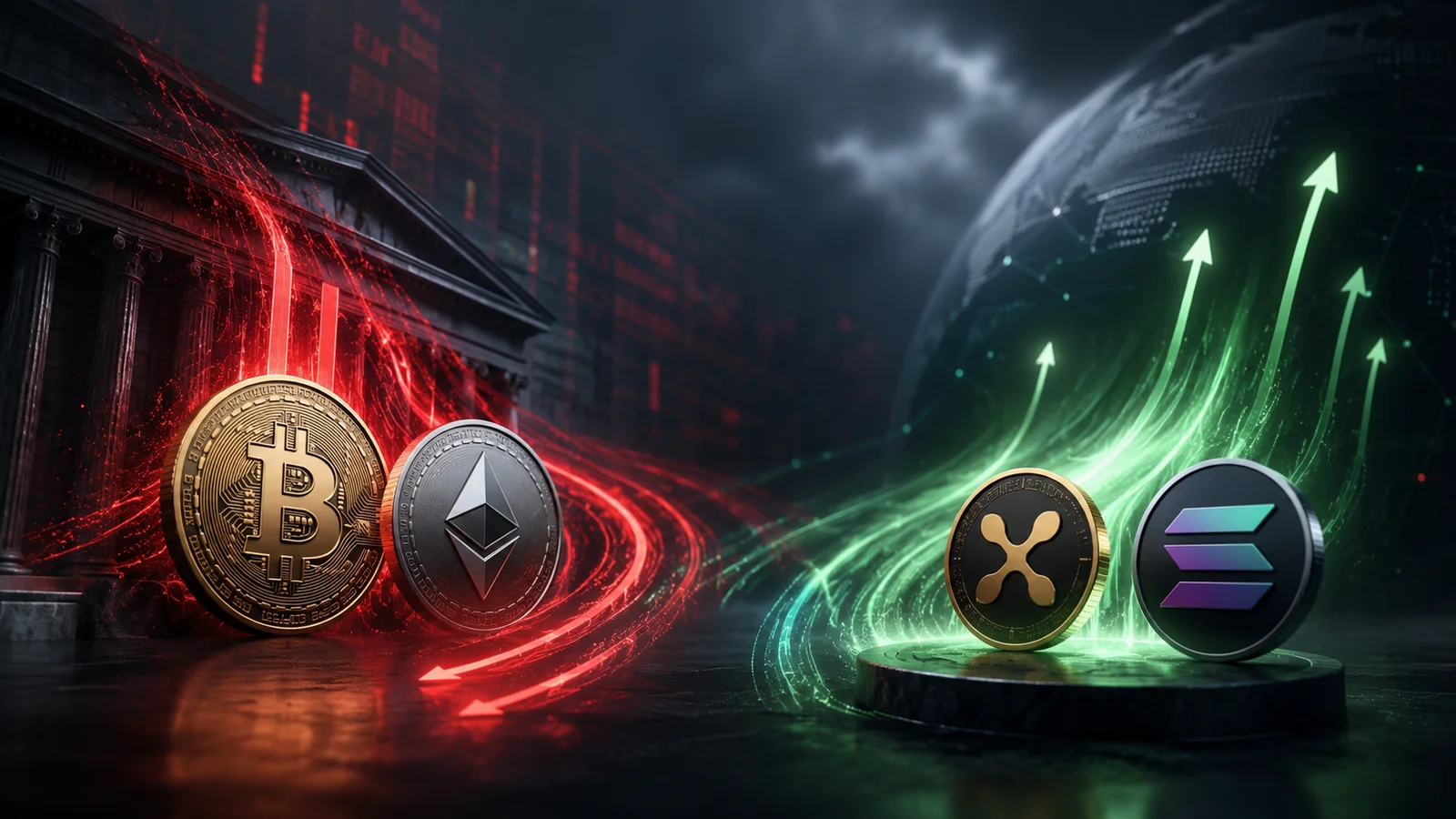
Countdown for Crypto Funds in Japan: Two Major Companies Take Action
A new era is dawning in Japan where the cryptocurrency market will become more closely intertwined with traditional finance. Two of the country's largest online brokerage firms, SBI Securities and Rakuten Securities, are preparing to offer cryptocurrency mutual funds once the regulatory framework is finalized. According to Nikkei Asia, these products will allow investors to access crypto assets like Bitcoin and Ethereum through their existing brokerage accounts. Currently in Japan, individual investors typically need to open a separate exchange account or use a wallet to buy cryptocurrencies. The new mutual fund model could make this process more familiar. Instead of directly buying cryptocurrencies, investors will be able to take positions through fund units based on these assets. This will make crypto investing more similar to buying stocks or mutual funds. SBI Securities' plan is based on distributing products developed by its group company, SBI Global Asset Management. The company's product portfolio is expected to include mutual funds and ETFs linked to liquid assets such as Bitcoin and Ethereum. The SBI group aims to manage the entire process internally, from product development to distribution. Rakuten Securities is similarly moving forward within its own group structure. Products to be developed by Rakuten Investment Management are planned to be directly buyable and sellable through Rakuten's smartphone application. This approach could make access to crypto more practical, especially for individual users who invest through mobile applications. It's not just SBI and Rakuten; other major financial institutions in Japan are also not shying away from this area. According to a Nikkei survey of 18 major brokerage firms, 11 companies stated they would consider offering crypto investment funds once regulations become clearer. These companies include prominent names such as Nomura Securities, Daiwa Securities, and Mizuho-affiliated Asset Management One. SMBC Group is also reportedly forming an in-house working group on the subject. Behind this interest are regulatory steps taken by the Financial Services Agency of Japan (FSA). The FSA aims to amend the implementing regulations of the Investment Partnerships Act to add crypto assets to the list of "certain assets" that investment funds can hold. This process is expected to be completed by 2028. Activity on the regulatory sideIn parallel, the Japanese government approved a bill in April that would classify cryptocurrencies as financial products rather than means of payment. If the bill passes parliament, the new regulation could come into effect in the 2027 fiscal year. Thus, crypto assets will be brought under a regulatory framework closer to financial instruments such as stocks and bonds.These preparations in Japan coincide with the increasing global interest in crypto ETFs. In the US, spot Bitcoin ETFs were approved in January 2024, after which these products became an important entry point for institutional and individual investors. According to SoSoValue data, the net assets of spot Bitcoin ETFs in the US have exceeded $100 billion. While Japan is proceeding more cautiously in this area, it is seen that large financial institutions are starting to take positions as regulatory uncertainty decreases. Crypto mutual funds can provide a significant convenience for Japanese individual investors. Users with an SBI or Rakuten account can access assets such as Bitcoin and Ethereum without opening a new crypto exchange account. Having regulated financial groups handle custody, reporting, and transaction processes can also strengthen the perception of trust. However, this structure is not the same as directly owning cryptocurrency. Instead of holding Bitcoin or Ethereum in their own wallets, investors will own funds based on these assets. Therefore, factors such as management fees, custody structure, and counterparty risk will determine the attractiveness of the products.