The US House of Representatives has taken a historic step toward providing regulatory clarity for crypto assets. Two critical bills, the CLARITY Act and the GENIUS Act, have advanced after a procedural process that lasted approximately 10 hours, marking the longest vote in Congressional history. This development means that long-awaited regulations for the crypto sector could finally become law.
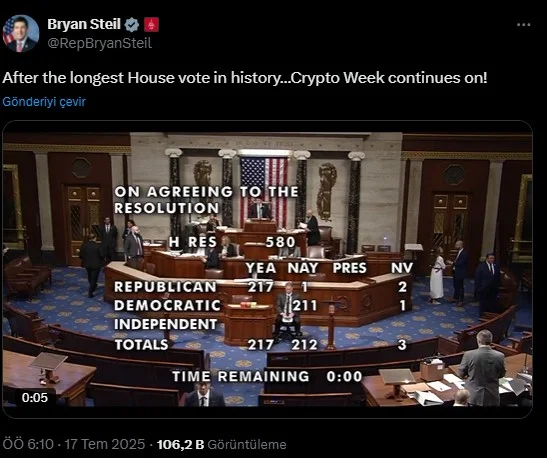
The process was shaped by internal tensions and negotiations within the Republican Party. As we reported, the bills, which failed to gain support from some Republican lawmakers in their initial vote on Tuesday, were officially introduced to the House floor on Wednesday, receiving the necessary procedural approval by a vote of 217-212. Closed-door meetings with US President Donald Trump, in particular, were decisive in changing the minds of some hesitant lawmakers.
The most critical element in paving the way for the bills was the addition of language to the CLARITY Act that includes "tough measures against Central Bank Digital Currency (CBDC)." This addition provides a safeguard against the federal government's potential surveillance powers over citizens. While the GENIUS Act cannot be amended, this agreement was sufficient to win the support of many undecided lawmakers.
House Financial Services Committee Chairman French Hill, in a statement after the vote, welcomed the process, saying, "Thanks to the efforts of President Trump, Speaker Mike Johnson, and Republican leaders to advance the digital asset agenda, we have achieved a historic success."
What do CLARITY and GENIUS aim to do?
The CLARITY Act aims to provide a clear regulatory framework for cryptoasset markets. The bill was drafted by House Agriculture Committee Chairman G.T. Thompson and subcommittee chairs Dusty Johnson and Bryan Steil. It aims to clarify fundamental issues such as how digital assets will be classified and which institutions will oversee them.
The GENIUS Act, on the other hand, focuses specifically on the stablecoin market and aims to increase consumer protection and encourage innovation in this area. If enacted, the bill could usher in a new era in the US digital asset sector. Additionally, the "Anti-CBDC Surveillance Act," introduced separately by House Majority Discipline Officer Tom Emmer, aims to prevent central bank digital currencies from violating citizens' privacy.
Record-length voting time marks crypto week
The procedural vote, which began at 1:19 PM on Wednesday, concluded at exactly 9:04 PM. The tension and negotiations that ensued during this period formed the backdrop for one of the most significant legislative steps in crypto history. Rep. Bryan Steil shared the following on social media platform X: "After the longest House vote in history... Crypto Week continues in full swing!"
If the bills are approved in the final vote in the coming days, President Trump is expected to sign the GENIUS Act into law by the end of the week. This could bring long-awaited regulatory clarity for digital assets in the US and usher in what supporters call a "golden age."