The International Monetary Fund (IMF) examined tokenization, a rising trend in global finance, in a new explainer video published today on its X account. While acknowledging that tokenization brings speed and cost advantages to financial markets, the institution also emphasized that this transformation creates new vulnerabilities.
The video describes tokenization as "the next step in the evolution of money." This structure, which replaces intermediaries who handle transactions, clearing, and recording in traditional markets with smart contracts, enables faster, more transparent, and cheaper asset buying and selling. According to the IMF, early research demonstrates significant cost advantages and increased efficiency in collateral use in tokenized markets. Near-instant settlement (T+0) is one of the most striking innovations.
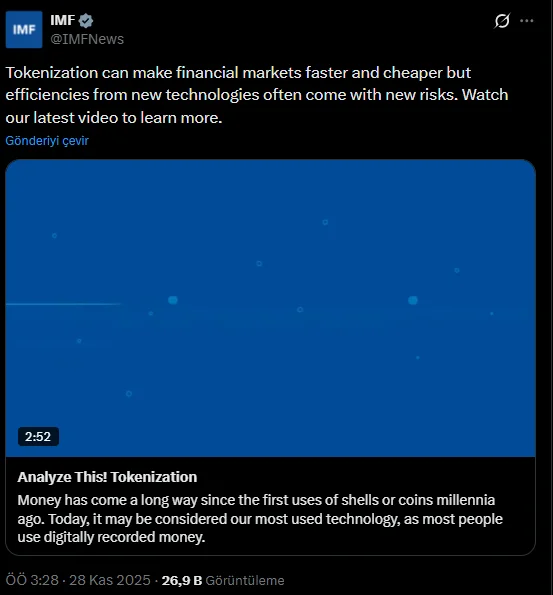
However, the IMF emphasizes that this efficiency also magnifies risks. Recalling the previous occurrence of "flash crashes," also known as sudden collapses in automated markets, the IMF states that code-based transactions conducted in tokenized markets can create a domino effect, especially during periods of stress. A smart contract error or an unexpected chain reaction could turn a local problem into a systemic shock.
Another warning highlighted in the video is the risk of fragmentation. If numerous tokenization platforms emerge and become unable to communicate with each other, liquidity could disperse, thus undermining the promise of creating a faster and more efficient market. The IMF states that infrastructure compatibility is therefore critical.
The IMF also emphasizes that governments have not historically been passive in the transformation of monetary systems, and states that states are likely to take a more active role in the future of tokenization. Historical examples such as the Bretton Woods agreement, the establishment of fixed exchange rate regimes, and the subsequent collapse of the gold standard demonstrate that states directly intervene in the functioning of monetary systems. According to the IMF, the tokenization process will likely not proceed independently of this tradition.
The IMF's interest in tokenization is not new. The IMF has been conducting extensive research in this area in recent years. However, the fact that these studies are now being transferred to a publicly accessible video format demonstrates that tokenization is no longer a niche technology in the global economy and has become a mainstream policy topic.
Significant growth in tokenization
Today, the tokenized market has surpassed billions of dollars. The rapid expansion of BlackRock's BUIDL fund over 2024 and 2025, transforming it into the world's largest tokenized Treasury fund, exemplifies the rapid maturation of the sector.
At the end of the video, the IMF acknowledges the potential of tokenization to make financial markets faster, cheaper, and more programmable, while stating that this transformation will occur under strict regulatory oversight. According to the institution, the new market structure is moving towards a future that is open to government intervention, while also leveraging the opportunities offered by technology.