
zkPass (ZKP) is a zkTLS-based data verification protocol that aims to convert private Web2 data into privacy-preserving verifiable proofs. The main idea behind the project is to allow users to verify data such as bank accounts, identity information, social media profiles, education history, gaming achievements or platform-based reputation without showing that raw data to third parties.
This approach responds to an important problem that the Web3 ecosystem has been facing for a long time. Blockchain applications offer open, transparent and verifiable infrastructures, but they cannot directly access users’ real-world data on the Web2 side. In traditional verification processes, users often have to upload documents, share screenshots, connect to a centralized application programming interface (API), or hand over their personal data to another platform. zkPass steps in at this point and makes it possible to share cryptographic proof about the data, rather than the data itself.
According to official documents, zkPass generates proofs locally in the user’s browser or on the user’s device. This means raw personal data is not transferred outside the user’s environment; only the necessary attributes for verification are turned into proofs. The project positions this model as a data verification layer that can be used across areas such as artificial intelligence, decentralized physical infrastructure networks (DePIN), digital identity, decentralized finance (DeFi), credit mechanisms, governance and compliance.
ZKP is the native token of the zkPass ecosystem. There is an important distinction here: ZKP is also the abbreviation for “zero-knowledge proof.” However, in this guide, unless stated otherwise, ZKP refers to the zkPass token.
zkPass: Definition and Origins
In its simplest form, zkPass is a privacy-focused protocol that makes Web2 data verifiable for Web3 applications. It allows users to prove that they meet a certain condition without directly sharing their private data. For example, a user can show that their credit score is above a certain level without revealing their full credit score, identity or financial history.
The project’s starting point is the fact that data on the internet is often visible, but not always verifiable. A screenshot can be altered, a document can be fake, and a social media account can be presented as if it belongs to someone else. In traditional systems, verification usually requires centralized intermediaries, API access or document upload processes. This creates additional risks for both user privacy and data security.
zkPass’s technical approach brings TLS, multi-party computation (MPC) and zero-knowledge proofs into the same architecture. The official technical document states that the protocol is built on three-party TLS, multi-party computation and interactive zero-knowledge proof structures. The goal is to prove that data accessed via HTTPS really comes from the relevant source, without exposing the user’s sensitive information.
For this reason, it would be incomplete to see zkPass only as an identity verification solution. The project targets a broader idea of a “verifiable internet.” According to this idea, users can turn the data they generate across different platforms into portable, verifiable and privacy-preserving proofs. This allows data that remains locked inside Web2 to be used more securely within Web3 applications.
zkPass History: Key Milestones
The technical foundation of zkPass dates back to 2022. Project summaries associate the first half of 2022 with technical architecture design, feasibility analysis and initial solution tests. In the second half of the same year, work reportedly continued on the multi-party zkPass prototype, PLONK19 and TLS 1.2 implementations. In the first half of 2023, the three-party TLS protocol was developed, the MPC network was expanded and the project moved into the pre-testnet phase.
May 2023 marked an important technical milestone for zkPass. The project’s technical document was updated on May 22, 2023, and the core problem of the protocol was clearly defined. Users can securely access private data via HTTPS, but they have difficulty proving to third parties, in a privacy-preserving way, that this data truly came from a specific website. zkPass aimed to close this gap through 3P-TLS, MPC and zero-knowledge proof structures.
In August 2023, the project announced a $2.5 million seed funding round. Participants included Sequoia China, Binance Labs, OKX Ventures, dao5, SIG DT Investments, Leland Ventures, Cypher Capital and Blockchain Founders Fund. zkPass stated that the funding would be used to accelerate the pre-alpha testnet process and expand the developer team. The same announcement also noted that the project had reached more than 190,000 waitlist registrations.
The second half of 2023 and the 2024 period can be seen as a phase of product development and ecosystem expansion for zkPass. Tools such as TransGate focused on turning selected data from any HTTPS website into verifiable proofs. Official announcements stated that TransGate could be used for different types of data, including identity, financial records, health information, social interactions, work history and educational certificates.
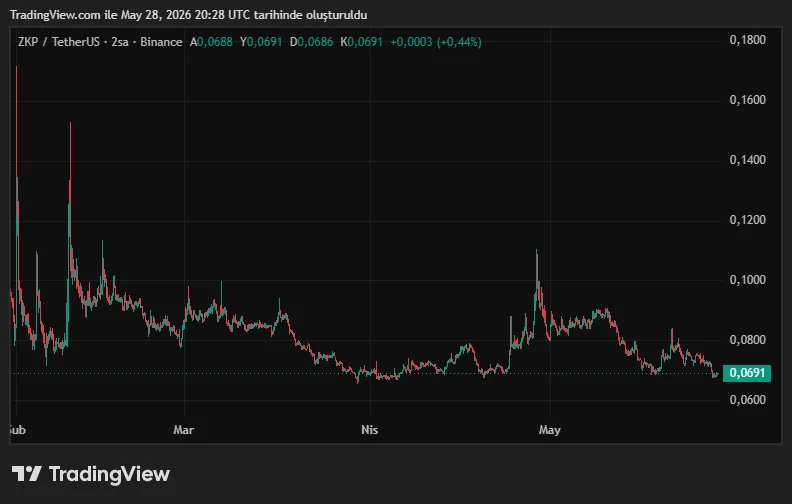
On the token side, ZKP became more visible in late 2025 and early 2026. The ZKP token was listed on Binance on January 7, 2026, and started trading with the Seed Tag. Trading pairs opened on Binance included ZKP/USDT, ZKP/USDC and ZKP/TRY.
ZKP’s all-time high is reported to be around $0.23. As of May 2026, the ZKP price is trading around $0.0690638.
Why Is zkPass Important?
zkPass is important because it touches one of Web3’s most fundamental gaps. Blockchain networks are powerful when it comes to verifying transactions within their own systems, but they struggle to directly verify off-chain data. A user’s banking history, social media reputation, education certificate, gaming achievement or platform membership does not naturally exist on the blockchain. This data remains on Web2 platforms.
This creates a major gap, especially in DeFi, digital identity and reputation systems. A DeFi protocol usually relies on overcollateralized lending models because it does not know the user’s credit history. A decentralized autonomous organization (DAO) may want to look at social or professional background as a membership criterion, but may not want to turn this into a centralized KYC process. A game or social platform may want to reward a user’s achievement on another platform, but screenshots are not reliable enough.
zkPass highlights the idea of “verification without sharing raw data.” The user can prove only the required condition without revealing the full data. For example, statements such as “I am over 18,” “I have an account on a specific platform,” “I have more than a certain number of followers,” or “I meet a certain financial criterion” can become verifiable.
This model is also important from the perspective of data ownership. Instead of handing over their data completely to a centralized intermediary, the user uses a proof generated from that data. This reduces the data storage burden for third parties and limits the risk of data leaks. Official documents also state that sensitive data does not leave the device and that proofs only reveal the attributes needed for verification.
How Does zkPass Work?
To understand how zkPass works, it is useful to first look at a standard internet connection. When a user connects to their bank, e-commerce account or social media profile via HTTPS, a secure TLS connection is established between the browser and the server. This connection encrypts the data and prevents third parties from reading the content. However, the traditional TLS structure does not make it easy for the user to later prove to a third party that “this data really came from this website.”
zkPass expands TLS into a three-party model at this point. According to the official technical overview, the protocol involves three parties: the prover, the verifier and the data source. The prover is the user and accesses their own data. The verifier is the party that checks the verification process. The data source is the HTTPS server from which the data comes. The user accesses the data and then proves, through a zero-knowledge proof, that the data satisfies a certain condition. The verifier checks the proof without seeing the user’s raw data.
What Is zkTLS?
zkTLS can be understood as the technological layer that makes the source of data coming from a TLS connection verifiable while preserving privacy. Normal TLS provides secure communication between the user and the website. zkTLS, on the other hand, aims to make the data produced through that secure communication provable to third parties.
In zkPass’s approach, zkTLS works together with the three-party TLS model. The user wants to prove that they received data from a specific website. However, while producing this proof, the user does not have to reveal their entire account, document content or personal information. For this reason, zkTLS plays a critical bridging role in moving Web2 data into Web3.
3P-TLS, MPC and Zero-Knowledge Proofs
zkPass uses three main technologies: 3P-TLS, MPC and zero-knowledge proofs. 3P-TLS adds a third verification party to the TLS process and helps check the source of the data. MPC allows the parties participating in the computation process to perform a joint verification without seeing each other’s private data. Zero-knowledge proofs allow the user to prove that a statement is true without revealing the raw data behind that statement.
The official technical document states that zkPass brings together 3P-TLS, MPC and zero-knowledge proof structures. This approach aims to help users prove statements about data accessed via HTTPS while preserving privacy. It specifically focuses on reducing the risks of fake documents, manipulated screenshots and centralized verifiers.
Hybrid Mode
Hybrid mode plays an important role in zkPass’s technical architecture. According to the official technical overview, zkPass uses a hybrid structure that combines proxy mode and MPC mode. In proxy mode, the user communicates with the data source through the verifier. In MPC mode, the user and the verifier form a client structure that acts together during the connection process with the server.
This hybrid approach was developed to adapt to different web server conditions. Some servers support certain connection types, while others may limit requests coming from different IP addresses under the same account. In such cases, zkPass aims to make the protocol more flexible by switching to MPC mode when needed. The technical overview also states that MPC mode is not the preferred model in every situation, but is used more as a backup mechanism under certain server restrictions.
What Is the ZKP Token Used For?
ZKP is the native utility token of the zkPass ecosystem. According to the official token document, ZKP is designed as an ERC-20 token and has a total supply capped at 1 billion. The document states that the token has a fixed supply, does not include inflation, and has a deflationary mechanism through the burning of part of settlement fees. A periodic buyback mechanism managed by the DAO is also included in the token documentation.
The first use case of ZKP is the proof settlement process. In the zkPass ecosystem, ZKP is used as a functional unit in processes such as proof generation, verification and verifier operations. This shows that the token is designed not only as a tradable asset, but also as a payment and coordination tool connected to the protocol’s operating logic.
The second use case is the verifier collateral mechanism. Verifiers provide ZKP collateral to support network accuracy, uptime and reliability. This model supports the verification infrastructure with economic incentives.
The third use case is network credits. ZKP can be used as an on-chain credit unit for verifiable computation, integrations and recording network contributions. The fourth area is developer and institutional access. Companies and developers can use ZKP to access zk-compatible verification interfaces and privacy-focused data infrastructure.
Finally, ZKP plays a role in governance and cross-system verifiability. Official documents state that the token supports decentralized coordination and is connected to ecosystem activities such as auditing and maintenance.
ZKP Tokenomics
ZKP tokenomics is built on a fixed total supply of 1 billion tokens. The official zkPass documentation lists the token standard as ERC-20, while cross-chain distributions follow LayerZero’s OFT standard. This structure aims to maintain a unified total supply and consistent token state across supported networks. The official document lists verified contract addresses on Ethereum mainnet, BNB Smart Chain and Base.
The largest allocation goes to the community category. The community allocation represents 48.5% of the total supply. Of this, 12.5% unlocks at the token generation event, 6% unlocks linearly over the first three months, and the remaining 30% is distributed monthly over five years starting from the token generation event. This category is reserved for ecosystem growth, reward distributions, network incentives, community sales, exchange-related marketing and strategic partnerships.
The early investors category receives 22.5% of the supply. This portion has a 12-month cliff period followed by an 18-month linear vesting model. The allocation for core contributors is 14%. This portion has a 24-month cliff period followed by a 24-month linear vesting structure. The DAO treasury receives 10% and unlocks through five-year linear vesting. The liquidity category receives 5% and fully unlocks at the token generation event. The official document states that there is 0% unlock for the team and investors at launch, while the circulating supply is limited to community participation and liquidity.
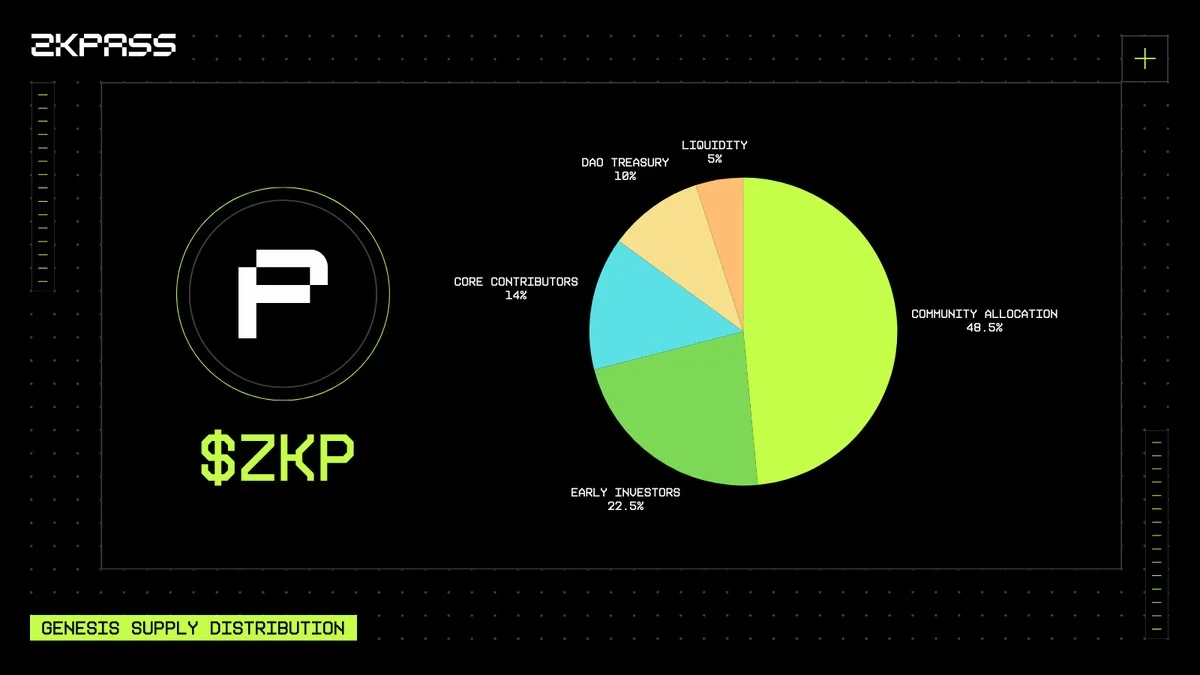
This structure highlights community and liquidity in the early stage, while team and investor tokens are tied to a time-based vesting schedule. Still, when evaluating tokenomics, it is important to look not only at allocation ratios but also at whether use cases create real demand, as well as network growth, verification volume and market liquidity.
zkPass Use Cases
zkPass use cases are shaped around scenarios where Web2 data can be used securely in Web3 applications. The first major area is decentralized identity. Users can prove their age, citizenship, account ownership, membership status or a specific identity criterion without sharing raw documents. This is especially important for transforming KYC processes into models that collect less data.
On the DeFi side, zkPass can be used for credit and reputation systems. In existing DeFi lending models, users often have to provide high collateral because the protocol does not know their off-chain financial history. With zkPass, a user can prove that their credit score, income level or account balance is above a certain threshold. In the long term, this could support the development of more flexible lending models.
Reward distribution and task verification also offer notable use cases. A project may want to prove that a user is genuinely active on a specific platform, manages a certain account or has completed certain tasks. If this verification is done with screenshots, manipulation risk emerges. zkPass can make this process more secure through proofs that verify data from its source.
A similar logic applies to social media and the creator economy. A content creator can prove that they have passed a certain follower threshold or that they own a specific social media account. However, they do not have to reveal their follower list, private messages or other sensitive account data. This structure can be used for DAO memberships, campaign access, brand collaborations or gated communities.
In gaming and education, user achievements come to the forefront. Achievements from services such as Steam, Epic Games, Duolingo, GitHub or educational platforms can be used as reward, access or reputation criteria in Web3 applications. The official document also gives examples of producing zero-knowledge proofs from Web2 data sources such as Binance, Duolingo and LinkedIn.
On the institutional side, compliance, data verification and customer criteria stand out. An institution may want to know that a user meets certain conditions, but may not want to store more data than necessary. Protocols like zkPass try to bring data minimization and verification needs into the same framework.
zkPass Developers and Community
zkPass is described in public project summaries as a project founded in 2022. On the team side, Bing Jiang and Joshua Peng stand out. These sources list Bing Jiang as co-founder and chief executive, and Joshua Peng as co-founder and chief technology officer. Joshua Peng is also said to have a University of Missouri background and to work on the technical research side.

The project’s vision is shaped around building an infrastructure that makes private internet data verifiable. zkPass explains this vision through the idea of a “verifiable internet.” This concept refers to internet data moving beyond being merely visible or self-declared and becoming cryptographically verifiable.
On the community side, zkPass’s growth is supported through testnets, campaigns, reward distributions, developer tools and integrations. In its 2023 seed funding announcement, the project stated that it had reached more than 190,000 waitlist registrations for the pre-alpha testnet. Later, campaigns such as the Binance Wallet Booster Program encouraged users to participate in processes such as proof generation, social tasks and delegation. The official document states that a total reward pool of 30 million ZKP was allocated for this campaign.
On the governance side, the ZKP token has a role connected to DAO coordination and ecosystem management. The official token document states that ZKP will be used for functions such as proof settlement, verifier collateral, network credits, service access and governance/coordination.
Frequently Asked Questions (FAQ)
Below are some frequently asked questions and answers about zkPass:
- What is zkPass and when was it launched?: zkPass is a zkTLS-based data verification protocol that aims to convert Web2 data into privacy-preserving verifiable proofs. The project’s technical work dates back to 2022, while its technical document was published on May 22, 2023. It became more visible in 2023 through the pre-alpha testnet and funding process.
- Who developed zkPass?: Public project summaries highlight Bing Jiang and Joshua Peng in the zkPass team. These sources list Bing Jiang as co-founder and chief executive, and Joshua Peng as co-founder and chief technology officer. The project’s technical focus is built around zkTLS, MPC and zero-knowledge proofs.
- What is the ZKP token used for?: The ZKP token is used in areas such as proof settlement, verifier collateral, network credits, service access and governance/coordination. According to official documents, ZKP works as a utility token designed for verification, network participation and protocol-level economic coordination within the zkPass ecosystem.
- What problems does zkPass aim to solve?: zkPass aims to allow users to verify private Web2 data without sharing it raw with third parties. This model focuses on reducing risks related to fake documents, manipulated screenshots, centralized API dependency, excessive data sharing and data leaks.
- Is zkPass suitable for investment?: zkPass is technically a notable project in the field of privacy-focused data verification. However, the ZKP token is subject to the volatile nature of the crypto market. Token unlocks, liquidity, network usage, regulatory risk and general market conditions should all be evaluated together before making an investment decision. This text is not investment advice.
- Which network does zkPass run on?: According to the official token document, ZKP is an ERC-20 token. Verified contract addresses have been published on Ethereum mainnet, BNB Smart Chain and Base. Cross-chain distributions follow LayerZero’s OFT standard.
- What is zkTLS?: zkTLS is the technological layer that makes the source of data coming through HTTPS verifiable while preserving privacy. zkPass uses this structure together with 3P-TLS, MPC and zero-knowledge proofs to generate proofs from private internet data.
- How does zkPass protect privacy?: In zkPass, proofs are generated on the user’s device or in the browser. Raw data is not transferred to third parties. The verifier only checks cryptographic proof showing that a certain statement is true. This allows the verification process to take place without sharing more personal information than necessary.
For the latest information on zkPass and privacy-focused Web3 data verification solutions, follow the JR Kripto Guide series.

