
Bitcoin holders usually have limited options when they want to access liquidity without selling their assets or earn yield on BTC. These options often involve centralized platforms or bridged tokens. Zest Protocol is developing a decentralized alternative by bringing Bitcoin-focused lending markets on-chain.
Definition and Origins of Zest Protocol
Zest Protocol is a DeFi protocol that allows Bitcoin holders to borrow against their assets or earn yield by providing liquidity to lending markets. The project focuses on putting Bitcoin liquidity to work without relying on centralized intermediaries.
ZEST was developed as the native token of this ecosystem. It is connected to community incentives, liquidity programs and a governance mechanism planned for activation at a later stage.
The protocol consists of more than a single lending application. Zest Protocol’s official documentation covers several products, including Stacks Market, Stacks Swap, the planned Stacks Vaults and Bitcoin Collateral Vaults.
Stacks Market allows users to deposit supported assets or borrow against collateral. Stacks Swap compares liquidity across different decentralized exchanges to find a suitable route for each transaction.
Stacks, Bitcoin and the multi-chain architecture
Zest Protocol’s first operational lending market was built on Stacks. Stacks provides a programming layer that allows smart contracts and decentralized applications to operate around Bitcoin.
The protocol’s contracts on Stacks were written in the Clarity language. Users can provide assets such as sBTC, STX and stSTX as collateral and borrow stablecoins such as USDCx and USDh.
sBTC is a BTC-backed asset that represents Bitcoin within the Stacks ecosystem on a one-to-one basis. Zest Protocol aims to offer lending, borrowing and yield options to Bitcoin holders through this asset.
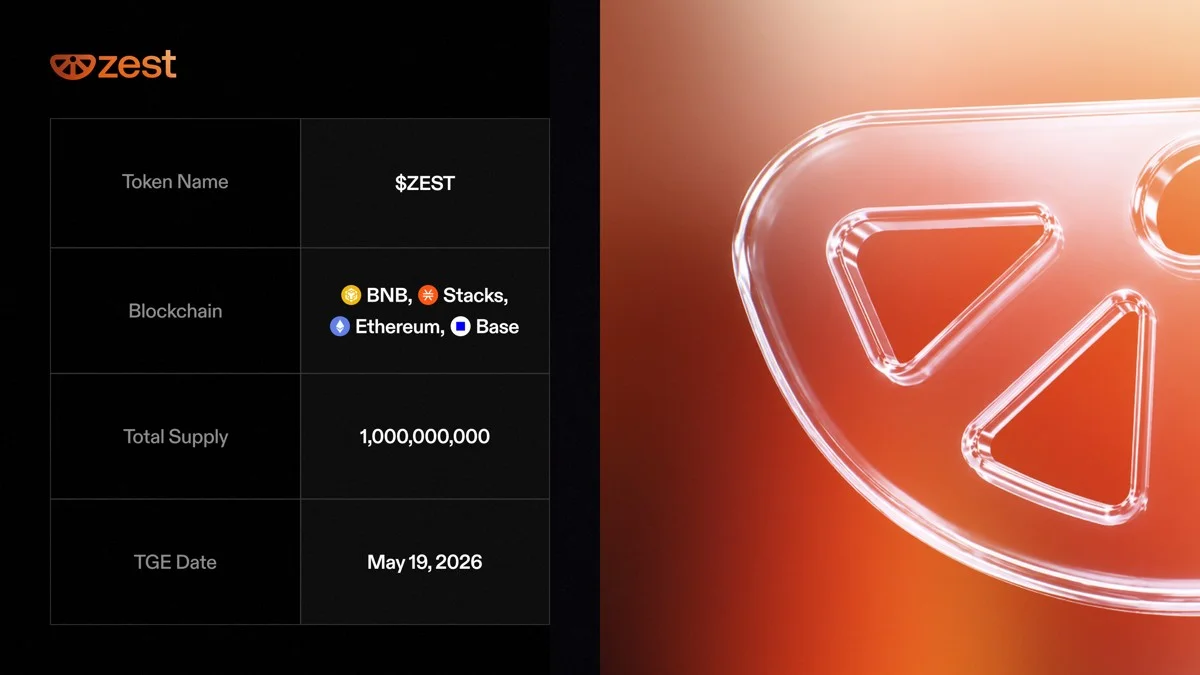
The ZEST token itself has a multi-chain structure. The project’s documentation lists official ZEST contracts on BNB Chain, Stacks, Ethereum and Base.
The BEP-20 version was used for the token’s initial centralized exchange listings. Support for Ethereum and Base was later added through Chainlink’s cross-chain messaging infrastructure, CCIP.
The networks supporting the protocol and the token need to be considered separately. Zest Protocol’s lending product primarily operates around Stacks and Bitcoin, while the ZEST token can be transferred across different networks.
Why the project was created
Bitcoin is one of the largest sources of liquidity in the crypto market, yet running general-purpose DeFi applications directly on its base layer remains difficult. BTC holders therefore often turn to centralized institutions or representations of Bitcoin transferred to other networks.
On centralized lending platforms, users send their assets to wallets managed by a company. They face direct counterparty risk if the company becomes insolvent, experiences liquidity problems or mismanages customer funds.
Bridged Bitcoin products carry separate risks. The bridge infrastructure, custody model and smart contracts may rely on security assumptions that differ from those of Bitcoin itself.
Zest Protocol aims to manage lending through smart contracts. Liquidity supplied by users is made available to borrowers according to defined collateral ratios and risk parameters.
One of the project’s long-term goals is to allow BTC to serve as collateral without leaving the Bitcoin mainnet. Bitcoin Collateral Vaults is being developed for this purpose.
Under the planned system, users lock BTC in a vault on Bitcoin. They can then borrow stablecoins from a liquidity pool on Ethereum or another EVM network.
History of Zest Protocol: Key Milestones
Zest Protocol’s history goes back to 2021, when the team joined Trust Machines to work on Bitcoin infrastructure. The team worked on Stacks, sBTC and Bitcoin-based smart contract infrastructure during this period.
The project became an independent venture in 2023 after the team’s work at Trust Machines. The founding team includes Tycho Onnasch, Fernando Foy and CTO Emil E.
Zest Protocol co-founder and CEO Tycho Onnasch serves as the public face of the project. Fernando Foy worked on smart contract development, while Emil E. focused on the technical infrastructure.
One of the protocol’s first products was a Stacks-based lending market. The market initially supported assets in the STX ecosystem before sBTC gained broader adoption.
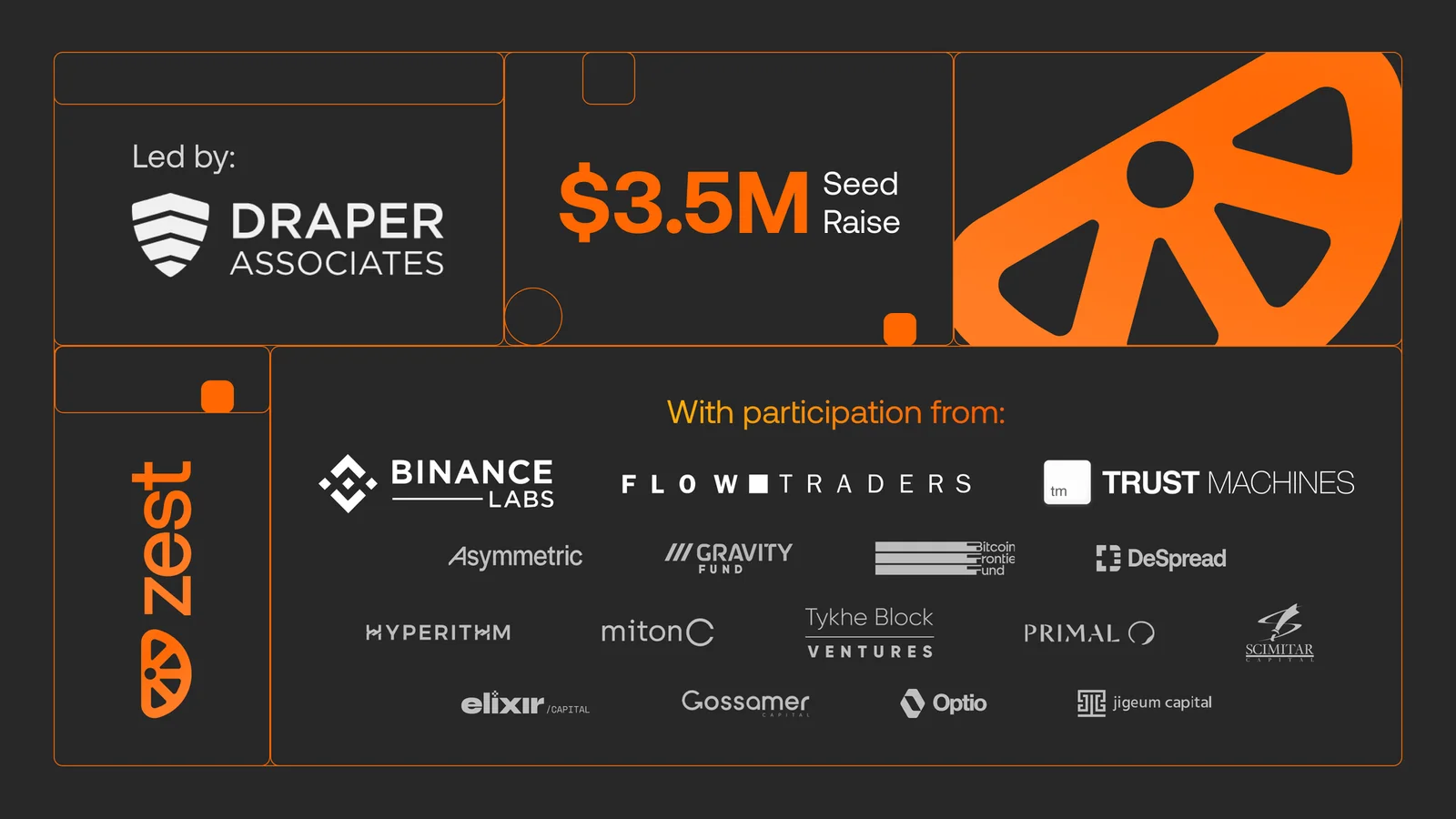
Zest Protocol completed a $3.5 million funding round in May 2024. According to the project’s May 2024 announcement, Draper Associates led the round.
Participants included Binance Labs, now known as YZi Labs, Flow Traders, Trust Machines, Asymmetric and Bitcoin Frontier Fund. The team said it would use the funding to expand its Bitcoin-focused lending infrastructure.
ZEST launch and exchange listings
Zest Protocol continued developing its Stacks market and Bitcoin yield products throughout 2024. During this period, the project also introduced a yield-focused Bitcoin product called BTCz.
BTCz was designed as a tokenized asset that users received in exchange for depositing Bitcoin into the system. The project later shifted its focus to sBTC, its new lending market and Bitcoin Collateral Vaults, gradually phasing out BTCz.
The protocol launched Stacks Market V2 in 2026. The new version introduced a “risk groups” model that allows different collateral and debt assets to be managed using parameters tailored to their individual risk profiles.
The liquidation system also changed with V2. Under the previous model, an entire position could be liquidated at once after crossing the risk threshold. The new structure applies gradual liquidations.
The ZEST token generation event took place on May 19, 2026. ZEST/USDT spot trading began on Gate and KuCoin on the same day.
The token also began trading on Binance Alpha, accompanied by a distribution for eligible users. A Binance Alpha listing does not carry the same status as a standard listing on Binance’s main spot market.
ZEST was later listed on other platforms, including BitMart. KuCoin opened a ZEST perpetual futures contract several days after spot trading began.
The listings increased the token’s accessibility while making its early price movements more volatile. A low circulating supply and speculative demand for newly launched tokens created conditions for sharp short-term price swings.
Bitcoin L1 expansion and current status
Zest Protocol announced Bitcoin Collateral Vaults in May 2026. The product aims to give users access to stablecoin liquidity on EVM networks while keeping their BTC on the Bitcoin mainnet.
The first phase is expected to use pre-signed Bitcoin transactions. These transactions limit the conditions and addresses under which the BTC held in a vault can move.
The project aims to move the verification process to BitVM in the second phase. BitVM is an approach designed to verify the results of external computations without running general-purpose smart contracts directly on Bitcoin.
The project team acknowledges that the BitVM-based version is not yet ready for production. Bitcoin Collateral Vaults is therefore progressing through a phased roadmap.
Zest Protocol expanded its products within the Stacks ecosystem during the same period. Stacks Swap launched as a liquidity aggregator that compares transaction routes across decentralized exchanges such as Bitflow, Velar, ALEX and Arkadiko.
Stacks Vaults is planned as a separate product that will combine automated yield strategies. As of August 2026, the official documentation still lists it among the upcoming features.
At the time of writing, the ZEST coin price is trading at around $0.13. Depending on the data provider, the token has a market capitalization of approximately $19 million to $20 million.
How Does the ZEST Token Work?
ZEST is the native token of the Zest Protocol ecosystem. Its planned long-term use cases include governance, staking and protocol incentives.
However, all these features were not activated when the token entered the market. The project’s documentation says governance and staking will be introduced once the protocol reaches sufficient scale.
This distinction matters when assessing ZEST’s current utility. It would be inaccurate to say that token holders can already vote directly on every protocol decision.
The planned governance structure may cover supported assets, risk parameters, protocol upgrades and the use of ecosystem resources. Its exact scope will become clearer as the governance modules are activated.
ZEST was also designed for user and liquidity incentives. Community programs, airdrop distributions and campaigns intended to increase protocol usage fall under this category.
An incentive token can generate lasting demand only if its rewards gain utility beyond short-term trading. High token incentives may create selling pressure if the user base and protocol revenue fail to grow.
ZEST supply, allocation and token unlocks
The total ZEST supply is capped at 1 billion tokens. The documentation states that the supply is fixed and that no additional ZEST can be created beyond this amount.
A total of 27.83% of the supply was allocated to the community. This share includes early-user distributions, protocol incentives and liquidity programs.
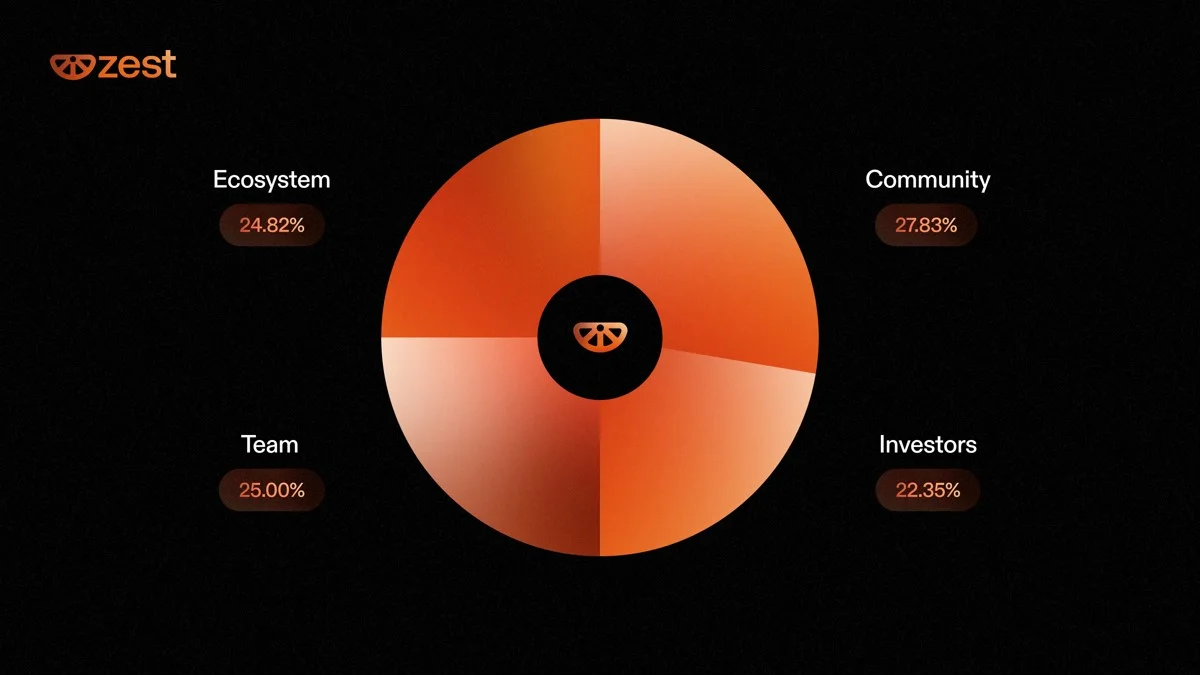
The ecosystem development allocation was set at 24.82%. This portion can support liquidity provision, partnerships, marketing, exchange-related processes and product growth.
Investors received 22.35% of the total supply. The team allocation stands at 25%.
The combined investor and team allocation therefore reaches 47.35%. This makes it important to monitor their token unlocks in the coming periods.
Approximately 14.6% of the total supply entered circulation during the token generation event. Most came from the ecosystem development fund, while a smaller portion was used for the initial community distribution.
A significant part of the remaining community allocation follows a 24-month linear vesting schedule. The locked portion of the ecosystem development allocation is released gradually over 12 months.
Team and investor tokens have a 12-month cliff. Their allocations are then scheduled to unlock linearly over 36 months.
The initially low circulation rate creates a wide gap between the fully diluted valuation and the current market capitalization. Approximately 146 million to 150 million tokens were in circulation in August 2026, compared with a total supply of 1 billion.
Tokens entering circulation in the future do not automatically lead to a price decline. However, the additional supply could place pressure on the price if market demand does not grow at the same pace.
Cross-chain transactions and security structure
Users begin by depositing a supported asset into Zest Protocol’s lending market. The deposited asset can provide liquidity or serve as collateral for a loan.
Liquidity providers earn returns from the interest paid by borrowers. Interest rates are variable and change according to the available liquidity in the pool and borrowing demand.
Borrowers can withdraw assets only up to a certain percentage of their collateral value. The position’s health factor weakens if the value of the collateral falls or the value of the debt rises.
Liquidation can begin when a position reaches the specified risk thresholds. Instead of closing the entire position in a single transaction, the V2 model applies gradual liquidation according to the level of risk.
The protocol uses Pyth’s oracle infrastructure for price data. Accurate oracle information is critical for the correct calculation of collateral ratios and liquidations.
Each collateral-debt pair can have different parameters under V2. For example, borrowing USDCx against sBTC may have different risk limits from borrowing another asset against STX.
Users can also keep their collateral separate from the lending pool. Under this model, the asset remains only as collateral and is not lent to another borrower. The user does not earn interest on this portion.
Zest Protocol experienced an attack targeting its smart contracts in April 2024. According to the project, the incident did not result in any loss of user funds.
The team later helped establish Clarity Alliance, an auditing group focused on Clarity smart contracts. It also introduced Hypernative infrastructure to monitor suspicious on-chain activity.
These measures aim to reduce technical risk, although they cannot eliminate it entirely. Software bugs, oracle problems, governance vulnerabilities and bridge risks can still affect audited protocols.
ZEST’s presence on multiple networks also requires users to verify contract addresses. Transactions involving the wrong network or a fake token contract can result in permanent loss of funds.
Why Is Zest Protocol Important?
A significant share of Bitcoin holders prefer to keep their BTC for the long term. However, they may still need to sell the asset when they require unexpected cash or liquidity for another investment.
Bitcoin-backed loans allow users to access stablecoin liquidity without closing their BTC positions. Zest Protocol is working to manage this model through on-chain contracts instead of a centralized lender.
Liquidity providers operate on the other side of the system. These users deposit assets into pools and earn variable returns from the interest paid by borrowers.
The scope of this model could expand when Bitcoin Collateral Vaults goes live. Keeping BTC on the Bitcoin mainnet without converting it into a wrapped token aims to reduce some bridge and custody risks.
However, the first version’s use of pre-signed transactions introduces different trust assumptions. The operation and production performance of the final BitVM-supported model can be assessed once the product launches.
Team, investors and ecosystem partnerships
The Zest Protocol team worked on Stacks and sBTC infrastructure before creating the project. This background demonstrates the team’s technical experience with Bitcoin programming layers.
Support from investors such as Draper Associates, YZi Labs, Flow Traders and Trust Machines also gave the project access to funding and industry connections. Investor support alone does not guarantee the protocol’s success.
The Stacks ecosystem plays a central role in Zest Protocol’s growth. Potential liquidity in the lending market could expand as the use of assets such as sBTC, STX, stSTX, USDCx and USDh increases.
Bringing together liquidity from Bitflow, Velar, ALEX and Arkadiko through Stacks Swap broadens the protocol’s product range. This allows Zest Protocol to seek a share of transaction flow on Stacks alongside its lending market.
Connections to Ethereum and Base make it easier to move ZEST across different ecosystems. Stablecoin liquidity on EVM networks could become more directly relevant as Bitcoin Collateral Vaults progresses.
The first-season points program and ZEST airdrop stood out on the community side. User incentives can support early liquidity, although lasting growth needs to continue after reward programs end.
Smart contract, liquidation and volatility risks
Zest Protocol is exposed to the fundamental risks of DeFi lending markets. A smart contract vulnerability, incorrect price data or an unexpected network problem could affect user funds.
Borrowers also face liquidation risk. If BTC or another collateral asset falls sharply, part or all of a position may be sold to repay the debt.
Gradual liquidation aims to reduce the impact of sudden liquidations. Even so, it cannot fully prevent collateral losses during rapid market movements.
Limited liquidity creates another potential problem. Interest rates can rise sharply if borrowing demand increases while available assets in the pool decline.
One of the most significant risks for the ZEST token is its low circulating supply. Most of the total supply will unlock in the coming years, which means the market may need enough demand to absorb the additional tokens.
The fact that the token’s governance and staking functions have not yet been fully activated also limits its current utility. It remains unclear when these features will launch and how much demand they will create for ZEST.
Competition in the BTCFi sector is growing. Ethereum-based applications, emerging Bitcoin layers and institutional custody solutions are also being developed for Bitcoin-backed loans.
The regulatory environment presents another source of uncertainty. Token incentives, decentralized lending services and stablecoin use may be subject to different rules across jurisdictions.
ZEST’s price performance therefore depends on more than the protocol’s technical development. The Bitcoin price, broader market conditions, token unlocks and exchange liquidity can also affect its value.
Frequently Asked Questions (FAQ)
Below are answers to some frequently asked questions about Zest Protocol (ZEST):
- What is Zest Protocol, and when was it launched?: Zest Protocol is a Bitcoin-focused on-chain lending and liquidity protocol. The team’s work on Bitcoin infrastructure dates back to 2021, while the project became an independent venture in 2023. Its first products on Stacks began operating in 2024. The ZEST token entered the market on May 19, 2026.
- What is the ZEST token used for?: ZEST is used for ecosystem incentives, liquidity programs and community distributions. Governance and staking functions are also planned for the token. According to the project’s documentation, these features will be activated when the protocol reaches sufficient scale. Planned functions should therefore be distinguished from the use cases currently available.
- Which network does Zest Protocol operate on?: The protocol’s active lending market operates on Stacks and supports Bitcoin-focused assets. Bitcoin Collateral Vaults aims to establish a collateral and borrowing connection between the Bitcoin mainnet and EVM networks such as Ethereum. Versions of the ZEST token are available on BNB Chain, Stacks, Ethereum and Base. Users should verify the correct network and official contract address before transferring the token.
- Who founded Zest Protocol?: Zest Protocol’s founding team includes Tycho Onnasch, Fernando Foy and Emil E. Onnasch serves as CEO, while Emil E. is the CTO. The team previously worked on Stacks and Bitcoin infrastructure at Trust Machines. The project became independent in 2023.
- What is the ZEST supply?: ZEST has a total and maximum supply of 1 billion tokens. As of August 2026, the circulating supply varies between approximately 146 million and 150 million, depending on the data provider. The community received 27.83% of the total supply, while 24.82% was allocated to ecosystem development. Investors received 22.35%, and the team allocation stands at 25%.
- Is Zest Protocol suitable for investment?: Zest Protocol has operational products in the Bitcoin-backed lending sector and an experienced development team. However, ZEST is a new token, and most of its total supply has not yet entered circulation. Smart contract vulnerabilities, liquidations, token unlocks and sharp price movements should be considered. Whether ZEST is suitable for any investor depends on their personal risk tolerance, research and portfolio structure. Zest Protocol is building a broad BTCFi ecosystem that aims to make Bitcoin easier to use for lending and stablecoin liquidity. Stacks Market currently forms the operational foundation of the project, while Bitcoin Collateral Vaults, governance and new vault products are among the developments that could shape ZEST’s long-term utility.
Follow the JR Kripto Guide series for updates on Zest Protocol’s Bitcoin-backed lending products, the Bitcoin Collateral Vaults roadmap and developments across the ZEST ecosystem.

