
Some blockchain transactions can only be verified when the underlying data is made publicly available. Zerobase aims to reduce this requirement by combining zero-knowledge proofs with trusted execution environments; sensitive calculations are performed off-chain while their results can still be verified on-chain. ZBT, the project’s native utility token, is used for proof generation, node incentives and certain governance processes within the ecosystem.
The Definition and Origins of Zerobase
Zerobase, officially written as ZEROBASE in the project’s documents, is a cryptographic computing network focused on producing real-time zero-knowledge proofs. The project aims to make the results of off-chain calculations verifiable, particularly when the data involved needs to remain private.
At the core of Zerobase is a proof-generation network known as a “prover network.” This network performs calculations on behalf of users or applications and then generates cryptographic proofs showing that the operation was completed according to predefined rules.
ZBT was designed as the utility token of this infrastructure. It can be used to pay for proof-generation services, reward node participants, access certain products and participate in governance processes related to network parameters.
Holding ZBT does not provide ownership or revenue rights in the company developing Zerobase. The project’s official economic model specifically states that the token does not represent equity, debt, dividend rights or a direct claim on project revenue.
Which Networks Does Zerobase Operate On?
Zerobase does not operate its own independent layer-1 or layer-2 blockchain. Proof generation and some calculations take place off-chain, while token transactions, staking contracts and proof-verification processes connect to Ethereum and other EVM-compatible networks.
ZBT primarily uses the ERC-20 token standard on Ethereum. Zerobase’s MiCA-compliant technical document also states that the token is compatible with EVM networks such as BNB Smart Chain and Polygon.
The token contract is also based on LayerZero’s Omnichain Fungible Token standard. This structure allows ZBT to move between supported networks while aiming to coordinate the total supply across different blockchains.
Various exchange-listing announcements have shown support for both Ethereum ERC-20 and BNB Smart Chain BEP-20 deposits. Some exchanges, however, only accept deposits through Ethereum. Users should therefore check which network an exchange supports before transferring ZBT.
The Purpose of ZK Proofs and TEE Infrastructure
A zero-knowledge proof allows someone to prove that a particular statement is true without revealing the underlying information. For example, the risk level of a trading strategy can be verified as remaining within a defined range without disclosing every detail of that strategy.
Although this approach improves privacy, generating proofs can require significant computing power. Zerobase uses Trusted Execution Environments, or TEEs, to speed up this process.
A TEE creates an isolated workspace at the hardware level for data used during a calculation. According to the project’s technical documents, sensitive data is processed inside this environment, preventing node operators from directly accessing the raw inputs.
Once the calculation is complete, a zero-knowledge proof is generated for the result. This proof is submitted to smart contracts on the blockchain, allowing users to verify whether the calculation followed the required rules without seeing all of the underlying data.
The Zerobase architecture relies on three main layers. The TEE layer carries out calculations privately, the ZKP layer converts the result into a proof and Proof Mesh aims to establish a standard connection between different proof systems and applications.
Proof Mesh provides a shared interface for formatting, combining and reusing proofs across different applications.
The History and Ecosystem of Zerobase
According to Zerobase’s official materials, the project emerged in March 2024 from cryptography work conducted within Salus Security. The team had previously completed various assignments for Privacy and Scaling Explorations, a group connected to the Ethereum Foundation’s cryptography research.
As demand for proof-generation services increased, the work developed into an independent project. At this stage, Zerobase positioned itself as a fast, decentralized and compliance-oriented ZK proof network.
Vortex Tech Ltd. is identified as the token issuer and the legal entity behind the network. The company was incorporated in the Cayman Islands on July 18, 2024.
Zerobase’s official MiCA document lists Xueyan Tang as the company’s CEO, Koppany Smith as its COO and Li Chen as its CMO. In other official project materials, Xueyan Tang is introduced as Mirror Tang and serves as one of the most visible public representatives of Zerobase.
Mirror Tang describes herself as a cryptography professor at Shanghai Jiao Tong University. However, project documents do not present Zerobase as a company founded by a single individual. Instead, it is described as a team-based project that developed out of Salus Security.
Zerobase announced a $5 million funding round in October 2024. Official documents list Binance Labs, which was later renamed YZi Labs, Lightspeed Faction, dao5 and Matrix Partners among the project’s backers.
According to the MiCA document, the project raised approximately another $1 million in April 2025 through a funding round aimed at community members and key opinion leaders. The document states that the team had 26 full-time employees as of the final quarter of 2025, although this figure may have changed since then.
ZBT Launch and Exchange Listings
Before ZBT entered the market, a Pre-TGE sale was held through Binance Wallet. According to the official document, the subscription period took place on September 24, 2025, with 10 million ZBT allocated to the sale at a price of 0.02 USDT per token.
This amount represented 1 percent of the total supply. Tokens purchased during the sale could not be transferred until the token generation event scheduled for October 17, 2025.
ZBT completed its Token Generation Event on October 17, 2025. On the same day, Binance listed ZBT as the 54th project in its HODLer Airdrops program and opened trading pairs against USDT, USDC, BNB, FDUSD and TRY.
According to Binance Research, ZBT’s initial circulating supply at the time of listing was approximately 220 million tokens. A total of 30 million ZBT, equivalent to 3 percent of the total supply, was allocated to the HODLer Airdrops program.
During the same period, the token also began trading on platforms including Kraken, KuCoin, Bybit, Bitget, OKX and Gate. Upbit opened KRW, BTC and USDT trading pairs for ZBT, while Kraken launched spot trading on October 17, 2025.
The large number of listings improved the token’s accessibility. However, being listed on major exchanges does not guarantee a project’s technical success, adoption rate or future price performance.
Products, Partnerships and Current Status
Zerobase is not only developing a general-purpose proof-generation network. The project also aims to reach the finance, identity-verification and computing sectors through different products built on the same infrastructure.
zkStaking is introduced as a product in which users deposit stablecoins and returns are generated through off-chain strategies. The goal is to verify yield and risk data through zero-knowledge proofs even when the full details of the strategies are not disclosed.
ProofYield focuses on measuring off-chain resources such as bandwidth and computing capacity. Participants can prove cryptographically that they supplied resources and may receive ZBT rewards according to the protocol’s conditions.
zkLogin aims to allow users to access specific accounts or services without directly sharing their identity information. The project lists gaming accounts, social platforms, voting systems and educational records among its potential use cases.
The official website also features other products, including zkDarkpool, zkFi and zkCEX. zkDarkpool focuses on private and compliance-oriented trading environments, zkFi targets stablecoin staking strategies and zkCEX focuses on verifiable staking models connecting centralized and decentralized finance.
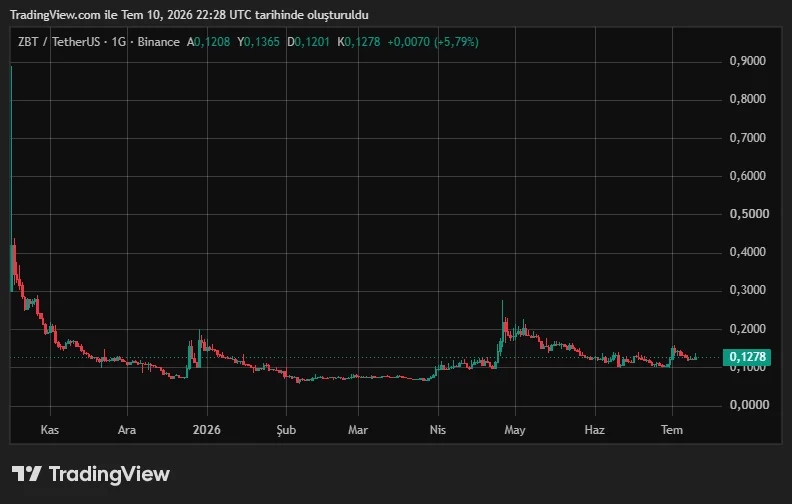
As of July 2026, the ZBT coin price was trading at around $0.12.
How Does the ZBT Token Work?
One of ZBT’s main use cases is providing access to cryptographic services on Zerobase. Developers can use the token to generate proofs or query results through Proof Mesh.
The Zerobase network includes two main types of nodes: HUB Nodes and Proving Nodes. HUB Nodes direct users’ proof requests to suitable Proving Nodes, help distribute network traffic and provide unused bandwidth to the system.
Operating a HUB Node does not require collateral. Rewards are distributed in ZBT based on factors such as routing performance, uptime and the amount of traffic contributed to the network.
Proving Nodes handle the computationally intensive side of proof generation. These nodes execute calculations inside TEEs and generate zero-knowledge proofs.
According to the official economic model, Proving Node operators must provide at least $1 million worth of stablecoin collateral. Rewards may be paid in ZBT or stablecoins based on the number, quality and transaction volume of completed tasks.
This high collateral requirement may encourage professional infrastructure providers to participate. However, it may also make it difficult for smaller participants to operate Proving Nodes, raising questions about how decentralized the network can become.
ZBT can also be used in proposals and votes related to protocol parameters. These rights do not provide participation in company management or revenue sharing; they serve as a procedural governance mechanism for technical network decisions.
ZBT Supply and Token Distribution
ZBT has a maximum supply of 1 billion tokens. The official economic model describes the supply as fixed and non-inflationary.
A total of 43.75 percent of the supply was allocated to node staking rewards. This represents the largest portion of the ZBT economy, with the tokens scheduled to enter circulation through a linear distribution program beginning one month after the TGE.
The team and advisers received an allocation of 20 percent. These tokens are subject to a one-year lock-up period, followed by a 48-month linear vesting schedule.
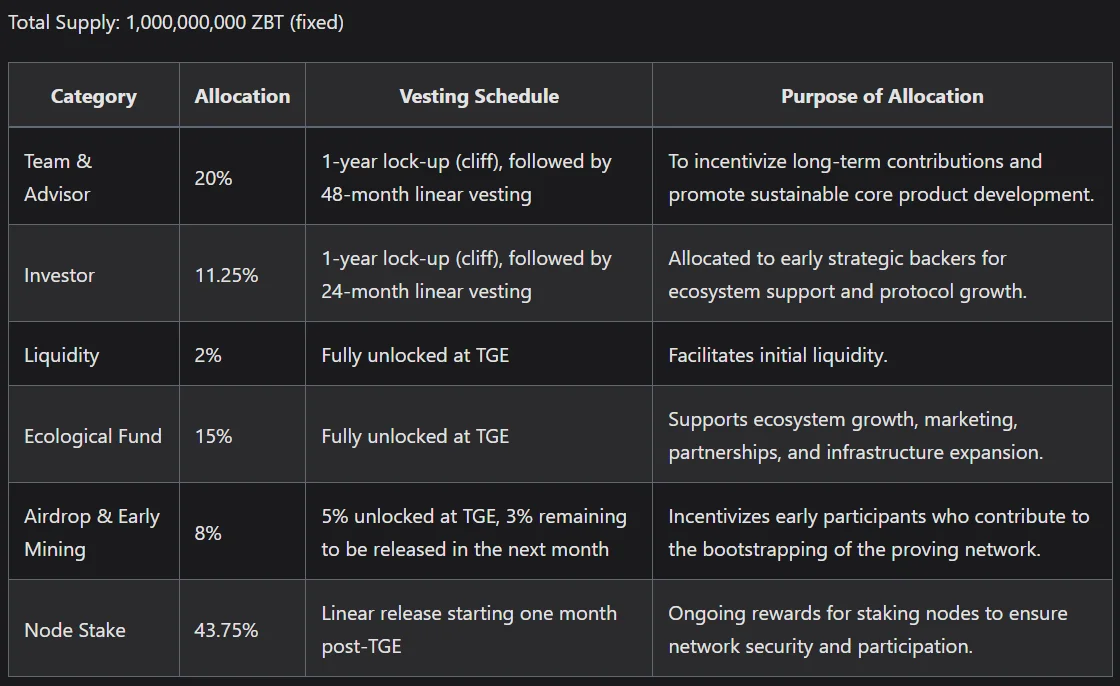
Investor allocations account for 11.25 percent of the total supply. These tokens are also subject to a one-year lock-up, followed by a 24-month linear vesting schedule.
The ecosystem fund received 15 percent, airdrops and early mining received 8 percent and initial liquidity received 2 percent. The ecosystem fund and liquidity allocations were reported to have been fully unlocked at the TGE.
A total of 5 percent of the airdrop and early-mining allocation entered circulation at the TGE. A separate distribution schedule was announced for the remaining 3 percent, which was released over the following month.
Node rewards and tokens allocated to the team and investors will gradually increase the circulating supply. If demand does not grow at the same pace, these unlocks may create selling pressure in the market.
Zerobase’s economic model page states that a buyback-and-burn mechanism could be introduced through a DAO decision. However, the MiCA document states that there is no active supply-adjustment mechanism and that the protocol does not allow minting or burning outside the vesting program.
These two statements do not fully align. It is therefore more cautious to view token burning as a potential economic mechanism that could be proposed through governance in the future rather than an active and confirmed feature of ZBT.
Multichain Structure and Security Audits
The ZBT contract uses the ERC-20 standard and LayerZero’s OFT infrastructure. Although separate contracts may exist on supported chains, the cross-chain messaging system helps maintain the total token supply.
The Zerobase token contract was reviewed by OpenZeppelin in August 2025. The audit did not identify any critical, high-severity or medium-severity vulnerabilities. It reported three low-severity findings along with several technical notes.
A total of 13 issues were recorded during the audit. Most were resolved, while some were only partially addressed. The report covered areas such as testing coverage, deployment scripts, administrative privileges and cross-chain configuration.
The administrator address in the contract can control LayerZero connections and certain administrator-only functions. The project stated that this address would be configured as a multisignature wallet.
According to the MiCA document, the zkStaking contracts were audited by PeckShield and Salus Security, while the ZBT contract was reviewed by OpenZeppelin and Salus Security. The document states that no critical vulnerabilities were identified.
Smart contract audits may help reduce risk, but they do not guarantee that every vulnerability has been discovered. Zerobase also depends on TEE hardware, off-chain servers, EVM networks and LayerZero’s messaging infrastructure, meaning that security assessments should not be limited to the ZBT contract alone.
Why Is Zerobase Important?
Blockchains provide transparent records, but commercial strategies, customer information and institutional calculations cannot always be conducted in public. In fully off-chain systems, users must trust the service provider to calculate results correctly.
Zerobase aims to connect these two environments. Sensitive calculations are performed privately inside a TEE, while the result can be verified on-chain through a zero-knowledge proof.
This model may be particularly useful for algorithmic trading strategies. A fund could prove information such as its leverage ratio, risk range or compliance with specific rules without disclosing its trading model and positions.
Similar methods could also be used to verify artificial intelligence outputs, perform calculations on private data, provide authorization without revealing identity information and measure bandwidth contributions.
Zerobase’s success will depend on whether these use cases generate real demand for proofs. Technical capability alone will not be enough; developers need to integrate the infrastructure, and users must choose the network over traditional alternatives.
Zerobase’s Position in the Ecosystem
Zerobase focuses on a different area from blockchain projects developing ZK rollups. Instead of creating a new general-purpose blockchain, the project aims to provide proof-generation and verifiable off-chain computing services to other applications.
For this reason, the project is close to a “proof as a service” model. Applications can use Zerobase’s node network, circuit templates and APIs without building their own extensive proof infrastructure.
The Proof Mesh layer aims to simplify integration by standardizing different types of proofs. Proof aggregation, recursive proofs and proof transfer between different protocols are among the layer’s objectives.
Zerobase also combines ZK infrastructure with staking and yield products. This approach aims to create utility for the token beyond technical proof fees by incorporating it into user-facing financial products.
However, the ZK proof market is highly competitive. Specialized prover networks, rollup teams, hardware-acceleration projects and centralized cloud providers all offer different solutions for the same computing demand.
Zerobase’s combination of TEEs, zero-knowledge proofs and a multichain token economy may help differentiate the project. Long-term competitiveness, however, will depend on measurable factors such as proof-generation cost, speed, uptime, developer experience and real customer usage.
Technical, Economic and Market Risks
ZBT is a crypto asset exposed to high volatility. Its price may experience sharp movements due to market sentiment, exchange liquidity, broader crypto trends, token unlocks and demand for Zerobase products.
A significant portion of the total supply was allocated to node rewards, the team and investors. Long-term vesting schedules may reduce sudden supply increases, but they still gradually increase the number of tokens in circulation.
On the technical side, TEE systems depend on hardware manufacturers and remote-attestation mechanisms. Hardware vulnerabilities, configuration errors or new attack methods targeting trusted execution environments could affect the system’s privacy assumptions.
The high stablecoin collateral requirement for Proving Nodes creates another risk. It may allow a small number of large operators to gain significant influence over the network and limit the project’s decentralization goals.
Products such as zkStaking use off-chain yield strategies. This model does not eliminate conventional DeFi risks such as strategy failure, liquidity problems, counterparty risk, stablecoin depegging or smart contract vulnerabilities.
The differences between the project’s economic documents regarding token burning should also be monitored. Important changes to token economics need to be verified through official governance decisions, updated smart contracts and newly published documents.
The regulatory environment represents another source of uncertainty. Privacy technologies, crypto-asset services and yield-generating products may be subject to different rules in different jurisdictions, and some features may be restricted by region.
Zerobase’s listings on major exchanges improve access to liquidity. However, these listings do not guarantee technical adoption, sustainable revenue or the preservation of the token’s value.
Frequently Asked Questions
Below are answers to some frequently asked questions about Zerobase.
- What is Zerobase and when was it launched?: Zerobase is a cryptographic infrastructure network that uses zero-knowledge proofs and trusted execution environments to make off-chain calculations verifiable. The project emerged from Salus Security’s cryptography work in March 2024, while the ZBT Token Generation Event and exchange listings took place on October 17, 2025.
- What is the ZBT token used for?: ZBT is used to pay for proof-generation services, reward node participants, access products such as ProofYield and zkStaking and participate in certain protocol-governance processes. The token does not provide ownership or profit-sharing rights in the company developing Zerobase.
- Which network does Zerobase operate on?: Zerobase does not have its own blockchain. ZBT was issued as an ERC-20 token on Ethereum, while the project uses a multichain structure designed to work with BNB Smart Chain, Polygon and other EVM-compatible networks.
- Who founded Zerobase?: Official sources identify Xueyan Tang, also known as Mirror Tang, as Zerobase’s CEO and project leader. However, Zerobase is described in its official history as an independent project that emerged from the cryptography team within Salus Security rather than a company founded by a single person.
- What is the ZBT supply? ZBT has a fixed maximum supply of 1 billion tokens. The circulating supply changes over time according to vesting schedules, node rewards and previously announced distribution programs. Figures published by data providers may differ depending on their calculation and update methods.
Follow the JR Crypto Guide series for the latest information about Zerobase and new projects across the crypto ecosystem.

