
Blockchain’s first major promise was to build a transparent financial system where everyone could look at the same ledger. This structure reduced the need for centralized intermediaries and allowed users to verify transactions directly. Over time, however, this transparency also created a new problem. Every transfer, every balance movement, and many smart contract interactions on-chain became traceable by anyone.
This created a serious limitation for financial transactions, institutional use, identity data, and governance processes. It is not always desirable for a user’s holdings, the protocols they interact with, or their voting choice in a DAO to be openly visible. Transparency is one of the features that gives blockchain its trust layer, but making every piece of information public makes it harder for the technology to reach broader use cases.
Zama (ZAMA) stands out as a privacy protocol that enters the picture at this point. The project uses Fully Homomorphic Encryption, or FHE, a technology that allows data to be processed while it remains encrypted on blockchain networks. Thanks to this technology, smart contracts can operate without directly seeing sensitive data. For example, a contract can check whether a user has enough balance without revealing the actual balance to the entire network.
Zama’s goal is to solve the privacy problem without removing blockchain’s verifiable structure. The project’s Confidential Blockchain Protocol is designed to enable the issuance, management, and transfer of confidential assets on public blockchains. This allows user balances, transaction amounts, voting preferences, or identity information to be used within applications without becoming fully visible on-chain.
What separates Zama from traditional privacy projects is that it does not try to build a new and closed blockchain. Instead, it aims to add a privacy layer on top of existing networks. The protocol is positioned as a cross-chain privacy layer that works on existing blockchains, rather than as a new Layer 1 or Layer 2. This approach allows users and developers to interact with confidential applications without leaving ecosystems such as Ethereum.
Definition and Origins of Zama
Zama emerged as a company and protocol ecosystem focused on open-source cryptography solutions. The project’s main goal is to make Fully Homomorphic Encryption practical for developers and turn this technology into usable infrastructure for blockchain applications.
FHE is a cryptographic method that allows direct computation on encrypted data. In traditional systems, data usually needs to be decrypted before it can be processed. This can create security risks in sensitive areas such as financial information, personal identity data, and corporate transactions. With FHE, the data remains encrypted, computation is performed on that encrypted data, and the result is also produced in encrypted form.
Zama aims to bring this structure into the blockchain world and pave the way for confidential smart contracts. Verifiability is a key advantage of public blockchain networks; anyone can check transactions and see whether the system follows its rules. However, this verifiability usually depends on transaction data being publicly visible. This is the core dilemma Zama seeks to address: keeping blockchain verifiable while protecting sensitive data.
For this purpose, the project also uses MPC and ZK technologies alongside FHE. Zama’s documentation states that FHE is used for confidential computation and public verifiability, MPC decentralizes key management, and ZK proofs show that encrypted inputs were generated correctly.
The protocol also serves many use cases, including confidential DeFi transactions, RWA tokenization, identity verification, DAO governance, sealed-bid auctions, and private token distributions. For this reason, Zama treats privacy as a fundamental part of application design, not as a separate feature in blockchain.
Zama’s History: Key Milestones
Zama was founded in 2020 by Dr. Rand Hindi and Dr. Pascal Paillier. According to CoinMarketCap’s project description, Rand Hindi serves as the company’s CEO, while Pascal Paillier serves as CTO. The team also includes academics and researchers working in cryptography and FHE.
In its early period, the project focused on making FHE technology usable for developers rather than building a direct token or blockchain network narrative. Fully Homomorphic Encryption was long seen as theoretically powerful but expensive and slow in practice. Zama’s early work focused on improving the performance of this technology and producing open-source tools that software developers could use.
One of Zama’s most important steps on the blockchain side was FHEVM. FHEVM allows Ethereum developers to write confidential smart contracts with Solidity, a language they are already familiar with. With this structure, developers can decide which data should remain private and build contracts that work with encrypted data types without learning an entirely new programming language. Zama’s official website states that developers can write contracts using traditional Solidity tools and define which parts of the contract should remain private through data types such as euint.
The year 2024 stood out as an important financing milestone in Zama’s growth. According to CoinList’s Zama auction page, the company raised $73 million in a Series A round in 2024. The same source also states that Zama raised $57 million in a Series B round in 2025, bringing its valuation above $1 billion.
In 2025, Zama’s Confidential Blockchain Protocol vision became clearer. The protocol was positioned as a structure that makes it possible to build confidential applications on Ethereum and other public blockchain networks. During this period, Zama’s narrative expanded from a cryptography company developing FHE libraries into a protocol ecosystem offering a privacy layer for blockchain.
In January 2026, the public auction process for the ZAMA token came into focus. According to CoinList data, the Zama Auction took place between January 21 and January 24. A total of 880 million ZAMA was allocated for the sale, corresponding to 6% of the total supply. The same page announced the total ZAMA supply as 11 billion tokens.
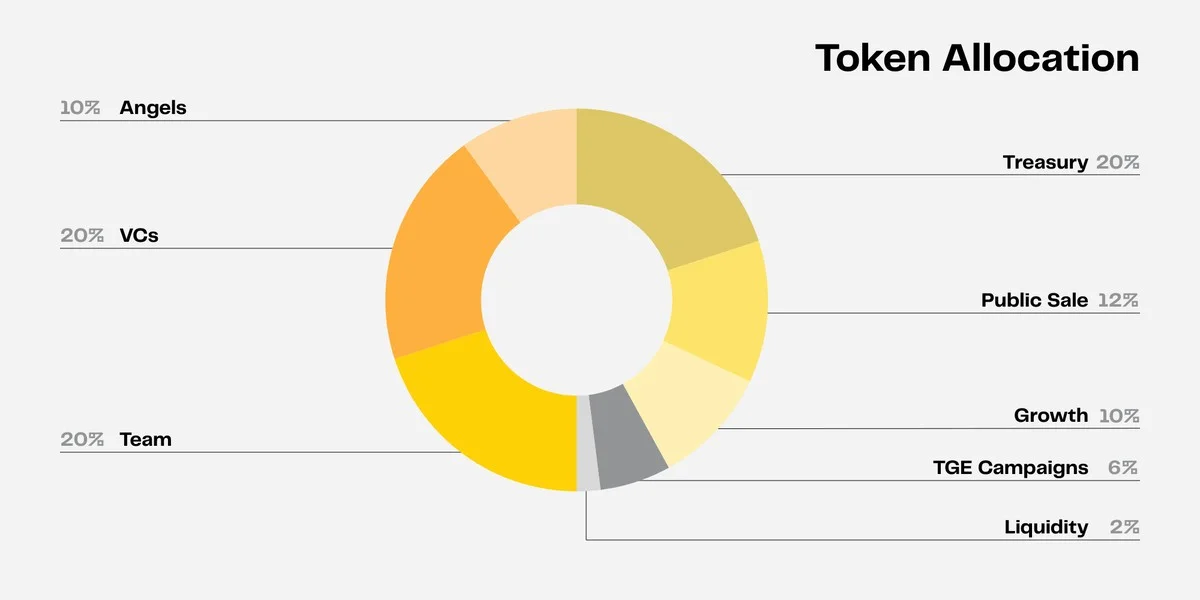
The official launch of the ZAMA token took place on February 2, 2026. In Zama’s official blog announcement, the ZAMA TGE was described as a new step toward bringing privacy to public blockchains. The same announcement stated that the token would be used as a payment tool for encryption and decryption operations, while also playing a role in rewarding operators and stakers within the protocol.
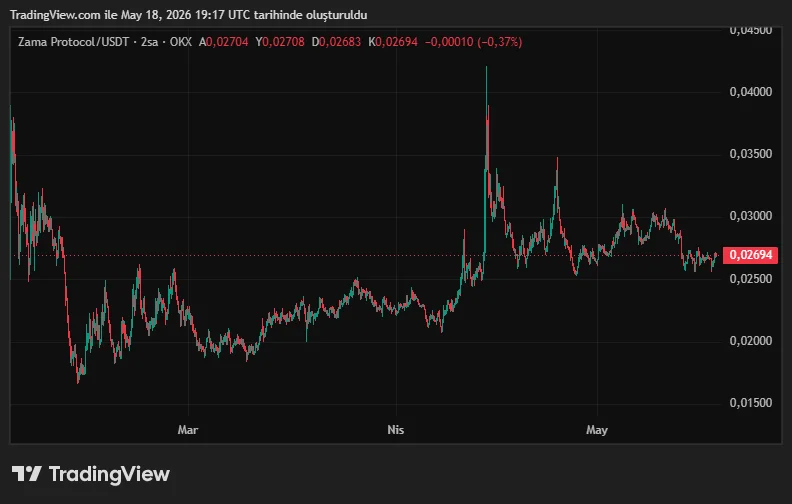
As of May 2026, the ZAMA coin price is around $0.02.
Why Is Zama Important?
One of the strongest features of blockchain networks is transparency. Users can verify transactions, address movements, and smart contract interactions on-chain. This structure creates a strong foundation for trustless financial systems. However, the same transparency becomes a major limitation in use cases that require privacy.
When a user’s wallet balance, a company’s treasury movements, an investor’s position size, or a DAO member’s voting choice can be tracked by anyone, blockchain technology becomes difficult to use in many real-world scenarios. In areas such as finance, healthcare, identity, corporate data management, and governance, making all data public is often unacceptable.
Zama aims to solve this problem without losing blockchain’s verifiability advantage. The protocol seeks to keep transactions verifiably compliant with rules while storing transaction inputs and contract states in encrypted form. Zama’s litepaper explains this approach through end-to-end encryption, interoperability between confidential and public contracts, and programmable privacy.
This structure is especially important for institutional adoption. Traditional financial institutions, RWA issuers, payment companies, or identity providers may want to benefit from the security and interoperability of public blockchains. However, they do not want to make customer information, transaction amounts, or compliance data fully visible. Zama is one of the infrastructures trying to meet both needs at the same time.
Another factor that increases Zama’s importance is developer experience. The project does not offer privacy only as a private transfer feature. It gives developers the ability to define, at the smart contract level, who can decrypt which data. This programmable privacy model provides a more flexible structure for both user privacy and applications that require regulatory compliance.
How Does Zama Work?
At the center of Zama’s working model is FHE technology. FHE allows computation to be performed on data without decrypting it. The user encrypts their data locally; the blockchain or related protocol components process this encrypted data; and the result is produced in encrypted form. This prevents sensitive data from being exposed during the transaction process.
On the blockchain side, this structure makes confidential smart contracts possible. For example, in a DeFi application, a user’s transaction amount can be processed without being openly visible. In a DAO vote, votes can remain encrypted while the final result is still calculated correctly. In a token transfer, the amount sent can remain private while contract rules are still enforced.
One of Zama’s main technical components is FHEVM. FHEVM works as the core technology of Zama Protocol and allows developers to write confidential contracts with Solidity. According to Zama’s GitHub documentation, FHEVM is a structure formed by several technical components working together. It includes a library that enables confidential contract development with Solidity, core components that manage contract interactions, coprocessors that handle heavy encrypted computations, the Gateway layer, the key management system, and relayer/oracle mechanisms that support data transfer.
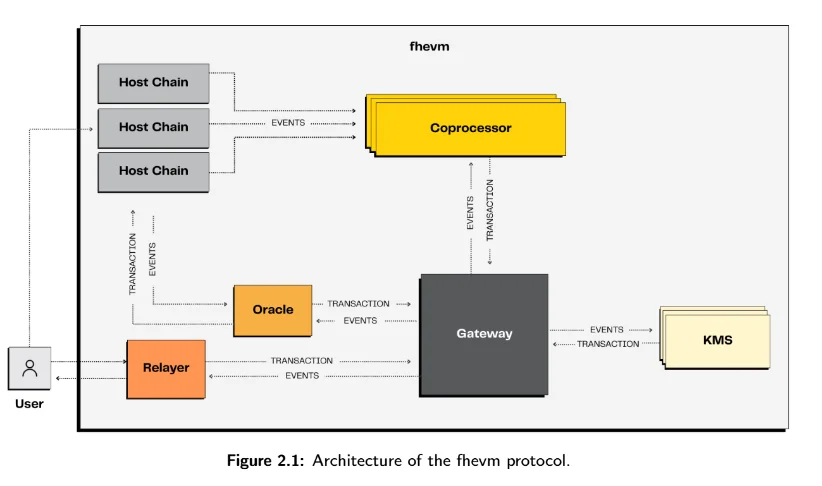
The FHEVM Solidity library allows developers to write contracts using encrypted data types and operations. This means some variables in a smart contract can remain public while others remain encrypted. The developer decides which part of the application requires privacy based on the contract logic.
Coprocessors are components that perform heavy FHE computations outside the main chain. Since FHE operations are computationally intensive, running them directly on the main chain can be expensive and inefficient. Zama aims to reduce cost and workload by moving FHE computation to a coprocessor network. According to the official website, the coprocessor structure takes FHE computation off the base chain, helping keep gas costs low while supporting horizontal scaling and public verifiability.
Gateway works like the coordination layer of the protocol. Verification of encrypted inputs, access control lists, movement of encrypted assets across chains, and coordination between KMS and coprocessors are handled through this structure. Zama documentation describes Gateway as the protocol’s central orchestration layer.
Key Management Service, or KMS, is used to manage decryption processes securely. In Zama, decryption keys are not intended to be controlled by a single party. For this reason, KMS works with a threshold MPC structure. A piece of data can only be decrypted after the relevant smart contract allows it. This structure prevents privacy from turning into an uncontrolled area while tying access rules to on-chain contract logic.
Privacy in Zama does not only mean hiding data. The protocol also allows applications to program who can see which data. For example, a user can see their own balance, while other users cannot. If required by regulation, a specific authority or application component may access limited data. This model creates a more balanced structure between privacy and compliance.
What Is the ZAMA Token Used For?
ZAMA is the native token of Zama Protocol. The token is used for protocol fees, staking, operator rewards, and network security. According to Zama’s official token launch announcement, ZAMA is used as a payment tool for encryption and decryption operations and plays a central role in the mechanism that rewards operators and stakers who run the network.
The first use case of ZAMA is protocol fees. Deploying confidential applications on Zama Protocol is free and permissionless, but some operations require protocol fees. According to the project description on CoinMarketCap, these fees cover ZKPoK verifications for encrypted inputs, encrypted data decryption operations, and the transfer of encrypted values between chains.
One notable part of the fee model is that payments are made in ZAMA, while pricing is set in U.S. dollars. The protocol uses an oracle that updates the ZAMA/USD price on Gateway. This allows users, developers, and relayers to calculate costs based on a more predictable dollar value rather than token price volatility.
The second major use case of ZAMA is staking. Operators need to stake ZAMA to participate in the protocol and earn rewards. Token holders can also delegate their ZAMA holdings to selected operators without running their own nodes. This structure contributes to protocol security while allowing token holders to receive a share of staking rewards.
ZAMA is designed with a burn-and-mint model. All protocol fees are burned, while operator and staker rewards are covered through newly minted tokens according to the annual emission schedule. Zama’s official announcement clearly states that all fees are burned and rewards are minted according to the yearly emission plan.
In this model, higher network usage is expected to lead to more fee burning. On the other hand, new tokens are minted for staking rewards. For this reason, when evaluating the ZAMA economy, both the amount burned through protocol usage and staking emissions should be considered together.
ZAMA Tokenonomy
The total supply of ZAMA was announced as 11 billion tokens. CoinList’s Zama Auction page stated that 880 million ZAMA was allocated for the sale and that this amount represented 8% of the total supply. The same page listed the total supply as 11 billion ZAMA.
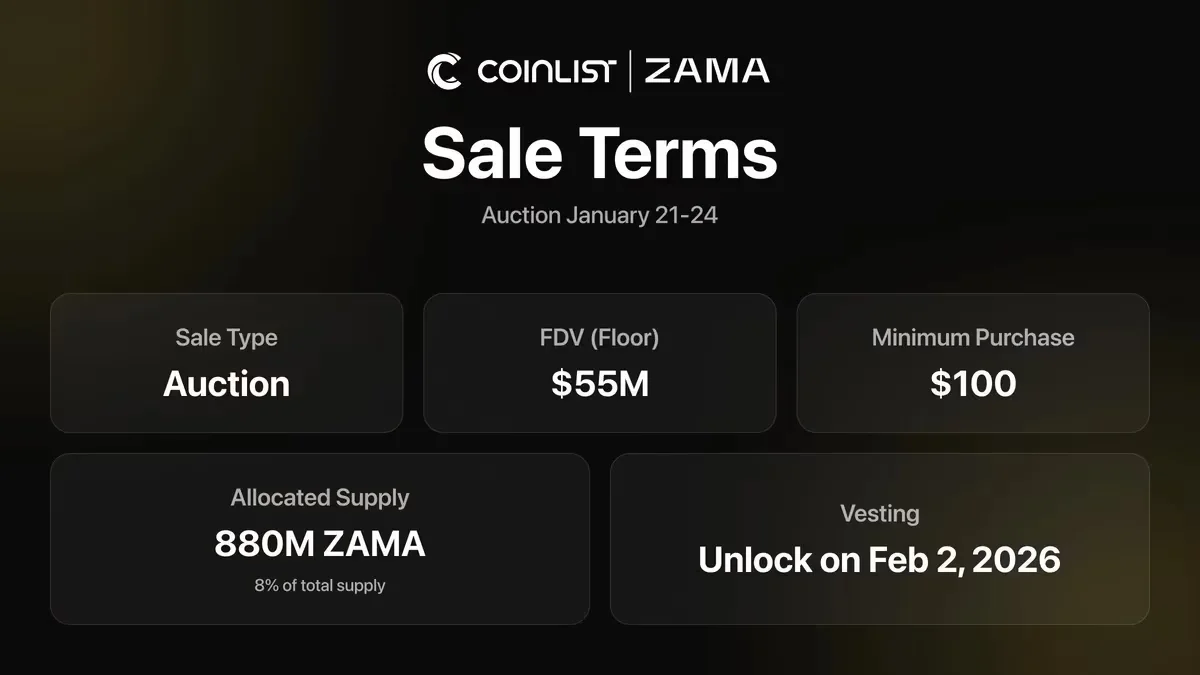
The ZAMA token launch took place on February 2, 2026. Zama’s official blog announcement stated that the token began trading on major exchanges on Monday, February 2, 2026, at 13:00 UTC, which corresponds to 16:00 Türkiye time. The same announcement also shared the official contract addresses for Ethereum, BNB Smart Chain, and Solana.
Public distribution played an important role in the token economy. In the CoinList auction, 880 million ZAMA was allocated for sale. The ZAMA sale was conducted through a sealed-bid Dutch auction model. In this model, participants submit their bids privately. At the end of the sale, the price is determined based on demand, and winning participants buy at the same final price.
ZAMA’s economic model within the protocol is built around fee burning and staking rewards. Protocol fees are paid in ZAMA and burned. Staking rewards are minted with an initial annual inflation rate of 5%. According to the project description, this inflation rate can be changed through governance.
Operator rewards are distributed according to task type. Different roles such as sequencer, coprocessor, and KMS nodes have separate responsibilities within the protocol. Rewards are first divided by role and then distributed among relevant operators based on the square root of their stake. This model aims to limit reward concentration among only the largest stakers.
The end-user experience for ZAMA was designed to be flexible. Protocol fees can be paid by the end user, the application interface, or a relayer. This allows developers to build confidential applications without forcing users to directly hold ZAMA. This detail is especially important for mainstream user experience, as many users do not want to buy a separate token before using a new application.
Zama’s Use Cases
Zama’s use cases are shaped around blockchain applications that require privacy. The protocol enables encrypted data processing across many areas, including finance, tokenization, identity, governance, and gaming.
One of the most important use cases is confidential payments. Stablecoin transfers have become one of the most common use cases in the blockchain world. However, transfer amounts and address movements can be tracked by anyone on public chains. In payment systems built with Zama, user balances and transfer amounts can remain encrypted. At the same time, payment providers can embed compliance rules directly into the token contract.
On the DeFi side, Zama can be used for confidential swaps, confidential lending, credit scoring, and options pricing. DeFi users often do not want their position sizes, trading strategies, or wallet histories to be tracked by everyone. Open transaction data can also increase problems such as front-running and copy trading. FHE-based confidential transactions create a new design space at this point.
RWA tokenization is another important area for Zama. Bringing real-world assets onto public blockchain networks is seen as a major opportunity for traditional financial institutions. However, making investor identity, transaction volume, and compliance checks fully public can create a serious barrier for institutions. Zama’s litepaper states that RWA and tokenization applications can be run on existing public chains such as Ethereum or Solana with privacy and compliance.
Another use case for Zama is confidential token distributions. In processes such as airdrops, grants, investor allocations, or team vesting, it is usually possible to see which address received how many tokens on-chain. This can create problems for security, privacy, and market behavior. With Zama, token distributions can be carried out in encrypted form; processes such as vesting and staking can also be managed over confidential values.
Sealed-bid auctions are also one of the natural use cases of FHE. Participants can submit their bids to the chain in encrypted form. At the end of the auction, the highest bid or winning result can be calculated, while all bids remain hidden throughout the process. This structure can support fairer price discovery for token sales, NFT sales, or on-chain auction systems. Zama’s litepaper presents the sealed-bid model as an example that could reduce manipulation by bots monitoring the mempool.
Identity and governance are also among Zama’s key areas. On the identity side, users can prove that they meet certain conditions without openly sharing their personal information. For example, information such as age, citizenship, accredited investor status, or KYC results can be used in encrypted form. On the governance side, DAO votes can remain private, with only the final result disclosed. This structure can help reduce issues such as vote buying, social pressure, or strategic manipulation.
Gaming applications are another potential use case for Zama. Some information needs to remain hidden in on-chain games. If cards in a player’s hand, map information in strategy games, or player moves in competitive games become openly visible, game balance can break down. FHE can allow this type of data to remain encrypted while game logic runs on-chain.
Frequently Asked Questions (FAQ)
Below, you can find answers to some of the most frequently asked questions about Zama (ZAMA):
- What is Zama (ZAMA)?: Zama is a privacy protocol that brings Fully Homomorphic Encryption technology to blockchain. It allows smart contracts to process encrypted data. This means user balances, transaction amounts, voting preferences, or identity information can be used in blockchain applications without becoming public.
- Is Zama a Layer 1?: Zama is not a traditional Layer 1 or Layer 2. The protocol is designed as a cross-chain privacy layer that works on top of existing public blockchain networks. Users do not need to move to an entirely new chain to access confidential applications.
- What does FHE mean?: FHE stands for Fully Homomorphic Encryption. This technology allows computation to be performed on data without decrypting it. Zama’s core technology is based on this structure.
- What is the ZAMA token used for?: ZAMA is the native token of Zama Protocol. It is used for paying protocol fees, staking, rewarding operators, and supporting network security. According to Zama’s official announcement, the token plays a central role in encryption, decryption, operator rewards, and staking.
- What is the ZAMA supply?: The total supply of ZAMA is 11 billion tokens. CoinList’s Zama Auction page announced the total supply as 11 billion ZAMA. The same page stated that 880 million ZAMA was allocated for the auction and that this represented 8% of the total supply.
- When did the ZAMA token launch?: The official launch of the ZAMA token took place on February 2, 2026. According to Zama’s official blog announcement, the token began trading on major exchanges on February 2, 2026, at 13:00 UTC.
- What can Zama be used for?: Zama can be used for confidential stablecoin transfers, DeFi transactions, RWA tokenization, identity verification, DAO governance, sealed-bid auctions, confidential token distributions, and on-chain games. The project’s documentation highlights finance, tokenization, identity, governance, and other confidential applications.
- What is FHEVM?: FHEVM is the core technology used by Zama Protocol to develop confidential smart contracts. It allows developers to write contracts with encrypted data types using Solidity. This means Ethereum developers can build privacy-focused applications with existing tools.
- Can ZAMA be staked?: Yes. ZAMA holders can stake their tokens with operators to contribute to protocol security and earn staking rewards. Zama’s official token announcement states that users can stake with selected operators and help support the security of Zama Protocol.
To follow privacy-focused projects like Zama more closely, you can explore other articles in the JrKripto Guide series.

