
Earning revenue from transaction fees by providing liquidity is one of the oldest use cases in decentralized finance. However, as price movements become larger, impermanent loss can erase a significant portion of the fees earned. Yield Basis stands out as a DeFi protocol that approaches this problem through Curve infrastructure, crvUSD borrowing and a continuously adjusted 2x leveraged liquidity model.
Definition and Origin of Yield Basis
Yield Basis is a decentralized protocol focused on allowing users to provide liquidity to automated market maker pools using Bitcoin- and Ethereum-linked assets. The project’s main goal is to reduce the impermanent loss seen in traditional liquidity pools while allowing users to continue earning revenue from transaction fees.
The protocol is generally written as “YieldBasis” in its official documents. YB refers to the system’s ERC-20 governance token issued on Ethereum. The YB token became ready for distribution on September 15, 2025, and its maximum supply was capped at 1 billion tokens.
It would be insufficient to describe Yield Basis solely as a yield platform. The protocol deposits volatile assets such as Bitcoin and Ethereum into Curve pools, borrows an equivalent amount of crvUSD and maintains the position at approximately 2x leverage.
When users deposit a supported asset into the protocol, they receive tokens called yb-LP. These tokens represent the user’s share of a leveraged Curve liquidity position. Users can hold yb-LP assets in their wallets or deposit them into the relevant gauge contract to earn YB rewards.
It is important to distinguish between YB and yb-LP tokens. YB is the protocol’s governance and incentive token. yb-LP functions as a position token representing a user’s share in a particular liquidity market.
Ethereum, Curve and crvUSD Infrastructure
Yield Basis does not operate directly on the Bitcoin network. The system runs on Ethereum and uses tokenized Bitcoin assets such as cbBTC, WBTC and tBTC for Bitcoin positions. On the Ethereum side, the protocol also supports a WETH market.
Because of this structure, users interact with an Ethereum-based representation of Bitcoin instead of depositing native BTC. Each wrapped Bitcoin asset depends on a different custody provider, issuer or bridge model, meaning each carries its own counterparty risks.
Curve Finance infrastructure sits at the center of Yield Basis. The protocol uses Curve Cryptoswap and the updated FXSwap pools, which facilitate transactions between volatile assets and stablecoins. crvUSD serves as the borrowing instrument used to finance the stable-asset side of each position.
The process can be explained with a simple example. When a user deposits a supported token worth 1 BTC, Yield Basis borrows an equivalent amount of crvUSD. The protocol then deposits both the Bitcoin representation and the borrowed crvUSD into a Curve pool.
This creates a liquidity position worth approximately twice the value of the single asset deposited by the user. The Curve LP tokens are held inside LEVAMM, which manages the position’s leverage ratio.
The leverage ratio is not maintained through a fixed debt position. When the price of BTC or ETH changes, the ratio of debt to the position’s value also moves. LEVAMM creates trading opportunities for arbitrageurs whenever a difference emerges between the market price and the target leverage ratio.
Arbitrage transactions bring the position back toward its targeted 2x leverage level. The mechanism aims to rebalance positions through economic incentives rather than relying on automatically operated keeper transactions. However, extreme volatility, network congestion or insufficient arbitrage profitability can slow the process.
Yield Basis’ Approach to Impermanent Loss
Impermanent loss occurs when the value of a liquidity provider’s position underperforms a strategy of simply holding the same assets in a wallet. The difference can grow as the market price moves further away from the level at which liquidity was initially provided.
In a traditional BTC-stablecoin pool, the pool sells BTC and accumulates stablecoins through arbitrage transactions when the BTC price rises. When the price falls, the amount of BTC held in the pool increases. As a result, a liquidity provider may hold less BTC during an upward move and more BTC during a decline.
Yield Basis attempts to change this curve by continuously maintaining the pool position at 2x compounding leverage. Under the protocol’s model, the value of the yb-LP position tracks the price of the supported volatile asset on an approximately one-to-one basis. Transaction fees are then added on top of this price exposure.
Official documents describe this mechanism as a model that “eliminates impermanent loss.” However, this does not mean that the position is risk-free. Users remain fully exposed to changes in the price of the underlying BTC or ETH asset.
Rebalancing costs, price oracles, the crvUSD dollar peg, Curve pool liquidity and the security of wrapped tokens can also affect the outcome of the position. Yield Basis therefore targets a particular mathematical form of impermanent loss; it does not eliminate the broader risk of losses in the cryptocurrency market.
History of Yield Basis: Major Milestones
Yield Basis was developed by Curve Finance founder Michael Egorov. Egorov incorporated his experience with Curve’s automated market maker models, crvUSD infrastructure and vote-escrow governance system into the design of the new protocol.
Early development focused on a leverage model capable of mathematically offsetting impermanent loss. Before Yield Basis became publicly available, the project raised $5 million in February 2025 at a token valuation of $50 million.
One of its first major introductions to the Curve ecosystem took place in June 2025. Egorov explained the project’s core mechanism at Curve’s event in Belgrade. In the following months, several security companies reviewed the protocol’s smart contracts.
According to the official audit page, the core architecture was audited by Statemind, ChainSecurity, Quantstamp, MixBytes, Electisec and Pashov. A full-protocol security competition was also organized through Sherlock. The Hybrid Vault contracts underwent additional reviews by MixBytes and ChainSecurity in 2026.
These reviews aim to reduce risk, but they do not provide an absolute guarantee of smart contract security. Yield Basis documentation also clearly states that audits may not identify every possible vulnerability and that users remain exposed to smart contract risks.
Mainnet, Token Launch and Exchange Listings
On September 24, 2025, Curve DAO approved an initial credit line of up to 60 million crvUSD for Yield Basis. The cbBTC, WBTC and tBTC markets were subsequently opened. Each initial pool launched with a capacity of approximately $1 million and reached its limit within a short period.
As demand continued, the market limits were first increased to $10 million. Curve DAO later raised the credit line to 300 million crvUSD. This decision created the possibility of increasing individual pool capacities to as much as $100 million per market.
The public sale of the YB token was conducted through Kraken Launch. A total of 25 million YB, equivalent to 2.5% of the maximum supply, was offered at a price of $0.20 per token. The sale provided the project with approximately $5 million in additional funding.
YB trading began on Kraken on October 15, 2025. Binance also listed the token on the same day with USDT, USDC, BNB, FDUSD and TRY trading pairs. Binance announced YB as the 53rd project in its HODLer Airdrops program and allocated 10 million YB to the campaign.
Token emissions also began on October 15. During the same period, the YB/crvUSD liquidity pool was launched, and an airdrop was distributed to veCRV holders who had supported certain Curve governance proposals.
Current Status
Although Yield Basis initially launched with tokenized Bitcoin markets, it later added support for WETH. Official documentation currently lists cbBTC, WBTC, tBTC and WETH markets.
The project launched its V3 architecture during May and June 2026. The V3 markets were among the first production implementations to use Curve’s updated FXSwap application. The update aimed to reduce the value lost to arbitrageurs during pool rebalancing and improve liquidity providers’ share of transaction fees.
The Hybrid Vault system was also updated during the same period. Hybrid Vault allows users to create BTC or ETH positions above standard pool limits by holding a specified amount of crvUSD in scrvUSD.
Under this structure, the crvUSD side follows the yield generated by scrvUSD. The cryptocurrency side tracks transaction fees from the Yield Basis pool or, depending on the user’s preference, YB emissions. Because the positions are kept separately, each section carries its own risks.
With the V3 update, the crvUSD ratio required for Hybrid Vault positions was reduced from 55% to 45%. In other words, under normal conditions, $45 worth of crvUSD support is required for every $100 of Yield Basis position capacity. This ratio may change depending on governance decisions and pool conditions.
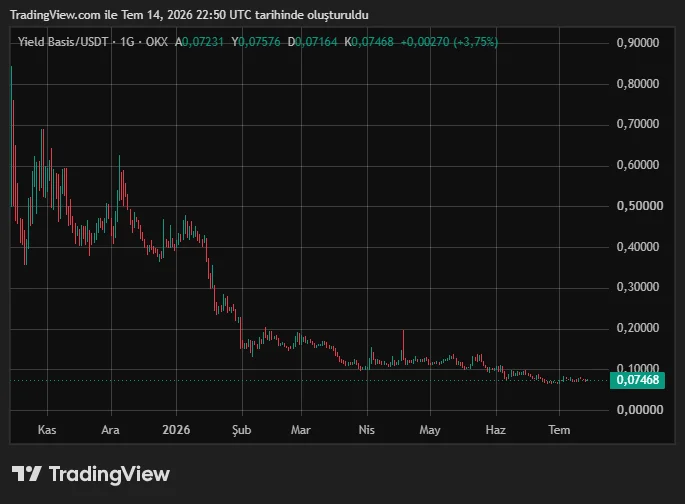
The amount of locked YB exceeded 100 million tokens by the end of June 2026. According to DeFiLlama’s figures on July 14, 2026, the protocol had approximately $124 million in total value locked. Since this figure is variable, the latest value should be checked again through current data platforms.
The YB coin price is around $0.07.
How Does the YB Token Work?
YB is the ERC-20 governance token of the Yield Basis protocol. However, the token’s main rights within the protocol do not become active when YB is simply held in a wallet.
Users must lock YB to participate in governance, direct the distribution of liquidity incentives and receive a share of protocol fees. Locking YB creates a veYB position.
veYB is represented as an NFT position under the ERC-721 standard. The voting power received by a user depends on the amount of YB locked and the selected lock duration. The maximum locking period is four years.
Locking one YB for four years provides approximately 1 veYB in voting power. A two-year lock provides approximately 0.5 veYB, while a one-year lock provides around 0.25 veYB. Under normal locks, voting power declines linearly as the unlock date approaches.
Users can also activate the “permalock” option. This model keeps the lock at the maximum four-year duration and prevents voting power from decreasing over time. Tokens cannot be withdrawn while permalock is active, although the option can be disabled under certain conditions.
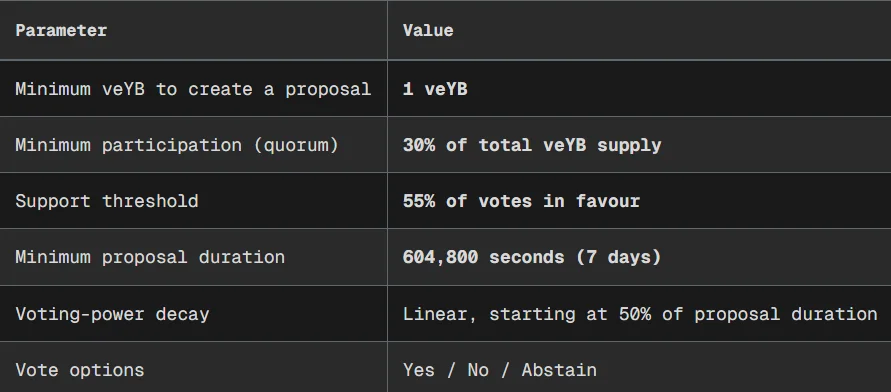
veYB holders can vote on protocol proposals. Under the official rules, at least 1 veYB is required to create a proposal. Proposals must meet a 30% quorum requirement and receive at least 55% support to pass. The voting period lasts seven days.
Gauge voting represents another important part of governance. Each Yield Basis market has its own gauge contract. veYB holders can distribute their votes among these gauges, determining which liquidity markets receive YB emissions.
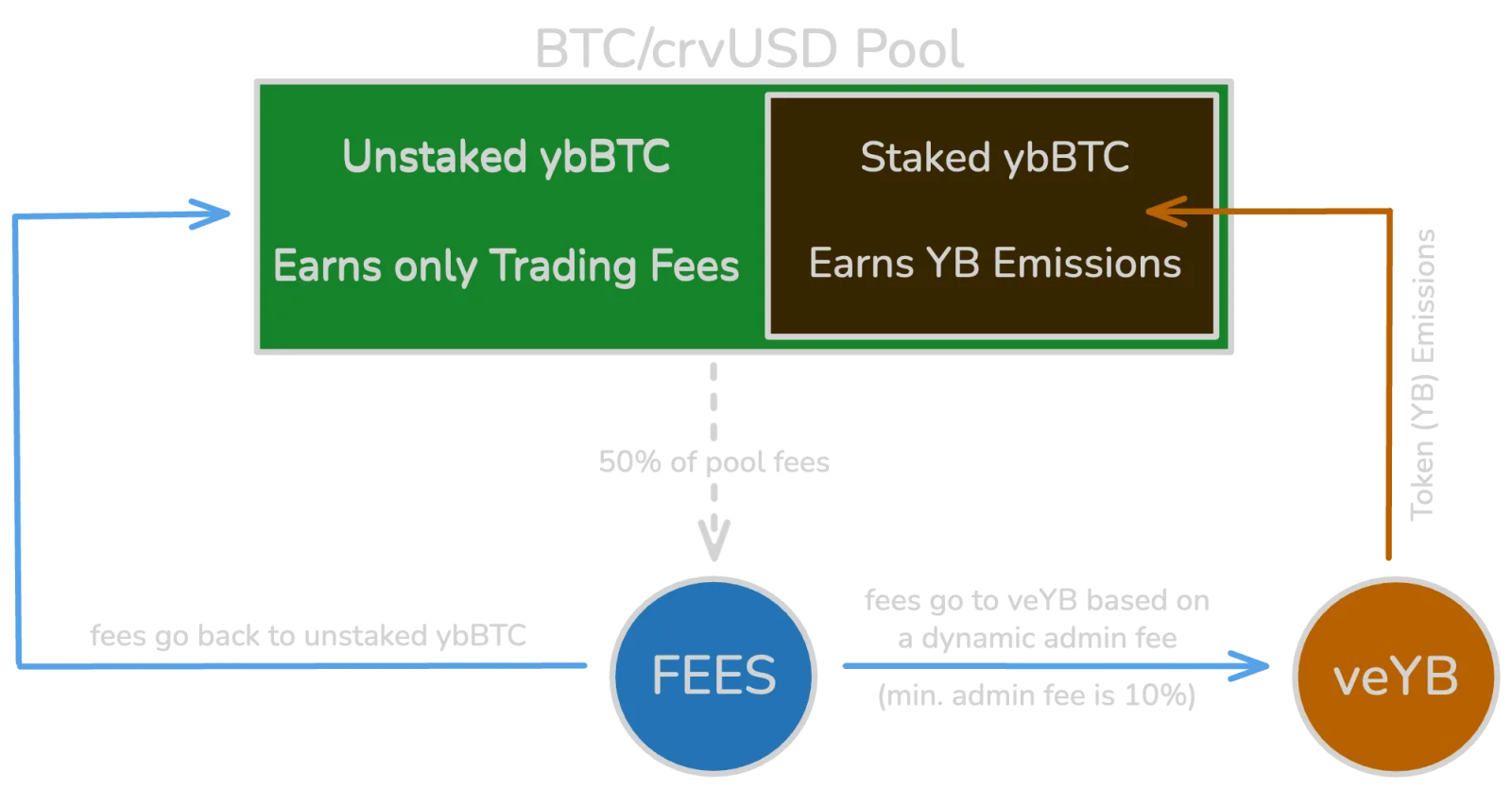
When users deposit yb-LP tokens into a gauge, they give up the standard value appreciation linked to transaction fees and earn YB emissions instead. Therefore, the revenue models of staked and unstaked yb-LP positions are different.
Supply and Tokenomics
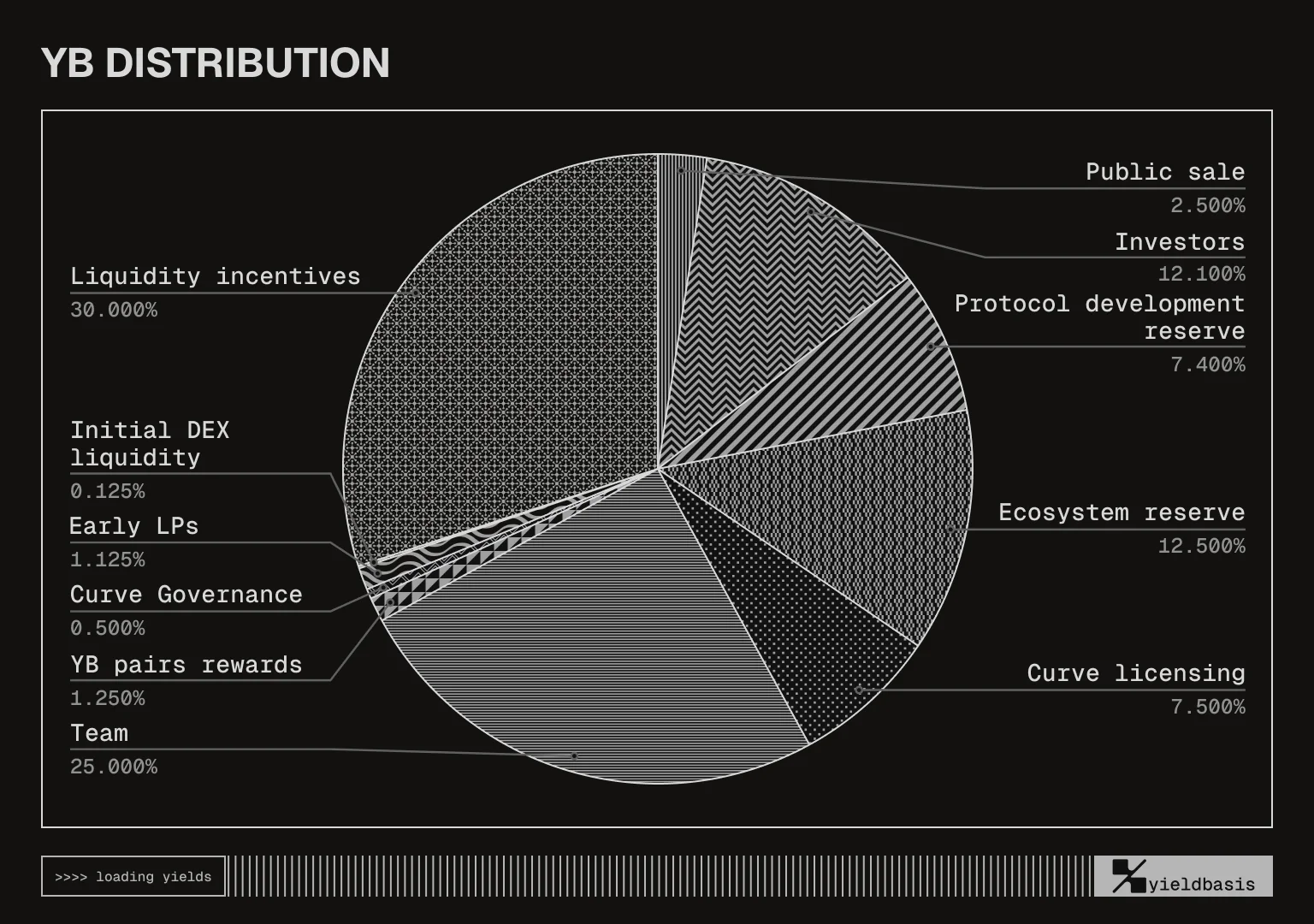
YB has a maximum supply of 1 billion tokens. This limit is established at the smart contract level. A total of 300 million YB was allocated for distribution over time through the gauge system as liquidity incentives.
The second-largest allocation belongs to the team, with 250 million YB. The ecosystem reserve received 125 million tokens, while 121 million YB was allocated to investors. Another 75 million was reserved for Curve licensing, and 74 million YB was assigned to the protocol development reserve.
The public sale covered 25 million YB. YB trading-pair rewards received 12.5 million, early liquidity providers received 11.25 million, Curve governance received 5 million and initial decentralized exchange liquidity received 1.25 million YB.
Team and investor tokens begin vesting after a six-month waiting period and then unlock linearly over two years. Of the ecosystem reserve, 50 million YB was unlocked at the token generation event. The remaining 75 million tokens were placed on a two-year vesting schedule.
The 75 million YB allocated to Curve unlocks in connection with liquidity incentives. When a certain percentage of the 300 million emission reserve enters the market, the same percentage of the allocation reserved for Curve DAO becomes claimable.
This distribution shows that the entire YB supply is not available on the market at the same time. The circulating amount changes depending on emissions, vesting schedules, early-user distributions and the status of locked tokens.
Transaction Fees, Emissions and Security Structure
Revenue on Yield Basis comes from two main transaction-fee sources. The first is the fees collected by the underlying Curve Cryptoswap or FXSwap pools. The second comes from transactions on LEVAMM, most of which are performed by arbitrageurs rebalancing the positions.
Holders of unstaked yb-LP earn revenue as transaction fees increase the position’s value per share. Holders who stake yb-LP do not receive this value appreciation. Instead, they earn a share of the YB emissions directed to the relevant gauge.
veYB holders receive a share of the protocol’s administrative fee. Distributions take place every Thursday and are smoothed over a four-week period. Payments are not made directly in YB; they are distributed in yb-LP tokens representing active markets.
The administrative fee rate depends on the proportion of yb-LP tokens staked in the market. Under the official model, the minimum administrative share is 10%. As the staking ratio rises, the proportion allocated to veYB holders also increases.
Because the protocol operates on Ethereum, transactions are subject to Ethereum network fees. The mainnet contract for the YB token is also located on Ethereum. Even when an exchange offers deposits through different networks, users should separately verify the official contract address and supported network.
The core contracts were designed to be immutable from a security perspective. Some fees, gauge weights and market parameters can be updated through the DAO. The protocol does not have a traditional system-wide emergency pause function, but a problematic market can be shut down and an emergency withdrawal route can be activated.
Why Is Yield Basis Important?
Automated market makers require liquidity for decentralized exchanges to operate. Liquidity providers meet this need but face impermanent loss when participating in pools containing volatile assets.
This issue is particularly important for users who want to accumulate Bitcoin or Ethereum over the long term. Even when users earn transaction fees, their pool position may underperform a simple holding strategy during a strong price movement.
Yield Basis aims to preserve users’ BTC or ETH price exposure while giving them access to pool transaction fees. Users deposit only the volatile asset; the protocol finances the required stablecoin side through crvUSD.
When the model operates successfully, the liquidity provider’s position tracks the price of the underlying asset, while transaction fees generate additional revenue. This narrows the performance difference between providing liquidity and holding the asset directly.
However, returns are not fixed. Fee revenue may decline when transaction volume falls. If rebalancing losses remain higher than the fees earned, value per share may grow more slowly or remain stagnant during certain periods.
Yield Basis’ Position in the Curve and DeFi Ecosystem
Although Yield Basis is an independent protocol, it has strong technical and economic connections to Curve. Curve pools provide the liquidity infrastructure, crvUSD is used for leverage and Curve DAO provides the protocol with a credit line.
In return, a total of 75 million YB was allocated to Curve DAO. These tokens are intended to attract incentives to crvUSD pools and strengthen stablecoin liquidity. Their final use depends on Curve governance decisions.
Transactions in Yield Basis pools may also generate volume for other Curve pools. For example, a trade between a stablecoin and BTC may first be routed through crvUSD and then into the BTC market. This structure creates additional activity for Curve liquidity, PegKeeper operations and crvUSD demand.
The Hybrid Vault model takes this connection further. Requiring users to deposit crvUSD into scrvUSD to obtain additional position capacity creates direct demand for crvUSD. The protocol aims to balance liquidity pressure on the stablecoin side as it grows.
YB’s vote-escrow model is also inspired by Curve’s veCRV system. Users who lock their tokens for longer periods receive greater voting power, influence the direction of emissions and participate in fee sharing.
This structure may encourage long-term participation. However, the concentration of voting power among a small number of large veYB holders could lead to centralized governance decisions. Yield Basis’ risk documentation also identifies voting concentration as a separate governance risk during the protocol’s early stages.
Risks and Volatility
Although Yield Basis focuses on impermanent loss, it remains a complex DeFi protocol that uses leverage. Users are not protected against declines in the price of BTC or ETH. If the underlying asset falls by 30%, the value of the yb-LP position will generally also be affected by that price movement.
The system depends on the assumption that crvUSD will maintain a value close to $1. A serious and lasting deviation in the price of crvUSD could disrupt the leverage ratio, the value of the debt and withdrawal outcomes.
Arbitrage-based rebalancing does not guarantee immediate results. During periods of high Ethereum transaction fees, network congestion or rapid market movement, arbitrageurs may not act quickly enough. In this case, the position may temporarily move away from its targeted 2x leverage level.
Although oracle systems use different price sources and moving averages, the risks of delay or manipulation are not completely eliminated. A difference between the actual market price and the price used by the protocol could cause transactions to occur at unexpected levels.
Users may encounter a temporary reduction known as the Temporary Redemption Discount when withdrawing funds. This difference results from a pricing divergence between the Curve pool and LEVAMM and is expected to close through arbitrage activity. However, the withdrawal amount may change between blocks during volatile periods.
Wrapped-asset risk is also important. WBTC and cbBTC depend on custodial organizations, while tBTC relies on bridge and decentralized signing infrastructure. If one of these tokens loses its peg to the Bitcoin price, users in the relevant Yield Basis market could be directly affected.
Finally, the YB token carries its own market risk. Since the revenue of staked yb-LP positions depends on YB emissions, a decline in the token’s price can reduce the dollar value of earned rewards. New tokens entering circulation over time may also create selling pressure.
Yield Basis Founder, Developers and Ecosystem
Yield Basis was developed by Curve Finance founder Michael Egorov. Egorov is known for previously designing Curve’s automated market maker infrastructure, the crvUSD stablecoin and the vote-escrow governance model.
Yield Basis’ operating model also uses technologies developed within the Curve ecosystem. The protocol combines Curve Cryptoswap and FXSwap pools, crvUSD borrowing and a veToken-based governance system within a single structure.
Egorov’s role in the project is not limited to being its founder. He was also directly involved in the technical studies explaining Yield Basis’ leveraged liquidity model and the protocol’s initial public presentations.
Development Team and Security Work
Yield Basis’ official documents do not provide a detailed list of every developer working on the protocol. It is therefore not possible to confirm the exact size of the project team or the identities of all developers.
However, several independent security firms have reviewed the protocol’s smart contracts. Statemind, ChainSecurity, Quantstamp, MixBytes, Electisec and Pashov conducted audits of different Yield Basis contracts and components.
A security competition covering the protocol was also organized through Sherlock. The Hybrid Vault contracts underwent additional reviews by MixBytes and ChainSecurity in 2026.
These audits help identify potential coding errors. However, security reviews do not mean that smart contracts are completely free from risk. The protocol also states in its official risk documents that users remain exposed to risks related to code, oracles, liquidity and leverage.
Community, Governance and Partnerships
The Yield Basis community participates in protocol governance through YB and veYB tokens. YB holders can lock their tokens to receive veYB and vote on protocol proposals.
veYB holders also determine which liquidity pools receive YB emissions. This structure allows users to do more than simply hold the token; they can also shape the protocol’s incentive policy.
Yield Basis’ strongest ecosystem connection is with Curve Finance. The protocol uses Curve pools, borrows crvUSD for leveraged positions and benefits from a credit line provided by Curve DAO.
Curve DAO provided the protocol with credit capacity worth hundreds of millions of crvUSD during Yield Basis’ initial growth period. A total of 75 million tokens from the YB supply was also allocated to the Curve ecosystem and licensing model.
The project conducted its token sale through Kraken Launch. YB was later listed on Kraken, Binance and several other centralized exchanges. These listings allowed the token to reach a wider group of users.
Frequently Asked Questions (FAQ)
Below are answers to some frequently asked questions about Yield Basis.
- What is Yield Basis and when was it launched?: Yield Basis is an Ethereum-based DeFi protocol that aims to create leveraged liquidity positions using BTC- and ETH-linked assets while reducing the effect of impermanent loss. Its first markets opened in September 2025. YB token trading and emissions began on October 15, 2025.
- What is the YB token used for?: YB is the protocol’s governance and incentive token. Users can lock YB to receive veYB. veYB gives holders the right to vote on protocol proposals, determine how YB emissions are distributed among pools and receive a share of administrative fees. Freely held YB does not provide direct protocol rights.
- Which network does Yield Basis operate on?: Yield Basis operates on Ethereum. In its Bitcoin markets, the protocol uses Ethereum-based Bitcoin representations such as WBTC, cbBTC and tBTC instead of native BTC. A WETH market is also supported.
- Who founded Yield Basis?: Yield Basis was developed by Curve Finance founder Michael Egorov. The project’s economic model is closely connected to Curve Cryptoswap pools, crvUSD and Curve’s vote-escrow governance approach.
- What is the YB supply?: YB has a maximum supply of 1 billion tokens. Of this amount, 30% was allocated to liquidity incentives, 25% to the team, 12.5% to the ecosystem reserve and 12.1% to investors. The circulating supply changes over time because of emissions and vesting schedules.
- Is Yield Basis suitable as an investment?: There is no single answer to this question. The price of YB may be affected by protocol adoption, token emissions, the locking ratio, governance demand, broader cryptocurrency market conditions and investor expectations. Providing liquidity to the protocol also carries different risks from purchasing YB. Smart contract vulnerabilities, leverage, deviations in the crvUSD price, wrapped BTC assets, limited liquidity and oracle failures may result in a loss of capital. Users should conduct their own research based on their risk tolerance and only use funds they can afford to lose.
Follow the JR Crypto Guide series for the latest information about Yield Basis and new projects across the cryptocurrency ecosystem.

