
Moving assets between different networks is still one of the more complicated processes in crypto. Squid aims to simplify this experience through its cross-chain infrastructure, bringing multiple steps closer to a single transaction flow. The protocol has been operating since 2023 and entered a new phase in 2026 with the launch of the QUID token, linking staking, governance and ecosystem participation to its token economy.
Squid: Definition and Origins
QUID is the native token of Squid, a platform built for cross-chain transactions. The distinction between the project and token names is important. The project is called Squid, while its token uses the QUID ticker. QUID is unrelated to the Squid Game (SQUID) token that previously attracted attention in the crypto market.
Squid essentially connects tokens across different blockchain networks. When a user wants to convert an asset on one network into a different asset on another, Squid’s routing infrastructure brings the necessary bridge and swap steps together.
According to official project data, the platform has expanded to support more than 100 blockchains, over 130 decentralized exchanges and more than 20,000 tokens. Squid also says it has served more than 1 million users and has been integrated into over 1,000 applications.
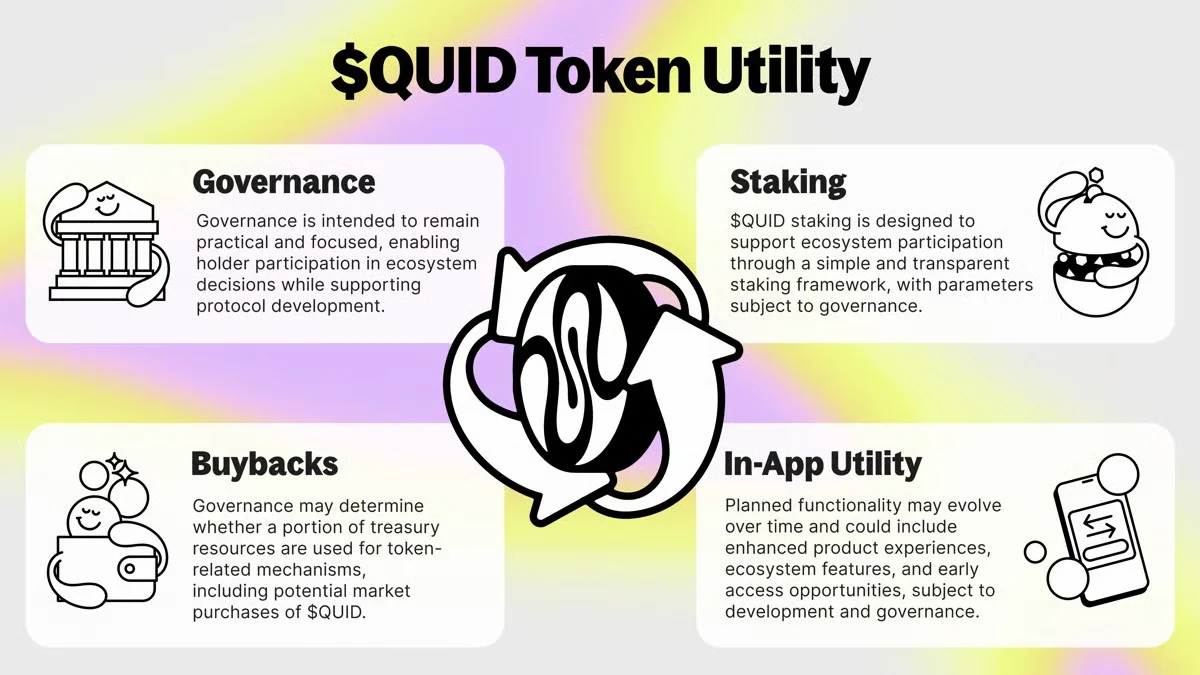
QUID, however, was not designed as a mandatory gas token for completing these cross-chain transactions. Its main role is to support participation in the Squid ecosystem. Staking, governance and potential future product features are among the elements connected to the token.
Which networks does Squid operate on?
It is important to distinguish between the networks supported by Squid and the blockchain on which the QUID token itself exists. Squid is a multichain infrastructure that routes transactions across numerous blockchain networks. QUID, meanwhile, was issued as an ERC-20 token on Base.
Squid’s supported networks are not limited to a single ecosystem. In addition to Ethereum and other EVM-compatible networks, the platform works to connect the Cosmos ecosystem, XRPL, Hedera and other blockchain architectures. Squid’s newer infrastructure focuses on expanding access between networks with different smart contract environments.
Axelar played a major role in the project’s original architecture. In Squid’s earlier cross-chain transactions, Axelar General Message Passing technology served as one of the main coordination layers.
This structure has changed over time. With Squid Intents, the project developed its own TEE-based execution and settlement infrastructure. Axelar remains one of the components that can be used, but it no longer serves as the primary execution layer for every Squid transaction. Depending on the route, the system can use Axelar, Circle CCTP, IBC, Chainflip and other liquidity sources.
Why was the project created?
The foundations of Squid were laid in 2022. At the time, the blockchain ecosystem was rapidly becoming multichain, while the user experience was not improving at the same pace.
A user who wanted to convert a token on Ethereum into a different token on another blockchain could be forced to complete several separate steps. This could involve using a bridge, obtaining the destination network’s gas token and then making another swap on a decentralized exchange.
Squid focused on bringing this fragmented process into a single route. The user selects the starting asset and the asset they want to receive. The routing engine then evaluates available DEXs, bridge infrastructure and other liquidity sources to determine the transaction path.
For this reason, Squid is not positioned solely as a traditional bridge. Its infrastructure combines a settlement protocol, liquidity routing engine, developer tools and a user-facing application.
Squid’s History: Key Milestones
The idea behind Squid emerged in 2022, and the platform went live in January 2023. Its first version focused particularly on making token transfers between different blockchain environments, including Ethereum and Cosmos, easier.
That same month, the project completed a $3.5 million seed funding round. The round was led by North Island Ventures, with participation from Distributed Global, Fabric Ventures, Galileo, Chapter One and Node Capital. Axelar was also among the strategic supporters of the project.
Squid upgraded its infrastructure several times in the following years. Axelar’s messaging system played a more central role in the first version, while Squid V2 introduced a broader routing system that could combine different bridges, DEXs and liquidity sources within the same transaction path.
The project later developed an intent-based architecture called CORAL. Under this model, market makers can compete to execute user transactions. Squid later expanded this approach through Squid Intents and moved part of its transaction execution logic into Trusted Execution Environments, or TEEs.
QUID token launch and exchange listings
Squid operated for several years without its own token. The QUID rollout gained momentum in 2026.
The public sale began on June 30, 2026 through Kraken and Legion and ended on July 3. According to Squid, 3,542 people participated in the sale. Total committed capital exceeded $26.66 million, while demand reached 11.9 times the sale cap.
The QUID Token Generation Event took place on August 4, 2026 at 13:00 UTC. From that point, the token became transferable and usable. The staking system also became available alongside the token launch.
Squid’s launch announcement listed platforms including Kraken, Bitget, Bitvavo, Upbit, Bithumb and MEXC for QUID. On Binance, the token became available through Binance Alpha, followed shortly by a QUID-focused Binance Alpha trading campaign. On-chain access was also provided through PancakeSwap and various DEX aggregators.
Squid’s current status
As of September 8, 2026, QUID has been trading for around one month since its launch. At the time this guide was prepared, market data placed the QUID price at approximately $0.0666. The token’s market capitalization stood at around $9.5 million, while its fully diluted valuation was approximately $66.5 million. Circulating supply was around 143.16 million QUID.
The token reached its current all-time high of approximately $0.143 on August 4, 2026, the day of its launch. Market data shows that QUID later fell to around $0.0629 on August 18. This created a relatively wide trading range during the token’s first weeks on the market.
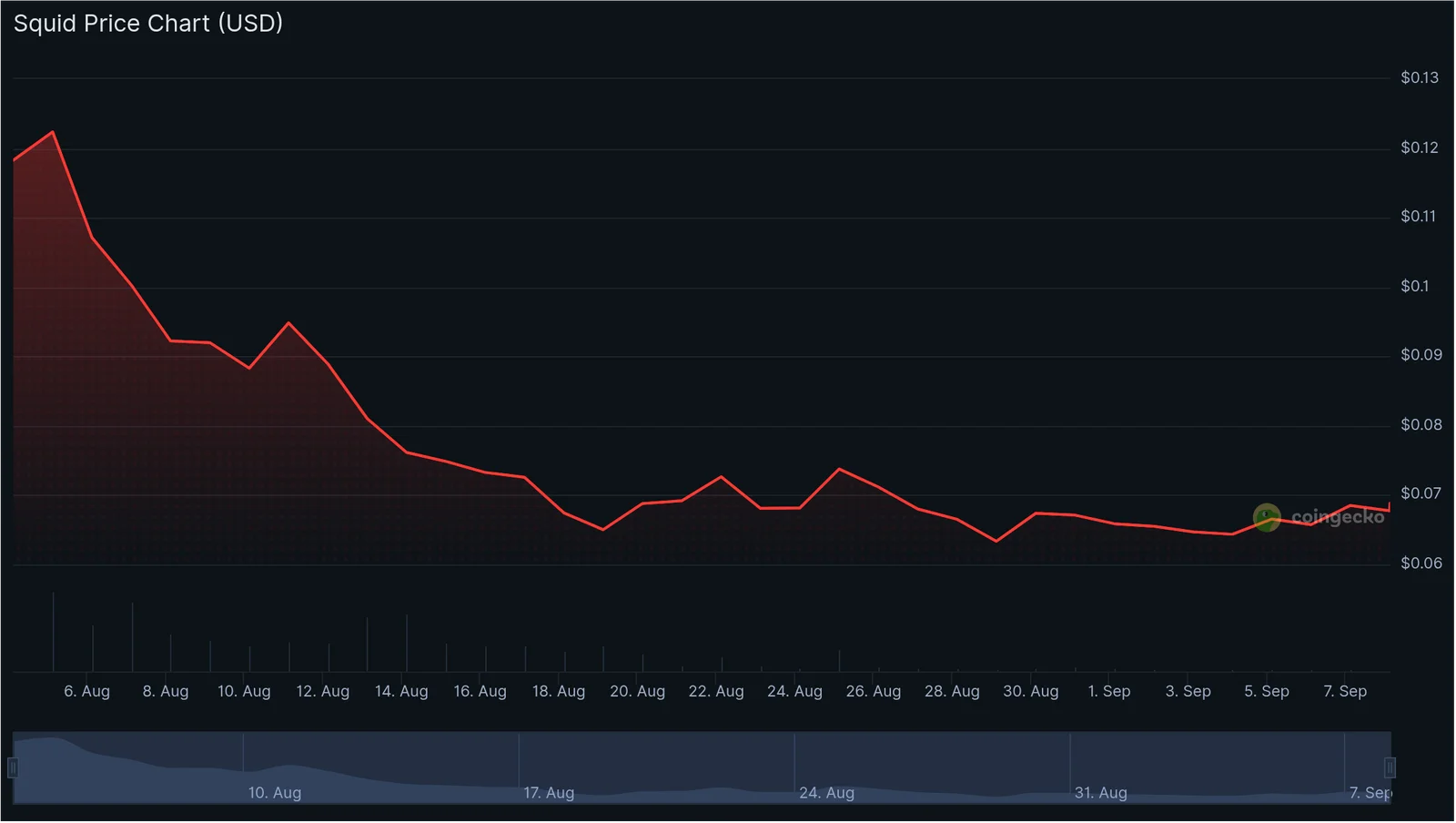
Because only a relatively small share of the total supply is currently circulating, future token unlocks will also be an important factor to watch in QUID’s market dynamics.
How Does the QUID Token Work?
Staking and governance sit at the center of QUID’s utility. Token holders can stake QUID to participate in ecosystem activity and earn QUID from a dedicated rewards allocation.
There is an important detail regarding these staking rewards. They are not created through new token issuance. Squid reserved a predetermined share of the total supply for the staking program.
A total of 5 million QUID has been allocated to staking during the first year. This represents 0.5% of the total supply. The amount distributed depends on staking participation and the parameters of the program.
QUID also has a governance role. According to Squid, the governance system will expand gradually. The model currently covers a limited range of ecosystem decisions, but it could eventually include protocol parameters, treasury use, staking conditions and other ecosystem matters.
The project has also outlined a potential token buyback mechanism. However, this system is not automatically active. Whether treasury resources will be used to purchase QUID, along with the conditions of any future mechanism, may eventually be determined through governance.
Squid also plans to introduce additional uses for QUID across its products. The project does not present these future features as fixed or guaranteed. Their scope may change depending on product development and governance decisions.
Supply, distribution and tokenomics
QUID has a maximum and total supply of 1 billion tokens. Its genesis supply was also set at 1 billion, meaning the current tokenomics structure does not plan for additional QUID issuance. There are also no validator emissions or permanently inflationary reward mechanisms.
The total supply is divided into six main categories:
- Investors: 30.39%, or 303,946,126 QUID
- Team and advisors: 23.95%, or 239,481,903 QUID
- Strategic partners: 10%, or 100 million QUID
- Public sale: 5%, or 50 million QUID
- Ecosystem growth: 7.5%, or 75 million QUID
- Foundation Treasury: 23.16%, or 231,571,971 QUID
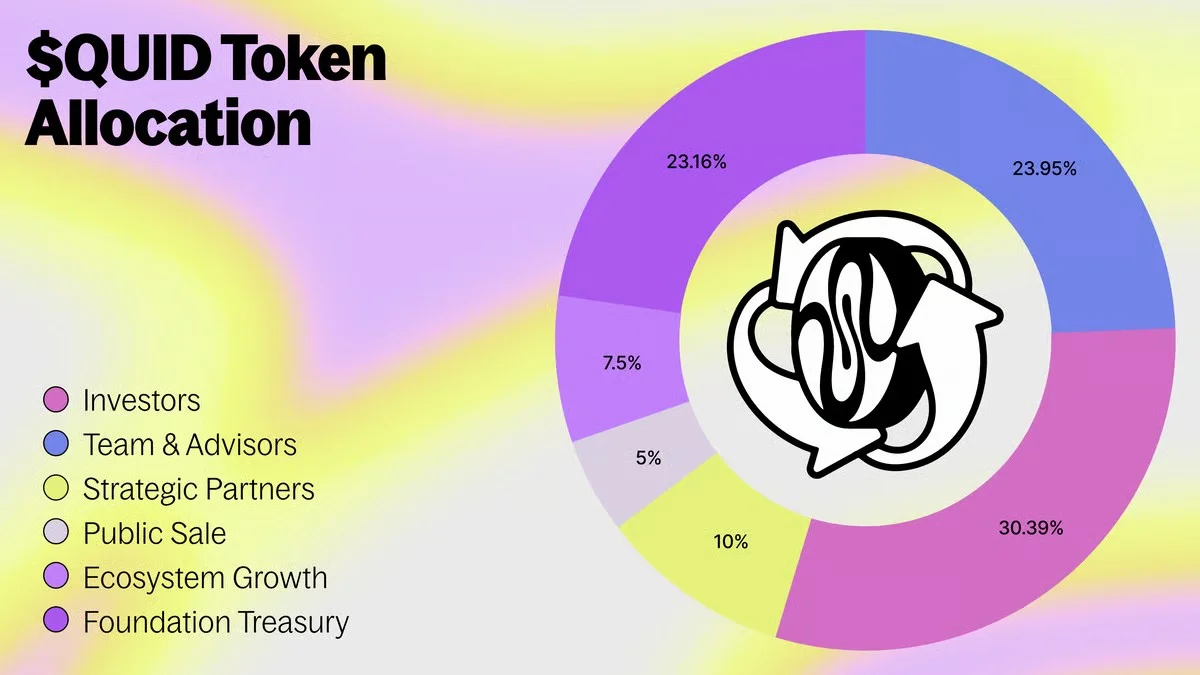
The token unlock schedule is particularly important. Tokens allocated to investors, the team, advisors and strategic partners did not unlock at the TGE. These categories are subject to a 12-month cliff.
For investor tokens, 25% will unlock at the end of the cliff, while the remaining allocation will vest linearly until month 24. Team and advisor tokens, along with strategic partner allocations, also unlock 25% at the end of the cliff, but the remaining tokens continue vesting until month 36.
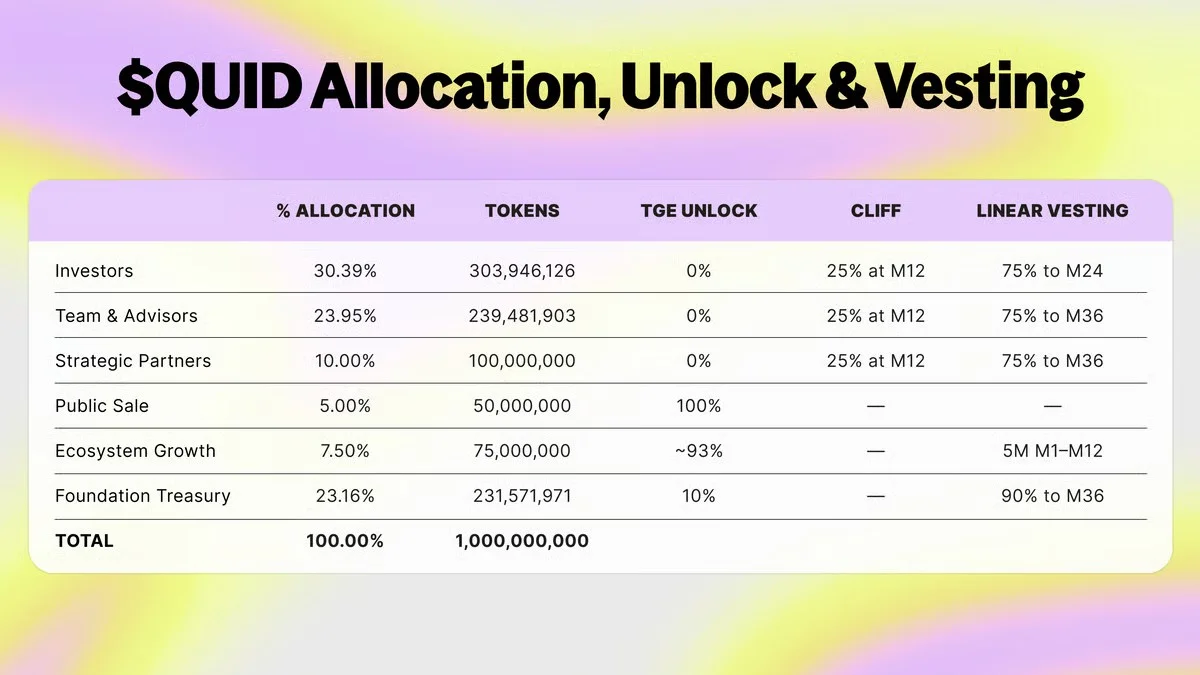
The 50 million QUID allocated to the public sale was fully unlocked at the TGE. Of the 75 million tokens reserved for ecosystem growth, 70 million became available around the TGE, while 5 million QUID was set aside for first-year staking rewards.
On the Foundation Treasury side, 10% of the allocation was unlocked initially. The remaining 90% unlocks linearly over 36 months. As a result, QUID’s circulating supply is expected to increase over time.
Network, transactions and security
Although QUID itself is a Base ERC-20 token, Squid’s technical infrastructure is not limited to Base. The protocol is designed to find suitable transaction routes across different networks, DEXs, bridge systems and liquidity providers.
Under the Squid Intents architecture, the user specifies the desired outcome. The system can then use an RFQ structure in which market makers compete to execute the transaction. Once a suitable route is selected, the transaction is completed.
Trusted Execution Environments are another notable part of the newer architecture. A TEE allows execution code to run inside an isolated hardware environment separated from the rest of the system. Squid executes part of its routing logic in this environment and settles the verified result on-chain.
The protocol operates on a non-custodial basis. In other words, Squid does not hold user assets in its own accounts in the same way a centralized exchange would.
On the security side, Squid says it has undergone nine independent audits. These audits were carried out by firms including Ackee Blockchain, Consensys Diligence, 0xKaden and n-Var. However, a history of audits does not guarantee that a blockchain protocol will never face vulnerabilities in the future.
Why Is Squid Important?
The shift toward a multichain crypto ecosystem has increased the number of assets available to users. At the same time, liquidity has become fragmented across different networks, making the overall user experience more complicated.
It has become normal for one token to exist on Ethereum, another asset to trade on Solana and a separate application to support only a particular Layer 2 network. Moving between these environments often requires users to understand the underlying blockchain infrastructure.
Squid attempts to hide much of this complexity within its routing layer. From the user’s perspective, the goal is simply to move from one asset to another. The system handles bridge selection, intermediate tokens, different DEXs and the transaction route.
This approach is also relevant for developers. Squid’s SDK, API and widget tools allow other applications to integrate cross-chain functionality directly into their own interfaces. As a result, users may interact with Squid’s infrastructure in the background without ever visiting the Squid website itself.
Squid’s place in the multichain ecosystem
Squid positions itself as a broader interoperability infrastructure rather than simply a bridge service. This distinction is also reflected in the way the platform has expanded.
According to official figures, Squid has routed more than $6 billion in transaction volume since launching in January 2023. The platform is used across more than 1,000 integrations and has served over 1 million users.
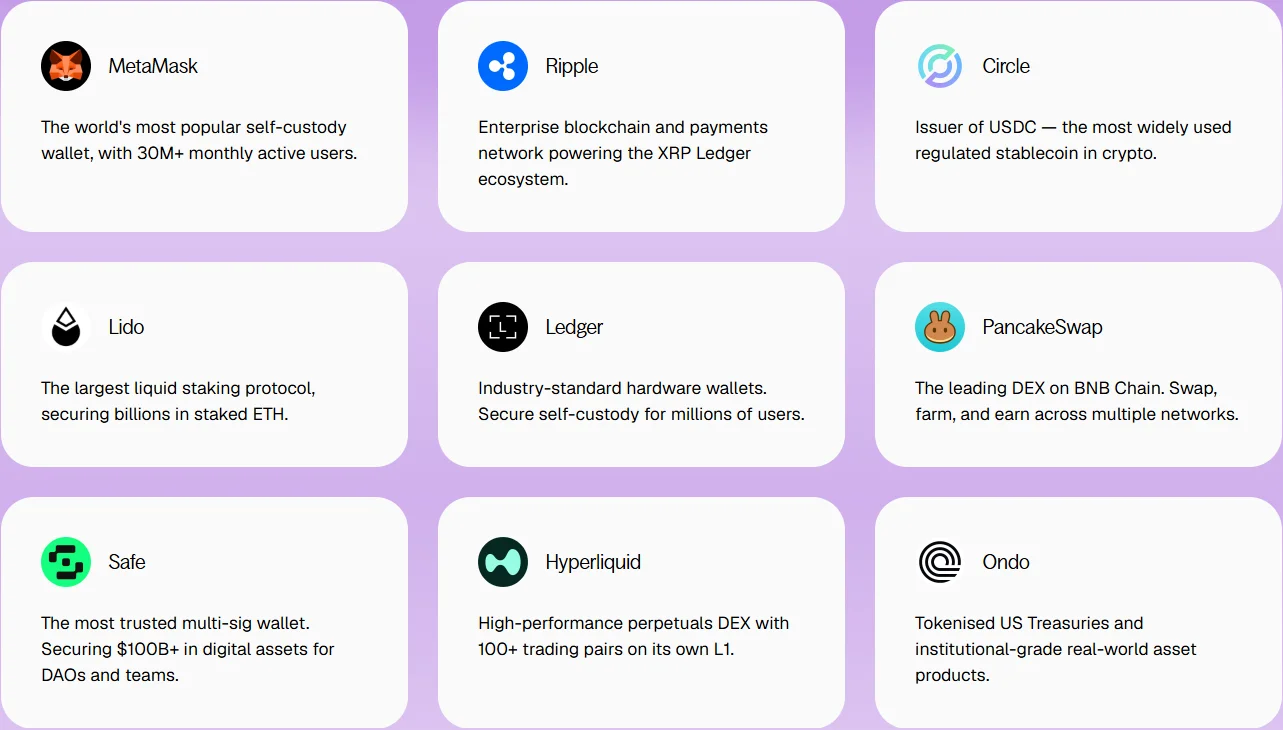
Wallets such as MetaMask, Brave, Keplr and Ledger; DeFi applications including PancakeSwap and Sushi; and payment products such as MiniPay are among the examples of services that use Squid infrastructure.
The project also has broader integrations with XRPL, Stellar, Hedera and Celo. Squid provides bridge infrastructure for XRPL and operates a validator on the network. On Stellar, it offers a cross-chain route for PYUSD, while it also works on onboarding and liquidity connectivity within the Hedera and Celo ecosystems.
This integration model matters because Squid does not need all of its usage to come directly from its own interface. As more products use Squid as an infrastructure layer, transaction flow through the network can expand.
QUID risks and volatility
One of QUID’s clearest risks is the fact that the token is still very new. Its short trading history means there is limited long-term data on liquidity and investor behavior.
The token supply structure also deserves attention. A significant share of the total supply is allocated to investors, the team, advisors, strategic partners and the treasury. These tokens will not all enter circulation at once, but vesting schedules will gradually increase the available supply.
The period following the 12-month cliff will be particularly important, as investor, team and strategic partner allocations begin to unlock. If demand does not grow at a similar pace, the increase in circulating supply could put pressure on the token.
Technical risks associated with cross-chain protocols should also be considered. Although Squid operates with a non-custodial architecture and has undergone security audits, a single transaction can interact with multiple blockchains, smart contracts and liquidity sources. This naturally creates additional technical dependencies.
Competition is another major factor. LI.FI, deBridge, Stargate, Wormhole and several other bridge and aggregation projects operate in the blockchain interoperability and cross-chain liquidity sector. Squid’s long-term position will depend on more than the number of networks it supports. Transaction quality, integrations, security and developer adoption will also play a role.
Squid’s Community and Ecosystem
Squid’s official sources identify Fig, Christina and Koda as the project’s founders. The founding team began working on the project in 2022, and the first product went live in early 2023.
Fig works on the product and protocol side of Squid. His background includes medicine, venture capital and algorithmic crypto trading systems.
Christina, who is also referred to as Xtina in some official sources, studied business before completing a master’s degree in philosophy and public policy at the London School of Economics. At Squid, she works across growth, operations, strategy and partnerships.
Koda focuses on engineering. He oversees the backend routing infrastructure and the project’s technical strategy. Squid says its team consists of around 20 people and operates fully remotely.
The project has also raised capital through several funding rounds. North Island Ventures was among its early backers, while Polychain Capital, Ripple and other crypto companies and investors later supported the project.
Community and governance
The launch of QUID expanded the potential role of the Squid community within the protocol. Staking is one of the main tools supporting this structure.
Users who stake their tokens can receive a share of the dedicated reward pool. Staking has also been designed with the possibility of being linked to governance weight in the future. Squid plans to expand governance gradually rather than immediately handing full control of the protocol to the community.
Future phases may bring protocol parameters, staking conditions, treasury decisions and selected ecosystem initiatives into the scope of QUID governance. However, it would be inaccurate to say that all of these areas are currently controlled by the community.
Public sale figures also showed considerable early interest in the token. Participants from 78 countries joined the sale, with 3,542 users submitting applications. However, demand during the public sale does not guarantee that the project will maintain the same level of user or investor interest in the future.
Integrations and use cases
One of Squid’s strongest areas is its broad integration network. The protocol operates not only through its own application but also as infrastructure inside other crypto products.
Wallets such as MetaMask, Ledger, Brave and Keplr; DeFi platforms including PancakeSwap; and payment applications such as MiniPay are part of the wider ecosystem. According to Squid’s official website, the number of integrators has surpassed 1,000.
The project’s relationship with Ripple also extends across several areas. Ripple is one of Squid’s investors, while Squid is also developing cross-chain infrastructure for the XRP Ledger ecosystem.
Squid also works with networks such as Stellar, Hedera and Celo. This diversity shows that the project is not focused exclusively on Ethereum and EVM-compatible chains.
Frequently Asked Questions (FAQ)
Here are some frequently asked questions about Squid:
- What is Squid and when was it launched?: Squid is a cross-chain infrastructure protocol designed to make token swaps and transfers between different blockchain networks easier. Development began in 2022, and the platform launched in January 2023. The QUID token held its TGE on August 4, 2026.
- What is the QUID token used for?: QUID is the native token of the Squid ecosystem. Its main use cases include staking and governance. The project may introduce additional product features and token-related mechanisms in the future. Staking rewards come from a predetermined QUID allocation rather than newly issued tokens.
- Which network does Squid operate on?: Squid is a multichain protocol that provides access to more than 100 blockchain networks. The QUID token itself was issued as an ERC-20 token on Base. For this reason, the networks supported by Squid should be distinguished from the blockchain on which QUID was created.
- Who founded Squid?: Squid’s official sources identify Fig, Christina and Koda as the project’s founders. Fig works on product and protocol development, Christina focuses on growth and strategy, while Koda oversees engineering and backend routing infrastructure.
- What is the QUID supply?: QUID has a total and maximum supply of 1 billion tokens. Under the current tokenomics structure, the supply is fixed and no additional QUID issuance is planned. The supply is distributed across six main categories: investors, team and advisors, strategic partners, public sale, ecosystem growth and the Foundation Treasury.
- Is Squid (QUID) suitable for investment?: Whether QUID is suitable for an investor depends on their risk tolerance, expectations and portfolio structure. The token is still relatively new, and a significant portion of the supply will enter circulation over time through vesting schedules. Competition in the cross-chain sector, protocol adoption, the development of QUID’s actual use cases and broader crypto market conditions should all be considered rather than making an investment decision based solely on the project’s integrations.
To follow how Squid develops its position in the cross-chain ecosystem and how the QUID token evolves within the project, keep exploring the JR Kripto Guide series.

