
High yields in the crypto market often come with directional exposure, complex transactions or short-lived token incentives. Solstice is trying to change this equation by turning the yield strategies used by professional funds into accessible assets on Solana. At the center of the protocol are USX, the yield-bearing eUSX and SLX, which provides access to the ecosystem.
Definition and origins of Solstice
Solstice Finance is a DeFi protocol that brings institutional-scale yield strategies on-chain. The project describes itself as a “yield layer.” Its goal is to connect different sources of yield to Solana applications through standardized tokens.
According to the Solstice whitepaper, the protocol consists of three main layers. USX serves as the settlement and entry-exit asset, YieldVault turns different strategies into on-chain tokens, and Nexus aims to bring yield, credit and payment products together in one consumer application.
SLX is the access, utility and governance token within this structure. Users can stake SLX to receive stSLX. The staked token is connected to functions such as priority access to new vaults, certain redemption privileges, planned credit features and governance weight.
It is important to distinguish between the tokens in the Solstice ecosystem. USX is designed to track the US dollar and acts as the asset through which capital enters and exits the protocol. eUSX is the yield-bearing token received when USX is deposited into YieldVault, reflecting the performance of the underlying strategy. SLX does not represent the dollar peg or the yield generated by eUSX.
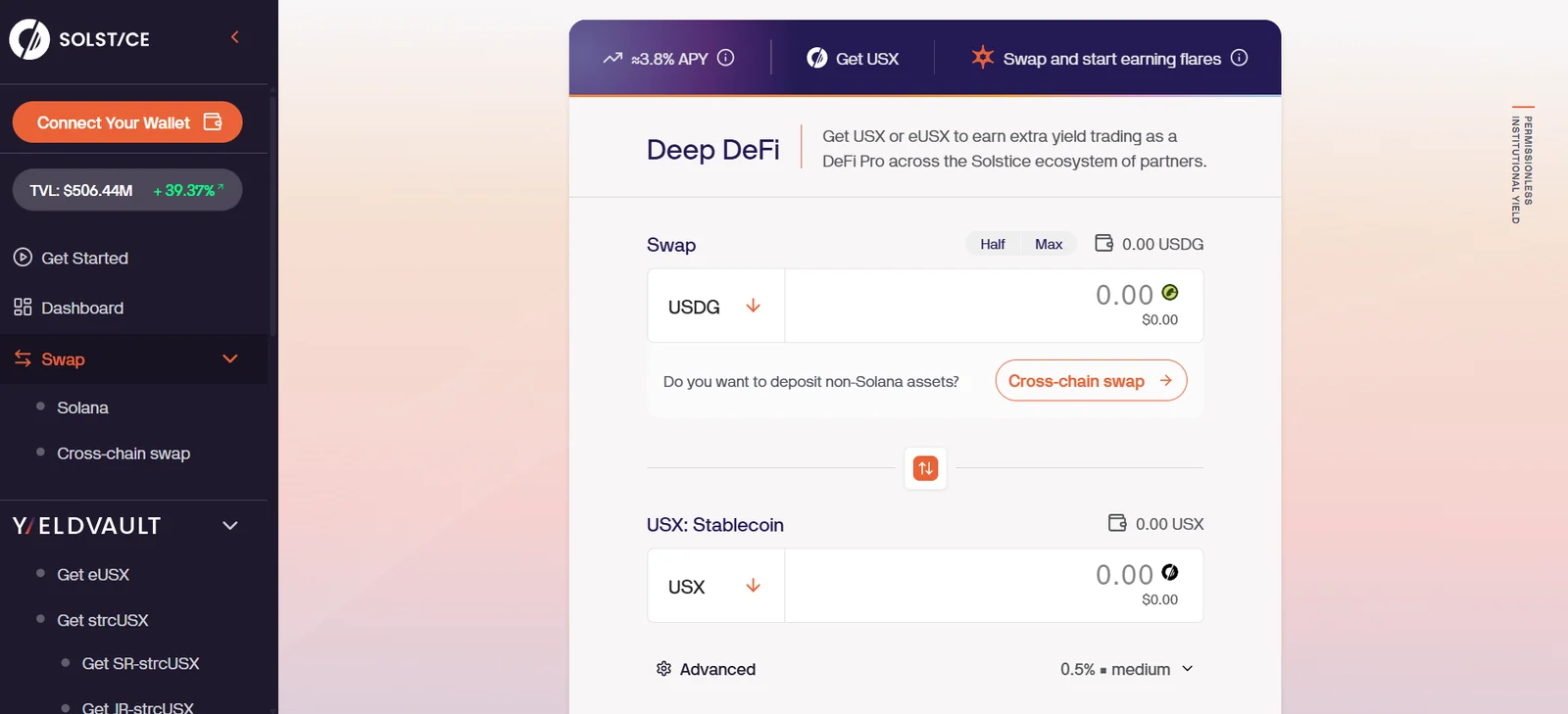
Which network does Solstice use?
Solstice’s core products run on Solana. USX, eUSX, YieldVault and the main SLX contract operate on this network. Solana’s fast settlement, low fees and composability make it easier to use yield tokens in lending markets, decentralized exchanges and payment applications.
Solstice does not operate its own blockchain or validator consensus system. Its transactions therefore rely on the underlying security of Solana. Solstice’s smart contracts, custody arrangements, price feeds and off-chain fund structure add further layers of risk on top of the network.
Why was the project created?
Institutional investment firms can use funding-rate arbitrage, hedged spot and futures positions, credit products and Treasury instruments to generate returns without taking direct market-direction exposure. These operations require substantial capital, professional infrastructure, custody agreements and continuous risk management.
Solstice aims to reduce the need for users to manage these strategies individually. An off-chain strategy run by a licensed manager is connected to a transferable on-chain token through YieldVault. Users can then hold the relevant asset in their wallets or use it in supported DeFi applications.
This model does not mean that the entire yield system operates on-chain. The whitepaper clearly states that capital moves through regulated off-chain structures. The Solstice Foundation oversees protocol direction and governance, while BVI-licensed Equinox Strategies Ltd manages the strategy of the Equinox Fund backing eUSX. Separate entities handle token issuance for each asset.
History of Solstice: Key milestones
Solstice’s institutional strategy track record dates back to 2023. However, Solstice Labs was publicly announced on September 20, 2024, during the Solana Breakpoint event. Deus X Capital introduced the company as a venture intended to expand access to DeFi products for institutional and retail users.
Solstice was established and funded by Deus X Capital, which has reported more than $1 billion in assets under management. Ben Nadareski was named co-founder and CEO, Deus X Capital CEO Tim Grant became co-founder and chairman, and Stuart Connolly joined as co-founder and chief investment officer.
Nadareski previously served as vice president of trading at Galaxy Digital and director of mergers and acquisitions at SIX Digital Exchange. Grant has more than 25 years of experience across traditional finance and digital asset markets. The team aims to use this background to connect institutional capital with DeFi infrastructure.
In December 2024, Solstice Labs acquired assets belonging to the institutional staking operations of Bridgetower Capital GmbH. The operations were placed under Switzerland-based Solstice Staking AG. According to the acquisition announcement, the acquired business serviced more than $1 billion in staked assets, including work carried out with Lido.
Launch of USX, YieldVault and SLX
Solstice Finance opened USX and YieldVault to the public on September 30, 2025. The protocol reported more than $160 million in total value locked on its first day. Galaxy Digital, Susquehanna Crypto, MEV Capital, Auros, Bitcoin Suisse and Deus X Capital were among the capital providers supporting the launch.
Direct minting and redemption of USX are not equally available to all users. According to DeFiLlama’s USX page, these transactions are available to verified institutional participants that deposit collateral such as USDC or USDT. Other users can access USX through the protocol interface or supported decentralized markets.
The SLX token generation event took place on May 25, 2026. Trading access opened on platforms including Binance Alpha and Bitget on the same day.
SLX was later added to Kraken, Upbit and other exchanges. OKX opened its SLX/USDT spot market on July 10, 2026. Access through Binance is provided via Binance Alpha.
Listings and current status
As of August 20, 2026, data showed approximately 242.85 million SLX in circulation. The SLX coin price was around $0.066, giving the token a market capitalization of about $16 million and a fully diluted valuation of roughly $66 million. These figures change continuously with market conditions.
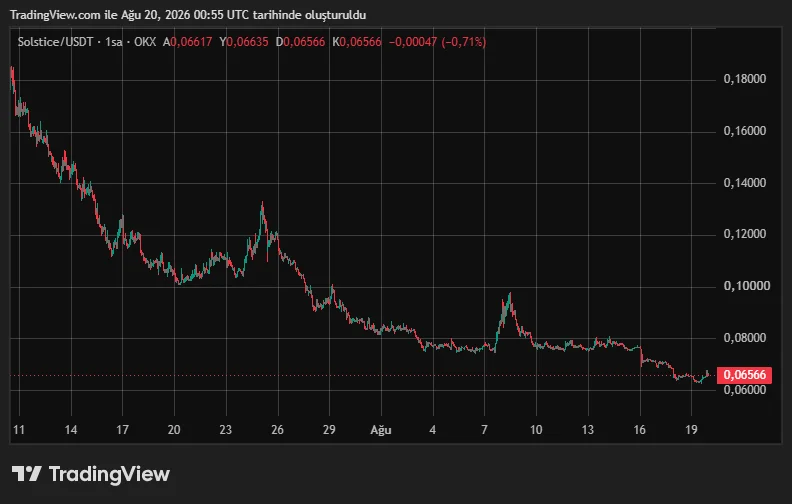
SLX reached an all-time high of approximately $0.66 in June 2026. It later fell to around $0.063 in August 2026.
Growth on the protocol side was not limited to SLX listings. Alongside eUSX, Solstice added strcUSX to the YieldVault structure, linking the product’s income to dividends from Strategy’s STRC preferred stock. aiUSX, tbUSX and some phases of Nexus are presented as forward-looking products in the whitepaper. They should not be treated as completed features.
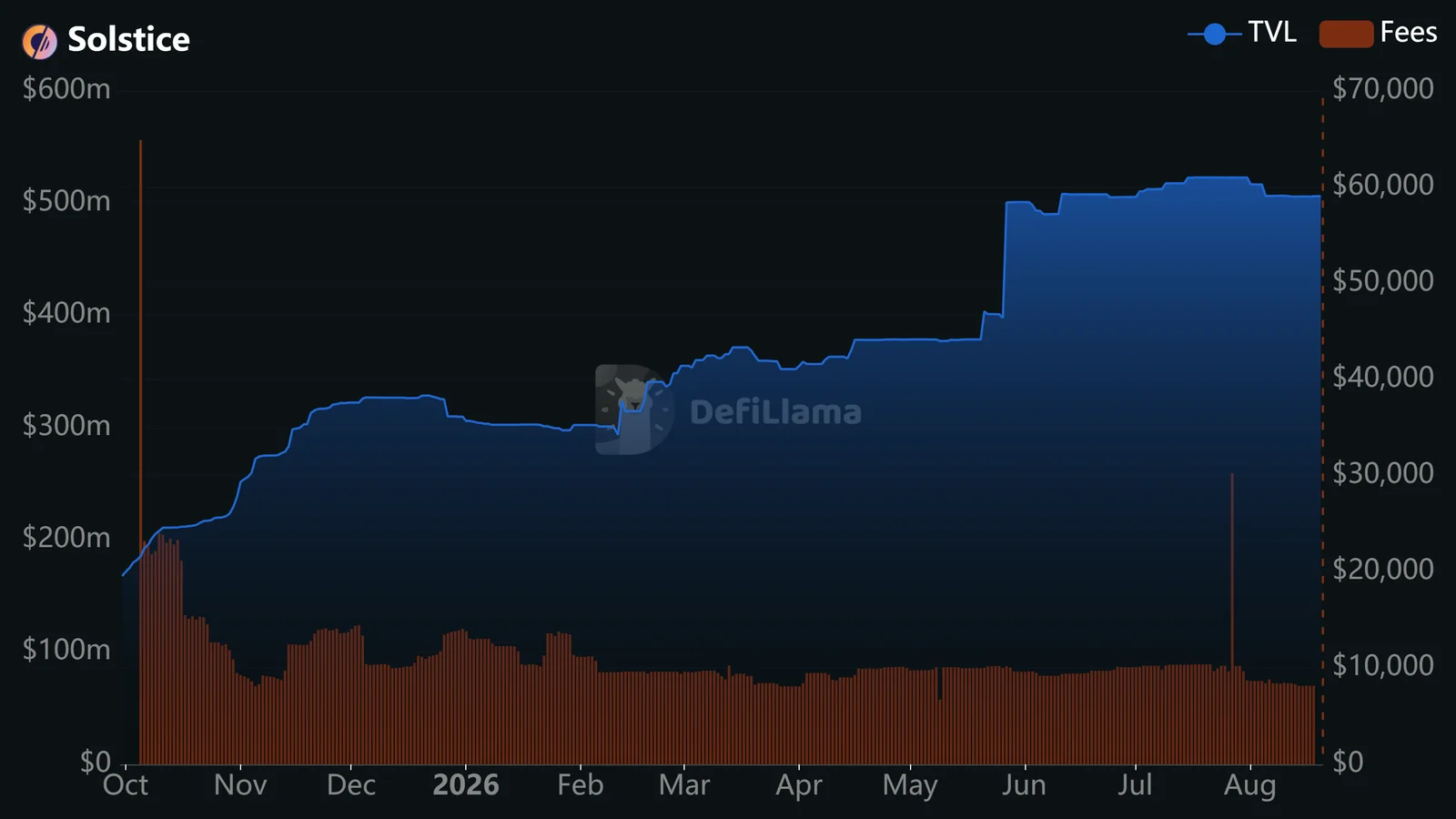
DeFiLlama data showed approximately $506 million in total value locked in the protocol on August 20, 2026. TVL measures the market value of assets held within a protocol. On its own, it does not demonstrate revenue, solvency or risk-free operation.
How does the SLX token work?
The core functions of SLX become available when the token is staked. Users deposit SLX and receive the liquid staking token stSLX. stSLX can be held in a wallet, locked or used as an access key for supported protocol features.
The whitepaper outlines four main use cases for stSLX. These include priority access to new YieldVault capacity, faster redemption options for eUSX and other yield tokens, higher borrowing capacity in the Nexus credit market and governance weight. Some of the credit and advanced automation features within Nexus remain under development or in the planning stage.
SLX holders should not be assumed to have complete control over the protocol today. Under the current model, the Risk Committee within the Solstice Foundation sets initial parameters, reviews audits and approves new product deployments. The community can signal its views on certain proposals, while binding votes through stSLX are expected to expand in later stages.
SLX also does not provide ownership in the company, represent debt or grant rights over protocol revenue. Holding the token does not entitle users to dividends, profit distributions or guaranteed returns. Project documents limit the economic function of SLX to the access and governance features it provides within the ecosystem.
SLX supply and tokenomics
According to the official tokenomics page, the SLX supply is fixed at 1 billion tokens. Community programs received 37.71% of the supply, while 24% was allocated to the foundation and 20% to the team and advisors. Airdrops received 10%, strategic TVL partners received 8%, and the public sale accounted for 0.29%.
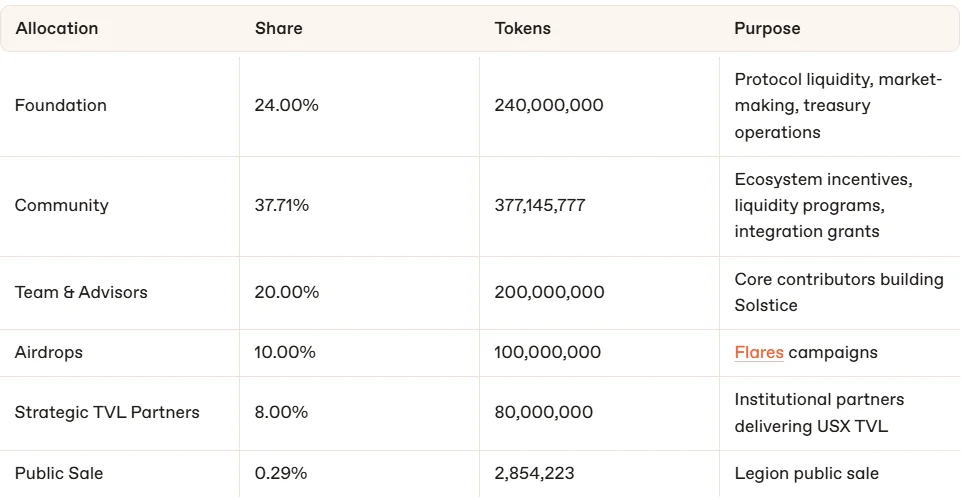
Approximately 24% of the total supply entered circulation at the token generation event. Team and advisor tokens are subject to a 12-month cliff followed by a gradual distribution schedule. Tokens allocated to the foundation, community and strategic partners also unlock according to different schedules.
The distribution can be assessed from two angles. The community and airdrop categories together account for approximately 47.7% of supply. At the same time, a large share is allocated to the foundation, team and strategic TVL partners. Token unlocks can increase the circulating supply over time.
Around one-quarter of the total supply was circulating on August 20, 2026. This creates a notable gap between the market capitalization and fully diluted valuation. If protocol use does not grow at a similar rate, new supply could put pressure on the price. Stronger demand could change the scale of this effect.
Transactions and security on Solana
USX, YieldVault tokens and SLX move on-chain. Some of the positions generating yield rely on off-chain parties, including licensed funds, custodians, prime brokers and centralized trading venues. Users therefore face both smart contract risk and traditional counterparty risk.
USX reserves can include audited dollar assets, tokenized Treasury products and hedged positions in major crypto assets. Solstice publishes reserves and liabilities through a proof-of-solvency dashboard verified by Accountable. This transparency makes it easier to monitor the reserve structure. It does not guarantee that the assets will retain their value or that redemptions will always be completed immediately.
Project documents state that the USX and YieldVault contracts have undergone independent security reviews. The audit page includes reports prepared by Halborn and other assessments. Audits may reduce code risk, but they cannot eliminate every vulnerability, oracle problem or operational error.
The way eUSX works is also important. Users receive eUSX when they deposit USX into YieldVault. Yield is added to the exchange rate between eUSX and USX instead of being distributed as a separate payment. During redemption, eUSX is burned and the user receives USX plus accrued yield, subject to queue and capacity conditions.
The underlying delta-neutral strategy generally takes a spot position in an asset while opening an equal-sized futures position in the opposite direction. If the price rises, the spot gain is intended to offset the futures loss. If the price falls, the futures gain is intended to offset the spot loss. A significant part of the yield comes from funding payments in perpetual futures markets.
The term “delta-neutral” does not mean risk-free. Funding rates can turn negative, the hedge ratio can break down, positions can close at different prices across different platforms, or a counterparty can face solvency problems. eUSX yield should therefore not be read as a fixed interest rate. The current rate, the period it covers and the risks used to generate it should be assessed together.
Why is Solstice important?
One of Solstice’s distinctive features is the separation between the yield-generating strategy and the on-chain distribution layer. Licensed managers can run different off-chain portfolios, while YieldVault brings them to Solana through a common token standard. This removes the need to create a separate user and integration model for every new strategy.
USX serves as the common unit of account and settlement asset within this structure. Users enter a YieldVault product with USX and later convert the yield token back into USX. eUSX depends on funding rates, while strcUSX offers a different source of yield linked to preferred-share distributions.
This architecture allows yield tokens to be used as collateral or liquidity assets in other DeFi applications. Composability also creates new dependencies. Using eUSX as collateral in a lending market can introduce the liquidation and oracle risks of that market alongside the risks associated with Solstice.
Team, community and ecosystem relationships
Solstice was developed with the capital and company-network support of Deus X Capital. Its team includes people with experience in traditional finance, institutional trading, staking and DeFi. This structure may make it easier to work with off-chain funds and professional custodians. It also increases the protocol’s reliance on centralized institutions.
USX and eUSX have established connections with platforms including Raydium, Orca, Kamino and Exponent in the Solana ecosystem. Data infrastructure providers such as Pyth and Chainlink are also among the ecosystem relationships announced by the project. The scope of each integration differs. A partnership announcement should not be interpreted as the other party assuming all risks associated with Solstice.
Community participation initially developed through the Flares points program and the SLX airdrop. The share of token supply allocated to community programs can be used for liquidity campaigns, integration incentives and ecosystem grants. These distributions may increase user numbers, but the amount of activity that remains after reward periods end should be monitored separately.
The project’s long-term plans include Nexus and Yield-as-a-Service. Nexus aims to bring yield optimization, credit, payment cards and AI-supported tools together in one interface. Yield-as-a-Service focuses on allowing fintechs, neobanks, payroll providers and corporate treasury applications to embed Solstice products into their own services.
Protocol risks and SLX volatility
One of the most significant risks for Solstice is the reliance of its on-chain tokens on off-chain strategies and entities. Problems at Equinox Strategies, a custodian, a prime broker or a trading venue could affect performance and redemptions. Segregated accounts and licensed managers are used to manage this exposure, but they do not remove it entirely.
USX may lose its dollar peg. If the value, liquidity or accessibility of reserve assets deteriorates, the balance around $1 could come under pressure. Heavy redemption demand could also exceed the protocol buffer and cause repayments to enter a queue.
Delta-neutral strategies carry funding-rate, basis, leverage, liquidation, execution and counterparty risks. Theoretical hedging does not mean every trade will close at the same time or at the expected price under real market conditions. Historical yield figures do not guarantee the same results in the future.
Smart contracts, price oracles, bridges and the Solana network carry technical risks. On the governance side, the concentration of critical powers within the Risk Committee during the early phase may raise centralization concerns. Emergency pause authority can be useful for security, but users should review who can make which decisions.
SLX carries additional risks. Some of the token’s use cases remain in the planning or development stage. The low circulating supply relative to the total supply, future unlocks and a relatively small market capitalization can create conditions for sharp price moves.
Frequently asked questions about Solstice
Below are answers to some of the most common questions about Solstice.
- What is Solstice and when was it launched?: Solstice is a DeFi protocol that turns institutional yield strategies into tokenized products on Solana. Solstice Labs was introduced in September 2024, while USX and YieldVault opened to the public on September 30, 2025. The SLX token launched on May 25, 2026.
- What is the SLX token used for?: SLX is the access, utility and governance token of Solstice. Users who stake SLX receive stSLX, which is used for priority access to new vaults, certain redemption options, future credit features and governance processes being introduced in stages.
- Which network does Solstice use?: Solstice’s core protocol and main SLX contract operate on Solana. CoinGecko also displays a BNB Smart Chain contract for SLX, although Solana remains the central network for USX, eUSX and YieldVault.
- Who founded Solstice?: The co-founders of Solstice Labs are Ben Nadareski, Tim Grant and Stuart Connolly. Nadareski serves as CEO, while Grant was named chairman. The project was established and funded by Deus X Capital.
- What is the SLX supply?: SLX has a fixed total and maximum supply of 1 billion tokens. Approximately 242.85 million SLX were in circulation as of August 20, 2026. The circulating amount can change as locked tokens are released.
- Is Solstice suitable as an investment?: There is no single answer that applies to everyone. SLX carries material risks due to its volatility, token unlock schedule and use cases that are still under development. USX and eUSX also involve reserve, counterparty, redemption, smart contract and strategy risks. Current token distribution, audit reports, the proof-of-solvency dashboard and personal risk tolerance should all be considered before making a decision. Solstice is trying to turn institutional yield strategies into standardized and usable tokens on Solana. The relationship between USX, eUSX, YieldVault and SLX gives the project a broader structure than a standalone governance token. Off-chain counterparties, variable yield sources and the token supply schedule remain areas that require close attention.
Follow the JR Kripto Guide series for the latest information on Solstice’s USX, eUSX and YieldVault products, as well as the development of the SLX token within the Solana ecosystem.

