
Insurance companies do not retain every risk they underwrite on their own balance sheets. The vast market known as reinsurance transfers some of these risks to other companies, while Re Protocol brings stablecoin capital and blockchain-based transparency into the process. RE, meanwhile, is not the yield-bearing asset of this infrastructure; it is the token used to govern the protocol’s rules.
What Is Re and How Did It Emerge?
Re Protocol is a blockchain-based capital markets protocol that channels capital from digital assets into real-world reinsurance contracts. The project aims to connect decentralized finance with licensed insurance companies.
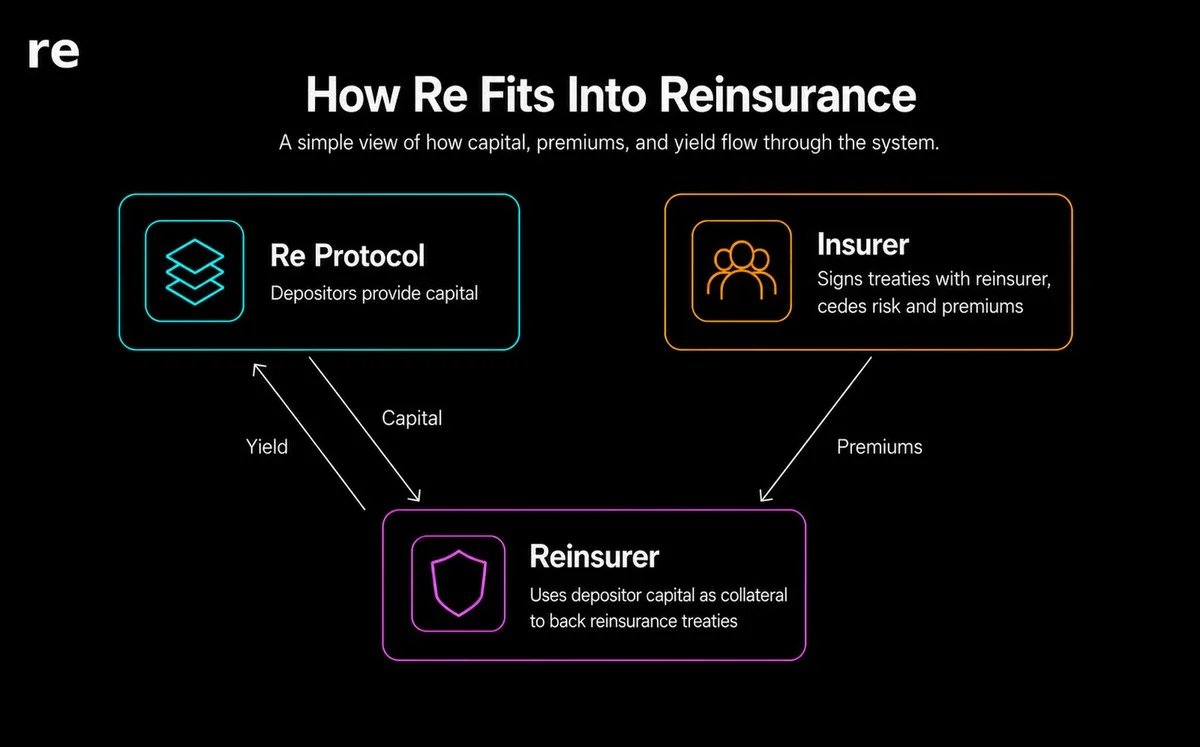
Reinsurance refers to the practice of an insurance company transferring part of the risk it has underwritten to another insurance provider. For example, when an insurer issues policies for thousands of homes, vehicles, or businesses, it may transfer part of that portfolio to a reinsurer to prevent large claims from destabilizing its balance sheet.
Re Protocol provides infrastructure that allows stablecoin capital to participate in this market. Assets deposited by users who meet the eligibility requirements are used to support fully collateralized reinsurance agreements.
The RE token plays a role in Re Protocol’s governance, coordination, and security mechanisms. By staking RE, token holders can participate in decisions concerning protocol upgrades, technical permissions, committees, incentive policies, and reporting standards.
The key distinction is between RE and reUSD or reUSDe. While reUSD and reUSDe are designed as deposit tokens that generate returns linked to reinsurance capital, RE focuses directly on governance.
Owning RE does not represent company equity, a debt instrument, dividend rights, or a share of insurance premiums. The token also provides no direct claim on Re’s revenue, reserves, collateral, or treasury.
Which network does Re operate on?
RE is an ERC-20 token issued on the Ethereum mainnet. Its official smart contract address is 0x526526528f35ac738177003b8773b402b8df8143.
Transaction validation and the preservation of transaction history rely on Ethereum’s Proof of Stake architecture. Users should therefore consider Ethereum network fees and possible congestion when transferring RE.
Re Protocol’s broader infrastructure is not limited to Ethereum. The protocol has a multichain structure spanning different EVM networks, including Avalanche and Arbitrum. reUSD is also available on several networks, including Base, and can be used across a range of DeFi applications.
In 2026, the protocol began migrating to Chainlink CCIP infrastructure for cross-chain reUSD distribution. This does not mean that the RE token uses the same contract on every network. Users should verify both the network and contract address through official channels before making a transaction.
Why was the project created?
The reinsurance market has long been dominated by large insurance companies, specialist brokers, and well-capitalized institutional investors. Capital requirements, licensing procedures, and legal restrictions make it extremely difficult for outside investors to access this market.
Limited data visibility is another problem in the sector. The location of collateral, the movement of premiums, and the amount of capital supporting particular risks often cannot be monitored in real time through a public system.
Re seeks to reduce this access problem by directing stablecoin capital into licensed and fully collateralized reinsurance structures. Publishing reserve data on the blockchain also aims to bring greater verifiability to traditional reinsurance processes.
Policy pricing, claims assessment, and insurance risk selection are not handled entirely by smart contracts. Licensed insurance entities, actuaries, and professional underwriters conduct these processes offchain.
Re’s History: Key Milestones
The Re project was unveiled publicly in 2022. Co-founder and CEO Karn Saroya had previously helped establish Cover, a Y Combinator-backed insurtech company. His background also includes Stylekick, a startup acquired by Shopify.
The early founding team included figures with experience in insurtech and software development, such as Natalie Gray, Cliff White, Ben Aneesh, and Anand Dhillon. Current project sources particularly associate Karn Saroya, Cliff White, Ben Aneesh, and Anand Dhillon with Re’s formation.
The project completed a $14 million seed funding round in September 2022. Participants included Tribe Capital, Defy, Exor, Stratos, Framework Ventures, Morgan Creek Digital, and reinsurer SiriusPoint.
In May 2024, Re raised another $7 million in a round led by Electric Capital. The two main disclosed funding rounds therefore brought the total to $21 million.
During the same period, Re announced the first open-ended tokenized reinsurance fund on Avalanche. Nexus Mutual allocated $15 million in capital to the fund, while Ava Labs’ real-world asset-focused Vista fund also participated. Nexus Mutual’s $15 million allocation should not be categorized as a direct venture investment in the Re company.
The protocol later expanded its reUSD and reUSDe products. Launched in July 2025, the Re Points program awarded points to early users who supplied capital to the system, based on transaction size and participation duration.
The Chainlink Proof of Reserve integration went live in October 2025. It helped publish verified data about offchain reinsurance collateral on the blockchain.
RE token launch and exchange listings
The Resilience Foundation launched the RE token on June 18, 2026. The token generation event made 159.6 million RE transferable and opened the first phase of governance.
Users who participated in the first season of the points program were also able to claim RE under specified conditions. Portions of larger allocations were tied to gradual vesting and requirements to hold assets within the ecosystem.
Binance opened RE/USDT, RE/USDC, and RE/TRY spot trading pairs on June 18. The exchange also applied its Seed Tag, used for new projects that may experience high volatility, to RE.
OKX launched RE/USDT spot trading on the same day and converted its previously opened pre-market futures into standard perpetual futures contracts. RE was subsequently listed on other platforms, including Coinbase, Upbit, Robinhood, Bybit, and KuCoin.
Re’s official June 2026 report stated that the RE token launched across 27 different trading venues. Broad exchange access can support liquidity, but it does not eliminate the sharp price movements commonly seen in newly listed tokens.
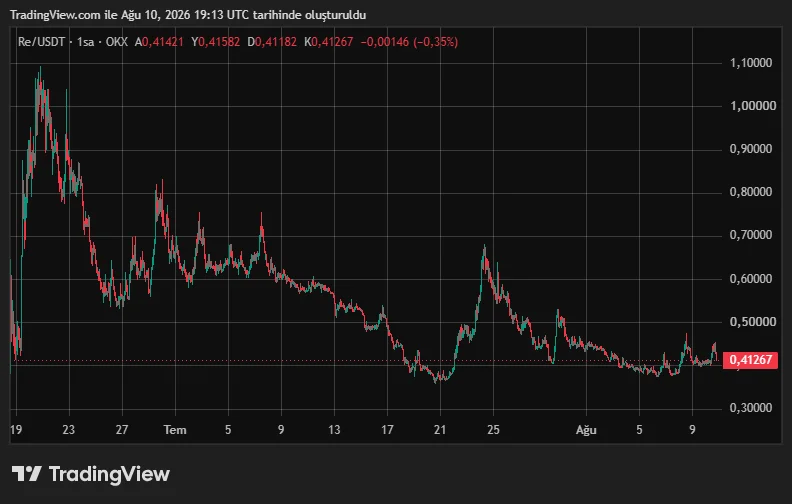
According to market data, RE traded at approximately $0.38 on August 7, 2026. Its circulating market capitalization stood at around $61 million, while its fully diluted valuation was close to $383 million. These figures change continuously with market conditions.
Re Protocol’s current status
Re’s July 2026 performance report shows that the protocol’s broad definition of total value locked reached $581.13 million. Of this amount, $82.76 million was held onchain, while $179.44 million was held in offchain reserves at regulated institutions.
The remaining $318.93 million consisted of contractually committed premium receivables arising from signed policies. The actual future collection of these premiums may be affected by policy performance and changes to reinsurance agreements.
The protocol reported a reinsurance portfolio of $510.5 million at the end of July. Small commercial insurance accounted for 40% of the portfolio, commercial auto insurance for 29%, and homeowners insurance for 18%.
Workers’ compensation insurance represented 12%, while personal auto insurance accounted for 1%. This distribution shows that the project initially prioritized more frequent and statistically modelable insurance risks.
The first reUSDe redemption window also opened in July. Requests were accepted between July 9 and 22, with $1.5 million in redemption liquidity allocated for the period. This marked one of the first real tests of a liquidity model dependent on the release of offchain collateral.
As of August 2026, the RE coin price is hovering around $0.40.
How Does the RE Token Work?
RE’s primary use case is participation in Re Protocol governance. Simply holding the token in a wallet does not automatically unlock every governance right; participants must stake RE.
Stakers can vote on proposals, submit new proposals, and delegate their voting power to representatives. Eligible participants may also serve on protocol committees or perform certain verification functions.
The initial governance phase covers smart contract upgrades, technical permissions, staking rules, committee formation, and transparency standards. The protocol includes the Market Acceptance Committee, Risk Standards Committee, Treasury and Investment Committee, Audit and Transparency Committee, and Technical Governance Committee.
The pricing of individual insurance policies, acceptance of specific risks, and payment of claims are not subject to direct votes by token holders. Licensed insurance companies and responsible reinsurance professionals retain authority in these areas.
RE can also be locked as collateral for sensitive governance responsibilities. A portion of staked tokens may be forfeited in cases of defined misconduct or failure to perform assigned duties. This mechanism is known as slashing in the crypto ecosystem.
Lock-up, waiting, and unstaking periods may apply during the staking process. Although Re plans incentives to encourage active participation in governance, the RE token was not designed as an asset that generates passive returns from insurance premiums.
RE supply, allocation, and token unlocks
RE’s total and maximum supply is capped at 1 billion tokens. Project documents state that there are no plans for perpetual inflation or unlimited token issuance.
Half of the total supply was allocated to the ecosystem. These 500 million RE tokens can be used for governance incentives, staking rewards, liquidity, integrations, grants, market expansion, and community programs.
Core contributors and advisors received 200 million RE, equivalent to 20% of the supply. Investors were allocated 170 million RE, or 17%, while the remaining 130 million RE, representing 13%, was set aside for the Ecosystem Development Reserve.
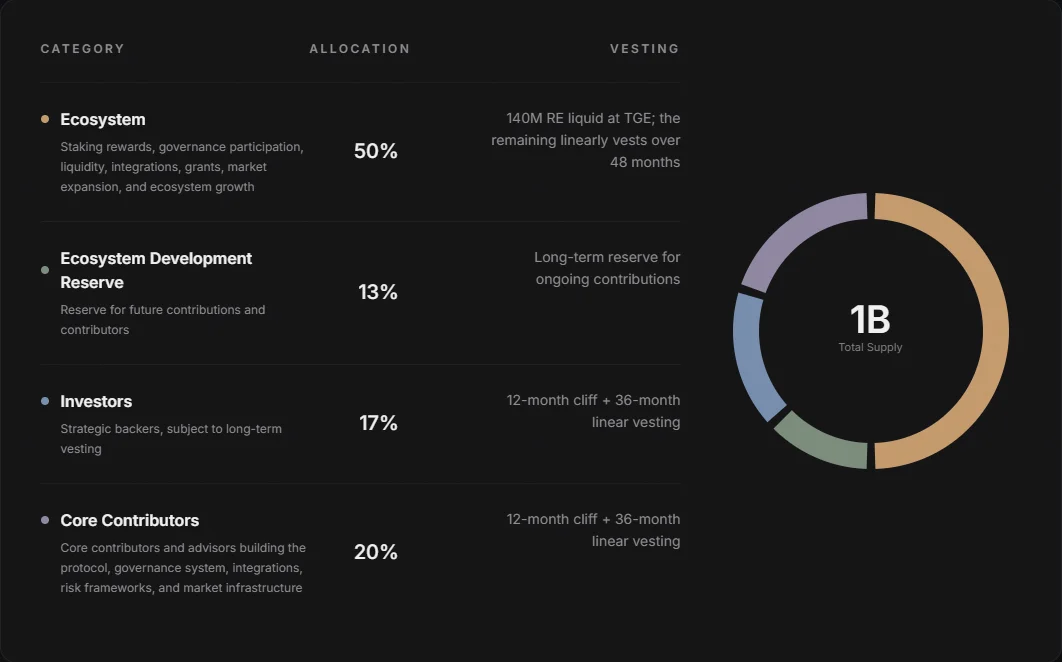
At the TGE, 159.6 million RE became liquid. This amount represents 15.96% of the total supply and comes entirely from the ecosystem allocation.
The portion of the ecosystem allocation that did not unlock at launch enters circulation linearly over 48 months. On July 18, 2026, for example, 7.09 million RE from the ecosystem allocation was released. Monthly unlocks are expected to continue on a similar schedule.
Tokens allocated to investors and core contributors have a 12-month cliff. After this period, the allocations will unlock linearly over 36 months. Based on the June 2026 TGE date, the first regular unlocks for team and investor tokens can be expected around June 2027.
The Ecosystem Development Reserve is intended for long-term contributions. The official launch announcement did not provide a monthly vesting schedule for this reserve in as much detail as it did for the other categories.
The share of total supply currently in circulation remains low. Future ecosystem, team, and investor unlocks could therefore create supply pressure on the RE price. A fixed total supply does not eliminate dilution risk; the circulating amount increases as previously locked tokens enter the market.
Ethereum, smart contracts, and security
RE transactions are settled on Ethereum. Re Protocol’s security, however, extends beyond token transfers; stablecoin deposits, deposit-token minting, offchain capital transfers, reserve reporting, and redemptions each introduce separate layers of risk.
Eligible users deposit supported assets into smart contracts known as the Insurance Capital Layer. The system issues reUSD or reUSDe according to the collateral deposited and the selected risk tranche.
Part of the capital remains onchain to provide redemption liquidity. The portion used in reinsurance contracts is transferred to legally segregated trust accounts and regulated structures.
The Resilience Foundation does not directly conduct Re’s insurance operations. Regulated reinsurance transactions are carried out by Cover Reinsurance SPC, which holds a Class B(iii) license in the Cayman Islands.
The Network Firm verifies the reserves daily. Verified information about offchain reserves is published on the blockchain through Chainlink, while Fireblocks infrastructure is used to custody crypto assets.
Hacken and Certora audited the smart contracts at different stages. Certora’s review focused on capital flows, the redemption mechanism, and administrator privileges; all disclosed findings were remediated.
In July 2026, Sherlock also reviewed the NAV oracle structure that supplies daily minting and redemption prices for reUSD and reUSDe. No high-severity vulnerabilities were identified, and the low-severity findings in the report were resolved before publication.
Why Is Re Important?
Participating in the traditional reinsurance market requires substantial capital, specialized expertise, and regulatory approval. This structure largely restricts access to returns generated by insurance risk to institutional firms.
Re establishes a system through which eligible participants using stablecoins can contribute to this capital requirement. This creates a new link between real-world insurance risks and blockchain-based liquidity.
The use of blockchain is particularly important for collateral visibility. Having reserves verified by an independent organization and publishing the results through an oracle allows participants to monitor the capital position more frequently.
Reinsurance returns are not directly derived from Bitcoin or Ethereum prices. Real-world events such as car accidents, workplace injuries, property damage, and commercial insurance claims determine portfolio performance.
This can allow reinsurance to have a lower correlation with the crypto market. Low correlation does not mean low risk, however. Major claims, mispriced policies, or higher-than-expected claim rates can cause portfolio losses.
reUSD, reUSDe, and the Insurance Capital Layer
The Re ecosystem contains three distinct token models. RE serves a governance function, while reUSD and reUSDe represent capital supplied through the Insurance Capital Layer.
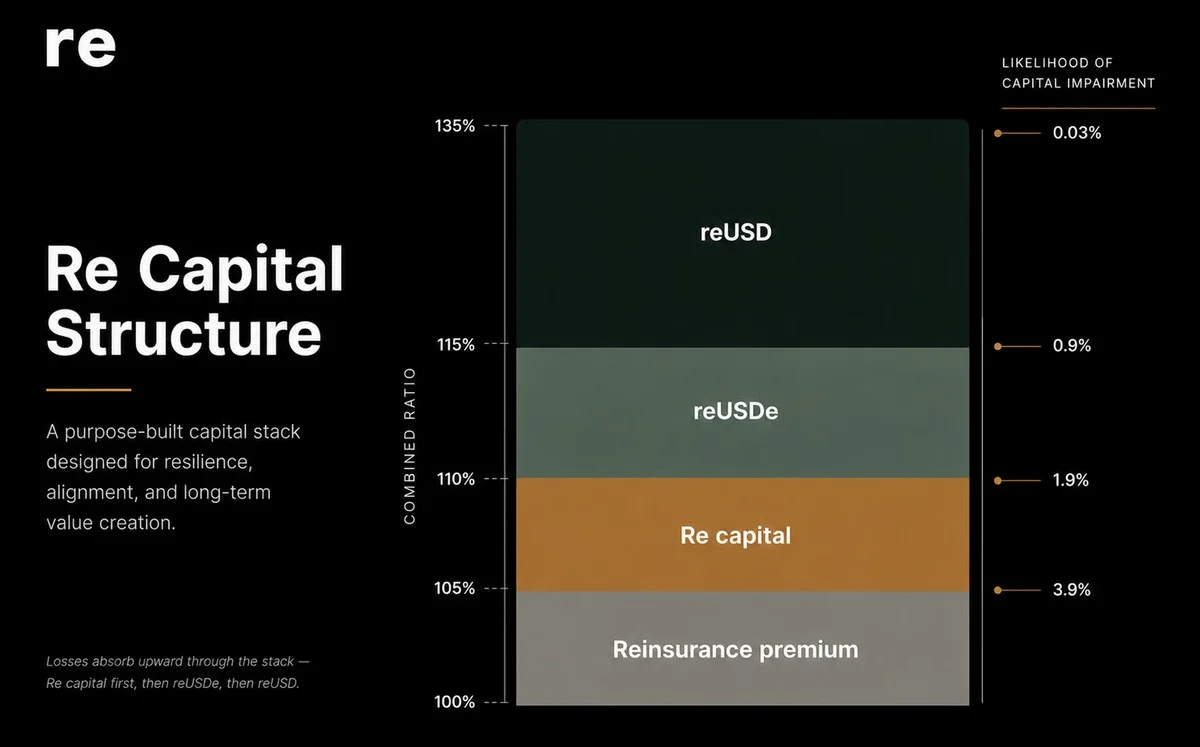
reUSD sits in the senior tranche of the capital structure. Users can obtain reUSD by depositing supported assets such as USDC, USDT, USDe, or sUSDe.
This tranche is structured to absorb losses only after reUSDe and Re’s own capital. reUSD is therefore positioned as the lower-risk and more liquid option. The description “principal protected,” however, should not be interpreted as an absolute guarantee.
The sources of reUSD yield vary according to whether capital is deployed onchain or offchain. The offchain portion is influenced by a spread over SOFR, a benchmark for short-term US interest rates, while the onchain portion is linked to the trailing yield of sUSDe.
Instant redemptions are available only when sufficient onchain liquidity exists. If the liquidity buffer falls below a certain level, requests may be moved into a quarterly queue.
reUSDe occupies a lower tranche in the capital stack and absorbs losses before reUSD. In return, it targets a higher share of the yield generated by reinsurance activity.
Because most reUSDe capital is used as offchain reinsurance collateral, it cannot be redeemed continuously. Exits are processed through periodic windows in which an independent actuary determines how much capital can be released.
Returns on both tokens are variable. reUSD and reUSDe are not bank deposits, carry no government guarantee, and are not covered by FDIC protection in the United States. KYC or KYB verification and jurisdiction-specific eligibility checks may apply.
reUSD and reUSDe can also be used across Curve, Pendle, Morpho, Silo Finance, and various liquidity applications. These integrations expand the tokens’ utility while introducing lending, liquidity pool, and third-party smart contract risks into the system.
Re’s Team and Governance
Re Protocol’s technical and governance layer is organized around the Resilience Foundation. Actual reinsurance contracts are executed through the licensed Cover Re SPC. This legal separation keeps the blockchain protocol and regulated insurance activities within distinct entities.
Chainlink supports the transmission of reserve data and cross-chain messaging. Fireblocks provides asset custody infrastructure, while The Network Firm performs daily reserve verification.
Nexus Mutual’s $15 million allocation to the tokenized reinsurance fund in 2024 became one of the project’s early institutional connections. Electric Capital, Tribe Capital, Framework Ventures, Morgan Creek Digital, and Coinbase Ventures are also among the organizations that invested in Re at different stages.
Governance is becoming decentralized in phases. RE holders can participate in certain policy and technical decisions, while licensed insurance, actuarial, and claims processes continue to depend on centralized organizations.
This hybrid structure concentrates Re’s main strength and its most significant risk in the same place within the real-world asset sector. Onchain data provides transparency, but the enforcement of insurance contracts, custody of collateral, and management of claims remain dependent on offchain parties.
RE investors should also examine the link between the token and protocol revenue carefully. RE does not provide a share of insurance premiums or reinsurance profits. Even if the protocol grows, there is no direct revenue-sharing mechanism that automatically transfers that growth to the token price.
The supply structure creates a separate risk. As of August 2026, approximately 16% of the total supply was in circulation. Four years of ecosystem unlocks, together with team and investor vesting beginning in 2027, will steadily increase the amount of RE available in the market.
The RE price is also exposed to the high volatility commonly seen in new tokens. Exchange listings, token unlocks, governance decisions, reinsurance portfolio performance, and liquidity conditions across the broader crypto market can affect the price in a short period.
Protocol products also carry risks associated with stablecoins and sUSDe. A loss of price stability in an asset used as collateral, declining liquidity, or problems with the underlying yield strategy could affect the Re ecosystem.
Risks on the insurance side operate differently. Higher-than-expected claims, modeling errors, insufficient reserves, and counterparty problems can cause losses across the capital tranches. Re’s own capital and the reUSDe tranche are intended to protect reUSD, but severe losses could affect every layer.
Regulatory uncertainty should not be overlooked. Under Re’s European Union MiCA document, RE is classified as an “other crypto-asset” rather than an asset-referenced token, electronic money token, or utility token. Access conditions for capital products such as reUSD and reUSDe may vary by jurisdiction.
Frequently Asked Questions (FAQ)
Below are answers to some of the most frequently asked questions about Re (RE):
- What is Re, and when was it launched?: Re is a blockchain protocol that connects stablecoin capital with fully collateralized, regulated reinsurance contracts. The project was announced in 2022, while the RE governance token launched on June 18, 2026.
- What is the RE token used for?: RE is used in governance decisions concerning protocol upgrades, committees, technical permissions, transparency standards, and incentive policies. Participants must stake RE to vote, submit proposals, or serve on committees. RE holders do not automatically receive a share of insurance premiums, company revenue, or reinsurance profits. The token also provides no ownership rights in Re Protocol or Cover Re.
- Which network does Re operate on?: RE follows the ERC-20 standard on the Ethereum mainnet. Other Re Protocol products may also be available on EVM-compatible networks such as Avalanche, Arbitrum, and Base.
- Who founded Re Protocol?: Karn Saroya is Re’s co-founder and CEO. The project’s early founding team included Natalie Gray, Cliff White, Ben Aneesh, and Anand Dhillon. Saroya previously founded the insurtech company Cover. Cliff White is also known as one of the key founders involved in Re’s technical formation and development.
- What is the RE token supply?: RE has a total and maximum supply of 1 billion tokens. Of this amount, 50% was allocated to the ecosystem, 20% to core contributors, 17% to investors, and 13% to the Ecosystem Development Reserve. A total of 159.6 million RE entered circulation at the TGE. The ecosystem allocation unlocks over 48 months, while team and investor allocations will vest over 36 months following a 12-month cliff.
- What is the difference between RE, reUSD, and reUSDe?: RE is the governance and coordination token. reUSD and reUSDe are yield-oriented tokens that represent capital deposited into the protocol and carry different levels of risk. reUSD sits in the senior tranche of the capital structure and is designed to be affected by losses last. reUSDe occupies a lower tranche and absorbs losses earlier; in return, it offers higher potential yield and lower liquidity.
- Is Re a suitable investment?: Whether RE is suitable depends on an investor’s risk tolerance, objectives, and assessment of its tokenomics. Factors to consider include the token’s low circulating supply, regular unlocks, the gradual development of governance, and the absence of rights to revenue from reinsurance activities. Smart contract, insurance claims, liquidity, stablecoin, regulatory, and counterparty risks also apply. Reviewing the latest token unlock schedule, official documentation, and current market data is therefore important before making a decision about RE.
Follow the JR Crypto Guide series to learn how onchain reinsurance works and track the RE token’s role in governance and the latest developments across Re Protocol.

