Pitbull (PIT) is a completely community-driven meme coin that lives on Binance Smart Chain. It's a digital asset that grows through voluntary contributions, independent of any central authority or founding team. When it launched on March 17, 2021, a total of 100 quadrillion tokens were minted; half of this massive amount was permanently removed from circulation by being sent to a "black hole" incineration address at launch. The project's guiding slogan is "All for One, One for All"; meaning everyone for each other, one for all. This perspective summarizes the nature of the Pitbull community. A portion of the fee earned from each transaction is directly passed on to existing token holders. The contract is non-modifiable, and liquidity is locked, creating a sense of security. In short, Pitbull exists as a decentralized community initiative that provides passive income. Let's take a closer look at Pitbull's origin story and what it aims to achieve.
Pitbull's Definition and Origins
Pitbull (PIT) is a token that automatically distributes rewards through a smart contract and operates using a "reflection" mechanism. Token holders automatically receive a share of transaction fees simply by holding PIT in their wallets; no extra staking, farming, or platform connection is needed. This feature offers an accessible and passive income-generating structure for many users. The project's striking aspect is that it has no central control point from the beginning. The development team relinquishes ownership of the contract immediately after launch; meaning no one has control over the contract anymore. This step is a significant turning point that makes Pitbull a true "community token." Similarly, there are no distributions such as project wallets or developer shares. From day one, all decisions are made by volunteers and users who contribute to the project.
Participants contribute voluntarily in many areas, from graphic design to web development, translations to social media campaigns. Many elements, from the platform's logo to its official website, are shaped by these contributions. Users are not only investors but also the true owners of the project. Pitbull's founding purpose is quite clear: to provide a transparent, decentralized, and entirely community-managed crypto experience. It also places special emphasis on animal rights. A portion of each transaction is used to support animal shelters and non-profit animal protection organizations. In this respect, Pitbull is not just a cryptocurrency; it also presents itself as a movement aiming to create social benefit.
Pitbull's History: Key Milestones
Since its launch, Pitbull has experienced remarkable developments in both technical and social areas. Token supply, burning strategies, exchange listings, and the evolving ecosystem have shaped the project's current identity. Here are some highlights from Pitbull's short but intense history:
The first step was taken on March 17, 2021. When Pitbull launched on Binance Smart Chain, a total of 100 quadrillion tokens were produced. Exactly half of this amount (50 quadrillion) was sent to the "burn" address in the first minute, completely destroyed. This action not only fixed the maximum supply; It also sent a strong message that supply would be reduced in a transparent and irreversible manner. Around the same time, ownership of the project contract was relinquished, making the contract irreversible.
Shortly after its launch, the Pitbull token began trading on various decentralized exchanges, most notably PancakeSwap. Subsequently, centralized exchanges such as CoinTiger, ZT, IndoEx, and BKEX also listed PIT. According to CoinMarketCap data, the token is currently traded on over 60 exchanges. This widespread access made it easier for investors to reach the project and significantly increased liquidity. The project also attracted attention with its community structure. Within the first year after its launch, Pitbull reached over 500,000 wallets. As of 2023, this number exceeded 528,000. Social media activities, community-organized competitions, and volunteer efforts contributed to the growth not only of the token but also of the consensus behind it.
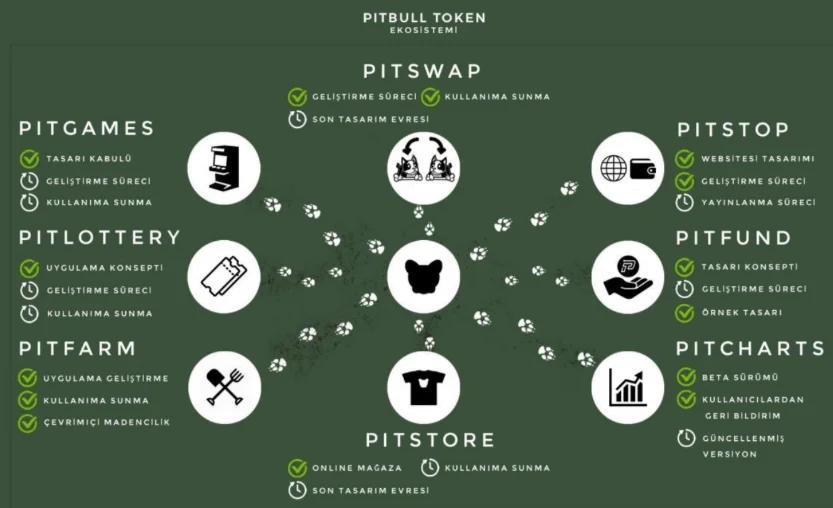
Pitbull's deflationary model became one of the fundamental building blocks of the token economy. Except for the initial burn, a 2% tax automatically collected from each transaction is sent directly to a "dead" address. This leads to a decrease in the token supply over time. The deflationary strategy aims for long-term value appreciation for token holders. Thanks to the decreasing supply, the value of circulating tokens theoretically has the potential to increase. Technically, the project is also progressing. The official roadmap includes numerous sub-projects such as PitDAO (governance), PitArcade (gamification), PitNFT (digital collectibles), PitMedia (content creation), PitPay (payment solutions), and PitBurn (automatic burning mechanism). While these projects are still under development, each one is a sign that Pitbull will evolve from just a meme coin into a multifaceted ecosystem. Specifically with PitBurn, the goal is to eventually eliminate 70% of the circulating tokens.
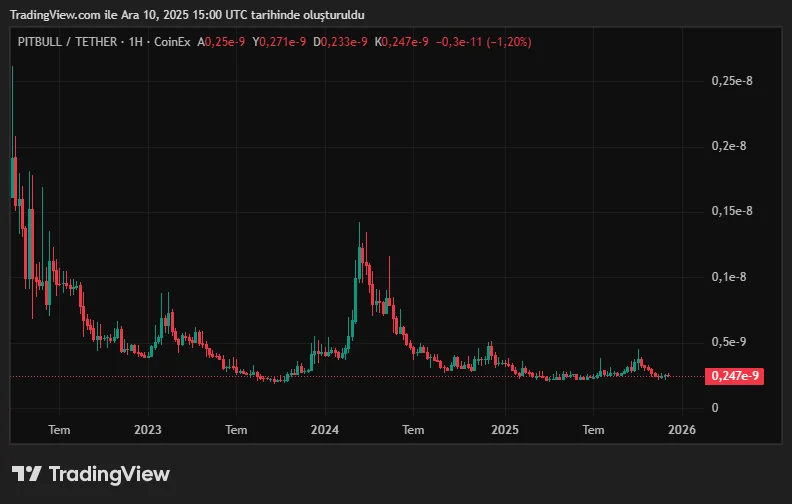
As of December 2025, the PIT coin price is trading at around $0.0000000002523.
Why is Pitbull Important?
Pitbull offers an experience that centers the community directly, not institutional investors. Ownership is delegated, liquidity is locked, and decisions are made through voluntary participation. In this way, it stands out as a rare example of "complete decentralization" in the crypto world. While offering a passive income model with its technical infrastructure, it does not neglect the social responsibility side. When financial tools, gamification, and aid projects are combined, what emerges is not just a token, but a comprehensive community movement.
Below, we examine the use cases and token economy separately to better understand why Pitbull is important:
Use Cases
One of Pitbull's strongest aspects is its community-centric applications and tools. Although most of these are still in active development, they have already taken shape with significant community contributions.
DeFi Infrastructures
The community has developed different projects to create decentralized finance tools. For example, PitSwap stands out as a DEX belonging to the Pitbull ecosystem. Users can exchange tokens on this platform. Another project called PitSafe focuses on asset security. Additionally, tools like PitCharts and PitTracker allow users to easily track the token's price movements, liquidity status, and trading volumes. Furthermore, content-focused projects like PitMag (community magazine) and PitMusic handle the entertainment and information aspects.
Gamification and NFTs
Some of the projects included in Pitbull's roadmap focus on NFTs and gamification. For example, PitFarm is planned as an NFT-based farming game. PitArcade aims to offer multiplayer mini-games. PitNFT will serve as a marketplace for trading collectibles. These projects target users who want to have an interactive and fun experience, not just hold tokens. For young communities in particular, such applications could be one of the factors accelerating the project's adoption.
Charity and Social Projects
One of Pitbull's most distinctive aspects is its close relationship with social responsibility. The project donates a portion of the taxes on each transaction to non-profit animal protection organizations. So far, it is known that organizations such as Kennel to Couch, Rolda, and Bullies in Need have been supported. In other words, every time a user transfers PIT, the system automatically directs a portion to charity. This makes the investment a form of donation. Projects that provide such direct social benefit are quite rare in the crypto ecosystem.
Token Economy
Although Pitbull's token structure seems simple at first glance, it contains several cleverly designed mechanisms. Supply limitation, automatic burning, and a passive income model offer incentives for long-term holders and play important roles in price stability. Supply and Burning Mechanism
The total supply of Pitbull was set at 100 quadrillion. At launch, half of this supply—50 quadrillion tokens—was irreversibly burned by being sent to a "black hole" address. This initial move significantly reduced the supply from day one. The burning process didn't end there; the system automatically burns 2% of each transaction. This aims to create a supply shortage by gradually reducing the amount of tokens in circulation. This strategy helps maintain the price floor while providing a stronger position for users who are holding (hodl). Smart
Contract and Security
Pitbull's security approach works on a "write code and leave it" basis. After launch, the developer relinquishes ownership of the contract. This means the smart contract can no longer be modified externally. In addition, the liquidity pool is permanently locked; meaning no one can withdraw these funds. All these measures make fraud scenarios like rug pulls (project founders fleeing) largely impossible. With this approach, called Safe by Design, Pitbull provides investors with confidence not only technically but also psychologically. Transfer Tax and
Distribution Model
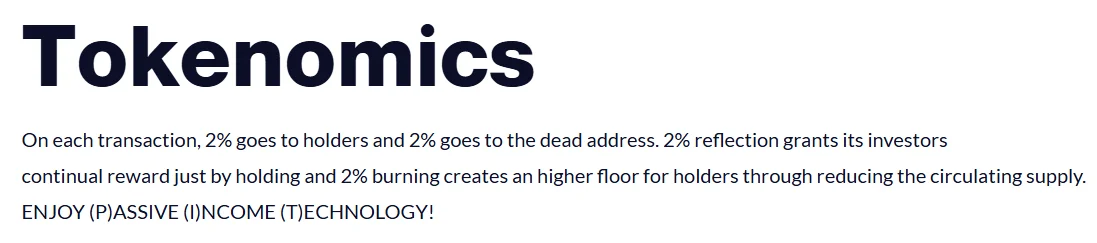
A flat tax of 4% is applied to PIT token purchase or sale transactions. Half of this percentage (2%) is automatically distributed to token holders. This means that as long as you hold PIT in your wallet, you continuously receive a share from transactions. The remaining 2% goes directly to the burning address. Thus, each transaction generates passive income while simultaneously reducing the token supply. This model eliminates the need for staking, farming, or third-party applications; earnings are directly credited to your wallet. This user-friendly system provides significant convenience, especially for investors without technical knowledge.
Pitbull's website's explanation of the token economy.
Who Founded Pitbull?
Behind Pitbull is a volunteer team that doesn't reveal its face but contributes continuously. The project's developer completely relinquishes ownership of the contract shortly after the token is launched. This means that no one has the authority to unilaterally interfere with the contract. "Renounced ownership" forms the technical basis for true decentralization, one of Pitbull's core principles. The project doesn't have a known, fixed founding team. Instead, volunteers from within the community support the project. According to official sources, names like Jack, Jari, Faab, Max, Mer, and Cameron play active roles within the community. Some contribute to software development, while others handle social media management, organization, or design. However, these individuals are not part of a hierarchy. Everyone has a say in proportion to their contribution.
Decisions don't come from a central structure, but from the collective wisdom of the community. Every important step is based on community discussions and feedback. In the future, a DAO (Decentralized Autonomous Organization) structure called PitDAO is planned to further institutionalize this process. With this system, voting, governance proposals, and question-and-answer sessions will be conducted more regularly. Thus, investors will not only hold tokens but also become actors who guide the project. In short, Pitbull's leadership approach is not a classic "team" model. Here, everyone's contribution is valuable, and everyone's voice is heard. The project stands out as an example of solidarity built with code, design, ideas, and volunteerism.
Frequently Asked Questions (FAQ)
As we come to the end of the article, let's summarize some of the most frequently asked questions about Pitbull (PIT) in the community. This section may be especially useful for those who are researching for the first time or who want to clarify some technical points before making an investment decision. Now let's take a look at those basic questions together.
Is PIT reliable? The Pitbull token has a security-focused design. At the beginning of the project, contract ownership was transferred from the central developer to the community (ownership renounced), and the liquidity pool was locked indefinitely. This prevents any individual from changing the contract or withdrawing liquidity funds. Therefore, from a distance, it has a structure with reduced risks. However, like all cryptocurrencies, PIT is subject to high volatility and market risk. Therefore, it is important to research the project details and assess your risk tolerance before investing.
Where to buy PIT? Since Pitbull (PIT) is a BEP-20 token, it can be traded on all Binance Smart Chain compatible DEXs (e.g., PancakeSwap). It is also listed on several centralized exchanges. According to CoinMarketCap data, the most active trading volume is seen on PancakeSwap (V2), while it is also traded on exchanges such as CoinTiger, ZT, IndoEx, and BKEX. Additionally, PIT is listed on major exchanges such as Gate.io, KuCoin, and MEXC. When making purchases, make sure the platform you use is secure and that you are using the correct token contract address. (You can check the BscScan page for the official address; for example, the address 0xa57ac35c…2c2e50 on BscScan belongs to the Pitbull token.)
What about wallet compatibility? The Pitbull (PIT) token runs on BNBChain (formerly BSC), so it can be stored in any BNBChain-compatible wallet such as Trust Wallet, MetaMask, and Binance Web3 Wallet. According to Binance's guidelines, Pitbull tokens can be easily traded using Binance Web3 Wallet. Make sure the wallet you are using supports the BNBChain network. For example, you can add the BSC network to your MetaMask wallet and view your token balance by uploading the PIT contract.
What is the tax rate and distribution based on? A fixed 4% transaction fee (tax) is deducted from Pitbull transactions. 2% of this amount is reflected in all PIT-holding wallets (as a holder reflection reward) and 2% is sent to the burning address, reducing the circulating supply. So, a total of 4% is deducted from each buy/sell transaction: half goes to rewards for community members, and the other half is spent on token burning. This allows existing holders to earn passive income and supports a decrease in supply instead of an increase. The tax mechanism is automatically executed via smart contract; investors do not need to perform any manual actions.
What is the long-term investment potential? Pitbull is a meme coin with a high total supply, so it's not easy for it to reach large price targets. According to CoinMarketCap analysis, values like $0.01, for example, don't seem very likely due to the current supply size; however, planned updates in the roadmap and strong community support could allow the price to increase in the long term. Of course, as with any crypto investment, there are risks. If community projects are successfully implemented and adoption increases, Pitbull's value could also rise over time. There are potential rewards as well as community incentives for active members who contribute to the community. However, it should be remembered that caution is always necessary when investing in any asset in the crypto markets.
Discover the latest analyses, tools, and developments regarding the PIT token and the community-driven meme coin ecosystem in the JR Kripto Guide series.
#what is pitbull#what is pit coin#pit coin price#Is PIT reliable#pitbull token supply#pitbull burn mechanism#pitbull coin future#pitbull
Do you have any questions?Feel free to send us your questions or request a free consultation.