Nano (XNO) is a digital currency that utilizes a DAG-based block-lattice architecture instead of blockchain, stands out for its lightweight structure, and completely eliminates transaction fees. The moment you enter the Nano ecosystem, you're greeted by sub-second fast transfers, a payment flow that requires no intermediaries, and a completely user-centric design. The high transaction fees and long confirmation times seen in first-generation cryptocurrencies like Bitcoin are replaced with a real-time, cost-free digital cash experience in Nano. Thanks to the block-lattice structure, where each user maintains their own chain, the network is congested; transactions proceed simultaneously, smoothly, and without interruption. On the security front, Open Representative Voting is implemented; XNO holders delegate their voting power to representatives, effectively preventing risks like double-spending while maintaining the energy-efficient nature of the network.
In short, for anyone wondering what Nano is, the picture is quite clear: speed, zero fees, environmentally friendly architecture, and a simple user experience all rolled into one. Let's explore how Nano makes this approach possible, what its technology offers, and why it's so talked about in the crypto world.
Nano's Definition and Origins
Nano's story actually begins with the name RaiBlocks (XRB) and begins with a radically different vision in the cryptocurrency world. In 2014, Colin LeMahieu focused on two fundamental problems facing Bitcoin: high transaction fees and slow confirmation times. At the time, Bitcoin's ability to process only a few transactions per second, coupled with the rapid increase in fees when the network became congested, made practical use cases like "daily payments" or "microtransactions" difficult. LeMahieu envisioned a completely new architecture that transcended these limitations.
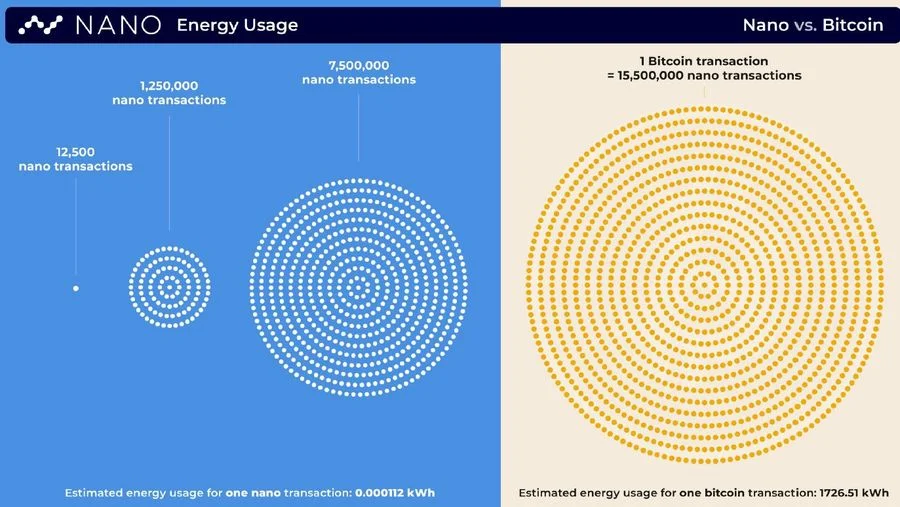
Nano vs. Bitcoin
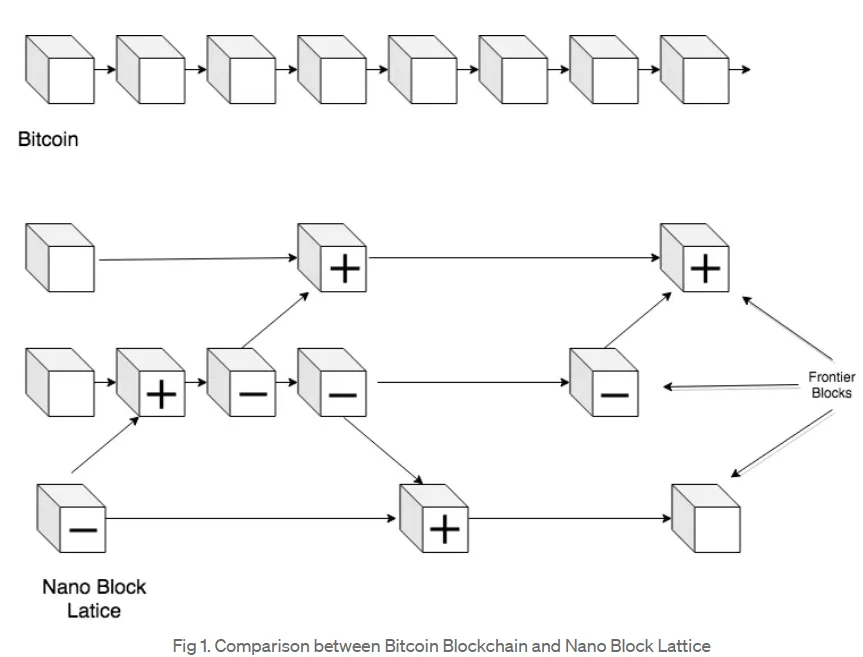
At this point, the foundations of RaiBlocks were laid. LeMahieu abandoned the traditional blockchain structure and developed an innovative architecture he called block-lattice. In this structure, each user had an independent chain for their account, and transactions were processed simultaneously on these chains. This approach was quite radical at the time, as it enabled parallel chains to operate independently, rather than the continuous growth of a single chain within a centralized network. This reduced congestion, increased transaction speeds, and significantly reduced energy consumption.
On October 4, 2015, the first RaiBlocks client was released, and the project saw real users. At the time, XRB coins were distributed free of charge to anyone who wanted them through a popular Captcha faucet. Users earned XRB simply by completing simple verification tests and, in return, provided feedback by testing the network. This method provided a fair distribution model and ensured early discovery of the network by a broad community. At the same time, the idea of a "public digital cash" gained strong acceptance from its inception.
In 2018, a significant turning point occurred in the project's identity: the name RaiBlocks was changed to Nano. This new name better represented the project's lightweight, speed-focused architecture, and user-friendly experience. The name Nano also became an ideal metaphor for digital cash, meaning "small, simple, fast." Following the branding, global exchanges began listing Nano, and the project quickly gained a broader user base.
In 2021, the Nano team took another step: the XNO currency code was aligned with the international ISO 4217 standard. This step strengthened Nano's ambition to become a recognizable asset not only in the crypto world but also in the financial systems of the future. Achieving this level of standard compliance is difficult for many cryptocurrencies, so the adoption of the XNO code was a significant indicator of trust for the community.
Today, Nano continues to hold a unique position in the crypto ecosystem thanks to the advantages of its blockchain architecture. Each transaction is processed independently, preventing network congestion. Transactions typically resolve in less than a second and, most importantly, are completely free. Because its energy consumption is virtually negligible, Nano largely escapes the environmental criticisms faced by contemporary cryptocurrencies.
Block-lattice architecture. Source: Nano/Medium
Nano's History: Key Milestones
Nano's history is crucial for understanding how the project took shape and how it reached its current state. The journey began with the name RaiBlocks and, over time, matured both technically and from a community perspective, acquiring the Nano identity.
• 2015: Colin LeMahieu released the first client, developed under the name RaiBlocks, on October 4, 2015. During this period, XRB (now XNO) coins were distributed free of charge through a Captcha faucet. Users obtained XRB by completing simple verification tests and also had the opportunity to test the network's resilience, speed, and performance through real-world usage. This early phase allowed Nano to gradually evolve into a project shaped by user feedback.
• 2017: After a total of 126,248,289 RaiBlocks had been distributed, the faucet was closed, ending the free distribution process. This step was a significant milestone that clarified the formal framework of the Nano economy. The maximum supply was set at 133,248,297 XRB, and an additional 7 million XRB were set aside as a development fund. This made Nano a cryptocurrency with a fixed and inflation-free supply structure.
• 2018: The project's identity was reshaped, and the name RaiBlocks was changed to Nano. This new name better reflected Nano's vision of lightness, speed, and efficiency. That same year, 17 million Nano were stolen due to a security breach on the BitGrail exchange; however, the incident was not caused by Nano's technological architecture, but by a vulnerability in a third-party platform. While the price fluctuated, the project was technically unaffected, and development continued unabated.
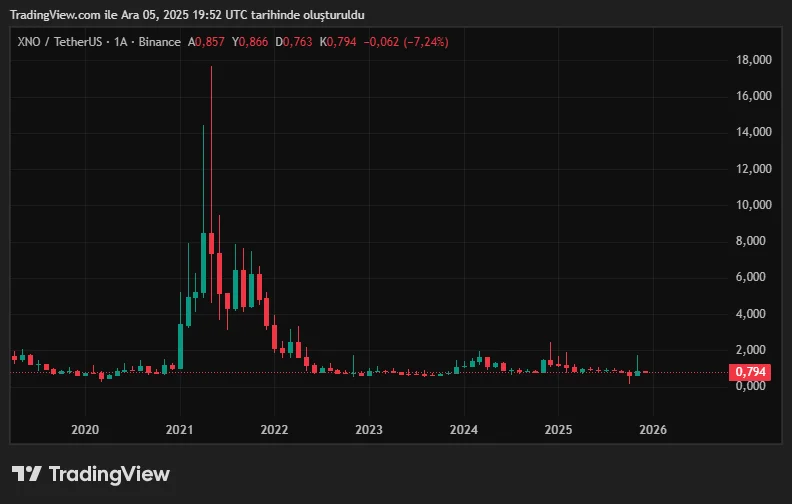
• 2021: The Nano ecosystem moved closer to international standards, and its currency code was aligned with ISO 4217. The official code was announced as XNO. This change supported Nano's goal of becoming a digital asset more compatible with traditional financial infrastructures. • 2024 – 2025: The Nano network continued to receive regular updates during these years. The V27.1 version, released in 2024, aimed to increase the network's stability. The V28 Electrum version, announced for 2025, aimed to bring performance improvements, particularly for commercial use and high-volume transaction traffic. The XNO coin price is currently fluctuating between $0.7 and $0.8 as of the last month of 2025.
Why Nano Matters?
Simply looking at the technical innovations it offers and the advantages it provides in daily life is enough to understand why Nano is so important. From the very beginning, the project has focused on fast transaction confirmation and zero fees. This approach distinguishes Nano from many cryptocurrencies and makes it a powerful payment tool valued by both individuals and businesses.
Nano is particularly prominent in micropayments and e-commerce. Because there are no transaction fees, even very small payments become meaningful. Sending a small tip to a content creator, purchasing a digital app in seconds, or paying for a small subscription becomes extremely convenient with Nano. Because there are zero fees, microtransactions cease to be a burden and become a real-world use case.
Nano's advantage is also clearly evident in cross-border money transfers. Transactions that might take hours or even days with traditional banking are completed in seconds with Nano. Furthermore, no commission is charged. Therefore, many users seeking urgent money transfers choose Nano for its speed and cost-effectiveness. The lack of delays and interruptions in transfers makes Nano a real-time digital cash alternative.
Nano's influence is also growing on the commercial side. Payment gateways like NOWPayments and Crypto.com offer Nano support, allowing businesses to accept payments with Nano. Because there are no transaction fees, merchants don't lose margin, and customers complete payments within seconds. This structure creates a significant advantage, especially for businesses selling low-priced products.
Additionally, Nano is a strong candidate for inter-object payments (IoT). Its low power consumption and instant verification architecture enable devices to make small payments between themselves. For example, a device can automatically make Nano payments for a microservice it uses. This suggests that it could play a significant role in the payment infrastructure of IoT ecosystems in the future.
Applications
Nano's application areas are expanding over time, and the network's technical specifications continue to support this growth.
• Instant and free transfers: Nano's most distinguishing feature is that transactions are often confirmed in less than a second. Because every transfer is free, it's possible to send money without bank fees or network charges. This speed and cost-effectiveness combined make the user experience much smoother.
• Micropayments: Because there are no fees, even the smallest balances reach the recipient in full. This makes Nano a powerful option for content platforms, subscription models, in-app purchases, or tipping systems.
• Cross-border transfers: International payments, which can be problematic in traditional banking due to high costs and long waiting times, can be resolved in seconds with Nano. The speed offered by Nano is a significant advantage, especially for urgent money transfers.
• Store and POS payments: Because Nano is supported by various payment providers, it can be used in online stores and some brick-and-mortar businesses. Because businesses pay no transaction fees, they maximize revenue from every sale, and customers enjoy a fast and seamless payment experience.
• Non-profit projects: Its low energy consumption and zero-cost transaction model make it a great fit for charity projects and social enterprises. Many community projects utilize Nano for processes requiring fast and free payments. Additionally, next-generation technologies such as Web3 and IoT can develop integrated payment solutions thanks to Nano's features.
Token Economy
Nano's token economy remains simple, predictable, and based on a fixed structure it has maintained since the very beginning. The total supply, like Bitcoin's, is predetermined and cannot be changed. This maximum supply is defined as 133,248,297 XNO. Because no new coins are created on the network, there is no inflation; in other words, there is no mining, no staking rewards, and no increasing supply over time in Nano.
Nano's initial distribution is via a Captcha faucet. Users earn XRB by completing simple verification tests, directly contributing to the network's early development. The faucet closed in 2017, and from that point on, all Nano coins were released into circulation. From that date on, the supply remains completely fixed. Thus, Nano maintains a completely inflation-free economic structure without a deflationary model. The network's consensus mechanism operates using the Open Representative Voting model. XNO holders hold voting power equal to their holdings and delegate these votes to representative nodes that contribute to the network. Because no rewards are distributed during this process, XNO ownership serves only a security and governance role. Network security is fueled not by economic incentives, but by a simple, lightweight, and efficient architecture.
The distribution model also supports this simplicity. Initially distributing Nano to the community for free allows the project to grow in a user-focused way. Later, centralized exchanges begin listing Nano, and users can buy and sell XNO through them. Because the supply is completely fixed, the price is driven entirely by market demand.
This entire model supports Nano's token economy on the following foundations:
• Fixed Supply: 133,248,297 XNO
• No New Coin Generation: No mining or inflation
• Distribution: Initially a faucet, now through exchanges
• Consensus: Open Representative Voting, with voting power determined by the amount of XNO
Who is Nano's Founder?
The key figure behind the Nano project is Colin LeMahieu. He worked on system optimization as a software engineer at major technology companies like Dell, AMD, and Qualcomm before stepping into the project full-time in 2015 as the founder of Nano, then known as RaiBlocks. LeMahieu's goal was clear: to develop a digital cash protocol that was free of unnecessary complexity, fast, energy-efficient, and completely user-centric. Even today, his vision continues to inform the core leadership shaping Nano's technical direction.
The project's development structure is currently being shaped by the Nano Foundation. Based in the UK, this organization embraces an open-source culture and incorporates volunteer contributors from around the world. This approach allows independent developers from various countries to contribute mobile wallets, desktop applications, payment gateways, and various integration tools to the Nano ecosystem. The Natrium wallet and other payment solutions developed by the community are also key components that accelerate Nano's adoption. From a technical perspective, Nano has maintained its philosophy from the outset: "removing unnecessary overhead and focusing on speed and efficiency." The Nano Foundation and volunteer developers regularly release updates to further reduce transaction times, increase scalability, and improve network stability. The project remains actively developed today, and its roadmap includes initiatives aimed at supporting real-world use cases such as POS terminals, merchant integrations, and fintech applications.
Frequently Asked Questions (FAQ)
Below are some frequently asked questions and answers about Nano.
How to buy XNO? To buy Nano (XNO), you need to register on cryptocurrency exchanges. Pairs like XNO/USDT can be traded on major exchanges like Binance, Kraken, Crypto.com, and OKX. In Turkey, some platforms offer the ability to directly purchase XNO by depositing Turkish Lira. After registering, you can purchase Nano by depositing funds into your account and withdraw them to your own wallet.
Which exchanges is XNO listed on? Nano is listed on many exchanges globally. For example, major exchanges like Binance and Kraken support Nano trading. Many exchanges and even decentralized exchange (DEX) platforms accessible from Turkey also offer Nano pairs.
Can you pay with Nano? Yes. Nano's free and fast transactions make it possible to use it for payments. Some payment providers (NOWPayments, CoinPayments, etc.) have integrated Nano as a payment method. This allows websites, stores, or service providers to accept Nano. Since Nano transaction confirmations are often under a second and there are no fees, payment is virtually instantaneous, and the recipient is free of fees.
What wallets can I use for Nano? Multi-asset wallets like Natrium (mobile), Nault (desktop/web), Ledger hardware wallets, and Atomic/Exodus can be used to store Nano. Natrium is one of the most preferred options by the community, particularly for its speed and ease of use.
Why are there no transaction fees on the Nano network? Thanks to Nano's block-lattice structure and Open Representative Voting (ORV) model, there is no need for an economic incentive mechanism for network verification. Because the network operates so lightly, paying miners is not required, naturally reducing transaction fees to zero.
Is Nano energy efficient? Yes. Nano's architecture consumes extremely low energy because it doesn't require mining. Since there is no block production or mining on the network, energy use is limited to the operation of the nodes. This makes Nano a standout among environmentally friendly cryptocurrencies.
Can a transaction be reversed on the Nano network? No. Once a transfer is confirmed on Nano, it cannot be reversed. This is an important principle for security and integrity, as with other cryptocurrencies. Therefore, users are advised to carefully verify the address before making a transfer.
Discover the latest analysis, tools, and integration guides on Nano (XNO) and instant payment solutions in the JR Kripto Guide series.
#what is nano#xno coin price#what is xno coin#nano
Do you have any questions?Feel free to send us your questions or request a free consultation.