
As DeFi grows across the Sui ecosystem, one key question becomes more important: where will liquidity on this network gather? Momentum is one of the projects trying to answer that question. With its DEX, liquid staking, vault products, token launch infrastructure and RWA ambitions, it aims to build a broader financial layer on Sui.
The project’s native token is MMT. Within Momentum, MMT stands out through governance, incentive distribution and the veMMT locking model. In this guide, we will look at what Momentum is, how it works, what the MMT token is used for and why the project has become one of the notable names in the Sui ecosystem.
Momentum’s Definition and Origins
Momentum is a liquidity and DeFi infrastructure built on Sui. Although Momentum DEX is the project’s most visible product, the ecosystem is not limited to that.
Momentum DEX is a decentralized exchange where users can trade tokens and provide liquidity. Its main difference is that it uses a CLMM structure, which is more capital-efficient than traditional automated market maker models.
CLMM stands for “concentrated liquidity market maker.” In this model, liquidity providers do not have to spread their assets across the entire price range. Instead, they can choose a narrower price range and use their capital more effectively within that area.
This structure is especially important for actively traded pairs. The same amount of capital can support more trading volume when placed in the right price range. For liquidity providers, this may increase potential returns; for traders, it can make transaction costs more efficient.
This is also the starting point of Momentum. The project argues that the DeFi market on Sui needs stronger liquidity infrastructure. That is why it does not only offer a trading interface; it also tries to bring liquidity, staking, treasury management, token launches and yield strategies into the same ecosystem.
Momentum’s Main Purpose
Momentum’s main goal is to make assets on Sui easier to trade and to create lasting liquidity for these assets. In DeFi, liquidity is often attracted through temporary campaigns. When a protocol distributes rewards, users arrive; when the rewards end, capital moves elsewhere. Momentum is trying to make this cycle more sustainable.
To do this, it uses the ve(3,3) model. In this model, MMT holders lock their tokens and receive veMMT. veMMT holders then have a say in which liquidity pools receive more incentives.
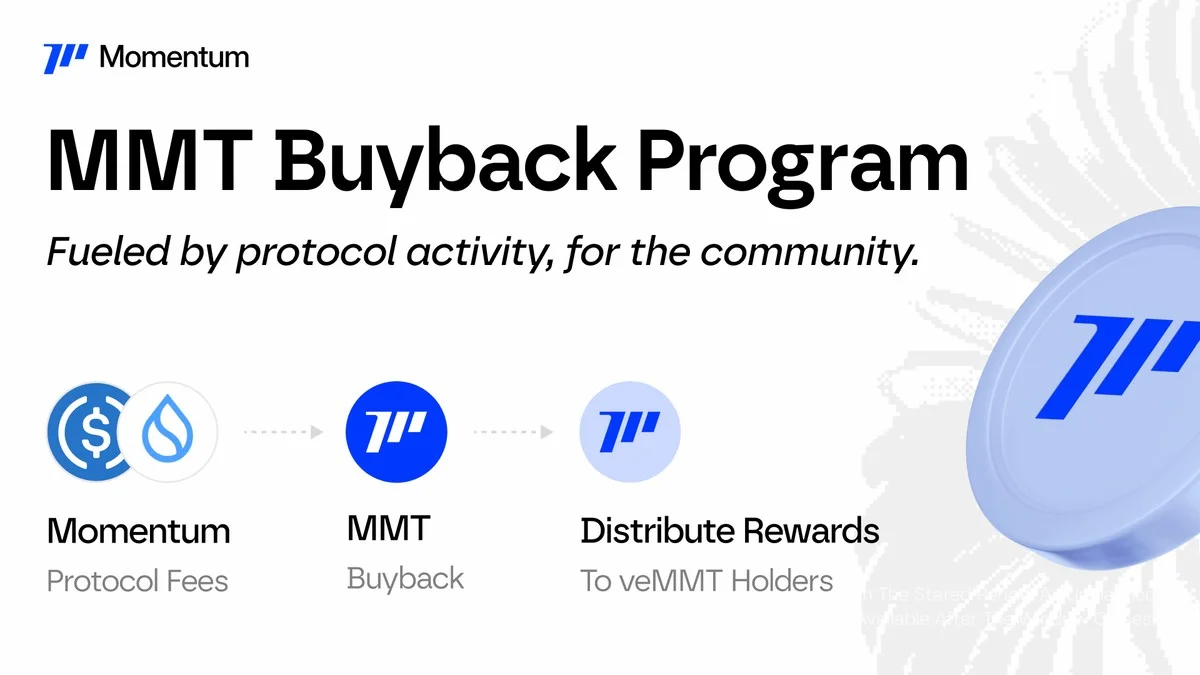
This means the system does not work only on a “provide liquidity, earn rewards” logic. Users can also influence the direction of the protocol’s liquidity. This shows that Momentum places community participation at the center of its token economy.
Another goal of Momentum is to make the Sui DeFi experience more useful. It offers liquid staking through xSUI, automated yield strategies through Vaults, multi-signature asset management through MSafe and token launch infrastructure through TGL.
Each of these products addresses a different need. Their common goal is to create a deeper, more useful and longer-term DeFi market on Sui.
Which Network Does Momentum Use?
Momentum’s main network is Sui. The project builds its products around the Sui ecosystem and focuses especially on providing liquidity infrastructure for Sui-based assets.
Sui’s Move-based structure creates an important foundation for Momentum. Move is known as a programming language focused on security and verifiable transaction logic. Momentum’s MSafe product is one of the asset management solutions built on this structure.
Momentum’s plan is not limited to Sui alone. Official documents state that after the Sui ecosystem, the project also aims to support assets from other chains. At this stage, a broader asset structure is planned through cross-chain messaging solutions such as Wormhole.
In the longer term, real-world assets also come into play. Momentum wants to support tokenized versions of assets such as securities, commodities, real estate and intellectual property.
Momentum’s History: Key Milestones
MSafe has an important place in Momentum’s history. MSafe is a multi-signature smart contract wallet developed for Move-based digital asset management.
A multi-signature structure is especially important for teams, DAOs and protocols. It prevents funds from being moved under the control of a single person. Before a transaction can be executed, multiple approvals are required.
This structure is a common security layer in treasury management for crypto projects. MSafe stood out as one of the products answering this need on Sui.
MSafe should not be viewed only as a fund custody tool. It can also be used in areas such as token vesting, protocol governance and dApp integrations. For that reason, MSafe is a good starting point for understanding Momentum’s more institutional and team-oriented side.
Official documents state that MSafe has been a multi-signature, non-custodial smart contract wallet operating since the first day of the Sui mainnet. This shows that Momentum’s connection to the Sui and Move ecosystems is not new.
Development of Momentum DEX
Momentum DEX became the project’s main product. According to official documents, the beta version of the DEX was launched on March 31, 2025.
The DEX aims to offer stronger trading infrastructure for tokens on Sui. At this point, the concentrated liquidity model becomes important. This model can help liquidity providers use their capital more efficiently and help traders execute transactions at better prices.
Another important side of Momentum DEX is that it works together with the ve(3,3) model. Liquidity incentives are not determined only by the protocol in a one-sided way. veMMT holders can vote on which pools receive more rewards.
This structure also matters for projects on Sui. When a new token enters the market, it needs a strong liquidity area. Momentum aims to make this process more organized through both its DEX and Token Generation Lab.
xSUI, Vaults and Token Generation Lab
One of the important products in the Momentum ecosystem is xSUI. xSUI works as the liquid version of staked SUI.
When users stake SUI, they can receive xSUI in return. This allows them to continue earning staking rewards while still having the chance to use their assets in DeFi. Compared with traditional staking, this offers a more flexible structure.
For example, when a user stakes SUI, they normally give up liquidity. In the xSUI model, the user receives a token representing the staked position. This token can be used in different DeFi products.
Vaults are designed to offer a more automated yield experience. Users do not need to constantly manage positions, choose price ranges or rebalance manually. On the Vaults side, these processes move through more ready-made strategies.
Token Generation Lab is Momentum’s launchpad product. Its aim is to make token launches for selected projects on Sui more efficient. TGL access being exclusive to veMMT holders is one of the elements that strengthens Momentum’s token locking and community participation model.
MMT Token’s Market Debut
The token of the Momentum ecosystem is MMT. In the official MiCA whitepaper, the token’s name is listed as Momentum Token and its ticker as MMT.
MMT’s total supply has been set at 1 billion. The token is defined as being issued under Sui’s fungible token standard.
The purpose of MMT is to power governance and incentive mechanisms within Momentum. Users can lock MMT and receive veMMT. veMMT is used for voting power, incentive direction and access to certain ecosystem opportunities.
There is an important distinction here. In official documents, MMT is not defined as a company share, revenue right or security. The token’s function is limited to its use within the Momentum protocol.
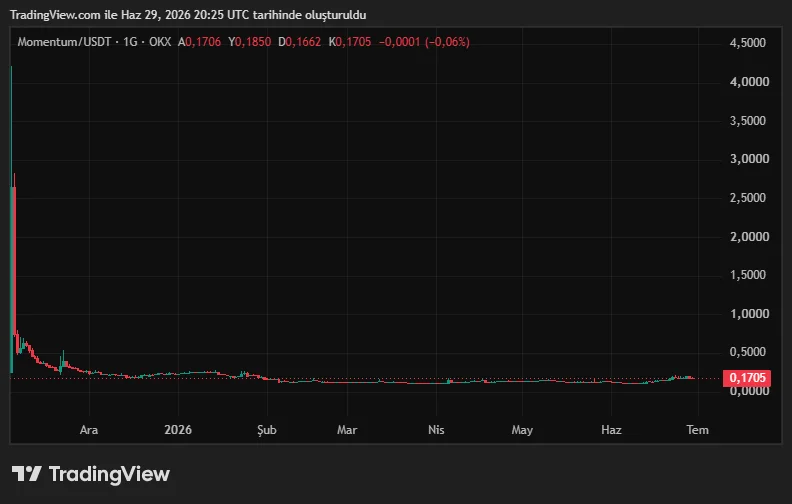
As of June 2026, MMT coin price is around $0.17.
What Is MMT Token and What Is It Used For?
MMT is primarily Momentum’s governance and incentive token. It is used as the main tool for long-term participation in the protocol.
Token holders can lock their MMT and receive veMMT. This locking structure encourages users to stay connected to the protocol for a longer period. A longer lock duration means more voting power.
MMT is also connected to liquidity rewards and community incentives. Users who trade, provide liquidity or participate in governance may encounter different reward mechanisms.
However, evaluating MMT only through price movement would be incomplete. The token’s real importance appears in Momentum’s operating model. Since the veMMT system determines where emissions flow, MMT sits directly at the center of the protocol economy.
What Is veMMT?
veMMT is the voting power token received by users who lock MMT. It does not work like a transferable token; it functions more like a participation right inside the protocol.
The more MMT a user locks, and the longer the chosen lock period is, the more veMMT power the user receives. According to official documents, the lock duration can go up to four years.
A one-year lock gives lower voting power, while a four-year lock provides maximum voting power. This structure aims to prioritize users who take a longer-term view of the protocol rather than short-term traders.
veMMT holders play a role in the distribution of liquidity incentives. They can vote on which pool receives more emissions. This allows Momentum’s liquidity map to be shaped by the community and token holders.
The strong side of this model is that it tries to align users with the growth of the protocol. The risky side is the lock duration. A user who locks tokens gives up liquidity for a certain period, even if market conditions change.
MMT Token Economy
MMT has a total supply of 1 billion tokens. The initial supply planned to enter circulation during the Token Generation Event was stated as 204,095,424 MMT. This equals around 20.41% of the total supply.
The largest share in the distribution is allocated to the Community Growth category. This category represents 42.72% of the total supply. Liquidity incentives, growth campaigns, risk management, RWA integrations and community-focused work are supported from this allocation.
The ecosystem allocation is 13%. This portion is reserved for developer support, integrations, hackathons and technical growth work.
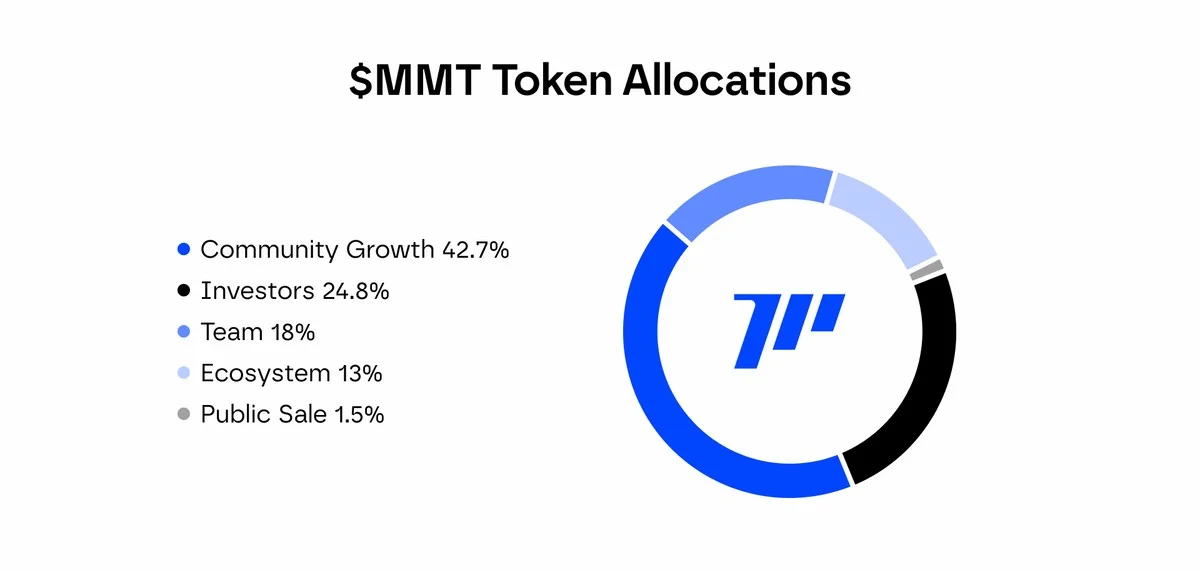
The share allocated to investors and early supporters is 24.78%. The Public Sale allocation is set at 1.5%. The team allocation is 18%.
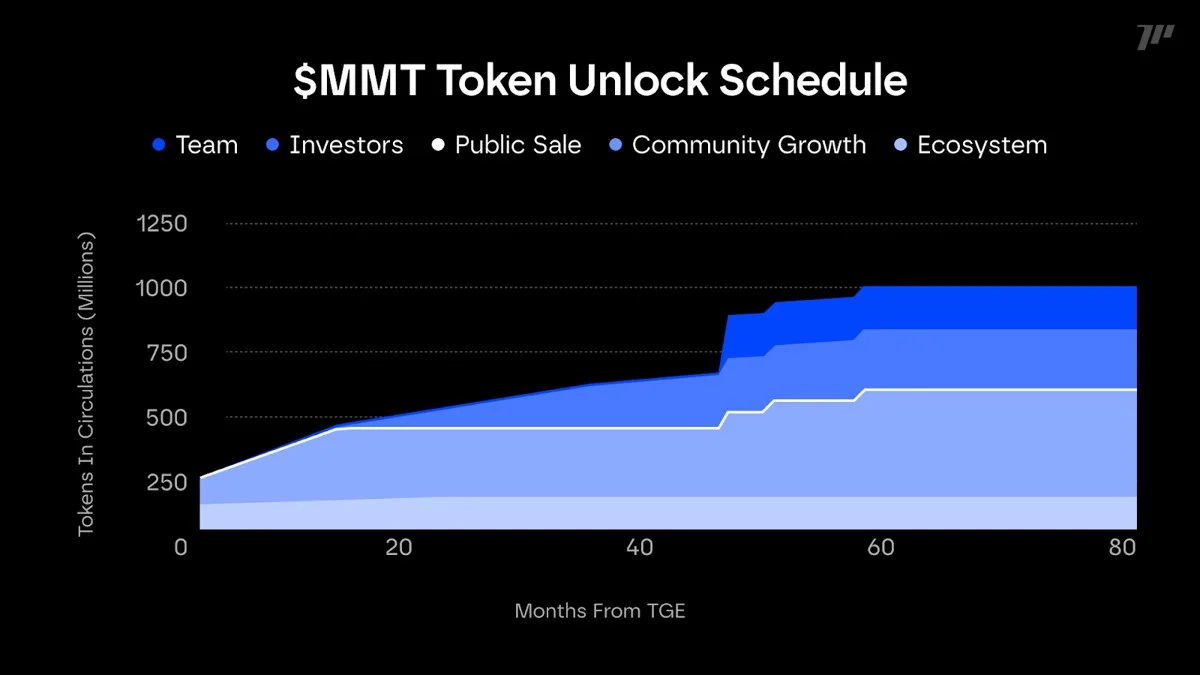
The vesting structure is based on long-term locking. According to official documents, team and investor tokens do not unlock at TGE. Investor tokens unlock gradually over 48 months after a 12-month cliff. Team tokens remain locked for the first 48 months.
This structure aims to prevent heavy selling pressure from forming on the first day.
Why Is Momentum Important?
Momentum’s importance comes from its direct focus on the liquidity needs of Sui. For a blockchain ecosystem to grow, fast transactions alone are not enough. The network also needs strong DEXs, deep liquidity and an active user base.
Momentum DEX tries to take on a critical role here. It offers infrastructure for tokens on Sui to trade more efficiently. Liquidity providers can place their capital in narrower ranges. Traders can execute transactions at more efficient prices.
This structure also matters for new projects. Tokens launched on Sui need a healthy market. Momentum tries to meet this need through both its liquidity and launch-side products.
Making Incentives More Long-Term With the ve(3,3) Model
Distributing incentives in DeFi is easy. Turning those incentives into lasting liquidity is the hard part.
Momentum uses the ve(3,3) model to answer this problem. Users lock MMT and receive veMMT. veMMT holders then decide which pools receive more rewards.
This system tries to manage liquidity through community direction rather than only growing it with short-term campaigns. If a pool is seen as important for the ecosystem, it can receive more incentives through the votes of veMMT holders.
Of course, this model also carries risks. Voting power may become concentrated in the hands of certain users. Long lock periods may be challenging for users during periods of market volatility. Still, Momentum’s token economy looks for a more structural answer to the temporary liquidity problem often seen in DeFi.
Giving SUI Holders More Flexibility With xSUI
xSUI is one of the most notable products Momentum offers to SUI holders. Users can stake SUI while staying liquid at the same time.
This creates an important difference for DeFi. When users stake their assets, they earn passive income. Through xSUI, they can also use the token representing this position in other DeFi transactions.
This means the same capital does not remain locked in one place. SUI staking rewards can continue while other opportunities within the ecosystem are also used.
These kinds of liquid staking products can increase DeFi activity on a network. User capital becomes more mobile. Momentum also aims to increase capital efficiency on Sui through xSUI.
Real-World Asset Ambitions
Momentum’s long-term plan also includes real-world assets. The Momentum X product sits at the center of this goal.
Real-world assets, or RWAs, have become one of the most discussed topics in the crypto market in recent years. Treasury bills, commodities, real estate and different financial products can be tokenized and brought onchain.
However, this area cannot be solved through technical infrastructure alone. Identity verification, compliance, transfer rules and regulation are also required. That is why Momentum X is designed as a more institutional layer.
Official documents state that Momentum X aims to build compliant trading infrastructure for tokenized assets. If this plan succeeds, Momentum may provide infrastructure not only for Sui tokens, but also for a broader onchain financial market.
Momentum’s Developers, Investors and Community
Rize Labs is the structure behind Momentum Finance. In the official MiCA whitepaper, Rize Labs Inc. and Rize Labs Foundation are listed as structures connected to the project.
On the team side, Wendy Fu is listed as CEO and co-founder. Fu’s background includes experience at Meta/Facebook and work connected to the Libra/Diem team. This detail is especially notable for the Move ecosystem.
Jacky Wang is listed as CTO and co-founder. Official documents state that Wang worked on Layer 1 protocol development, consensus mechanisms and smart contract infrastructure at Harmony.
Vinson Leow is listed as CSO. Leow is described as having experience in Web3 growth, strategy and investment.
Investors and Strategic Backers
Momentum’s official documents state that the project has raised more than $11 million in total funding. Investors include Coinbase Ventures, Circle Ventures, OKX Ventures, Jump, Aptos Foundation, Sui Foundation, Varys Capital, Protagonist, Selini Capital, Amber Group, KuCoin Ventures, Gate Ventures and MEXC Ventures.
This list shows that the project is seen as one of the notable infrastructure initiatives within the Sui and Move ecosystems. The presence of names connected to the Move ecosystem, such as Sui Foundation and Aptos Foundation, is especially important in this regard.
Community and Governance
Momentum’s community structure is shaped around MMT and veMMT. Users lock MMT to receive veMMT. This veMMT provides voting power inside the protocol.
veMMT holders can have a say in which pools receive liquidity incentives. This moves the community away from being only an observer. Users can influence which areas of the protocol receive more resources.
There is also a special access model for veMMT holders on the Token Generation Lab side. Selected token launches, early-stage opportunities and community-focused campaigns may be connected to this structure.
This model shows that Momentum places the community inside the protocol economy. However, the point users need to pay attention to is the lock duration. To receive veMMT, users need to lock MMT, which means giving up liquidity.
Frequently Asked Questions
Below, you can find some frequently asked questions and answers about Momentum.
- What is Momentum and when was it launched?: Momentum is a DeFi and liquidity infrastructure built on Sui. Its main product is Momentum DEX. According to official documents, the beta version of Momentum DEX was launched on March 31, 2025.
- Who developed Momentum?: Rize Labs is the structure behind Momentum Finance. In official documents, Wendy Fu, Jacky Wang and Vinson Leow are listed among the core team members.
- What is MMT token used for?: MMT is the governance and incentive token of the Momentum ecosystem. Users can lock MMT and receive veMMT. veMMT provides voting power, incentive direction and access to certain ecosystem opportunities.
- What is veMMT?: veMMT is the voting power token received by users who lock MMT. A user’s voting power changes depending on the amount of MMT locked and the lock duration.
- Which network does Momentum use?: Momentum’s main network is Sui. The project focuses on strengthening liquidity, staking, token launch and DeFi infrastructure on Sui.
- What is xSUI?: xSUI is the liquid version of staked SUI. Users can receive xSUI when they stake SUI and use this token in DeFi.
- Why is Momentum important?: Momentum tries to bring liquidity, DEX, staking, vaults, token launch infrastructure and RWA infrastructure together in the same ecosystem on Sui. For that reason, the project stands out as a broader Sui-based DeFi infrastructure, rather than only a decentralized exchange.
Follow the JR Kripto Guide series for the latest information on Momentum and Sui-based DeFi projects.

