
What Is Midnight (NIGHT)?
When privacy comes up in the crypto market, people often think of fully closed transactions that are difficult to track. Midnight does not fit neatly into that mold. The project approaches privacy from a more practical angle: the sensitive data of a user, institution, or application should be protected; however, specific information should still be shareable for audit or compliance purposes when needed.
Midnight (NIGHT) is a data protection-focused Layer-1 blockchain network that uses zero-knowledge technology. According to Input Output, Midnight is positioned as a network designed to protect personal data and support digital freedom. The project aims to create room for institutions to build regulation-friendly, privacy-preserving applications through its “rational privacy” approach, which means privacy that works according to context.
This is why reading Midnight simply as a “privacy coin” would be incomplete. NIGHT token is the network’s visible and transferable native asset, while DUST offers a non-transferable resource model used to run transactions. This structure is one of the project’s most distinctive features. Midnight aims to bring privacy and compliance to the same table while making transaction costs more predictable.
Midnight’s Definition and Origins
Midnight focuses on one of blockchain’s most fundamental problems: everything being visible to everyone. On networks such as Bitcoin and Ethereum, transparency has provided a major advantage in terms of trust. However, that same transparency can become a serious barrier in areas such as institutional finance, identity verification, health data, commercial agreements, and RWA.
It is not easy for a company to move payment flows, customer information, supply chain details, or balance sheet activity into an environment where everyone can see them. The same also applies to individual users. On a blockchain, a trail that starts with a wallet address can eventually reveal a person’s transaction habits, asset distribution, and interactions with others.
Midnight brings forward the idea of “programmable privacy” at this point. The network allows the truth of a piece of information to be proven through zero-knowledge proofs, without requiring the information itself to be made public. A user can prove that they meet a certain condition, while a developer can embed that verification into an application. In Midnight’s official statements, this structure is described as an architecture that allows developers to decide when and how privacy should be applied at both the application and transaction layers.
Behind the project are Midnight Foundation and Shielded Technologies. Shielded Technologies is a technology company that spun out of Input Output and is positioned as one of the key technology partners of Midnight Network. The company describes itself as one of the core developers, architects, and contributors to the Midnight protocol.
Why Is Midnight Important?
Midnight’s importance goes beyond the word “privacy.” The issue here is not only hiding transaction details. The real question is whether blockchain can work in harmony with real-world institutions, regulations, and data security expectations.
So far, many institutions have closely followed blockchain and even carried out pilot projects. However, an infrastructure where every piece of data is visible to everyone can only be used in a limited way, especially in regulated sectors. For banks, payment companies, insurance firms, healthcare institutions, or asset managers, privacy is not just a nice-to-have feature; in many cases, it is essential for operations to continue.
Midnight’s “rational privacy” approach comes into play here. The logic is simple: instead of hiding everything from everyone, the system makes it programmable who can see what, and to what extent. The user protects their data, the application runs transaction rules, and an auditor or regulator can see only the limited information that is necessary for their role.
This approach separates Midnight from classic privacy coin models. While projects such as Monero or Zcash are more commonly known for value transfer and transaction privacy, Midnight targets a broader application layer. Identity, compliance checks, collateral verification, RWA transactions, and institutional DeFi therefore sit at the center of the Midnight narrative.
How Does Midnight Work?
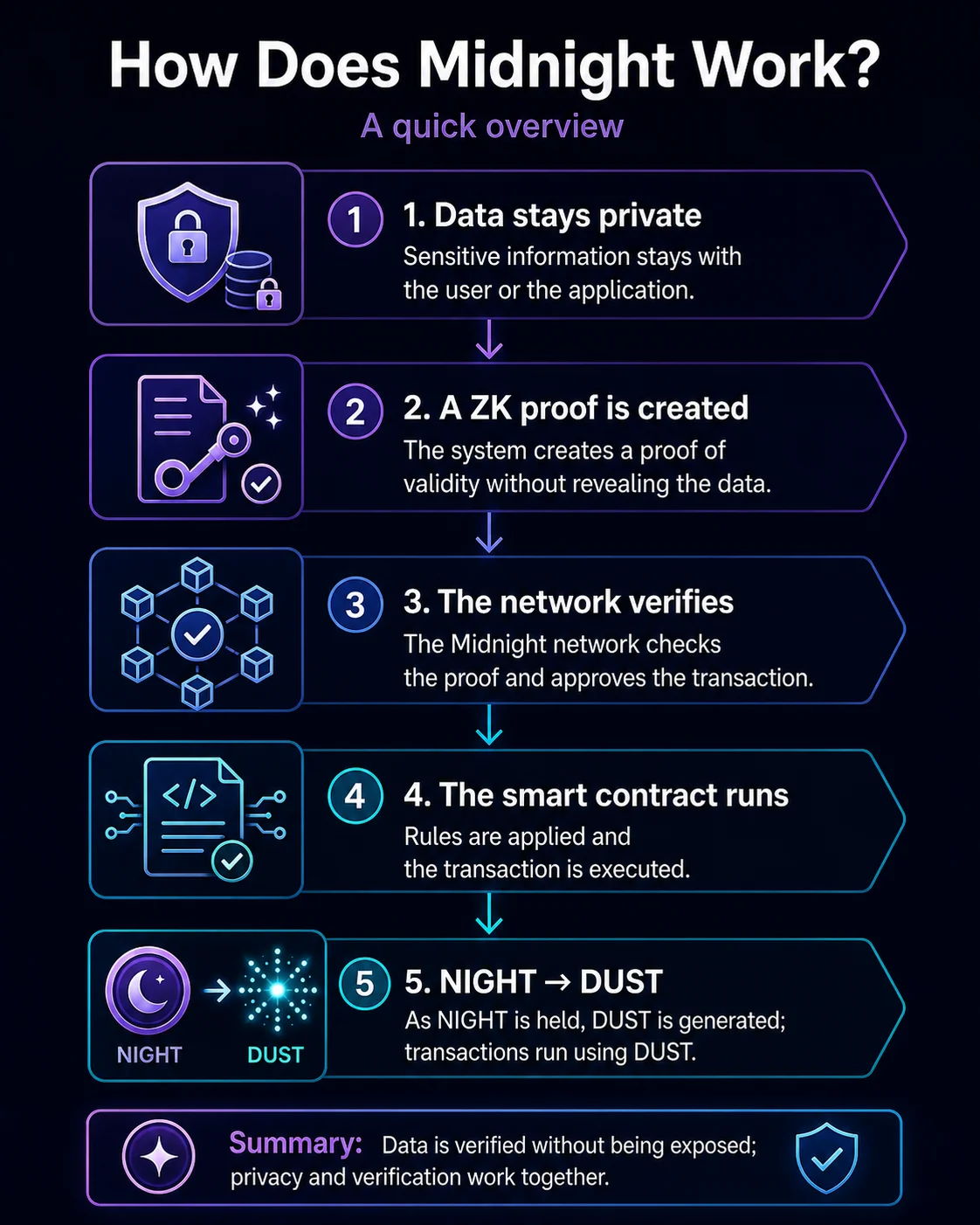
At the center of Midnight’s technical structure are zero-knowledge proofs. ZK technology allows one party to prove that a certain piece of information is true, without revealing the information itself. In practice, this is a cryptographic way of saying, “I meet this condition.”
For example, imagine a user needs to prove that they are above a certain age, eligible to receive a service in a specific region, or able to meet a certain collateral ratio. Under normal conditions, verifying these details would require sharing an ID document, financial data, or personal information. In a Midnight-style structure, this information remains under the user’s control; what is sent to the network is not raw data, but a verification proof.
In Midnight’s official mainnet announcement, this structure is described through “client-side proofs.” Sensitive data remains on the user’s device, a zero-knowledge proof is generated through a local proof server, and this proof is sent to the network for verification. As a result, identity, eligibility, credit, or compliance checks can be carried out without exposing the underlying data to the entire network.
Another important part of the network is its dual-state ledger architecture. On Midnight’s own website, this model is explained as the interaction between public on-chain state and local private state through ZK proofs. This allows applications to have both a public layer that everyone can verify and a private data area that belongs to the user.
On the developer side, this model is supported by a programming language called Compact. Compact is introduced as a TypeScript-based, statically typed domain-specific language. Its purpose is to allow developers to write privacy-focused smart contracts without needing to become experts in ZK cryptography.
What Is NIGHT Token?
NIGHT is the native and governance-focused token of Midnight Network. However, there is an important detail here: NIGHT is not a private token. According to Midnight’s official NIGHT page, NIGHT works as an “unshielded,” open, and transparent token. Transaction information can be viewed publicly.
This is a deliberate choice. Midnight does not build privacy by turning value transfer into a completely dark environment. While NIGHT token works like the network’s capital and governance asset, the transaction execution side is handled through a separate resource called DUST.
Users who hold NIGHT generate DUST. DUST is designed as a shielded and non-transferable resource used to pay transaction fees and run smart contracts on the Midnight network. In official documents, NIGHT is compared to a “solar panel,” while DUST is compared to “electricity.” NIGHT is held, DUST is generated over time, and network transactions are run using DUST.
The goal of this model is not necessarily to fully separate transaction costs from token price volatility, but to make them more predictable. In the traditional gas model, a user directly spends the network’s native token to make a transaction. On Midnight, NIGHT is not spent; DUST works more like a renewable capacity that is generated over time.
What Is DUST? Why Is It a Separate Resource?
DUST is one of the most interesting parts of Midnight’s token economy. It is a non-transferable, shielded resource designed only for network usage. You cannot use DUST to pay someone, trade it, or settle debt. This makes Midnight’s privacy approach more controlled.
In the official NIGHT explanation, DUST is described as non-transferable and as a resource that decays when unused. Because of this, DUST does not become a tool for anonymous value transfer; it is used only to run transactions.
This distinction is especially important for institutional use. If a company wants users to interact with an application, it can hold NIGHT, generate DUST, and allocate that DUST to application usage. This means the end user may not need to buy a token or understand the gas model for every transaction.
Midnight’s mainnet announcement also refers to this model through the example of “self-funding applications.” A developer or application owner can hold NIGHT and generate the DUST needed to cover users’ transaction costs. This can create a smoother experience for users who are not familiar with crypto.
Midnight’s History
Midnight was followed for a long time as a privacy-focused project connected to the Cardano ecosystem. The year 2025 marked a period in which the project accelerated in terms of institutional structure, token economy, and community distribution. The rise of Midnight Foundation and Shielded Technologies showed that the project was moving toward a more organized ecosystem structure.
The tokenomics whitepaper published in 2025 set the NIGHT token supply at 24 billion. The document states that NIGHT would be minted on Cardano, and once the Midnight mainnet opened, the NIGHT tokens on Cardano would work together with their counterparts on Midnight. The same document also states that NIGHT would exist in a multi-chain structure both as a Cardano Native Asset and as the native token of the Midnight network.
The most discussed part of the token distribution was Glacier Drop. According to Midnight’s December 2025 guide, the first stage of Glacier Drop targeted self-custody users holding ADA, BTC, ETH, SOL, XRP, BNB, AVAX, and BAT. The snapshot date was June 11, 2025, while the participation period ran from August 5 to October 20, 2025. During this process, more than 3.5 billion NIGHT tokens were claimed by over 170,000 eligible wallet addresses.
NIGHT token officially launched on Cardano on December 4, 2025. The tokens claimed by the community began entering circulation through the Glacier Drop thawing schedule starting on December 10, 2025. The tokens were not released all at once; a gradual unlocking model was preferred.
The most critical recent development for the project happened on the mainnet side. Midnight Network announced on March 29, 2026, that the network had gone live. With the genesis block, state continuity and permanence on the network officially began.
Midnight Mainnet and the Federated Node Model
The launch of Midnight mainnet does not mean that the project has become fully permissionless and fully decentralized from day one. The network initially moves forward with a federated node operator model. Under this model, certain trusted operators run the network, with a gradual transition toward broader decentralization targeted over time.
In Midnight’s February 2026 announcement, Google Cloud, Blockdaemon, AlphaTON Capital, and Shielded Technologies were listed among the federated node partners. It was stated that Google Cloud would contribute to network infrastructure and security, while its Mandiant unit would provide threat monitoring and incident response support.
Worldpay and Bullish later also joined as federated node operators. On the Worldpay side, stablecoin payment infrastructure and compliant payment flows stood out. On the Bullish side, zero-knowledge-based proof of reserves work came into focus. Bullish’s goal is to provide proof of reserves while verifying solvency without exposing sensitive data such as wallet addresses, counterparties, or transaction history.
Midnight’s Use Cases
To understand Midnight’s use cases, it is enough to ask one question: which data should not be public? Financial transactions, identity information, company agreements, collateral structures, customer records, health data, and private market transactions are among the main examples.
One of the first use cases is private trading and liquidity management. On public blockchains, large orders, wallet movements, or strategy traces can be seen by everyone. This can create risks such as front-running, copy trading, and strategy exposure. Midnight aims to offer a structure where information such as order size, transaction timing, and strategy can be verified without becoming public. The official website lists private trading and liquidity formation among the main use cases.
The second area is institutional lending and capital markets. In a lending protocol, collateral, leverage, portfolio distribution, or liquidation rules need to be verifiable. However, making this information public can be risky for institutions. Midnight aims to verify this information through cryptographic proofs instead of exposing the raw data.
The third area is RWA tokenization. When real estate, private equity, structured products, or regulated assets are tokenized, ownership records alone are not enough. It also matters who can trade these assets, which rules apply in which region, and how eligibility checks and audit processes are handled. Midnight aims to offer selective disclosure and a programmable compliance layer for such transactions.
The fourth area is identity and eligibility verification. A user may be able to prove that they meet a certain condition without having to share all personal documents every time they enter a platform. For example, accredited investor status, age verification, regional eligibility, or a KYC result can be verified without exposing the raw data.
Monument Bank Example on the Institutional Side
Among Midnight’s recent developments, the Monument Bank partnership also stands out. According to an announcement published in March 2026, Monument is working with Midnight Foundation on the tokenization of retail deposits. This development shows that Midnight is trying to move beyond being a theoretical privacy infrastructure and enter concrete use cases on the banking side.
This example matters because deposit tokenization is a highly sensitive area. User balances, account information, compliance checks, and banking regulations all come into play at the same time. Building such a structure on a fully open network is difficult from both user privacy and institutional security perspectives.
Midnight’s claim becomes clearer here. Institutions may benefit from blockchain’s instant settlement, programmability, and digital asset infrastructure without having to expose customer data to the public. If this narrative succeeds, it would not be surprising to see Midnight become part of more pilot projects in RWA and institutional DeFi.
NIGHT Token Economy
The total supply of NIGHT token has been set at 24 billion. According to the tokenomics whitepaper, the total supply is minted on Cardano at the beginning of token distribution; the tokens are then divided into circulating and non-circulating categories. Tokens can enter circulation through the distribution process or block production rewards.
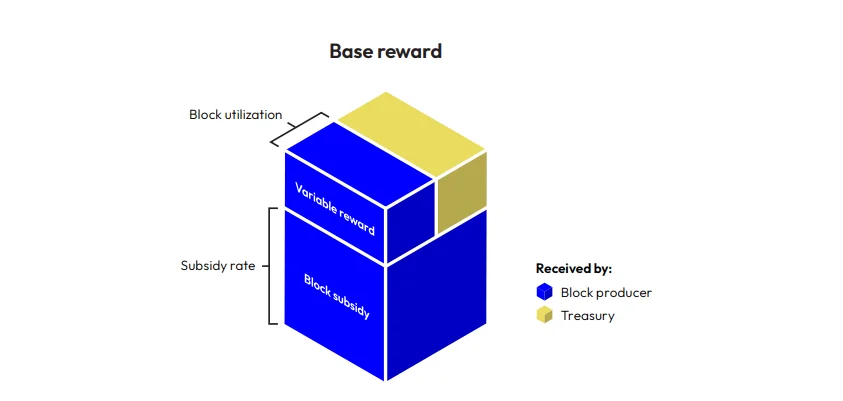
The key point here is that NIGHT is not spent directly as transaction fuel. NIGHT generates DUST. DUST runs transactions. NIGHT is also expected to play a role in governance and network security.
According to CoinGecko data, as of May 4, 2026, NIGHT is trading at around $0.03097; its market capitalization is around $514 million, and its circulating supply is around 16.6 billion NIGHT. The same data page lists the total and maximum supply as 24 billion NIGHT. Since this type of market data changes quickly, it should always be updated before publication.
The fact that NIGHT is listed on exchanges provides an advantage in terms of liquidity. CoinGecko lists trading pairs for NIGHT on centralized exchanges such as OKX, Gate, Binance, KuCoin, Kraken, Bybit, and HTX. However, listings, price performance, or trading volume alone do not guarantee the project’s long-term success. Midnight’s real test will be developer interest and real use cases.
Midnight’s Future
Midnight’s roadmap for 2026 is quite busy. According to the January 2026 State of the Network update, the project’s focus in 2026 shifted from token distribution to mainnet, scaling, and cross-chain hybridization. In the Hilo phase, NIGHT token was expected to go live on Cardano mainnet, while in the Kūkolu phase, the goal was to move toward a stable federated mainnet and the first production applications.
With the mainnet now live, the project is currently moving forward mainly through application deployment, node operators, institutional use, and developer tools. The next critical point will be the emergence of dApps that are actually used on Midnight. Privacy technology can create broader value only when it is carried into daily use.
In the Mōhalu and later phases, broader network participation, validator diversity, staking rewards, and a DUST capacity market are expected to come into focus. These areas will show more clearly how NIGHT token works not only as a market asset, but also as part of the network economy.
In the long term, Midnight’s main claim is to become a privacy infrastructure that works with different chains. If this happens, Midnight would not be limited to its own network; it could also provide a privacy layer for applications in other ecosystems. This is a major goal, and it will not be easy to implement. Still, the project’s Cardano connection, institutional partners, and ZK-focused architecture make it one of the projects worth following.
Frequently Asked Questions (FAQ)
Below, we answered some of the questions you may have about Midnight:
- What is Midnight (NIGHT)?: Midnight is a Layer-1 blockchain network focused on data privacy and selective disclosure, powered by zero-knowledge technology. Its goal is to allow users and institutions to build blockchain applications without exposing sensitive data to everyone.
- What is NIGHT token used for?: NIGHT is the open and transferable native token of Midnight Network. It is associated with network security, governance, and DUST generation. NIGHT is not spent directly as transaction fuel; it generates DUST.
- What is DUST?: DUST is a shielded and non-transferable resource model used to run transactions on the Midnight network. Users who hold NIGHT generate DUST over time. DUST cannot be sent to other users as a payment tool.
- Is Midnight a privacy coin?: Midnight is not a classic privacy coin. NIGHT token is open and transparent. The project’s privacy approach is based on providing programmable privacy for applications and data.
- Which ecosystem is Midnight connected to?: Midnight stands out as a project born around Cardano and Input Output. Shielded Technologies, a technology company that spun out of Input Output, is one of Midnight’s key technology partners.
- Has Midnight mainnet launched?: Yes. Midnight Network announced that its mainnet went live in March 2026. This marked the beginning of real on-chain activity with the production of the network’s genesis block.
- What is Midnight’s biggest advantage?: Its strongest advantage is that it combines privacy with a regulation-friendly and developer-friendly model. Selective disclosure, zero-knowledge proofs, and the NIGHT-DUST model are the core parts of this structure.
- Is Midnight risky?: As with every new blockchain project, Midnight carries technical, regulatory, competitive, and adoption-related risks. Since the network is still in a new mainnet phase, its long-term performance will become clearer through application usage.
To explore new projects, token models, and current developments in the crypto ecosystem more closely, you can follow the JR Kripto Guide series.

