
The idea behind MarsCoin is simple: hold a meme coin and earn rewards in another token. Built around a Mars theme, MARSCOIN runs on BNB Chain and funds SPCXB rewards through fees collected on purchases and sales. The project combines interest in space with tokenized stocks, offering a reward model tied to trading activity.
What MarsCoin Is and How It Began
MarsCoin is a meme token built around Mars and space exploration. The project describes itself as a “stock coin,” highlighting its connection to a tokenized asset called SPCXB. Distributing SPCXB to eligible MARSCOIN holders is one of its defining features.
The MarsCoin name has been familiar to the crypto community for years. A social media exchange between Elon Musk and Binance founder Changpeng Zhao in February 2021 helped bring it to a wider audience. The current BNB Chain project draws on the attention generated by that conversation and the broader fascination with Mars.
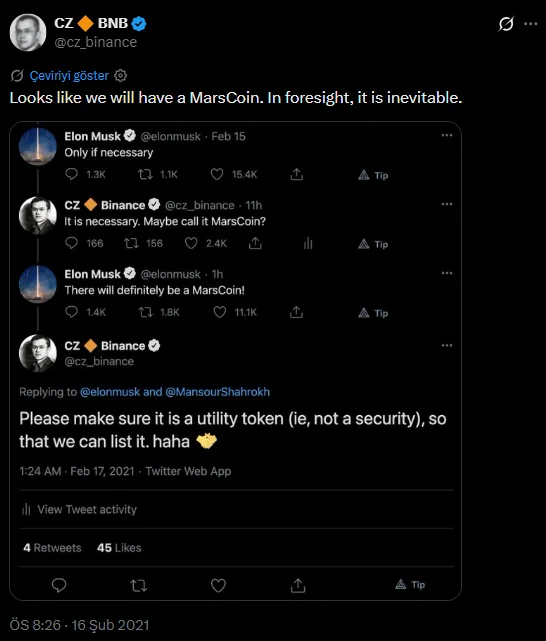
That exchange does not mean MARSCOIN launched at the time. Several projects have used the MarsCoin name; this guide covers the BNB Chain token that uses Flap’s infrastructure and offers SPCXB rewards.
The project’s approach creates an incentive to hold the token. Trading activity funds the rewards vault, while users with qualifying balances can receive distributions. Interest in the token therefore feeds into both its trading market and its reward system.
The Connection to BNB Chain and Flap
MarsCoin runs on BNB Smart Chain and uses Flap’s token creation infrastructure. Flap allows developers to launch tokens and direct trading fees toward different purposes, including reward distributions.
For MarsCoin, this works by channeling trading fees into a rewards vault. BNB Chain provides the network where transactions take place, while Flap supports the project’s trading and vault mechanisms. The token’s own rules determine how that infrastructure is used.
The vault is the smart contract structure at the center of the system. Funds collected from users’ transactions accumulate there and support reward distributions. Understanding MARSCOIN therefore involves looking at how the vault is funded alongside the price chart.
How It Differs from Other Marscoin Projects
The project most easily confused with MarsCoin is MARS, which launched in 2014. That older project has its own blockchain, uses a Scrypt-based Proof of Work mechanism, and has a total supply of approximately 39.57 million coins. MARSCOIN on BNB Chain is a separate token with a different economic model.
The distinction also matters when looking at historical price data. MARS’s earlier price movements, mining structure, and development history do not describe MARSCOIN. One project’s years of operation do not give the other the same track record.
MARSCOIN’s contract address on BNB Chain is 0xfe189e97832da1573e4e4ff034f4ffc3a15c7777. In wallets, block explorers, and decentralized trading platforms, this address distinguishes the token from other assets with the same name.
MarsCoin’s History and Developers
MarsCoin’s history on centralized exchanges can be traced through listing announcements from the summer of 2026. MEXC announced July 30, 2026, as the start date for MARSCOIN/USDT trading, with withdrawals scheduled for the following day at the same time.
This listing is a documented milestone in the project’s expansion onto exchanges. The exact date the token was created and the time of its first on-chain transaction are less clear. The July listing therefore marks its entry into centralized markets.
MEXC’s announcement already highlighted trading against SPCXB and distributing rewards from a vault. This shows that the reward mechanism was a core feature in the project’s early exchange introductions.
The next major listing announcement came from Gate. The exchange announced that MARSCOIN spot trading against USDT would open on August 27, 2026. Its conversion service for the token was also scheduled to launch that day.
Binance added MARSCOIN to its spot market on September 4, 2026, with USDT, USDC, and TRY pairs. According to Binance Academy, the token had been available through Binance Alpha before its spot listing. Binance also applied the Seed Tag, which identifies projects that may experience higher volatility.
KuCoin announced September 5, 2026, as the start date for MARSCOIN/USDT trading. These announcements, spanning July through September, show an increase in the number of centralized platforms offering access to the token.
Centralized exchange pairs allow users to trade MARSCOIN against assets such as USDT. Its SPCXB pairing on Flap forms part of the project’s on-chain model. Fees and reward arrangements can differ between these two trading environments.
What Is Known About the Team and Community
Public information about MarsCoin’s founding team is limited. The official website does not provide a detailed team profile covering the developers’ names and professional backgrounds. A specific individual therefore cannot be identified as the founder with confidence.
One of the project’s community communication channels is the @bnbMarsCoin account on X. The official website also emphasizes community participation, although it provides less detail about how responsibilities are divided within the team.
This is one of the information gaps to consider when assessing MarsCoin. Knowing who is responsible for technical decisions and contract management is particularly relevant to following the project’s long-term development.
How Does MARSCOIN Work?
MARSCOIN has a total supply of 1 billion tokens. This figure appears in MEXC’s listing announcement. Available sources do not include a detailed allocation table showing the shares reserved for the team, private investors, and community.
Supply also affects how the price should be interpreted. If all 1 billion tokens were circulating, for example, a price of $0.10 would imply a market capitalization of $100 million. A low price per token therefore does not necessarily mean a low overall valuation.
Token ownership is a separate consideration. Large wallets can matter for potential selling pressure, but an exchange custody address may contain the combined balances of many users. The size of an address does not always reflect the holdings of a single investor.
MARSCOIN’s reward threshold is another factor to consider alongside supply. Even if the required number of tokens stays the same, the cost of reaching that balance changes with the price. A rising price can make participation more expensive, while a falling price allows the same number of tokens to be purchased for less.
The SPCXB Connection and Reward System
MarsCoin is paired with SPCXB on Flap. The project describes SPCXB as a tokenized version of SPCX on BNB Chain and distributes it to MARSCOIN holders as a reward. Users therefore hold one asset and receive rewards in another.
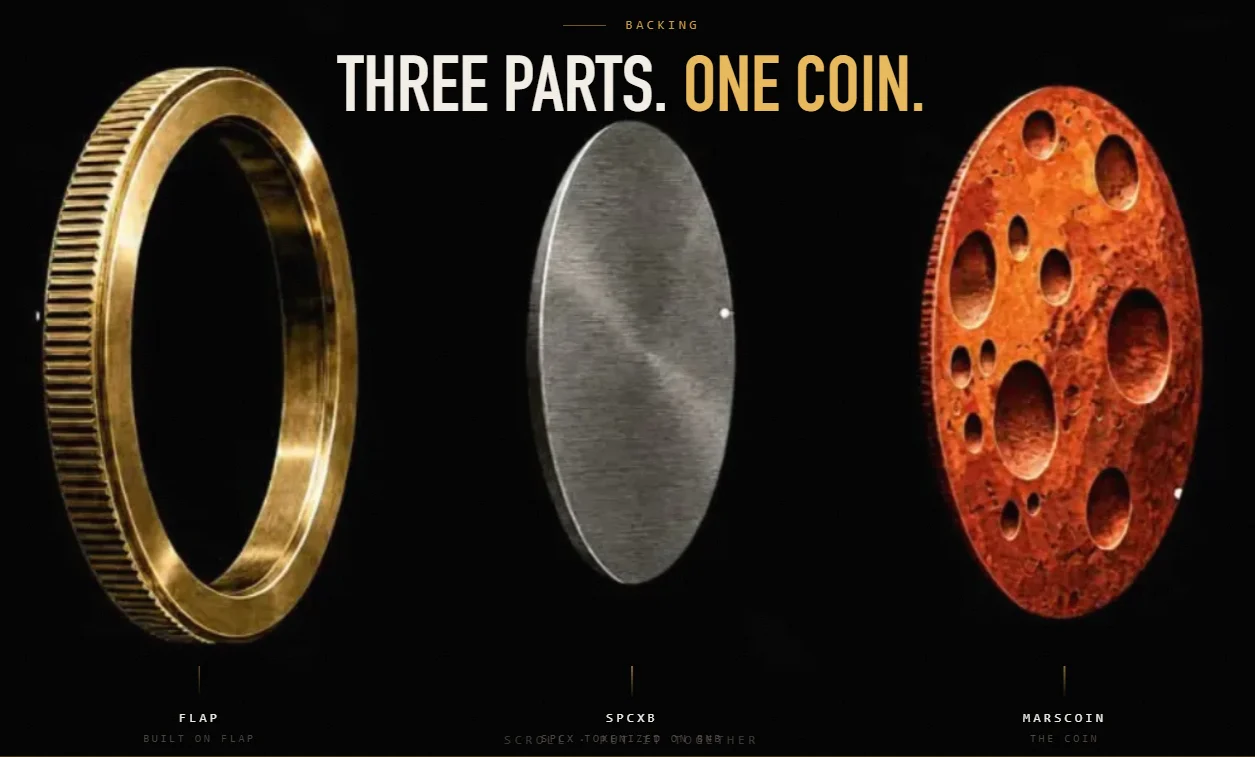
This distinction directly affects return calculations. As MARSCOIN’s market price changes, the value of accumulated SPCXB can change too. A user’s total holdings depend on both their MARSCOIN balance and the current value of the rewards received.
A trading pair is an exchange of one asset for another. Trading MARSCOIN against SPCXB does not mean the two tokens have equal prices or move by the same percentage. Their exchange rate can change with market conditions.
Tokenized stocks bring exposure to a traditional asset’s price onto a blockchain. How the underlying asset is held and which rights the token holder receives can vary by product. The claim that SPCXB has one-to-one backing comes from the project; its reserves and custody arrangements require separate verification.
Trading Taxes and Distribution Rules
Under MarsCoin’s stated model, purchases incur a 3% charge and sales incur another 3% charge. These funds support the SPCXB rewards vault, with a stated minimum balance of 10,000 MARSCOIN for automatic distributions. Manual reward claiming is also available through Flap.
Here, “trading tax” refers to the charge built into the token’s mechanism. It does not describe a payment to a public authority or a user’s personal tax obligations. The charge on token purchases and sales finances the reward model.
These deductions create a cost, particularly for frequent traders. In a simplified example, deducting 3% from 100 units leaves 97; deducting another 3% from the remaining amount on sale leaves 94.09. Even with no price change, the combined effect is a 5.91% reduction.
Flap’s general reward infrastructure can include minimum balances, distribution thresholds, and automatic triggers. Qualifying for a reward and receiving it in a wallet may therefore happen at different stages. The exact rules for MarsCoin depend on its vault and contract settings.
Rewards for MARSCOIN held on an exchange depend on that platform’s arrangements. For example, MEXC’s September 16–October 14, 2026, campaign offers reward sharing subject to identity verification and an average holding of at least 1,500 MARSCOIN; payments are converted into futures bonuses. These terms differ from automatic SPCXB distributions to a personal wallet.
The Meme Coin and Tokenized Stock Model
MarsCoin stands out for connecting interest in a meme token with rewards paid in another asset. The space theme shapes its branding, while trading charges provide an economic incentive to hold the token. This adds expectations of rewards to expectations about its price.
The model links traders with holders. Transactions subject to the trading tax fund the vault, while qualifying balances benefit from distributions. The continuity of rewards therefore depends on sustained trading activity.
This structure does not provide a fixed monthly income. Market activity, the total balance eligible for rewards, and the value of the distributed asset can all change over time. A payout during an active trading period may not reflect returns during a quieter one.
The currency used to measure rewards also affects the result. The amount of SPCXB in a wallet can increase while its dollar value falls, and the reverse is also possible.
Looking only at the number of tokens distributed also leaves out buying and selling costs. The full return becomes clear only when these elements are considered together.
Earning rewards does not necessarily mean the overall position is profitable. If a MARSCOIN holding initially worth $1,000 falls to $800 while generating $30 in rewards, its total value is $830. In this hypothetical example, the rewards offset only part of the price decline.
Is There a Connection to SpaceX or Elon Musk?
Elon Musk and the Mars theme feature prominently in MarsCoin’s story. However, there is no verified announcement that Musk developed this token or that SpaceX is an official partner. The earlier social media conversation did not announce such a partnership.
Buying MARSCOIN does not give the holder equity in SpaceX. It provides neither voting rights in the company nor direct ownership. The project’s connection through SPCXB does not change that distinction.
The rights attached to a tokenized product depend on its issuer’s terms. Price tracking, custody protections, and shareholder rights are separate features. MarsCoin’s space-themed branding should therefore not be read as a promise of company ownership.
Price Volatility, Liquidity, and Sustainability
MarsCoin’s price can respond to community interest and broader market movements. Sharp gains can attract new buyers, while moves in the opposite direction can increase selling pressure. Trading charges add another cost on top of these price changes. At the time of writing, MARSCOIN is trading at around $0.11.
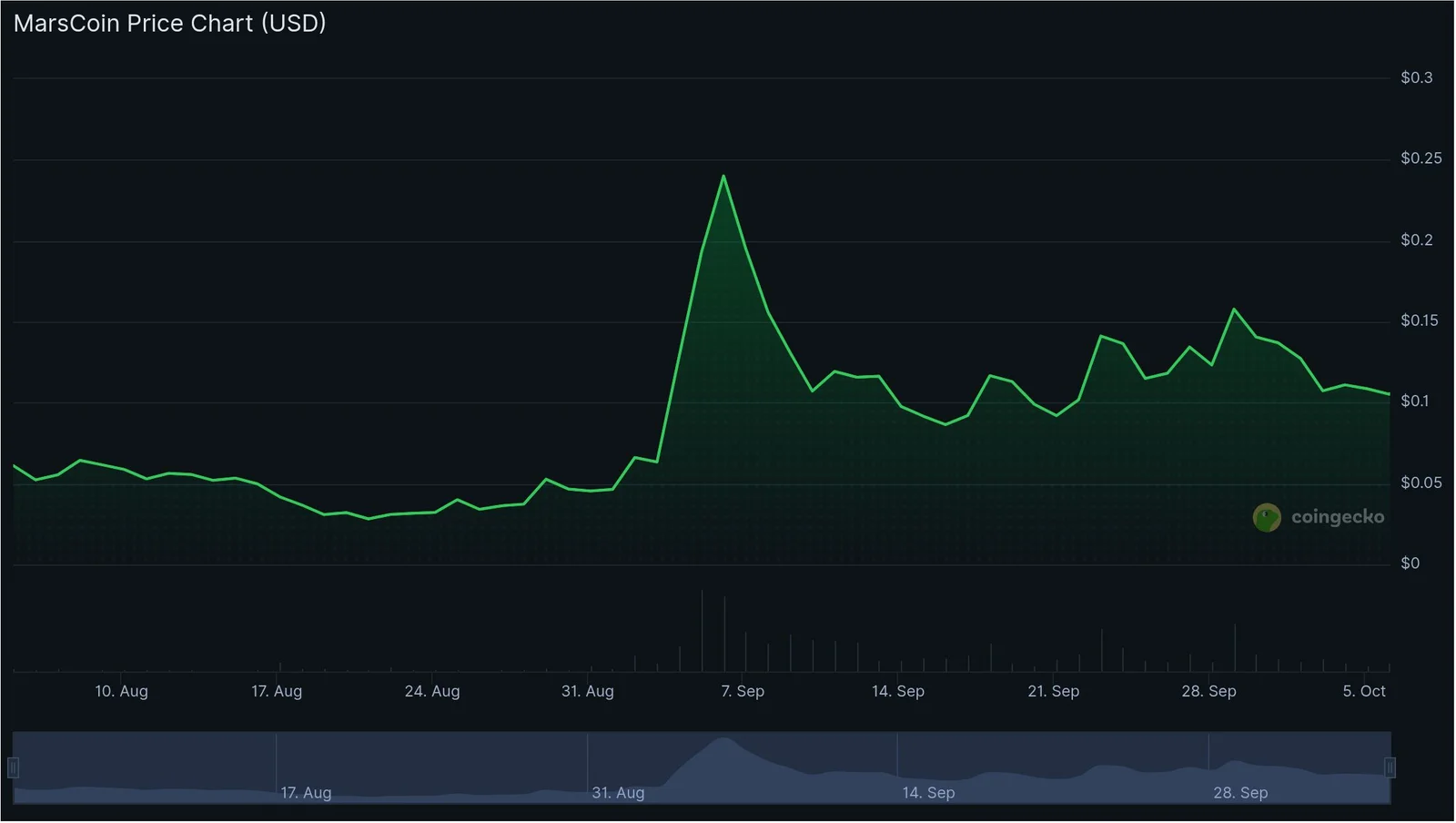
For the reward model, the key variable is the funding flowing into the vault. With other conditions unchanged, lower trading volume subject to the tax can reduce the new funds collected for distribution. This follows from the fee-funded structure; past payouts cannot be assumed to continue at the same level.
Liquidity determines how easily the token can be bought and sold. Even if the last traded price looks attractive, a large sale may execute at lower prices when there are too few buyers. In decentralized pools, order size can also create a gap between the quoted price and the amount received.
The cost of a trade may therefore extend beyond the 3% charge. Depending on the platform, network fees, bid-ask spreads, exchange commissions, or withdrawal fees may also apply. Trades recorded internally by a centralized exchange should not automatically be assumed to incur the same on-chain tax on every order.
Developments affecting SPCXB also matter to MARSCOIN holders. A decline in the reward token’s price or liquidity can reduce the monetary value of the rewards received. Users therefore face risks associated with the reward asset as well as MARSCOIN’s own price.
Finally, the system depends on the token and vault contracts functioning correctly. Limited information about the team, combined with insufficient detail about contract management and security, increases uncertainty. Assessing MarsCoin’s reward model involves considering the source of returns, the costs, and these technical conditions together.
Frequently Asked Questions (FAQ)
Here are answers to some common questions about MarsCoin.
- What is MarsCoin, and when did it launch?: MarsCoin is a meme token on BNB Chain that offers SPCXB rewards to holders with qualifying balances. Its centralized exchange history includes a MEXC listing dated July 30, 2026; information about the exact date the token was first created is limited.
- Who developed MarsCoin?: There is no detailed, publicly available introduction to the project’s founding team.
- Which network does MARSCOIN use?: MARSCOIN runs on BNB Smart Chain. It is a separate project from MARS, which launched in 2014 and has its own blockchain.
- How do MARSCOIN holders receive rewards?: SPCXB is distributed from a vault funded by trading charges. The stated threshold for automatic rewards is 10,000 MARSCOIN; reward arrangements on centralized exchanges depend on each platform’s terms.
- Does buying MarsCoin mean buying SpaceX shares?: No. MARSCOIN provides no direct ownership or voting rights in SpaceX. Receiving SPCXB rewards does not make a MARSCOIN holder a shareholder in the company.
- Is MarsCoin a suitable investment?: MarsCoin carries risks associated with price volatility, trading charges, and the reward asset. Since it does not offer fixed returns, its suitability depends on an individual’s investment goals and ability to bear those risks.
Follow the JR Kripto Guide series to understand MarsCoin’s SPCXB rewards, token economics, and developments across the BNB Chain ecosystem.

