
Today, the idea of representing real-world assets (RWAs) such as real estate, bonds, commodities, and fund products on the blockchain is gaining more importance. This field takes crypto beyond market-based trading and connects it more directly with the financial system. MANTRA is one of the projects aiming to bring real-world assets on-chain and support this process with a regulation-friendly infrastructure.
MANTRA (MANTRA) is an RWA-focused Layer-1 blockchain network built around bringing real-world assets to the blockchain. The project stands out in the crypto market with its focus on tokenization, regulatory compliance, and institutional DeFi. MANTRA’s main idea is to make cryptocurrencies, as well as off-chain assets such as real estate, commodities, financial products, and similar instruments, more accessible through blockchain technology.
RWAs, or real-world assets, have become one of the most discussed topics in the crypto ecosystem in recent years. This field does not limit blockchain technology to crypto transfers or speculative token trading. Instead, it focuses on bringing assets used in traditional financial markets on-chain and building a more programmable financial structure.
At this point, MANTRA tries to build a more orderly, compliant, and usable bridge between DeFi and traditional finance. The network offers infrastructure designed specifically for RWA tokenization.
MANTRA’s Definition and Origins
MANTRA’s starting point is based on reducing the gap between crypto and traditional finance. In its early period, the project became known through the OM token and DeFi products. Over time, it shifted its focus more clearly toward the RWA sector and positioned MANTRA Chain as a Layer-1 network developed specifically for real-world assets.
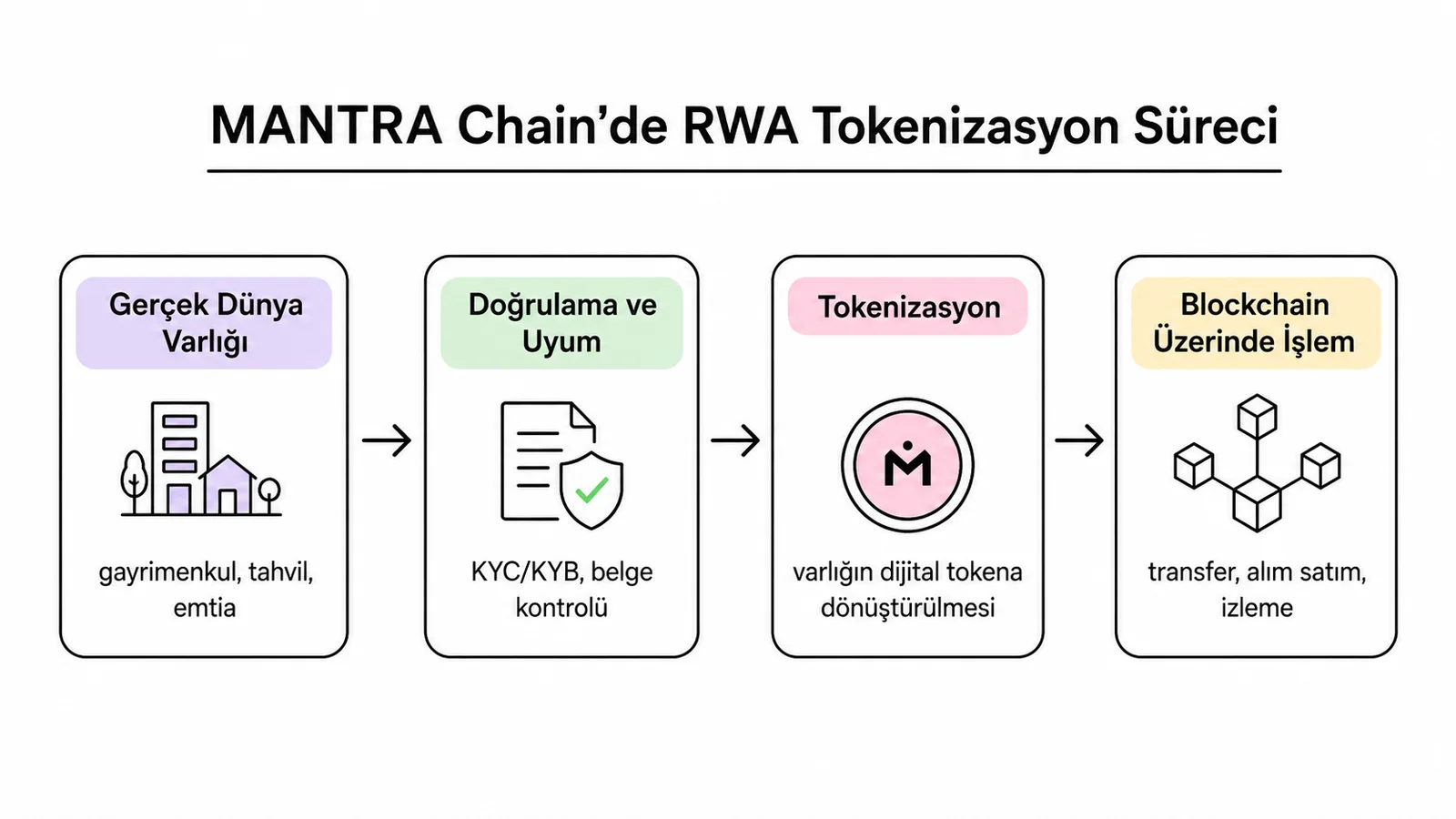
Tokenization is one of the main concepts at the center of MANTRA. This concept refers to creating a digital representation of a physical or traditional financial asset on the blockchain. For example, when a real estate asset, artwork, commodity, or financial instrument is tokenized, it can be divided into smaller parts, tracked on-chain, and traded under certain rules.
In theory, this model offers a more accessible investment structure. Assets that normally require large amounts of capital can be opened to smaller investor groups. Smart contracts can automate processes such as revenue distribution, transfer restrictions, identity verification, and transaction monitoring.
What separates MANTRA from many other blockchain projects is that it does not approach RWA only as a market narrative. The project also tries to make regulatory compliance, identity verification, institutional access, and cross-chain interoperability part of its infrastructure. For this reason, MANTRA aims to combine an open blockchain structure with the control mechanisms required by permissioned financial applications.
MANTRA’s History: Key Milestones
MANTRA first emerged as a DeFi project known through the OM token. In its early period, it grew through staking, governance, and community-focused financial products. However, as the RWA market developed, the project moved toward building a broader infrastructure through its own Layer-1 network.
The MANTRA Chain testnet process began in November 2023. This period became an important stage in the project’s transition from a token-based DeFi structure into its own blockchain network. The testnet strengthened MANTRA’s narrative as a dedicated RWA-focused Layer-1.
MANTRA Mainnet was officially launched on October 23, 2024. The mainnet launch marked a critical milestone for the project’s goal of bringing real-world assets on-chain.
The year 2025 was intense for MANTRA in terms of both growth and trust-related discussions. The project received a VASP license from Dubai’s virtual asset regulator VARA. This license stood out as an important regulatory step, allowing MANTRA Finance FZE to operate as a virtual asset exchange and provide broker-dealer, management, and investment services.
In April of the same year, the OM token experienced a very sharp price decline. The MANTRA team stated that forced liquidations on centralized exchanges played a role in the drop. The team also said that MANTRA had not sold tokens during the process and argued that some large OM positions were liquidated on centralized exchanges.
After this event, the project took several steps to rebuild trust. MANTRA CEO John Patrick Mullin’s pledge to burn 150 million OM from the team allocation became one of the most notable moves in this process. The project also announced a broader token burn plan.
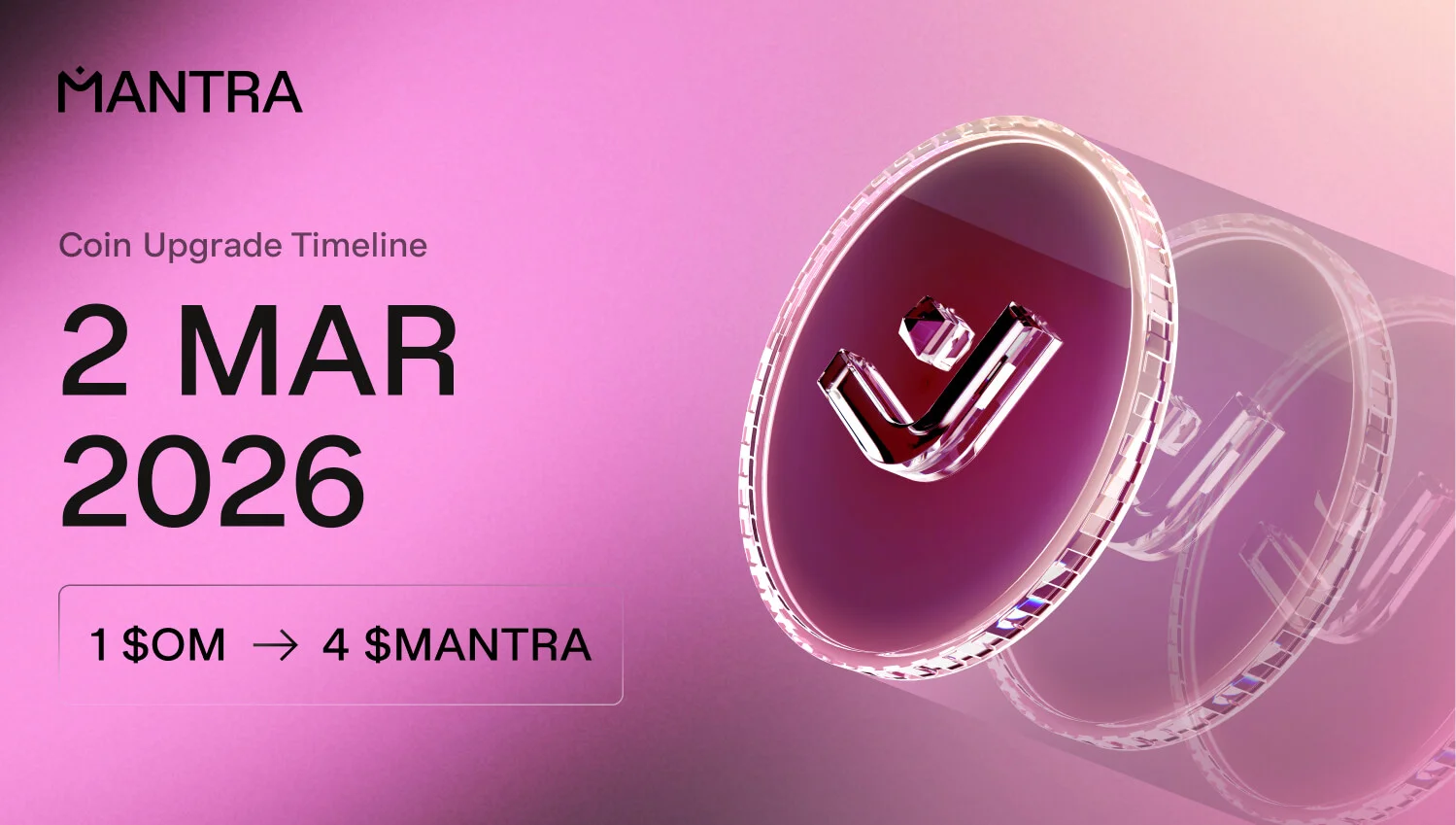
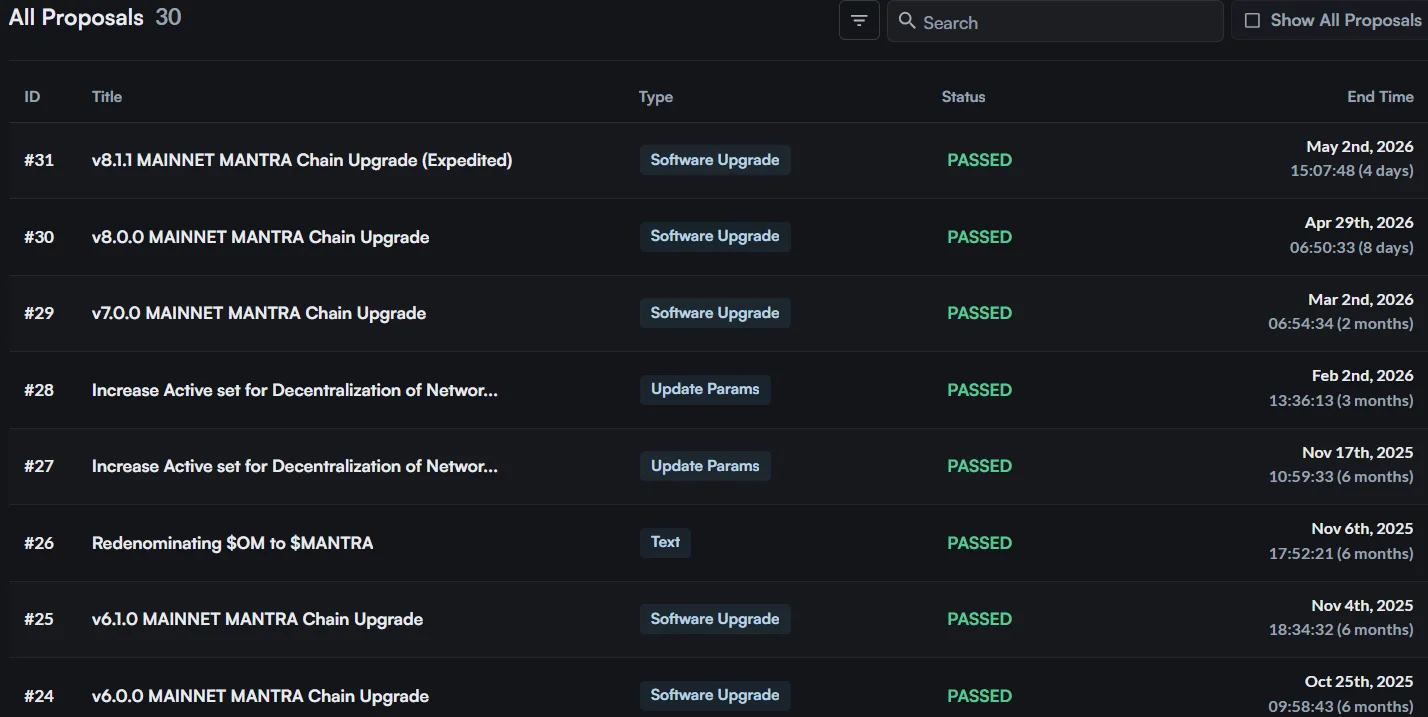
In March 2026, the transition from OM to MANTRA became one of the project’s main agenda items. A 1:4 token split and ticker transition was planned for the OM token. With this conversion, 1 OM became equivalent to 4 MANTRA, and the maximum supply was updated to 10 billion MANTRA.
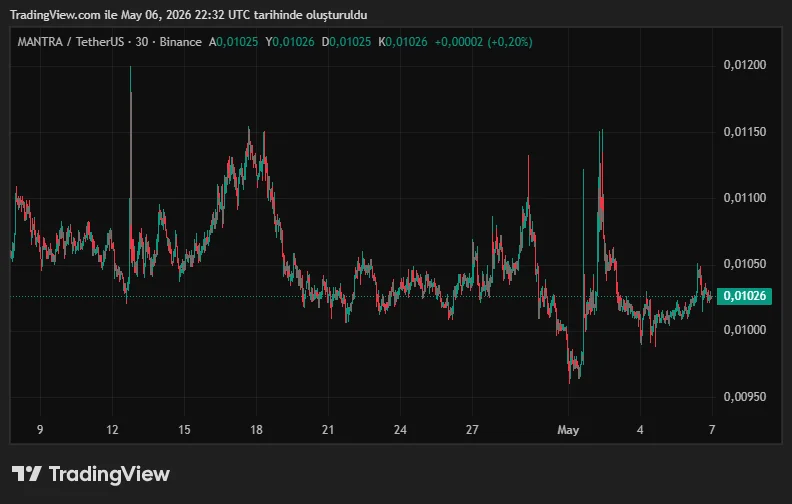
As of May 2026, MANTRA price is around $0.0102577.
Why Is MANTRA Important?
To understand MANTRA’s importance, it is useful to look at why the RWA market has attracted so much attention. For a long time, DeFi, NFTs, Layer-1 networks, and Layer-2 solutions stood out in the crypto market. RWA differs from these areas because it directly connects with traditional financial assets.
The tokenization of real-world assets can help blockchain become more practically integrated into financial markets. A tokenized bond can be transferred on-chain. A tokenized real estate product can be divided into smaller shares and offered to different investor groups.
MANTRA’s importance comes from offering a network developed specifically for this field. General-purpose blockchain networks support many different use cases. MANTRA takes a more focused approach to RWA, compliant DeFi, and institutional tokenization.
Another important aspect of the project is its effort to bring together an open blockchain structure with regulated applications. Fully open networks are common in crypto, but identity verification, transaction monitoring, and legal compliance are highly important on the institutional finance side. MANTRA aims to bring the needs of these two worlds together within the same infrastructure.
This structure can be meaningful especially for banks, asset managers, real estate companies, fintech platforms, and teams that want to develop regulated investment products. These institutions need more than just a fast and low-cost blockchain network; they also need a technical framework that supports compliance processes.
How Does MANTRA Work?
MANTRA Chain operates as a Layer-1 blockchain. This means the network does not exist only as an application or token on another blockchain. MANTRA has its own validator structure, transaction infrastructure, and native token economy.
The network’s technical structure is designed according to the needs of RWA applications. These needs include low-cost transactions, fast confirmation, cross-chain asset transfers, regulatory compliance, and developer-friendly tools. MANTRA aims to offer flexible infrastructure for DeFi and RWA applications.
One of MANTRA’s important technical features is EVM compatibility. EVM stands for Ethereum Virtual Machine and refers to the environment where smart contracts run on Ethereum. MANTRA’s EVM compatibility allows developers to write smart contracts with Solidity and use tools from the Ethereum ecosystem.
This feature makes developer migration easier. A team experienced in the Ethereum ecosystem can build applications on MANTRA without learning a completely new technology stack. This can mean faster product development and easier integration, especially for RWA projects.
MANTRA Chain also places importance on cross-chain interoperability. Asset transfers and application interactions between different blockchain networks can help RWA products reach a wider ecosystem. In this way, tokenized assets can connect with different blockchain structures instead of remaining limited to a single network.
Permissionless and Permissioned Structure
One of MANTRA’s most notable concepts is its use of an open blockchain together with a permissioned application model. This approach allows the network to operate as a public blockchain while letting certain applications remain limited to verified users or institutions.
On the open blockchain side, users and developers can access the network, build applications, and carry out on-chain transactions. However, in areas closer to regulation, such as RWAs, some products cannot be opened to everyone without restrictions. For example, a tokenized real estate fund may only be offered to investors who have verified their identity or meet certain legal requirements.
This is where compliance mechanisms such as KYC, KYB, KYT, and KYV come into play. KYC refers to user verification, KYB to business verification, KYT to transaction monitoring, and KYV to know-your-validator processes. With these structures, MANTRA tries to meet the need for trust and auditability in institutional DeFi.
This model makes MANTRA a network that can also appeal to institutional structures. In traditional finance, trust, auditability, and legal compliance are among the essential parts of product development.
What Is the MANTRA Token Used For?
The MANTRA token is used as the native asset of MANTRA Chain. After the transition from OM to MANTRA, the token returned to exchanges under the name MANTRA within the network’s updated economic structure. The token is connected to network security, staking, transaction fees, governance, and ecosystem use cases.
Staking is one of the most basic use cases of the MANTRA token. Users can stake their MANTRA tokens with validators and contribute to network security. In return, they may receive a share of the network’s reward mechanism.
The MANTRA token also plays a role in network transaction fees. When users make transactions on-chain, interact with smart contracts, or use ecosystem applications, the MANTRA token becomes part of the economic system.
On the governance side, MANTRA is important for community participation. Token holders can take part in decision-making processes related to the network’s future. These decisions may cover technical upgrades, ecosystem incentives, parameter changes, and the use of community funds.
The MANTRA token’s use cases are not limited to the network level. Ecosystem components such as MANTRA Zone, MANTRA Finance, RWA products, and stablecoin infrastructure also expand the token’s function. For this reason, MANTRA is considered both a technical network asset and an ecosystem participation tool.
Transition from OM to MANTRA
The transition from OM to MANTRA became one of the project’s most important structural changes in the recent period. This transition should not be seen only as a name or ticker change. It represents MANTRA’s move from the old OM period toward a more institutional, RWA-focused, and mainnet-centered structure.
According to the official timeline, the transition from OM to MANTRA was planned as a two-stage process. For users holding OM on MANTRA Chain or on supporting exchanges, the conversion was expected to happen automatically. OM token holders on EVM networks were told to use the official migration tool.
The 1:4 conversion ratio means that every 1 OM token converts into 4 MANTRA tokens. This process was presented as a redenomination and supply adjustment that does not create economic dilution. While users’ token numbers increased, the total supply expanded at the same rate.
After this conversion, MANTRA was defined as the current native staking coin of MANTRA Chain. The maximum supply was also updated to 10 billion MANTRA.
MANTRA Token Economy
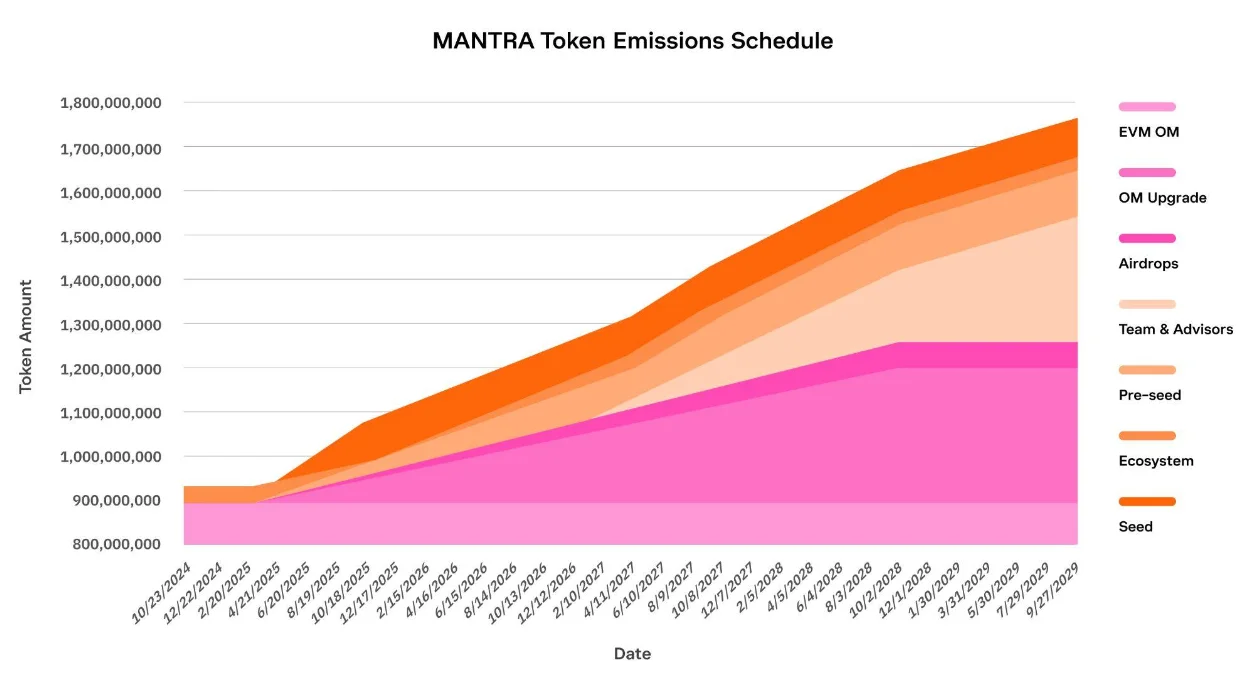
The MANTRA token economy was shaped by adapting the supply structure from the OM period to MANTRA. At the genesis stage, MANTRA Chain was launched with a total of 1,777,777,776 OM mainnet staking coins. Part of this reflected the old ERC-20 OM supply, while the remaining portion was allocated to the ecosystem, contributors, investors, and incentives.
In the genesis distribution, the largest share was given to the OM Upgrade category. MANTRA Chain Association, core contributors, and airdrop allocations were also among the other important parts of the token economy. This distribution shows that the project aimed to bring both the old OM community and the new MANTRA ecosystem under the same roof.
A long-term vesting structure was planned for the core contributors’ coin allocation. These types of unlock schedules aim to keep the team and contributors committed to the project over a longer period. On the airdrop side, a separate distribution model was used to support community participation.
MANTRA Ecosystem and RWA Use
The MANTRA ecosystem consists of several main components. MANTRA Chain sits at the center of these components. MANTRA Chain works as the main network where RWA applications are developed, tokens are transferred, staking operations take place, and institutional products can be brought on-chain.
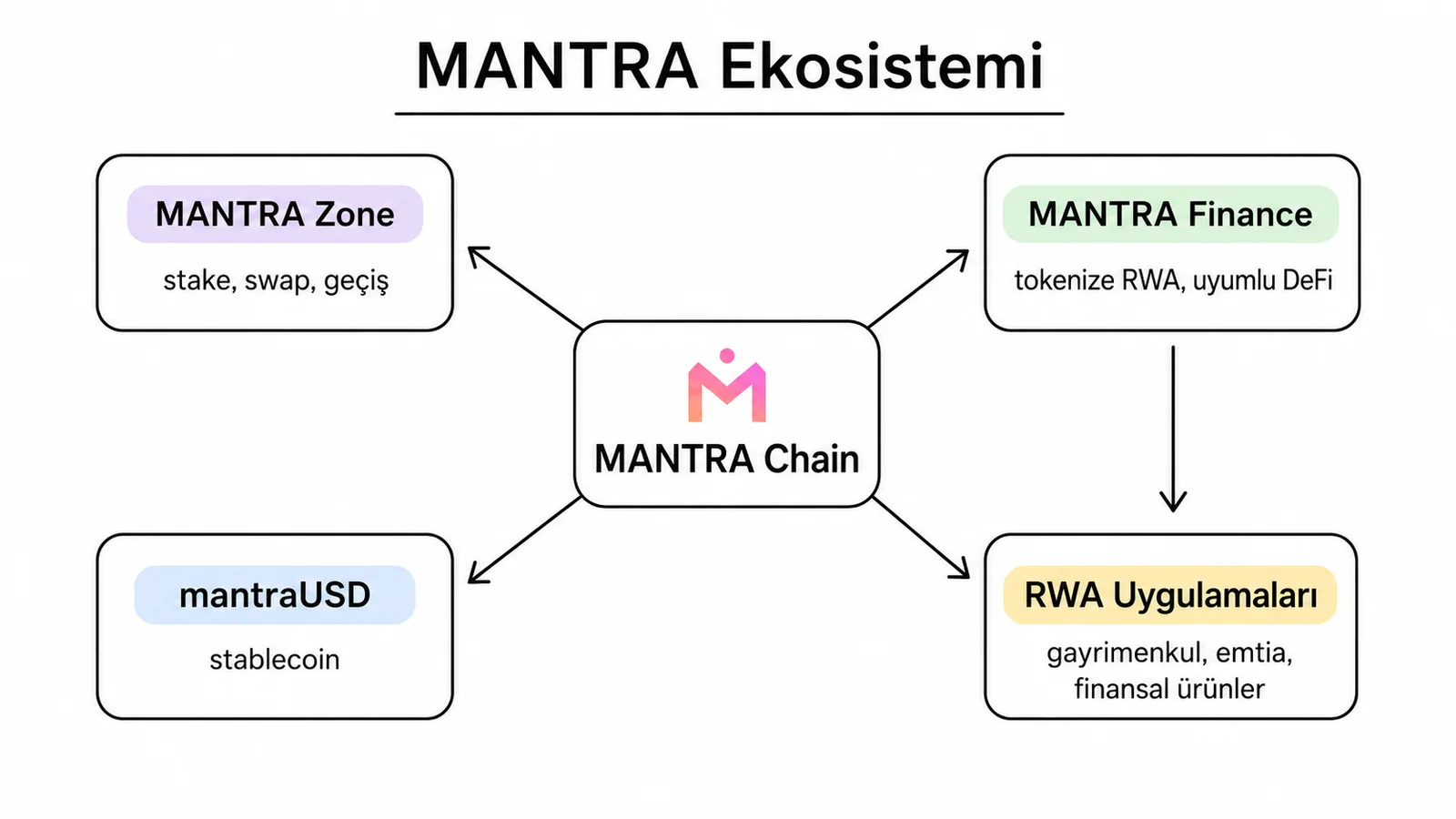
MANTRA Zone is one of the main interfaces through which users access the ecosystem. Token migration, staking, swaps, and access to ecosystem applications can be carried out through this area. This structure makes MANTRA’s technical infrastructure more accessible for end users.
MANTRA Finance is one of the project’s key components on the tokenized real-world asset and compliant DeFi side. The aim here is to build a more orderly structure suitable for institutional use by bringing traditional financial products together with blockchain infrastructure.
RWA use within the MANTRA ecosystem can spread across different areas. Real estate tokenization, commodities, financial assets, yield-generating vault structures, stablecoin-based payment systems, and settlement systems are some of these areas.
What Is mantraUSD?
mantraUSD is a stablecoin structure developed for the MANTRA ecosystem. This stablecoin, backed by short-term U.S. Treasury bills, was designed for use within the MANTRA EVM RWA ecosystem. The goal is to create a digital dollar layer for payments, settlement, liquidity, and yield products within the ecosystem.
mantraUSD is intended to work in connection with RWA transactions, vault structures, DEX usage, and ecosystem rewards. This structure shows that MANTRA is not focused only on asset tokenization. The project is also trying to build the financial infrastructure through which these assets can be used and traded.
For tokenized assets to function properly, it is not enough to bring the asset on-chain. Liquidity, a payment medium, yield distribution, and an on-chain settlement layer are also needed. mantraUSD stands out as one of the ecosystem components developed to address this need.
MANTRA’s Developers, Partnerships, and Community
One of the best-known names behind MANTRA is John Patrick Mullin. Mullin stands out as MANTRA’s CEO and co-founder. The project’s strategy around RWA, DeFi, and tokenization is shaped largely around this leadership structure.
According to the MANTRA team, the project’s broader goal is to create a compliant financial infrastructure that institutions can also use. The VARA license, mainnet launch, OM-to-MANTRA transition, and products such as mantraUSD are different parts of this strategy.
The community also plays an important role in the MANTRA ecosystem. Staking participants support network security. Token holders can take part in governance processes. Ecosystem users contribute to the network’s daily use through MANTRA Zone, staking, swaps, RWA applications, and stablecoin products.
However, the sharp decline in the OM price in 2025 created an important test for community trust. The steps the project took after this event focused mostly on rebuilding trust through token burns and communication.
Frequently Asked Questions (FAQ)
Below, you can find answers to the main questions that can help you understand the MANTRA ecosystem more clearly:
- What is MANTRA, and when was it launched?: MANTRA is an RWA-focused Layer-1 blockchain network developed for the tokenization of real-world assets. The project first became known through the OM token period. MANTRA Chain mainnet was launched on October 23, 2024.
- What does MANTRA Chain do?: MANTRA Chain provides blockchain infrastructure for RWA and DeFi applications. The network is designed for tokenization, staking, compliant financial applications, cross-chain transfers, and institutional use cases.
- What is the MANTRA token used for?: The MANTRA token is used as the network’s native asset. It plays a role in staking, network security, transaction fees, governance, and ecosystem use cases.
- Did OM coin convert to MANTRA?: Yes. In 2026, the OM token converted to MANTRA at a 1:4 ratio. With this transition, 1 OM became equivalent to 4 MANTRA, and the token’s current name became MANTRA.
- How did the transition from OM to MANTRA take place?: The conversion was planned to happen automatically for users holding OM on MANTRA Chain or on supporting exchanges. Users holding OM on EVM networks were told to use the official migration tool.
- Why is MANTRA important in the RWA sector?: MANTRA offers a network developed specifically for the tokenization of real-world assets on the blockchain. Its focus on regulatory compliance, identity verification, and institutional use strengthens its position in this field.
- What is mantraUSD?: mantraUSD is a stablecoin structure developed for the MANTRA ecosystem. It is intended to be backed by short-term U.S. Treasury bills and used as a payment, liquidity, and settlement layer within the MANTRA EVM RWA ecosystem.
- What is MANTRA staking?: MANTRA staking is the process of users locking their MANTRA tokens with validators to contribute to network security. Users may receive network rewards during this process.
- Is MANTRA reliable?: MANTRA aims to strengthen its institutional trust narrative through regulatory compliance, its VARA license, and RWA-focused infrastructure. However, the sharp decline in the OM price in 2025 created an important trust-related debate for the project. For this reason, MANTRA should be evaluated together with its technical developments, past market events, and the current state of its ecosystem.
- Is MANTRA suitable for investment?: MANTRA is one of the notable projects in the RWA and regulation-friendly DeFi sector. However, like every crypto asset, it carries high volatility, liquidity risk, regulatory uncertainty, and project-specific risks. For this reason, current data, personal risk profile, and independent research should be considered before making any investment decision.
Follow the JR Kripto Guide series to learn more about MANTRA and RWA-focused crypto projects.

