
As the DeFi ecosystem has grown, opportunities have multiplied, but this growth has also brought serious fragmentation. Liquidity has been split across different chains, yields have become tied to short-term incentives, and the user experience has become increasingly complex. Katana stands out as a DeFi-centered Layer-2 network developed to offer a more focused solution to this picture. The network aims to concentrate capital around selected applications, create deeper liquidity, improve trading conditions, and build a more sustainable yield cycle.
Katana (KAT) is an Ethereum-based Layer-2 network designed for decentralized finance, or DeFi. The project aims to reduce the liquidity fragmentation often seen in DeFi, use capital more efficiently, and redirect network revenues back into the ecosystem. For this reason, it would be incomplete to describe Katana only as a network that offers faster and lower-cost transactions. The project’s main idea is to bring DeFi activity around a more selected application layer and allow users to access trading, borrowing, lending, liquidity provision, and staking in a more integrated structure.
At the center of Katana is the KAT token. However, KAT does not function like a governance token that controls everything in the traditional sense. According to the official token economics article, KAT is not the gas token of the network; ETH is used as the gas token on Katana. KAT’s main role appears after staking, through vKAT, in directing emissions to DeFi pools. This structure turns the token from an asset that is only bought and sold into a tool that influences liquidity flows within the network.
Katana’s Definition and Origins
Katana is a DeFi-focused Layer-2 network. The project addresses Ethereum’s scaling needs specifically from a DeFi perspective. While many Layer-2 networks offer general infrastructure open to different types of applications, Katana builds a more selective model. The network aims to concentrate liquidity around core DeFi applications such as Sushi and Morpho. In Katana’s whitepaper, Sushi is highlighted on the spot DEX side, while Morpho is highlighted on the lending and borrowing side.
This structure strengthens Katana’s narrative as a “chain specifically designed for DeFi.” For users, the goal is to offer a simpler experience. Instead of spreading steps such as bridging an asset, accessing yield opportunities, trading, or borrowing across different networks and scattered protocols, Katana aims to bring them into the same economic cycle.
Katana’s starting point also takes shape here. As DeFi grew, more networks, protocols, and pools emerged. This variety gave users more options, but it also caused capital to spread out. Katana tries to build a more focused alternative to this fragmented structure. The network aims to keep the value created by active users and liquidity providers within the ecosystem and gradually build deeper market structure.
Katana emerged as a DeFi network developed with the support of Polygon Labs and GSR. The project focuses on two core problems in DeFi: liquidity being spread across different networks and protocols, and incentive systems often relying too heavily on inflationary token rewards.
This is also where Katana’s description as an “opinionated chain” comes from. The term means that instead of building a completely open ecosystem that treats every application equally, the network chooses to concentrate DeFi activity around specific core protocols. This is where the importance of Sushi and Morpho becomes clearer.
How Does Katana Work?
Katana’s operating logic is built on several core mechanisms. The first is the Vault Bridge model. Vault Bridge allows users to move selected assets to Katana through yield-generating wrapper structures. The initial vbToken set users receive on Katana consists of assets such as vbUSDC, vbUSDS, vbUSDT, vbWBTC, and WETH. In this model, bridged capital is not only moved between networks; it is also positioned in a way that generates yield for the Katana ecosystem.
The second important structure is Chain-Owned Liquidity, meaning liquidity owned by the chain itself. Katana aims to build its own liquidity through core assets and distribute this liquidity across core applications. According to the documentation, Chain-Owned Liquidity is funded through sequencer fees and aims to help users access better pricing and deeper liquidity.
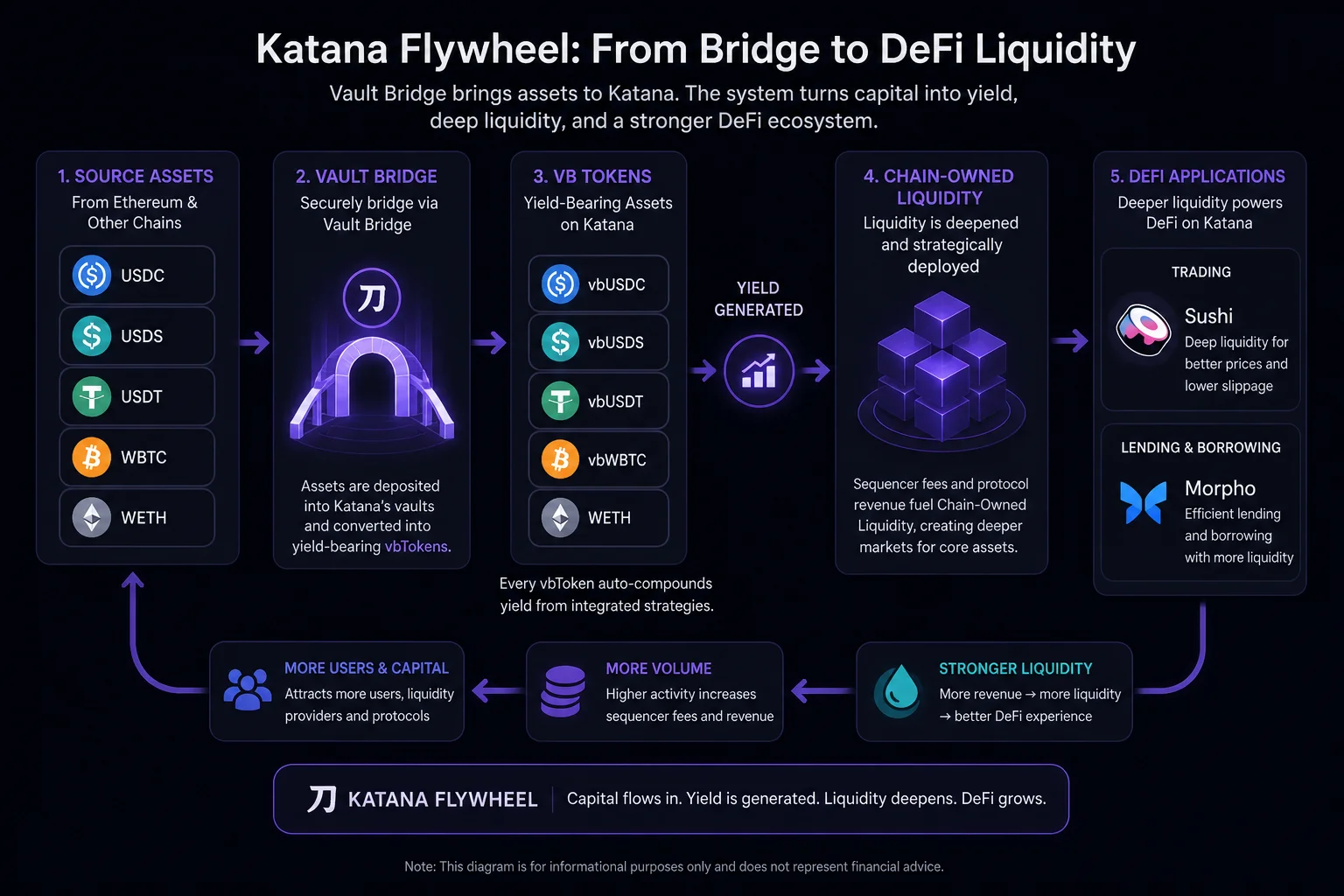
These two mechanisms feed Katana’s DeFi cycle. Vault Bridge helps incoming capital be used more efficiently. Chain-Owned Liquidity helps the network grow its own liquidity base over time. Core applications such as Sushi and Morpho create the areas where this liquidity can be used for trading, lending, and borrowing. In this way, Katana tries to build a longer-term model where revenues from network usage are returned to the ecosystem, rather than relying only on short-term growth based on token incentives.
KAT Token and Token Economics
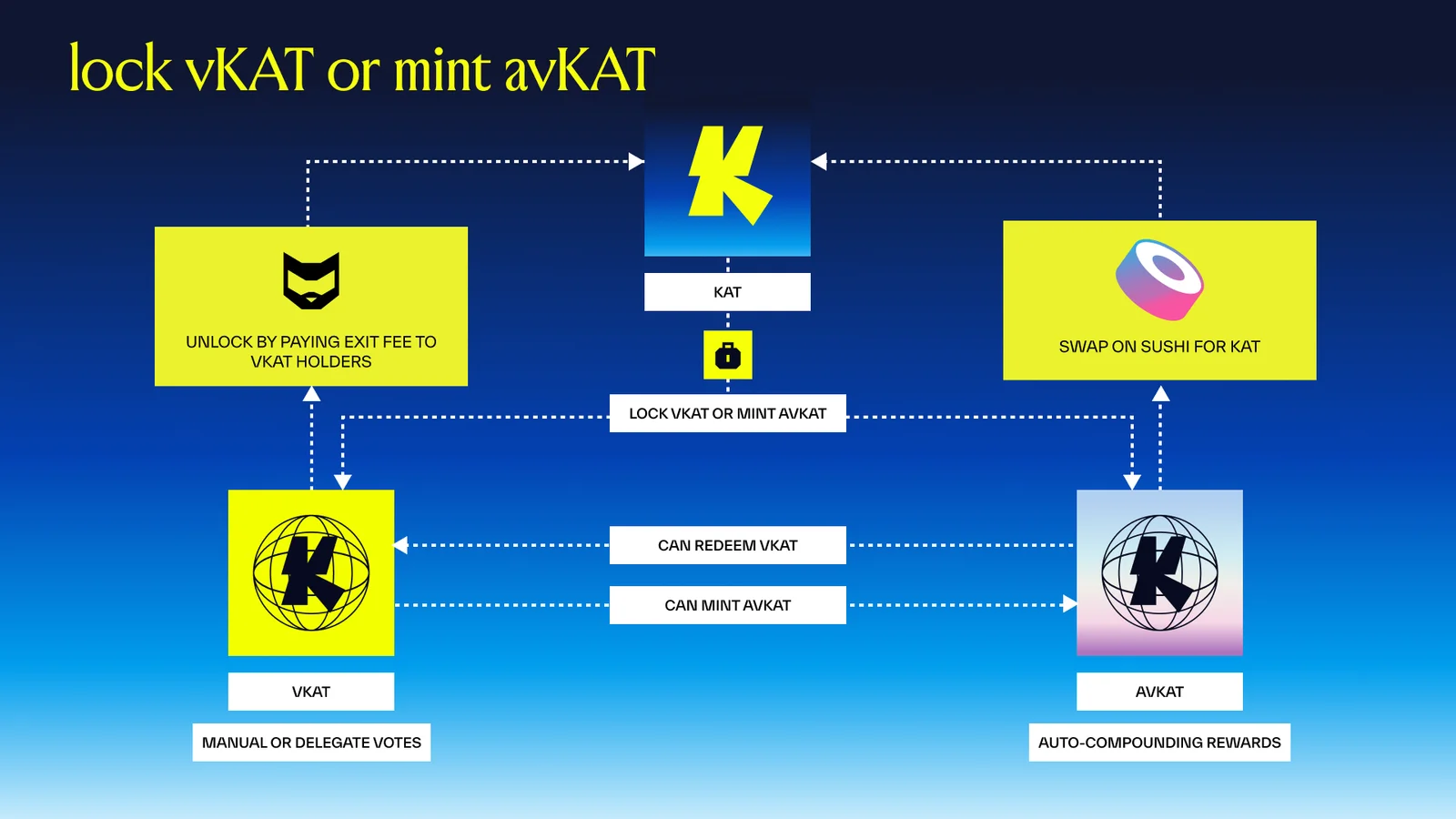
KAT is the core token of the Katana ecosystem. KAT was designed as an ERC-20 token that is transferable and can be held in Ethereum-compatible wallets. However, it does not provide voting power by itself. Users need to stake KAT in order to influence the KAT emissions directed to DeFi pools.
There are three main token structures in the Katana ecosystem: KAT, vKAT, and avKAT. KAT is the base token. vKAT is a non-transferable NFT-based voting position received when KAT is staked. Each vKAT represents the user’s locked position and voting power over which pools KAT emissions are directed to. avKAT is an ERC-4626 vault token that offers a more automated staking experience. When a user deposits KAT into the avKAT vault, the vault votes on behalf of the user and automatically compounds rewards.
On the token economics side, the initial total supply was set at 10 billion KAT. The official token economics article states that 20 percent was allocated to user liquidity mining, with 1 billion KAT of this amount going to core application user incentives. Of these incentives, 400 million KAT was allocated to Sushi, 250 million KAT to Morpho, and up to 350 million KAT to future perpetual DEX, launchpad, and yield tokenization products. Community airdrops received 15 percent, core contributors received 15.65 percent, the ecosystem and community treasury received 48.35 percent, and the public sale received 1 percent.
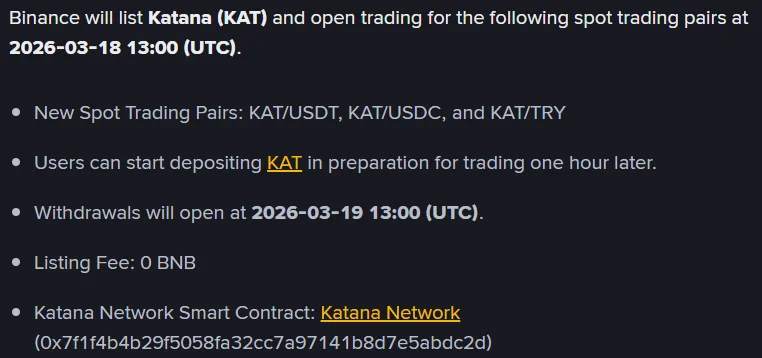
Binance listed KAT on the spot market on March 18, 2026, with the KAT/USDT, KAT/USDC, and KAT/TRY trading pairs. In the announcement, Binance stated that KAT was given a Seed Tag and emphasized that the token may be considered a new asset with high volatility.
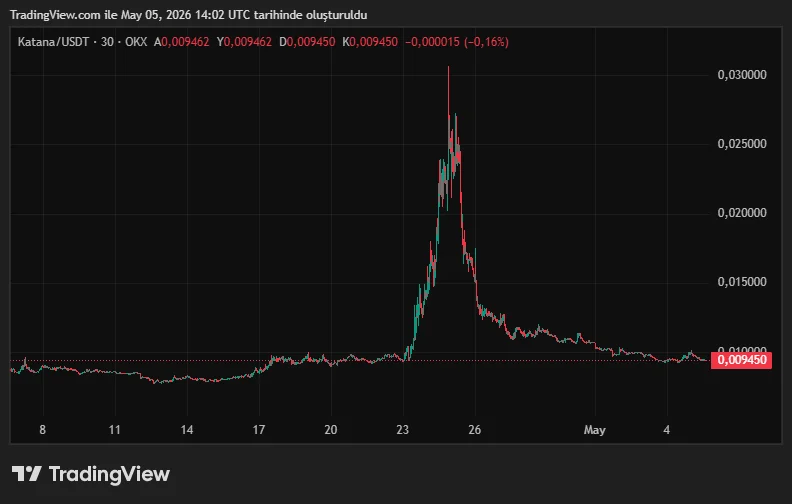
As of May 2026, the Katana price is trading around $0.0094753.
Why Is Katana Important?
To understand why Katana matters, it is necessary to look at the liquidity problem in DeFi. As decentralized finance grew, more protocols, more networks, and more yield products appeared. This growth increased the number of options for users, but it also caused liquidity to be divided across many pools and chains.
Liquidity fragmentation creates several core problems for DeFi users. A user who wants to trade may face higher slippage. Liquidity providers need to deal with a more complex picture when deciding which network or pool to place their capital in. For developers, launching a new application also becomes harder, because attracting liquidity turns into a major challenge alongside building the product itself.
Katana responds to this problem with a more focused approach. The network tries to increase capital concentration by directing DeFi activity toward selected core applications. If this model succeeds, users may access deeper markets, liquidity providers may access more efficient incentives, and developers may benefit from a more prepared DeFi base.
Katana’s Different Model
Katana’s difference is that it does not try to attract DeFi liquidity only through external incentives. The network wants to build its own revenue cycle. In the mainnet announcement, Katana states that VaultBridge, Chain-Owned Liquidity, AUSD, and net sequencer fees are used as mechanisms that support DeFi yield and liquidity. The same announcement also states that a 1 billion KAT liquidity mining incentive program was planned for two years, with rewards distributed more heavily in the early period.
In this model, KAT emissions are not the sole objective. KAT rewards are initially used to attract liquidity and increase user activity. However, Katana’s long-term goal is to build a more sustainable liquidity structure through sequencer revenues, bridge yields, and core application activity as network usage grows.
The vKAT system is also an important part of this model. vKAT holders vote on which pools KAT emissions should be directed to. According to the tokenomics article, these votes can increase rewards for liquidity providers and attract more liquidity; more liquidity can create a better trading experience; trading volume can then support sequencer revenues and the Chain-Owned Liquidity model.
Advantages and Risks
Katana’s most important advantage is that it tries to offer the DeFi experience within a more focused structure. The model built around core applications such as Sushi and Morpho can make trading, lending, borrowing, and liquidity provision easier to understand for users. Vault Bridge and Chain-Owned Liquidity aim to make capital more productive within the network.
Another advantage is the separation between KAT, vKAT, and avKAT. Active users can vote directly with vKAT. More passive users can choose automated staking and reward compounding through avKAT. In this way, Katana offers different participation options for different user profiles.
On the risk side, the picture needs to be read more carefully. Since Katana is a new network, smart contract risk, bridge risk, liquidity risk, network outages, withdrawal delays, and token volatility are important factors. KAT being listed on Binance with a Seed Tag also supports this risk perception. In addition, vKAT positions have a cooldown period for exits; on the avKAT side, exiting through a DEX depends on liquidity conditions. For this reason, Katana may offer a strong DeFi model, but it should not be seen as a risk-free structure.
Katana’s Use Cases
One of Katana’s main use cases is spot trading. Sushi is positioned as the network’s main spot DEX application. Users can trade supported asset pairs on Katana, add capital to liquidity pools, and aim to earn a share of trading fees.
Liquidity provision plays a central role in Katana’s economic cycle. Since the votes of vKAT holders determine which pools receive more KAT emissions, liquidity flows depend not only on market demand but also on internal incentive direction. This structure creates a more direct relationship between active users and liquidity providers.
However, liquidity provision always carries risk. When asset prices change, impermanent loss can occur. If pool depth is insufficient, exit costs may rise. If incentives change, yields may decline. For this reason, liquidity opportunities on Katana should be evaluated not only by looking at KAT rewards, but also by examining pool structure, trading volume, and market conditions.
Lending and Borrowing
Morpho stands out on the lending and borrowing side of Katana. Users can lend supported assets or borrow by providing collateral. Lending markets play an important role in capital efficiency within DeFi. Users can use lending markets to put their assets to work instead of holding them passively.
For borrowers, Katana offers access to collateralized liquidity. This model can be functional, especially for users who want to manage positions within DeFi. However, on the borrowing side, collateral ratio, interest rate, and liquidation risk must be monitored carefully. If the market moves sharply, collateral value may fall and the user’s position may move closer to liquidation.
Katana’s difference here is that it places lending and borrowing activity within a broader DeFi flywheel. Activity on Morpho becomes one of the components supporting the network’s broader liquidity and yield structure. As a result, lending and borrowing matter not only for individual user returns, but also for Katana’s core DeFi economy.
Staking, avKAT, and Developers
KAT staking is the main path for users who want to participate more actively in the Katana ecosystem. Users who stake KAT receive vKAT and can vote on which pools KAT emissions are directed to. This process connects Katana’s incentive distribution mechanism to user participation.
avKAT makes the staking process more automated. When a user deposits KAT into the avKAT vault, they do not need to vote manually or collect rewards themselves. The vault votes on behalf of the user and compounds rewards. This structure offers a more practical option for users who do not want to closely follow the DeFi process.
For developers, Katana aims to offer focused infrastructure for DeFi applications. In the mainnet announcement, it is stated that the Katana application supports adding funds from more than 75 chains, discovering more than 30 applications, managing DeFi positions, and tracking earned KAT tokens from a single view.
Katana’s future will depend on how successful its claim of sustainable yield and lasting liquidity becomes in DeFi. The project aims to move beyond short-term token incentives and connect network revenues and core app activity to a stronger economic cycle.
Instead of becoming a general chain that offers “everything” in DeFi, Katana is trying to build a more selective and focused structure. If this approach succeeds, the network could become a strong example in terms of capital efficiency and liquidity depth. However, this requires user activity, developer interest, liquidity provider participation, and network revenues to grow steadily.
Frequently Asked Questions (FAQ)
The most common questions about Katana (KAT) usually focus on how the network works, what the KAT token is used for, the differences between vKAT and avKAT, the staking process, and how the project differs from other Layer-2 networks. Below, you can find answers to the key questions that help explain the Katana ecosystem in a simpler way.
- What is Katana (KAT)?: Katana is an Ethereum-based Layer-2 network designed for DeFi. It aims to concentrate liquidity around selected core applications and offer a more efficient trading, lending, borrowing, and yield experience.
- What is the KAT token used for?: KAT is the core token of the Katana ecosystem. It does not provide voting power by itself. Users can stake KAT to receive vKAT and take part in directing KAT emissions to DeFi pools.
- Is KAT the gas token on Katana?: No. ETH is the gas token on Katana. The official tokenomics article states that KAT is not the network’s gas token and does not directly manage chain upgrades.
- What is vKAT?: vKAT is a non-transferable NFT-based voting position received when KAT is staked. It gives users voting rights over which pools receive KAT emissions on Katana.
- What is avKAT?: avKAT is a transferable ERC-4626 vault token designed for automated staking. It votes on behalf of users, collects rewards, and compounds them.
- Which protocols does Katana work with?: In Katana’s core DeFi structure, Sushi stands out on the spot trading side, while Morpho stands out on the lending and borrowing side. The network also uses mechanisms such as Vault Bridge, Chain-Owned Liquidity, and AUSD to support yield and liquidity.
- What is the total supply of KAT?: The initial total supply of KAT is 10 billion tokens. The distribution includes categories such as user liquidity mining, community airdrops, core contributors, the ecosystem and community treasury, and the public sale.
- How is Katana different from other Layer-2 networks?: Katana’s difference is that instead of positioning itself as a general-purpose L2 network, it tries to concentrate DeFi liquidity around selected applications. The network aims to build a more focused DeFi model that redirects yields generated from user activity and bridged capital back into the ecosystem.
- Is KAT listed on Binance?: Yes. Binance listed KAT on March 18, 2026, with the KAT/USDT, KAT/USDC, and KAT/TRY trading pairs. The token was given a Seed Tag.
- Is Katana risky?: Yes. Since Katana is a new and DeFi-focused network, it carries risks such as smart contract risk, bridge risk, liquidity risk, staking exit conditions, and token volatility. Users should understand the differences between KAT, vKAT, and avKAT before making transactions.
To learn more about Katana (KAT) and similar crypto projects, you can continue following the JrKripto guide series.

