
If data is the fuel of the digital age, Irys (IRYS) is setting a new standard by offering an infrastructure that not only stores this data but also processes it. IRYS is a pioneering Layer-1 blockchain project that brings the idea of programmable data to life, making waves in the Web3 world. The Irys coin is not just a cryptocurrency; it reflects a vision of technology that can form the backbone of projects working in areas such as big data, artificial intelligence (AI), decentralized applications (dApps), and NFTs. In traditional blockchains, data is often passive, difficult to access, and unprocessable. However, IRYS reverses this structure. Thanks to its data model integrated with smart contracts, data on the chain can now be processed directly; this brings together speed, efficiency, and security in data-driven applications. The Irys token, the cryptocurrency of Irys, is used in this network for paying transaction fees, staking mechanisms, and ensuring network security. What is IRYS, why is it being talked about so much, and what does it promise for the future? Let's examine all the details of IRYS together, from its technical infrastructure and use cases to its token economy and future vision.
Definition and Origins of IRYS
Irys is an innovative infrastructure that takes the importance of data to a new level in the digital age and redefines it with blockchain technology. Its main purpose is not only to store data but also to make this data active and programmable. In traditional blockchain systems, data is usually written to the chain, but then mostly remains passive; it can neither be read nor processed in a meaningful way. Irys breaks this mold with an approach. By allowing the data placed on the blockchain to be used simultaneously by smart contracts, it transforms data from being merely a recorded element into an asset that can be transacted, queried, and verified. This vision makes Irys not only a data storage blockchain but also a "data processing infrastructure". The project's roots lie in the Arweave ecosystem. Irys was initially developed under the name Bundlr Network. Bundlr was a content upload network designed to make Arweave's persistent data storage capabilities more accessible and faster. It enabled users to write data to Arweave at lower costs, faster, and with greater flexibility. The fact that over 1 billion transactions were processed through the Bundlr network clearly demonstrated the power and necessity of this technology as an infrastructure. This high transaction volume also indicated that data upload infrastructures were beginning to play a central role within Web3. This experience formed the cornerstone of what we now know as Irys.
In 2023, Bundlr underwent a major evolution. It decided to move beyond being merely an auxiliary network integrated with Arweave and become an independent Layer-1 blockchain. With this transformation, a name change occurred, and Bundlr officially transformed into Irys. Irys was now an independent chain operating with its own virtual machine (IrysVM), staking model, and native token economy. Indeed, Irys now offered the infrastructure to build its own data economy.
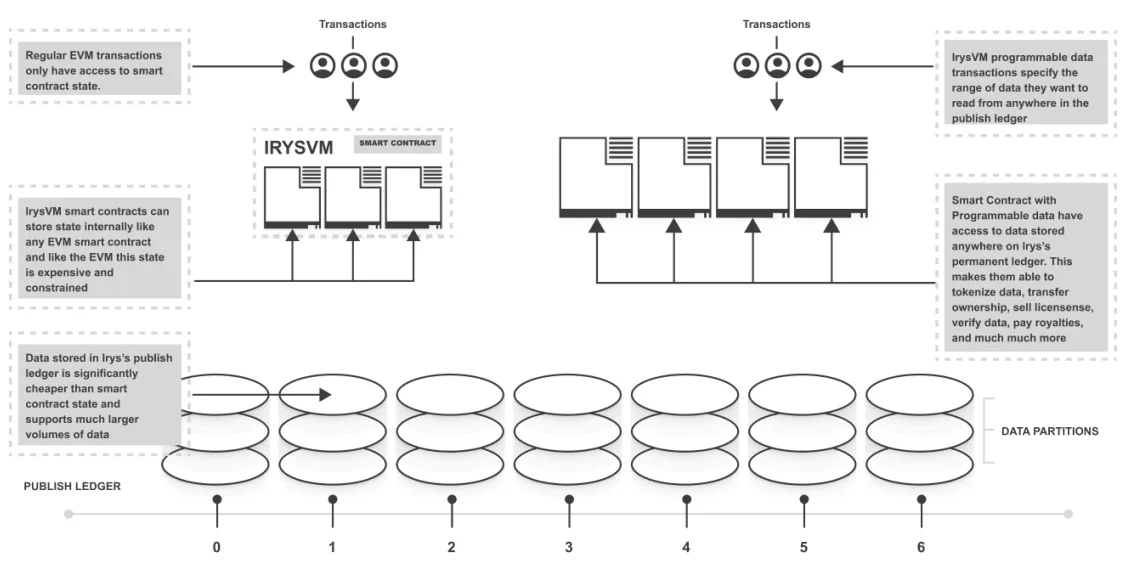
Josh Benaron, the man behind the project, spearheaded this transformation. Known for his entrepreneurial and developmental background, Benaron, as the founder of Bundlr, contributed to the Arweave ecosystem before setting his sights on a bigger vision. He realized that the Web3 world needed not only computing power but also an accessible, auditable, and programmable data infrastructure. Developed to meet this need, Irys now offers a powerful foundation that can be used in many areas, from AI systems to DeFi applications, NFTs to IoT devices. In short, Irys places the power of data at the heart of the chain.
IRYS History: Key Milestones
Initially serving as a supporting layer for Arweave, the Bundlr Network gradually transformed into an independent structure aiming for a deeper data infrastructure needed by Web3. To understand where Irys is today, let's look at these important steps it took in the past.
May 2022: First Seed Investment
When Irys was founded as Bundlr Network, the project was still a side tier providing content upload services to Arweave. However, even then, investors recognized its great potential and supported the project in its early stages. In May 2022, Bundlr raised $5.2 million in seed funding with participation from leading industry investors such as Union Square Ventures (USV), Arweave Team, and Hypersphere Ventures. This funding was used for infrastructure optimization, team expansion, and building a more sustainable content upload network. During the same period, Bundlr acted as a bridge managing millions of transactions and significantly improving Arweave's performance.
October 2023: Name Change and New Identity, Transition to Irys
As the need for scalability and flexibility in Web3 rapidly increased, Bundlr decided to move beyond being just a side service and chart its own independent course. The most important step in concretizing this decision was taken in October 2023. Bundlr Network officially changed its name to Irys. This change was not just a rebranding; it also symbolized the project's commitment to becoming a Layer-1 blockchain and continuing on its path with a broader vision, independent of Arweave. Irys' goal was no longer just to upload data, but to run it on-chain, analyze it, and integrate it with smart contracts.
June 2024: Strategic funding round
Seeking to accelerate its growth after the rebranding, Irys launched a strategic funding round in June 2024. This round secured an additional $3.5 million in investment. This funding was used to make the network architecture independent, prepare the testnet infrastructure, and expand developer tools. Thanks to this funding, Irys began to establish a strong position not only in the Web3 world but also in artificial intelligence and big data applications.
January 2025: Testnet Launched
On January 28, 2025, the Irys testnet was launched. However, this testing phase was much more than just a technical launch. To encourage users to test the network, a retro-style game called IrysArcade was released. Through this game, users could earn testnet tokens and experience on-chain data transactions in a fun way. During this period, 900 million transactions were recorded on the testnet; over 4 million wallets were created by developers and early users. This data volume demonstrated Irys' technical robustness and scalability.
November 2025: Mainnet Launch and Technical Summit
Following a long testing period, the Irys mainnet officially went live on November 25, 2025. The Layer-1 blockchain infrastructure was now operating at full capacity. During this period, Irys reached a limit of 100,000 transactions per second (TPS) and accelerated block times by 70%. This technical achievement showcased the project's engineering capabilities. It was announced that it had received over $20 million in total investment by the launch period and was supported by significant funds such as CoinFund, Hypersphere, and Arweave Team. This support was instrumental in Irys' rapid growth and adoption process after the mainnet launch.
November 25, 2025: Binance Alpha Launch
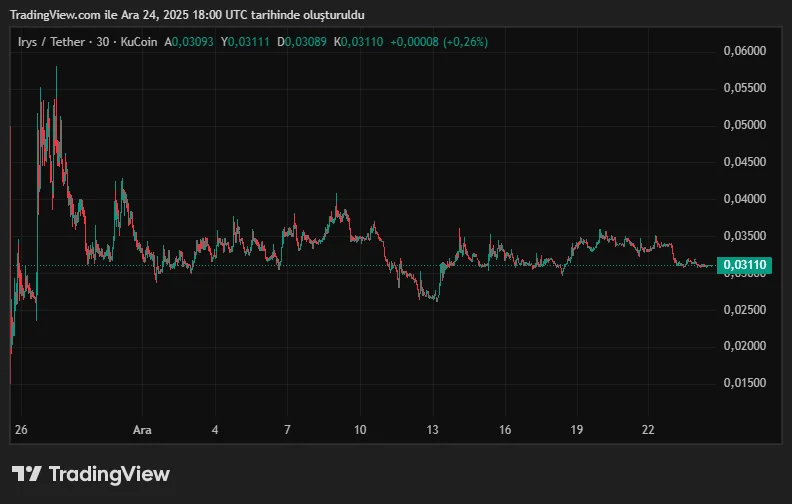
On the same day, the IRYS token began trading on the Binance Alpha platform. Trading, which opened with 20x leverage support, caused the price to increase by 76% in the first day. This aggressive price movement triggered new investor interest as well as increased short-term volatility. The Binance launch became one of the turning points for IRYS in terms of both liquidity and market awareness.
December 2025: Current Outlook
After reaching an all-time high (ATH) of $0.0549 due to the Binance effect, IRYS entered a technical correction phase. On November 28th, a 23% drop occurred, and the price began testing important support levels. In the final days of December 2025, the IRYS coin price was hovering around $0.03.
Why is IRYS Important?
IRYS bridges the gap between computation and storage in blockchain technology. Traditional blockchains struggle to store large-scale data and cannot perform deep analytics. Irys solves this problem by offering both together. For example, Irys makes data an active resource by directly connecting an Ethereum-like EVM layer to the data on the blockchain. This allows AI workflows to be created on the data, NFTs to become dynamic, and decentralized applications (dApps) to offer new experiences by leveraging each other's data. Irys has also become important because it offers a Web3 data solution with low cost and predictable prices compared to cloud and other Web3 storage solutions.
Use Cases
- Artificial intelligence and data science: Large datasets can be stored on Irys; thanks to rules embedded in the data, AI models can directly interact with this data and royalties can be managed automatically.
- Dynamic NFT and game applications: NFT metadata is stored on Irys and can be modified according to blockchain events. In-game assets and digital collectibles can be instantly verified with data integrity; this makes virtual collectibles programmable.
- Decentralized Data Networks (DePIN) and IoT: Irys is used in verifying data from sensors and in reliable data transfer in physical infrastructure networks. It also provides a verifiable data infrastructure for the security of financial transactions in DeFi and real-world assets (RWA).
- Persistent Storage and Content Upload Network: Irys stands out as an alternative to Arweave in persistent data storage. Continuing the legacy of the Bundlr project, it functions as a content upload network; creating an efficient infrastructure for the indefinite storage and fast access of data.
Token Economy
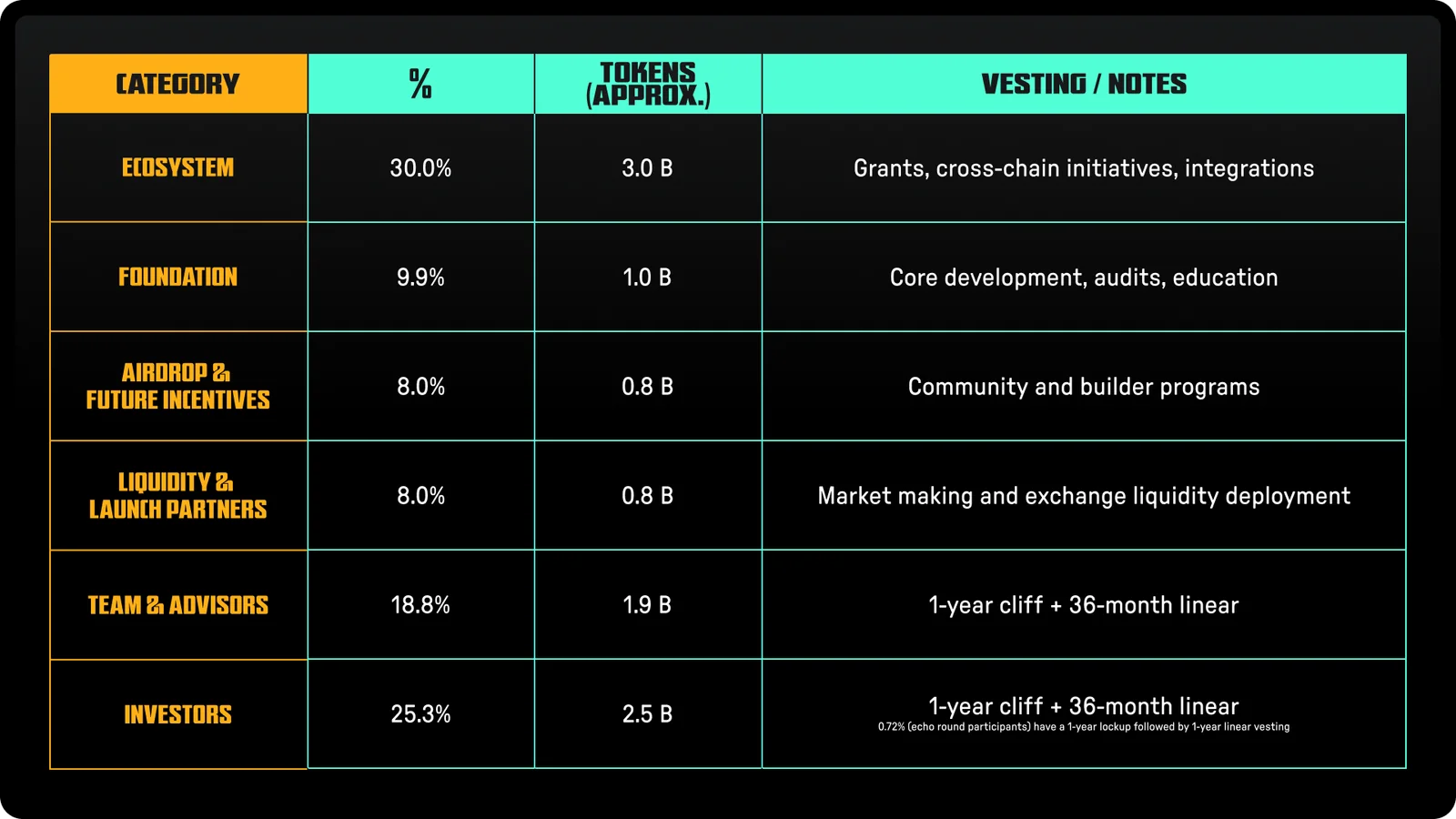
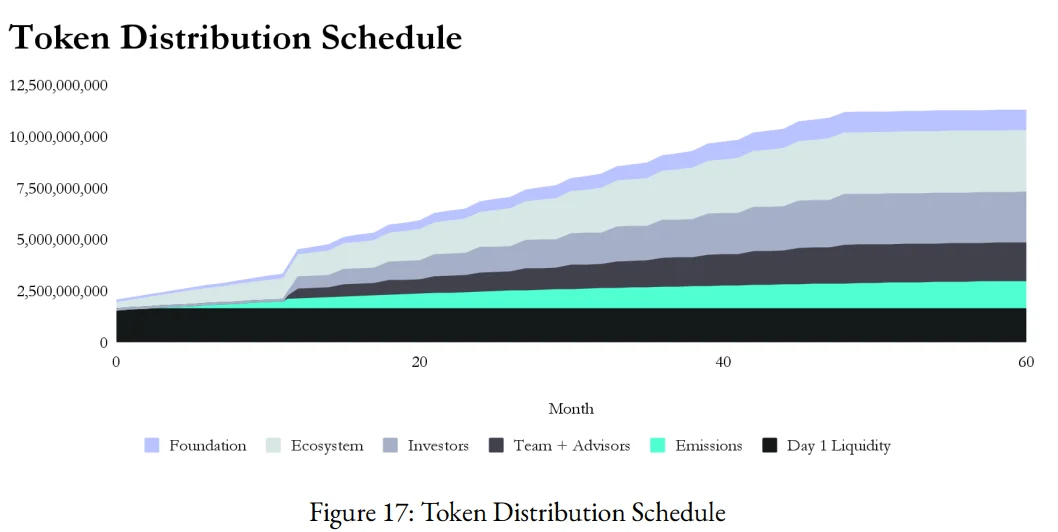
The IRYS token has a total of 10 billion units, and initially 20% of this was put into circulation. These tokens are used to pay storage and transaction fees on the network; there are separate fee mechanisms for temporary and permanent storage. The majority of fees are burned to reduce the circulating supply: for example, 50% of transaction fees and 95% of storage fees are burned. Thus, the IRYS economy initially adopts an inflationary model, gradually becoming deflationary, with supply growth slowing in the early years and approaching a final fixed rate (0.25%). Validators (miners and miners) participate in the network by staking IRYS and receive rewards based on their transactions; malicious behavior is deterred by slashing. This model aims to establish a balanced relationship between network security and the economy.
Irys' Future and Roadmap
While an official roadmap isn't frequently updated, Irys' future focus is becoming clear. By 2025, the project is focused on scaling its infrastructure, providing developers with the ability to write code embedded in data, and making storage cheaper than both Web2 and Web3 solutions. As IrysVM's capabilities evolve, new dApps will emerge, and more applications will be supported with a multi-revenue model transaction fee infrastructure. Thanks to investments secured in 2024-2025, Irys has a strong foundation for new integrations and partnerships; with the growth of the ecosystem, more blockchain and AI projects may choose Irys. It is anticipated that data-driven second-layer (L2) solutions and additional storage options will be developed in the future, and that Irys' technologies supporting enterprise workflows, such as its S3 compliant API, will be expanded.
Who are Irys' Developers?
The team behind Irys consists of individuals experienced in data and blockchain technologies. CEO Josh Benaron is the founder of Irys and previously developed the Bundlr network for Arweave. With Benaron's vision, Irys aims to provide a data-driven blockchain infrastructure. Connor King is involved in development; he previously worked at firms such as Social Capital and Arca. The project is growing with support from investors such as Framework Ventures, Hypersphere Ventures, and CoinFund, providing financial strength to its management team.
Frequently Asked Questions (FAQ)
Below you will find some frequently asked questions and answers about Irys (IRYS):
- What is Irys (IRYS)? Irys is a programmable layer-1 blockchain that stores and processes data on the blockchain. The Irys coin is used to pay fees, stake, and ensure network security on this network. Starting as Arweave's Bundlr network and rebranded in 2023, Irys provides a decentralized data infrastructure, enabling new possibilities for big data and AI applications.
- What are the use cases of Irys? Irys is used especially in Artificial Intelligence, NFT/gaming applications, DeFi/DePIN, and persistent data storage. For example, AI models can instantly use data stored on the blockchain and perform automated transactions. NFTs can create live digital assets by making metadata variable. It also provides infrastructure for Web3 solutions such as data verification from IoT devices, sensor networks (DePIN), and data security in financial applications.
- How does the IRYS token economy work? The IRYS network has a fixed supply of 10 billion IRYS tokens. Storage and transaction fees are paid with IRYS; a significant portion of the fees is burned, reducing the circulating supply (50% of transaction fees, 95% of storage fees are burned). New tokens are minted every block (mining reward), initially with an annual inflation rate of approximately 2%, which halves every four years to 0.25%. Users can stake IRYS by participating in the network, rewarding correct behavior and subject to slashing for abuse. This ensures the network remains secure and sustainable, both economically and technically.
- Where to buy IRYS tokens? By the end of 2025, IRYS will be available on a limited number of trading exchanges in the main market. For example, the IRYS token is currently traded on the Phemex exchange. It is not yet listed on other major exchanges; its listing on new exchanges is expected in the future. The token is not yet available for general sale, and access can be gained by following official announcements.
- How to stake on IRYS? To stake on the IRYS network, you need to join as a validator. Validators lock IRYS tokens as collateral (stake) and participate in block production and storage verification. This ensures network security and participants earn rewards; validators who engage in malicious behavior will have their stakes slashed. IRYS staking contributes to the ecosystem by guaranteeing the network's continuity.
- What is the difference between IRYS and Arweave? IRYS, initially a content upload network for Arweave called Bundlr, has evolved into an independent blockchain. While Bundlr was used to write data to Arweave, Irys is a fully programmable data chain on which smart contracts also run. While Arweave focuses on persistent data storage, Irys provides both storage and data processing with smart rules. Therefore, Irys can be considered an alternative Web3 data solution to Arweave; it offers both persistent storage and programmability.
- What is the IRYS token economy? The IRYS token has a total supply of 10 billion, with approximately 2 billion initially in circulation. Tokens are used to pay fees incurred during data storage and processing; a significant portion of these fees is burned out of circulation, creating deflationary pressure. Validators and miners also stake IRYS to participate in the network and earn rewards while ensuring network security. The token economy has a structure that transitions from an initial inflationary period to equilibrium over time; staking and burning mechanisms aim for long-term sustainability.
- What does the future of IRYS look like? IRYS's plans for 2025 and beyond include scaling the network, expanding low-cost storage, and improving developer tools. The project aims to enhance IrysVM capabilities, allowing more dApps to process data directly on the blockchain; it also aims to surpass Web2 and Web3 alternatives by offering stable and predictable storage fees. Thanks to significant investments and new partnerships, IRYS will continue to expand its ecosystem. It is expected to strengthen its role as a reliable data infrastructure in the Web 3 world.
Don't forget to follow the latest analyses, user guides, and project evaluations on IRYS and data-driven blockchain technologies in the JR Kripto Guide series.

