You might remember the early days of the internet. Pages loaded slowly, connections dropped, and everything was controlled by a few centralized points. Much has changed since those days; the internet has gotten faster and smarter, but the majority of our data is still in the hands of giant platforms. But what if this control, which should belong to you, was actually in your hands? There's a technology that answers exactly this question: Holochain. It's decentralized, energy-efficient, and user-centric. The Holo (HOT) project aims to bring this technology to the world. Holo promises a new digital space for both developers and end users. So, what is Holo, what is HOT coin, and why is it attracting so much attention? Let's take a look at what Holo offers.
The Definition and Origins of HOT
Holo (HOT) is a peer-to-peer (P2P) distributed hosting platform built on Holochain technology. This platform aims to make next-generation decentralized applications accessible to everyone. Holo's most important role is to bridge the gap between Holochain technology and internet users. In other words, it has a hybrid structure that appeals to both developers and everyday users. This allows applications developed with Holochain, called "hApps," to be easily run through browsers, without requiring any additional software.
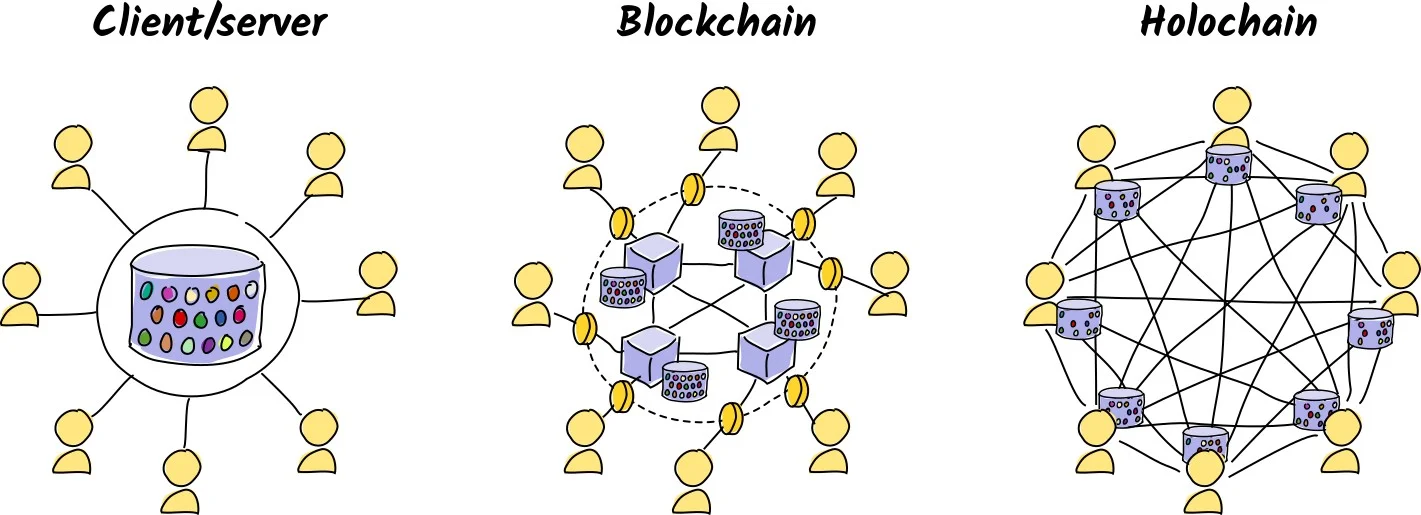
So, how is this possible? At the heart of this lies Holochain's innovative infrastructure. Unlike traditional blockchains, Holochain processes data directly on user devices rather than on central servers. In this open-source system, each user maintains their identity and data entirely on their own device. In other words, you have control; no external platform or company has control over your information. Applications run on your device, and data is created on your device. This model both enhances security and inherently protects user privacy.
Thanks to this structure, applications developed on Holochain can be implemented without the need for centralized servers. Developers can create distributed applications that run securely and quickly, scalable across the network. Furthermore, because energy-intensive processes like mining are eliminated, the system is much more environmentally friendly.
Holo is a project designed to make this infrastructure available to everyone. First launched in 2016 by experienced technology entrepreneurs Arthur Brock and Eric Harris-Braun, Holo was designed as a layer connecting Holochain to the real world. Its goal was clear: to enable decentralized applications to enter the lives of not only tech enthusiasts but also ordinary internet users.
Today, we use countless centralized applications on the internet. Social media, messaging services, file-sharing tools—all under the control of certain companies. Holo aims to transform this system. Making applications developed on Holochain accessible in the mainstream internet offers developers significant freedom while promising users an internet experience free from centralized control.
In short, "What is Holo?" If you're wondering: Holo is a platform that aims to bring the power of Holochain technology to the average user. It enables distributed applications running in the browser, suitable for everyday use, to work in harmony with the traditional internet. The vision behind Holo is quite ambitious: to build a highly energy-efficient and fully transparent digital ecosystem where data resides solely with its owner and applications run on user devices.
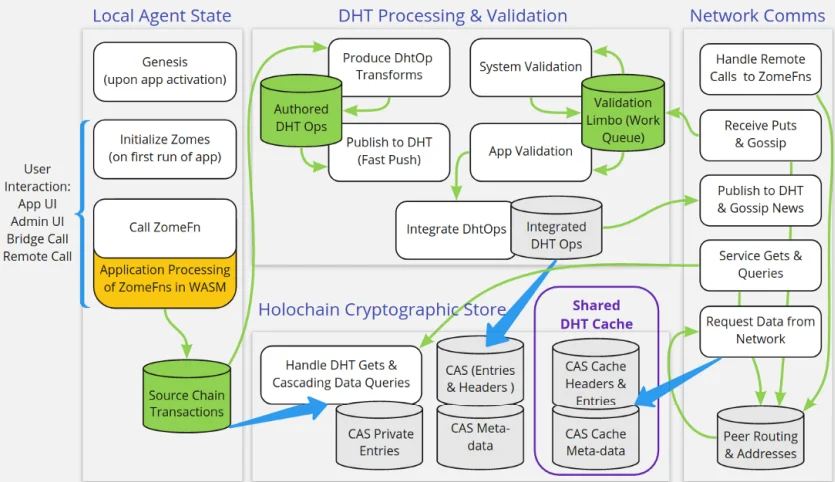
Dağıtık hash mimarisi.
Holo (HOT) History: Major Milestones
The Holo project was founded in 2016. Behind it were two individuals who had spent years thinking about digital systems: Arthur Brock and Eric Harris-Braun. Their shared vision was clear: to create a next-generation digital infrastructure where users would maintain their own data, eliminating the need for centralized servers and authorities. In line with this vision, Holochain technology was developed. However, this powerful and innovative infrastructure needed a bridge to reach everyday users. Holo was designed to fill precisely this gap.
Holo's goal was to enable Holochain-based applications, also known as hApps, to reach a wide audience. This required building not only a technical infrastructure but also an ecosystem and a digital marketplace. Users could use the applications within this system and earn rewards by funding them with their own devices. The Holo network was built on this idea.
A community-driven funding process was launched between March and April 2018 to bring the project to life. This was announced as an "Initial Community Offering," a slight departure from traditional ICOs (Initial Coin Offerings). Initially, 25 billion HOT tokens were released; however, demand was so high that the total supply was increased to over 133 billion HOT. A total of 30,202 ETH was raised. This amount was quite remarkable for the time. 75% of the tokens sold were offered publicly to investors, while 25% were allocated for the project's long-term development and team expenses. The maximum supply was capped at 177 billion HOT tokens.
After the successful completion of the funding process, the team quickly moved into development. In the first quarter of 2018 (Q1 2018), distribution of HoloPorts, physical devices that would connect to the Holo network, began. These devices allowed home users to host Holo applications using their own hardware. Over 500 HoloPorts were connected to the network in the first batch. In the second quarter (Q2 2018), the HoloFuel testing phase began, and the number of hosts approached 5,000. Development was rapid. By the third quarter (Q3 2018), the network had reached a capacity of processing hundreds of transactions per hour; the testnet consisted of approximately 15,000 hosts. By the end of 2018, this number had surpassed 30,000. Such a rapid expansion of the testnet demonstrated Holo's infrastructure success.
All of these developments occurred simultaneously with the Holochain software reaching beta. The necessary tools for developers were developed, the first sample hApps were launched, and the community grew. Meanwhile, the infrastructure hosting the Holo network was improved; both the physical devices and the software were continuously updated.
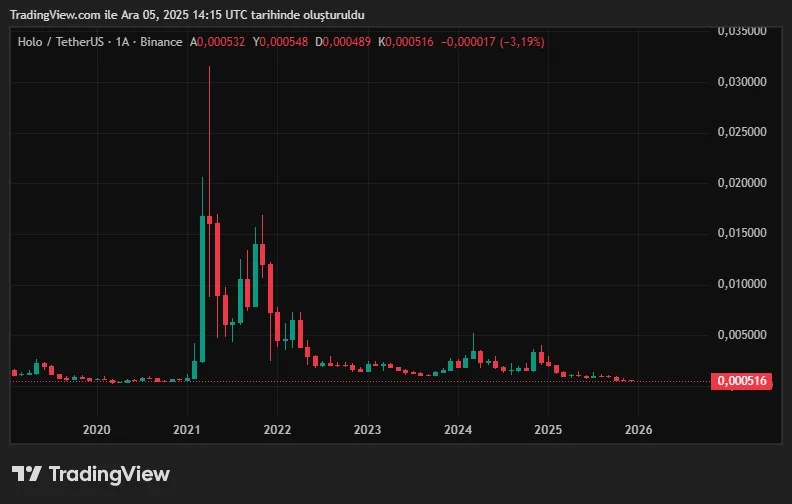
As of December 2025, the HOT coin price was trading at $0.00051991. The all-time high was seen in March 2021 at $0.035.
Why is Holo (HOT) Important?
Decentralization has become a frequently heard concept in the crypto ecosystem in recent years. However, how this concept is implemented in real life, its effectiveness, or the advantages it offers are often unclear. This is precisely where Holo (HOT) comes in, providing a powerful example of decentralization moving beyond theory into practice.
Decentralized Applications (hApps)
One of Holo's greatest contributions is making decentralized applications, or hApps, developed on Holochain, accessible to everyday internet users. Holochain's architecture allows each user to store their data on their own device, and the application only shares information over the network when needed. This ensures data security while also enabling the system to be fast and scalable.
Many applications, such as social networks, games, voting systems, and data management tools, can now operate without the need for centralized servers. Developers create these hApps using Holochain, and Holo enables these applications to reach internet users. These browser-accessible applications offer ease of access beyond traditional blockchain dApps.
Hosting Network: HoloHosts
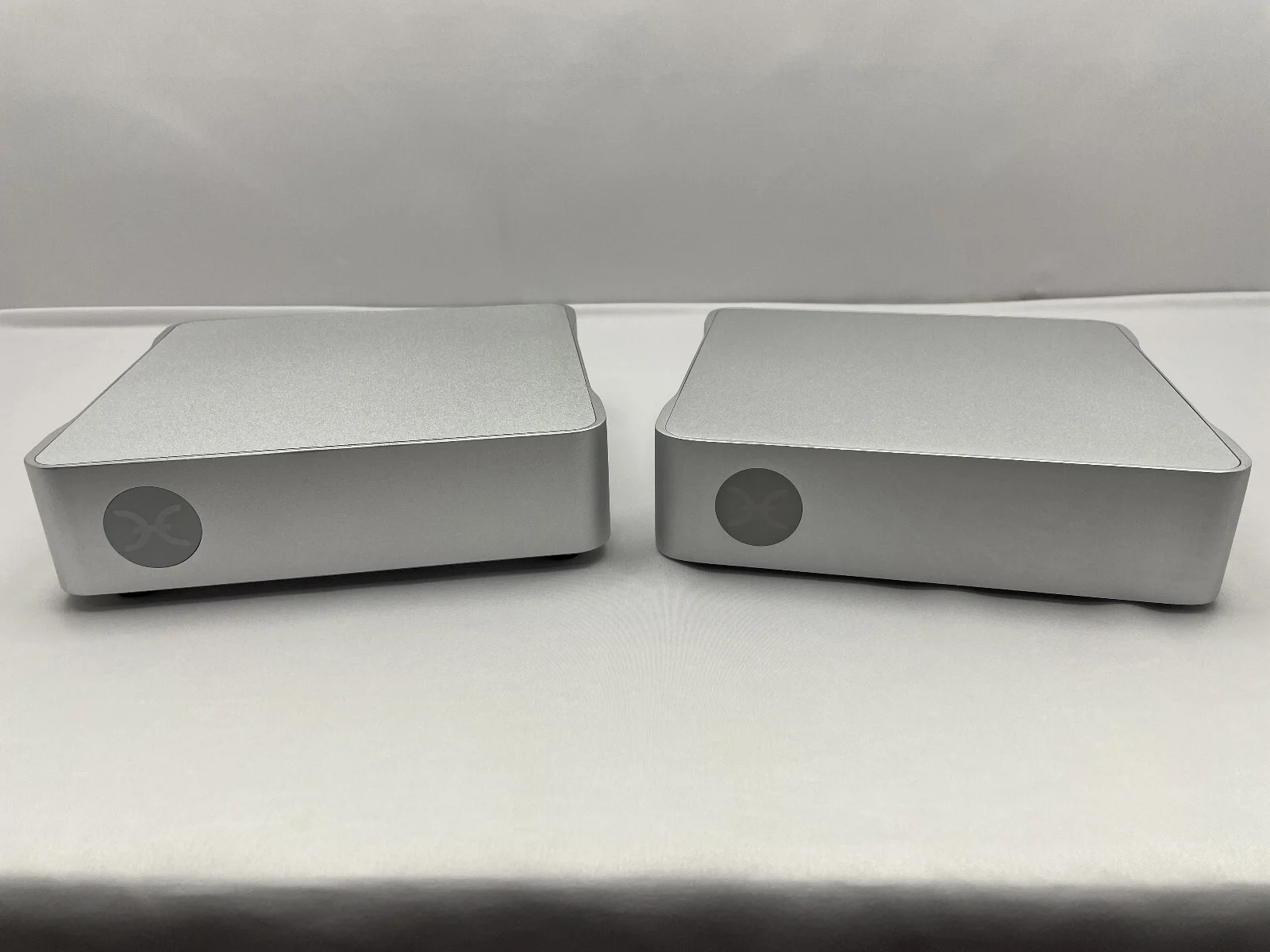
Another key building block is Holo's hosting infrastructure, the Holo hosting network. This network provides services directly from individuals' devices, eliminating the need for centralized data centers or servers. Using your home computer or specially designed HoloPort device, you can join the Holo network and become a part of the system.
An example HoloPort device.
In this model, each participant is rewarded with HoloFuel for contributing processing power or storage resources to the Holo network. These individuals are called "HoloHosts." This means you not only support decentralization but also earn revenue based on your contribution. This structure consumes significantly less energy than the traditional mining model and is much more accessible.
Energy Efficiency and Sustainability
When it comes to blockchain technology, energy consumption is often a topic of discussion. The high energy requirements of mining-based networks like Bitcoin, in particular, are seen as a major problem in terms of environmental sustainability.
Holochain offers a radical difference in this regard. The network has neither mining nor a global consensus mechanism. Each user manages their own data chain, minimizing Holochain's energy consumption. The Holo network offers a much more efficient and environmentally friendly alternative to blockchain systems.
In this respect, Holo demonstrates a strong stance not only on technology but also on sustainability principles. Its energy efficiency makes it possible to reach a wider user base at a lower cost. HOT token economics
The project's token structure is as noteworthy as its technical infrastructure. The HOT token played a significant role as the starting point of the Holo ecosystem; however, the real focus emerged with the transition from HOT to HoloFuel. Let's take a closer look at this structure.
The Function of the HOT Token
HOT is an ERC-20 token developed on the Ethereum network, used in the early stages of the Holo ecosystem. HOT, offered to investors during the 2018 ICO, was used to finance the project. In other words, the HOT token was launched to rally support from the community while the Holo network was still inactive.
This token does not directly run an application or perform transactions. It essentially serves as a transitional tool, a placeholder. Under the planned structure, once the Holo network is fully operational, HOT holders will be able to exchange their tokens for HoloFuel at a 1:1 ratio.
HoloFuel Transition and Economic Model
HoloFuel, which will replace HOT, has a structure quite different from traditional cryptocurrencies. HoloFuel was designed as a mutual credit system. In this model, every transaction is recorded through a two-way calculation. This means no additional money is printed within the system, nor is external value created; everything is based on contributions and services.
HoloFuel is not a token or coin. Its value is tied to tangible contributions, such as the service provided (e.g., application hosting). In this respect, it is based entirely on a circular economy. Its pricing is not fixed; it is determined by factors such as transaction time, bandwidth, and storage requirements. This makes it flexible, fair, and sustainable.
In short, HoloFuel is not just a digital currency; it is also a service economy tool. After the transition from HOT, the entire Holo network will be built on this new digital economy.
Supply structure, distribution, and circulation
During the 2018 ICO, a total of 133,214,575,156 HOT tokens were minted and released into circulation. The maximum supply was set at 177,619,433,541 tokens. In other words, the project adopted a transparent distribution model by initially opening the majority of the supply to users.
75% of the distribution was offered to investors through a public sale, while the remaining 25% was allocated to the team for development and operational expenses. This model was effective in establishing a community-based structure at an early stage.
In the future, once the Holo network becomes active, HOT tokens will be converted to HoloFuel. Following this transition, HOT's technical function in circulation will cease; the new economic structure will be run through HoloFuel.
Who are the Founders of Holo (HOT)?
Behind every successful project lies a powerful vision. The people behind Holo haven't just developed a technology; they've also articulated a clear and idealistic vision of what the digital world should be like. Arthur Brock and Eric Harris-Braun are the co-founders of the Holo and Holochain projects. Their long-standing experience has enabled them to lay the foundations for an infrastructure that prioritizes not only technical but also ethical and social values.
Arthur Brock
Arthur Brock stands out as one of the project's main architects. He's much more than just a software developer; he describes himself as a "culture hacker" and a "targeted money designer." These terms essentially sum up his approach to technology. According to Brock, digital systems should not be used merely to process data or run applications; they should be used to create new value models for how society functions.
Brock's vision was to build a new internet where users have complete control over their data and identities, and where individuals, rather than centralized structures, manage the network. Thanks to the agency-centric architecture it developed, Holochain applications can run directly on the user's device without relying on any central server. This results in a much more flexible structure in terms of both speed and privacy.
Eric Harris-Braun
Eric Harris-Braun, the project's other co-founder, played an equally important role in shaping Holochain's technical structure as Arthur Brock. Harris-Braun has long worked on distributed identity systems, energy efficiency, and decentralized network architectures.
From his perspective, while existing blockchain systems promise decentralization, they also face serious challenges in scalability and efficiency. Holochain offers an alternative solution to these problems: a lightweight and environmentally friendly system where individuals manage their own data, sharing data only when necessary, rather than relying on global consensus.
The "Mutual Sovereignty" Approach
The team led by Brock and Harris-Braun built the Holo ecosystem on not only a technological but also a philosophical principle: mutual sovereignty. According to this principle, the rules of the network are determined and enforced directly by users, not by a central authority. In Holochain, each individual owns and manages their own data chain.
This approach completely eliminates the classic server-client model. Each participant is both a user and a controller. The network's security is ensured by mutual verification within the community. This makes the system both more democratic and more resilient.
Frequently Asked Questions (FAQ)
Below are some frequently asked questions and answers about Holo (HOT):
What's the difference between Holochain and blockchain?: Unlike traditional blockchains, Holochain doesn't use a centralized consensus mechanism. Each user maintains their own "chain of origin"; only the necessary data is written to a distributed hash table (DHT). Transactions occur between two parties; the entire network doesn't need to confirm simultaneously. This structure makes Holochain much more scalable and energy efficient.
What's the difference between HOT and HoloFuel?: HOT is an ERC-20 token created on Ethereum and used as an investment tool during the ICO. When the Holo network launches, HOT will be converted to HoloFuel at a one-to-one ratio. HoloFuel operates with an asset-backed credit system; it is the network's native currency and directly drives the transaction economy.
How does the Holo network work?: Holo acts as a bridge connecting Holochain applications to internet users. With HoloPort devices or HoloHost software, users become part of the network and earn HoloFuel in exchange for contributing processing power and storage. This allows applications to run without central servers.
What is Holo hosting?: Holo hosting is a distributed infrastructure where individuals host applications on their devices. Hosted users are rewarded with HoloFuel based on their contributions to the network. Applications reach the end user simply through a browser; no additional software is required.
What does the future of the HOT token look like?: The long-term value of HOT depends on the HoloFuel transition and the widespread adoption of the network. Once the transition is complete, HOT's active use will cease. Under current market conditions, the HOT price is subject to fluctuations; however, project development and regulatory compliance are considered among the most important factors that will determine its future value.
You can follow the latest analyses, developments, and technical guides on Holochain technology and the HOT coin in the JR Crypto Guide series.
#what is holo#what is holo chain#what is hot coin#hot coin price#holochain and blockchain difference#holofuel#holoport device#holo
Do you have any questions?Feel free to send us your questions or request a free consultation.