
Bitcoin offers strong security and deep liquidity, yet its smart contract capabilities remain limited. Hemi aims to narrow the gap between Bitcoin and Ethereum by making Bitcoin data accessible to Ethereum-compatible applications.
Hemi’s Definition and Origins
Hemi is a Layer-2 protocol that brings Bitcoin and Ethereum together within a single modular network architecture. It draws on Bitcoin’s Proof-of-Work security while providing developers with an application environment compatible with the Ethereum Virtual Machine.
The Hemi team describes this approach as a “supernetwork.” The goal is to treat Bitcoin and Ethereum as complementary parts of the same system instead of two isolated ecosystems.
At the center of the network is the Hemi Virtual Machine, or hVM. According to Hemi’s documentation, hVM operates as an upgraded EVM environment capable of accessing Bitcoin data.
Applications built on Hemi that use Bitcoin data are known as “hApps.” These applications are designed to access Bitcoin balances, UTXO data, transaction histories and block headers from within smart contracts.
HEMI serves as the native ecosystem token of the network. Its use cases include staking, governance, liquidity incentives, network security and developer rewards.
Which network does Hemi run on?
Hemi has its own EVM-compatible mainnet. Hemi Mainnet uses chain ID 43111, while transaction fees are currently paid in ETH. This distinction matters because HEMI is the network’s ecosystem token, yet the current technical documentation lists ETH as the gas token.
From an architectural perspective, Hemi is more than a conventional sidechain running alongside Bitcoin. It uses Ethereum rollup technology for transaction execution and data processing while relying on Proof-of-Proof to publish security-related data to Bitcoin.
This structure places Hemi within discussions around both Ethereum Layer-2 networks and Bitcoin programmability layers. The project is commonly categorized as a Bitcoin Layer-2 or Bitcoin DeFi infrastructure protocol.
HEMI also has token contracts on Ethereum and BNB Chain. Binance’s listing announcement identifies the Ethereum contract as 0xEb964A1A6fAB73b8c72A0D15c7337fA4804F484d and the BNB Chain contract as 0x5fFD0EAdc186AF9512542d0d5e5eAFC65d5aFc5B.
Token contracts on different networks may not support the same applications or transfer methods. Users should check the destination network, contract address and supported bridge before transferring HEMI.
The goal of connecting Bitcoin and Ethereum
Bitcoin holds a vast amount of capital and relies on a strong security model. However, it was not designed to run general-purpose smart contracts in the same way as Ethereum.
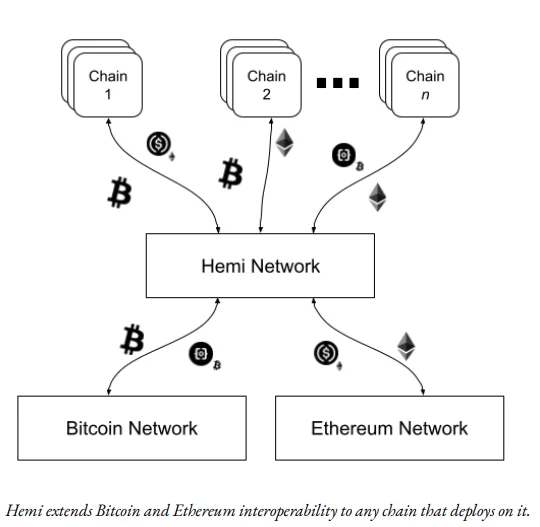
Ethereum offers a broad development environment for decentralized exchanges, lending protocols, stablecoins and other DeFi products. Hemi aims to connect the value held in Bitcoin with this programmable infrastructure.
Traditional cross-chain applications often depend on third-party relayers or bridges that take custody of assets. These systems introduce additional security assumptions and have contributed to several major bridge exploits.
Hemi’s hVM architecture seeks to reduce this dependence by making Bitcoin data available from within the EVM. A component called Tiny Bitcoin synchronizes with the Bitcoin network, while Hemi nodes process the collected data through a shared state view.
The Hemi Bitcoin Kit, or hBK, makes this technical layer easier for developers to use. Solidity developers can work with ready-made contracts and query tools instead of processing low-level Bitcoin data from scratch.
This architecture could support lending markets, BTC-backed financial products, cross-chain swaps and smart contracts that respond to Bitcoin transactions. Wider adoption will still depend on developer interest, network reliability and available liquidity.
Hemi’s History: Key Milestones
Hemi Network was introduced publicly by Hemi Labs in 2024. The founding team includes Jeff Garzik, Maxwell Sanchez and Matthew Roszak.
Jeff Garzik contributed to Bitcoin Core during Bitcoin’s early years. He also worked on the Linux kernel and now leads engineering and protocol development efforts at Hemi.
Max Sanchez is best known as the architect behind Hemi’s Proof-of-Proof mechanism. Sanchez has experience in distributed systems and blockchain security and previously co-founded VeriBlock.
The foundations of Proof-of-Proof were developed during the VeriBlock era. Hemi Labs acquired VeriBlock in 2023 and turned the technology into a central part of Hemi’s Bitcoin security layer.
Matthew Roszak is another co-founder, with a focus on business development, capital and strategy. Hemi’s broader team includes contributors working across engineering, security, operations and community development.
Hemi Labs announced a $15 million funding round in September 2024. Binance Labs, later renamed YZi Labs, joined the round alongside Breyer Capital and Big Brain Holdings.
The project completed another $15 million growth round in August 2025. Participants included YZi Labs, Crypto.com, Republic Digital, Selini Capital, HyperChain Capital and Quantstamp.
From testnet to mainnet and the HEMI launch
Before launching its mainnet, Hemi operated an incentivized testnet program. Users earned points by testing bridges, swaps, wallets and other on-chain tasks, while developers tested the application infrastructure.
The mainnet was initially scheduled for the final quarter of 2024. Development took longer than expected, and Hemi Mainnet eventually launched on March 12, 2025.
At launch, the team reported more than $440 million in value and over 50 ecosystem partners. These figures included liquidity commitments and different forms of locked assets, so they should not be compared directly with standard DeFi TVL measurements.
The HEMI token economy was announced in August 2025. The launch process involved airdrops, token sales and liquidity campaigns.
On September 23, 2025, Binance selected Hemi as the 43rd project in its HODLer Airdrops program. The campaign distributed 100 million HEMI, while spot trading opened on the same day for the HEMI/USDT, HEMI/USDC, HEMI/BNB, HEMI/FDUSD and HEMI/TRY pairs.
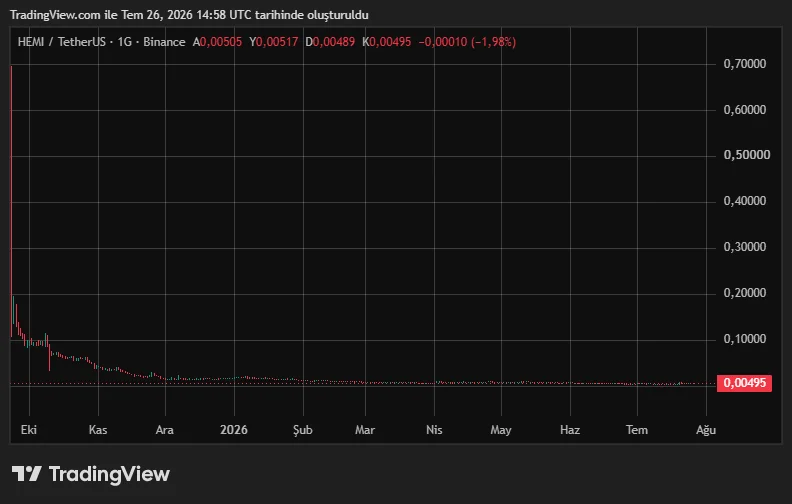
The Binance listing significantly expanded HEMI’s market access. Market data shows that the token reached an all-time high of approximately $0.1915 on September 24, 2025.
Funding, listings and ecosystem partners
The Hemi ecosystem includes decentralized exchanges, lending markets, yield platforms, oracle networks and cross-chain messaging protocols. Sushi, DODO, iZUMi, LayerBank, ZeroLend, LayerZero, RedStone and Pyth were among the integrations announced around the mainnet launch.
Applications on the network allow users to swap assets, provide liquidity, lend, borrow and access Bitcoin-related DeFi strategies. Hemi’s current positioning places particular emphasis on helping institutional Bitcoin holders use on-chain yield strategies while maintaining control over custody.
hemiBTC forms another part of this strategy. It is designed to make Bitcoin value usable within Hemi’s EVM environment and bring BTC liquidity into decentralized applications.
Outside Binance, HEMI trades on centralized platforms such as Gate and MEXC. Decentralized trading options may include Uniswap, Curve and PancakeSwap on BNB Chain. Availability varies by country and platform policy.
A single TVL figure does not provide a complete picture of Hemi’s size. The secured value shown on Hemi’s website, assets deposited in staking platforms, bridge collateral and DeFiLlama’s chain TVL are calculated using different methods.
This issue is not unique to Hemi. Active addresses, transaction volume, protocol revenue, liquidity depth and developer activity can offer a more balanced view of actual network adoption.
How Does the HEMI Token Work?
HEMI acts as an economic coordination tool for Hemi Network. The project lists staking, governance, liquidity provision and ecosystem rewards among the token’s main use cases.
Users can participate in governance by locking HEMI and creating a veHEMI position. Instead of operating as a standard transferable token, veHEMI uses an NFT to represent each locked position.
Under the economic model known as HIPPO-002, users can lock HEMI for periods ranging from 12 days to four years. Longer lock periods receive greater governance and reward weight.
veHEMI holders can vote on protocol decisions or delegate their voting rights to other participants. Future phases may also use the system to decide where liquidity incentives and protocol-owned funds are directed.
Hemi’s economic model attempts to connect network revenue with HEMI. A portion of the net revenue from gas fees, cross-chain services and security infrastructure is converted into HEMI and hemiBTC.
Some of the purchased HEMI is burned. The remaining HEMI and hemiBTC can be distributed to staking participants according to the relative weight of their veHEMI positions.
HEMI also functions as a reward for Proof-of-Proof miners. These miners publish Hemi consensus data to the Bitcoin blockchain, helping the network connect its security model with Bitcoin.
Hemi’s longer-term plans include validator staking and decentralized sequencing. Planned features should be separated from those already available, as several parts of the economic model are being introduced in phases.
Supply, allocation and annual emissions
HEMI launched with an initial supply of 10 billion tokens. Community and ecosystem programs received 32% of the allocation, while 15% went to the Hemispheres Foundation.
Investors and strategic partners received 28% of the supply. The team and core contributors received another 25%. This means that 68% of the initial allocation sits within the foundation, investor, partner, team and contributor categories.
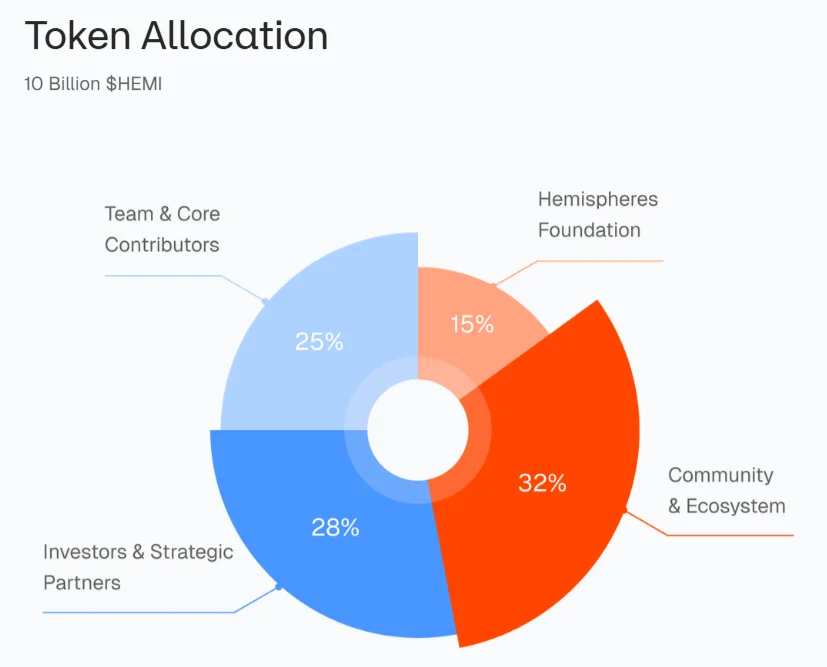
This distribution makes future token unlocks an important factor. As locked tokens enter circulation, supply may rise faster than demand and create additional pressure on the market price.
The 10 billion figure should not be interpreted as a fixed maximum supply. Binance updated its announcement on October 2, 2025, adding an unlimited maximum supply with annual emissions ranging from 3% to 7%.
Market data from July 2026 placed the circulating supply at approximately 977.5 million HEMI. This represented around 9.78% of the initial supply.
The low circulation ratio makes future supply growth worth monitoring. Token unlocks, annual emissions, staking allocations and the effect of the burn mechanism should all be considered together.
HEMI contracts and cross-chain use
Although HEMI is the native ecosystem token of Hemi, it is also represented on other networks for centralized exchange and DeFi activity. Its Ethereum and BNB Chain contracts are the main examples.
The BNB Chain version is used within Binance’s listing infrastructure and applications such as PancakeSwap. The Ethereum contract supports access through Ethereum-based wallets, exchanges and DeFi platforms.
A standard wallet transfer may not be enough to move HEMI between networks. Users need to select a supported bridge or choose the correct deposit network on an exchange.
Selecting the wrong network, sending funds to an unsupported contract or interacting with a fake token can result in permanent loss. Contract addresses should be checked against Hemi’s documentation and the deposit page of the relevant exchange before any transaction.
HEMI’s role within the network may also change over time. Hemi Mainnet currently uses ETH for gas fees, while HEMI is primarily used for staking, governance, rewards and economic security.
This distinction matters when assessing demand for the token. Rising transaction activity does not automatically mean that each transaction creates direct HEMI demand, although higher protocol revenue and staking requirements could affect the token economy indirectly.
Why Is Hemi Important?
Hemi’s most distinctive component is hVM. It expands the standard EVM environment so that smart contracts can read and work with Bitcoin data.
The Tiny Bitcoin daemon connects to Bitcoin’s peer-to-peer network and indexes blocks. The processed data is then added to a shared state known as the Processed Bitcoin View.
Hemi nodes process Bitcoin blocks at the same Hemi block height. This is designed to ensure that Bitcoin-aware smart contracts produce the same result across every node.
Special precompiled contracts within hVM expose this information to Solidity applications. Developers can run queries involving Bitcoin balances, UTXOs, transactions and block headers from inside the EVM environment.
Hemi’s whitepaper also lists potential query support for Bitcoin-native assets such as Ordinals, BRC-20 tokens and Runes. The scope of these features may change through network upgrades, so developers should refer to the latest technical documentation.
hBK converts these queries into higher-level development tools. Developers can use ready-made Solidity components instead of decoding each Bitcoin data structure from the ground up.
This approach could support BTC-backed lending, DAOs that respond to Bitcoin balances and exchange applications operating across both networks. Hemi focuses on allowing smart contracts to use Bitcoin state data directly, extending its role beyond basic token transfers.
Proof-of-Proof, Bitcoin finality and Tunnels
Proof-of-Proof is a complementary consensus mechanism that connects Hemi data with the Bitcoin blockchain. PoP miners publish Hemi consensus information through Bitcoin transactions.
Bitcoin miners do not need to operate Hemi nodes or participate directly in Hemi’s consensus. They only include the relevant transactions in Bitcoin blocks, while PoP miners may receive HEMI rewards for publishing the data.
The Hemi protocol uses these proofs during possible chain conflicts. The goal is to make reorganizing older Hemi blocks progressively more expensive.
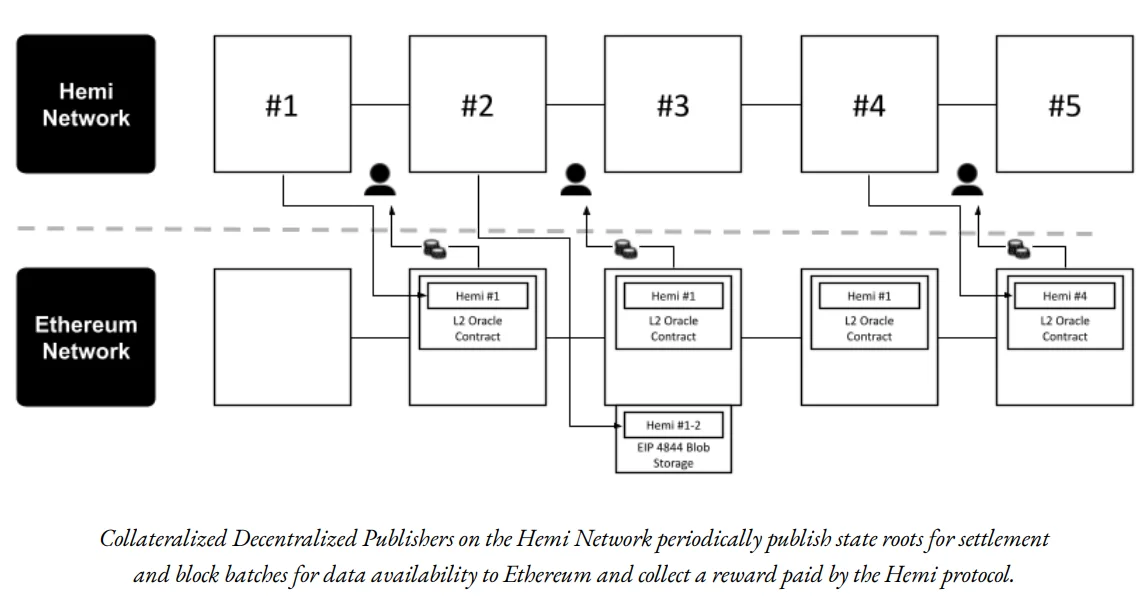
According to the whitepaper, a Hemi block reaches full Bitcoin finality after nine Bitcoin blocks under normal conditions. This takes around 90 minutes on average, although the actual waiting period can vary with Bitcoin block times.
Hemi calls the stronger state reached after an additional Bitcoin confirmation “Superfinality.” The security claims around this stage are based on the protocol’s design and consider the cost of attacking both Hemi and Bitcoin.
The Tunnels system allows assets to move between Bitcoin, Hemi and Ethereum. Hemi presents this model as a more flexible alternative to conventional bridges, with support for different security assumptions.
Not every tunnel offers the same level of security. Custody arrangements, multisig systems, BitVM-based components, liquidity providers and smart contracts can introduce different risks.
Using Bitcoin security does not remove these additional risks. Users still need to understand which asset they are moving, which tunnel they are using and what level of finality the transfer requires.
BTCFi use cases, competition and risks
Hemi’s primary market is Bitcoin-centered decentralized finance, commonly known as BTCFi. This sector aims to make Bitcoin usable as collateral, liquidity or part of a yield strategy instead of leaving it idle in a wallet.
Developers can build decentralized exchanges, lending markets, yield platforms and cross-chain applications on Hemi. Contracts with access to Bitcoin data may also support products that standard EVM applications cannot offer.
Hemi is competing in a crowded field. Stacks, Rootstock, Core, Bitlayer, Botanix and other networks are also developing smart contract or DeFi infrastructure around Bitcoin.
Technical capacity alone will not determine which platform succeeds. Liquidity, developer participation, user experience, bridge security, exchange support and real protocol revenue will also shape the market.
Hemi’s hVM and Proof-of-Proof systems offer a distinct technical approach. At the same time, the architecture requires several components to work together, including Bitcoin data processing, Ethereum rollup infrastructure, sequencers, tunnels and staking contracts.
This complexity creates additional areas where technical problems may emerge. On June 1, 2026, Hemi Mainnet stopped producing blocks for roughly two hours after an hVM precompile call triggered a runtime error in the sequencer. Hemi’s status page later reported that the issue had been resolved and no user funds were at risk.
HEMI also carries considerable price volatility. Market data shows that the token had fallen by more than 97% from its September 2025 high of around $0.1915 by July 2026.
In July 2026, HEMI coin price traded near $0.0049, with a market capitalization of approximately $4.8 million. Its low circulating ratio, future emissions, token unlocks, technical risks and competition across the BTCFi sector remain key factors to monitor.
Frequently Asked Questions (FAQ)
Below are answers to some of the most common questions about Hemi and the HEMI token.
- What is Hemi, and when did it launch?: Hemi is a blockchain network designed to combine Bitcoin security with Ethereum-compatible smart contracts through a modular Layer-2 architecture. The project was introduced in 2024, Hemi Mainnet launched on March 12, 2025, and the HEMI token entered the market later in 2025.
- What is the HEMI token used for?: HEMI is used for staking, governance, network security, liquidity incentives and ecosystem rewards. PoP miners can earn HEMI for publishing Hemi data to Bitcoin, while veHEMI holders can participate in governance and fee distribution.
- Which network does Hemi run on?: Hemi operates its own EVM-compatible mainnet as a modular Layer-2 protocol. It uses Ethereum rollup infrastructure and connects its data to Bitcoin through Proof-of-Proof. HEMI also has token contracts on Ethereum and BNB Chain.
- Who founded Hemi?: The founding team of Hemi Labs includes former Bitcoin Core developer Jeff Garzik, Proof-of-Proof architect Maxwell Sanchez and blockchain entrepreneur Matthew Roszak. Garzik and Sanchez lead much of the project’s technical development.
- What is the HEMI supply?: HEMI launched with an initial total supply of 10 billion tokens. Binance and CoinMarketCap list the maximum supply as unlimited due to annual emissions ranging from 3% to 7%. Around 977.5 million HEMI were in circulation as of July 2026.
- Is Hemi suitable as an investment?: HEMI’s suitability depends on the investor’s risk tolerance, time horizon and portfolio structure. Its high volatility, low circulating ratio, future supply growth, technical network risks and intense competition within BTCFi should all be considered before making a decision. Hemi follows a distinctive path within BTCFi through hVM, which exposes Bitcoin data to Solidity applications, and Proof-of-Proof, which connects the network’s security model with Bitcoin. Its long-term position will depend on application adoption, network reliability and whether the HEMI economy develops as planned.
Follow the JR Kripto Guide series for the latest insights into Hemi, the network bringing Bitcoin data to Ethereum-compatible applications, and other emerging projects across the BTCFi ecosystem.

