
Artificial intelligence and robotics technologies were discussed separately for a long time. On one side, large language models, AI agents and data processing systems developed; on the other side, robots started to take on more tasks in the physical world. Fabric Protocol sits in the middle of these two fields and aims to enable robots, AI agents, developers and users to work on the same open network.
Fabric Protocol (ROBO) is defined as a decentralized infrastructure project developed for robotic systems and artificial intelligence workloads. The project’s native token, ROBO, is used for network fees, task coordination, staking, governance signaling and contribution-based reward mechanisms. Binance Research describes Fabric Protocol as a decentralized infrastructure designed to coordinate robotics and AI workloads across devices, services and people.
The core idea behind Fabric is based on the view that robots will not remain passive machines in the future. The project aims to build a “robot economy” where robots can have identities, receive tasks, share data, make payments and verify completed work. For this reason, Fabric Protocol stands in a slightly different position from a classic AI coin narrative.
Fabric Protocol Definition and Origin
Fabric Protocol emerged as a network designed for the open, decentralized and human-centered development of general-purpose robots. In the project’s whitepaper, Fabric proposes a decentralized structure to develop, manage and gradually evolve a general-purpose robot called ROBO1. According to the whitepaper, Fabric aims to coordinate computation, ownership and oversight through public ledgers instead of closed datasets and opaque control mechanisms.
This starting point is based on a key question in the fields of AI and robotics: when intelligent machines take on more roles in the physical world, who will manage them, who will oversee them and who will be able to contribute to these systems? Fabric Protocol tries to answer this question through a blockchain-based coordination layer.
The project’s goal is not only to produce robots. Fabric aims to build an economic system around robots. In this system, developers can create robotic capabilities, operators can run machines, users can request services and network contributions can be incentivized through the ROBO token.
The emergence of Fabric Protocol coincides with a period in which artificial intelligence is moving from the digital world into the physical world. AI agents no longer only generate text; they can plan, use software tools and, in some cases, guide robotic systems. Fabric aims to provide identity, payment, verification and coordination infrastructure for robots and AI agents during this transition.
Fabric Protocol History: Key Milestones
The early developments around Fabric Protocol have taken shape around robotic software, open-source development and blockchain-connected machines. According to Binance Research, the first blockchain-connected Robodog was introduced in November 2024; this development offered an early example of on-chain data records, smart contract-supported task execution and decentralized verification. In December 2024, the OM1 whitepaper was published, explaining an AI-native operating system architecture for robots.
In February 2025, OM1 was released as open-source software, marking an important step in opening the project to the developer community. The SF Hacks Robotics Hackathon, held in April 2025, allowed developers to build prototypes on OM1. It was reported that more than 300 developers participated in the event and over 50 prototypes were created.
The most notable date for the ROBO token came in the first quarter of 2026. Binance listed Fabric Protocol on its spot market on March 4, 2026, and opened ROBO/USDT, ROBO/USDC and ROBO/TRY trading pairs. In the same announcement, Binance stated that ROBO would carry a Seed Tag, meaning the token was considered a new asset with higher volatility risk.
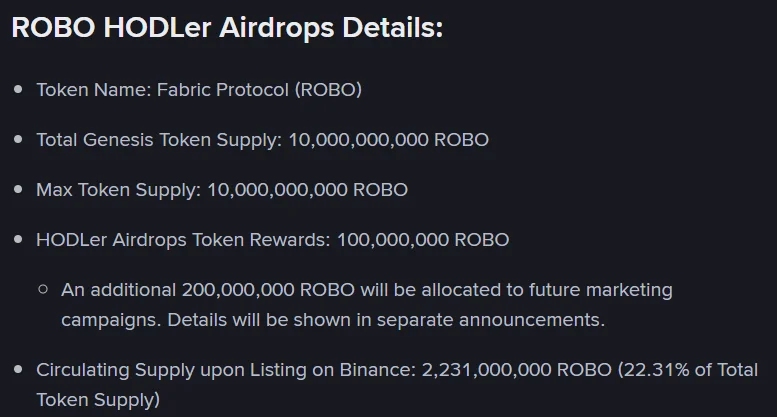
Binance also included Fabric Protocol in its HODLer Airdrops program on March 18, 2026. According to the announcement, the total supply was set at 10 billion ROBO, while the circulating supply at the time of the Binance listing was 2.231 billion ROBO, equal to 22.31 percent of the total supply.
How Does Fabric Protocol Work?
Fabric Protocol aims to build a shared coordination layer for robots and AI agents. Today, most robotic systems operate inside closed platforms. Machines from different manufacturers, different software systems and different data structures often do not share a common identity or payment standard.
Fabric aims to connect this fragmented structure with blockchain. The network plans to allow robots to have on-chain identities, record tasks, verify completed work and manage economic flows through the ROBO token. Binance Academy states that Fabric focuses on the need for a shared identity layer, trustless payment system and transparent records for machine actions.
This structure works through several core components: robot identity, task coordination, data sharing, machine payments, verification and incentives. When a user requests a task, the network determines which robot or operator will perform it, what type of proof will be submitted and how the payment will take place.
Robot Identity and Task Coordination
One of the most important parts of Fabric Protocol is robot identity. A robot needs a verifiable identity structure to be recognized on the network, receive tasks, track its past performance and receive payments. Just as a bank account, passport or user account is fundamental for humans, on-chain identity plays a similar role for robots.
Fabric Foundation states that robots will need web3 wallets and on-chain identities in the future. According to the foundation, the Fabric network will initially be launched on Base, while the long-term goal is to move to its own Layer 1 network as adoption grows.
On the task coordination side, the goal is to enable robots and AI agents to work within a shared marketplace logic rather than in disconnected systems. A robot may take on tasks such as delivery, monitoring, maintenance, data collection or security. Fabric aims to manage the record, proof and economic value of these tasks within the same infrastructure.
Machine Payments and Settlement Structure
Fabric Protocol also aims to build a settlement layer for transactions between robots and AI agents. At this point, the ROBO token stands out as one of the main tools for network fees and service payments.
According to Fabric Foundation, network fees will be paid in ROBO. Network activities such as robot identities, payment tracking, verification and transaction fees are tied to the ROBO token economy.
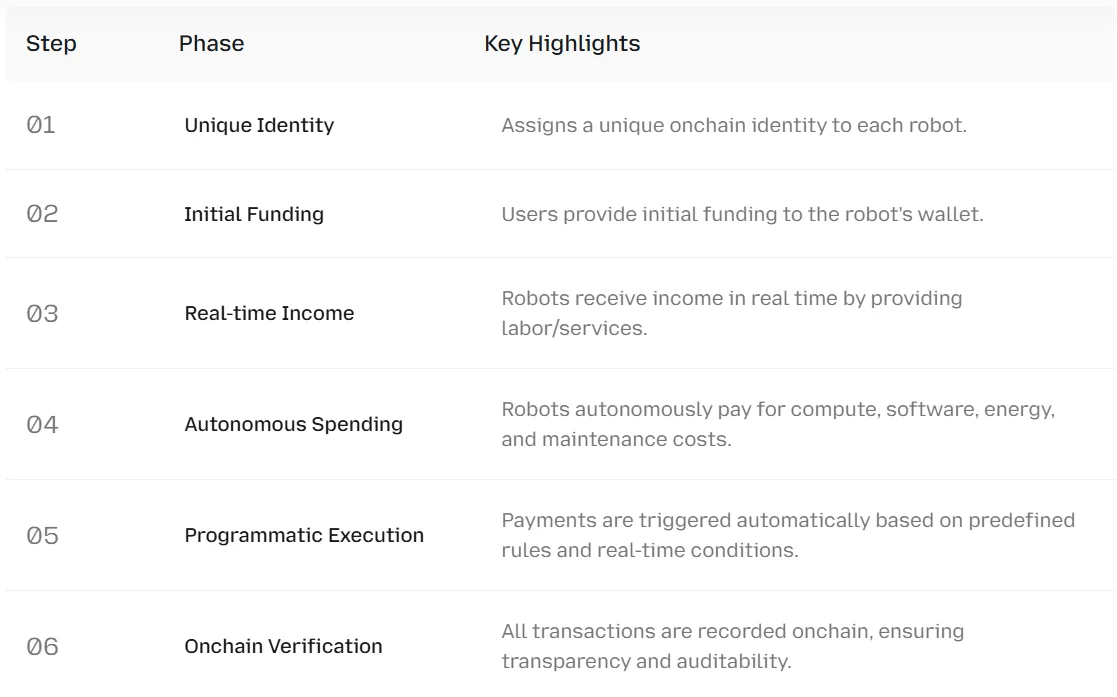
This structure presents an important idea for the machine economy. In theory, a robot could automatically buy energy, use data, access an API or receive a service from another robot. Fabric tries to close the gap between human-centered payment systems and robot-centered workflows.
What Is ROBO1?
ROBO1 represents the general-purpose robot vision described in the Fabric Protocol whitepaper. At this point, ROBO1 should not be confused with the ROBO token. The ROBO token is used as the network’s utility and governance asset; ROBO1 refers to the robot concept that Fabric aims to build and gradually develop.
According to the whitepaper, ROBO1 will operate with a modern and AI-first cognitive architecture. This structure consists of modules designed for different functions. The project explains these modules through the concept of “skill chips”; in other words, specific capabilities can be added to or removed from robots. The whitepaper compares this approach to applications in app stores.
This idea offers a very practical framework for robotics. Instead of making a robot learn every task from scratch, the goal is to allow it to use skill modules developed for specific tasks. Developers can create these skills, operators can run the robots in the field and users can access the services they need.
What Is Proof of Robotic Work?
Proof of Robotic Work is one of the most notable concepts in Fabric Protocol. In classic Proof of Work systems, machines solve mathematical problems. In the Proof of Robotic Work model, the focus shifts to verifying tasks that robots complete in the real world.
According to official documents, Proof of Robotic Work is built on the idea that a robot cannot receive ROBO rewards without proving that it has completed real-world tasks such as delivery, inspection or monitoring. When a task is completed, robots can submit sensor-based proof such as GPS data, camera footage or LiDAR measurements; after the network verifies this proof, payment is released. Robots that submit false or faulty proof do not receive rewards, while operators may face token slashing.
What Is the ROBO Token?
The ROBO token is used as the native utility and governance asset of the Fabric Protocol ecosystem. Fabric Foundation defines ROBO as the core utility and governance asset within its mission. The token plays a role in network fees, robot coordination, staking mechanisms, developer and enterprise participation and governance processes.
ROBO is designed to move beyond speculative trading. In the project’s narrative, the token serves as an economic connector for robots to create identities, receive tasks, provide services, generate data and reward contributions.
However, the Fabric team also clearly emphasizes that the ROBO token does not provide ownership rights or revenue rights over robot hardware. Fabric Foundation states that participation in the network through the token does not mean robot hardware ownership, fractional ownership, revenue rights or any economic claim.
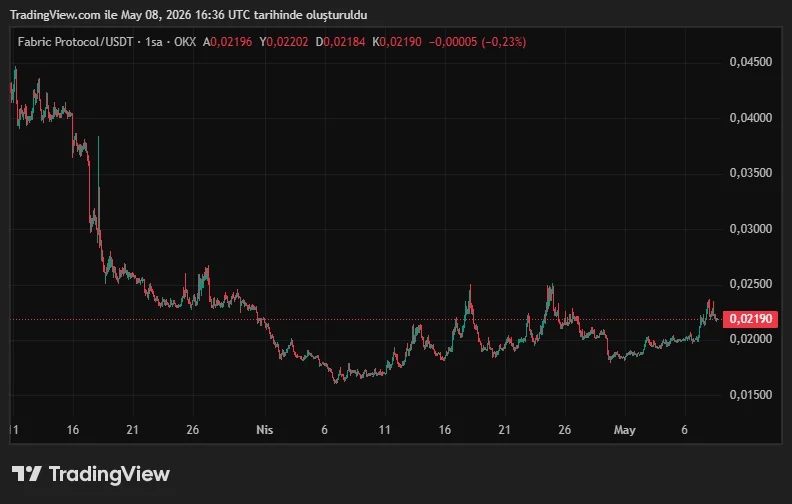
As of May 8, 2026, the ROBO coin price is around $0.0216498.
What Is the ROBO Token Used For?
The first use case of the ROBO token is network fees. ROBO can be used in network activities such as creating robot identities, task coordination, verification and on-chain transactions. This mechanism aims to connect token demand with network usage.
The second use case is robot coordination and staking. According to Fabric Foundation, users need to stake ROBO to participate in network coordination. This structure is linked to participation mechanisms such as priority access and task allocation in the early operational stages of robots.
The third use case is developer and enterprise participation. As the Fabric ecosystem grows, developers and companies are expected to buy and stake a certain amount of ROBO to build applications on the network. This aims to connect developers more directly with the success of the network.
The fourth use case is the reward mechanism. Fabric Foundation states that rewards may be paid for verified work in areas such as skill development, task completion, data contribution, computation and verification. These rewards aim to help the network grow not only through user demand but also through contributors.
The final use case is governance. ROBO can play a guiding role in topics such as network fees and operational policies. How this governance structure will mature is expected to become clearer in the later stages of the project.
Fabric Protocol Token Economy
The total and maximum supply of Fabric Protocol is set at 10 billion ROBO. In Binance’s HODLer Airdrops announcement, the circulating supply at the time of the Binance listing was stated as 2.231 billion ROBO, equal to 22.31 percent of the total supply.
According to the token distribution shared by Fabric Foundation, 24.3 percent of the supply is allocated to investors, 20 percent to the team and advisors, 18 percent to the Foundation Reserve, 29.7 percent to the ecosystem and community, 5 percent to community airdrops, 2.5 percent to liquidity and launch processes and 0.5 percent to the public sale. A 12-month cliff followed by 36-month linear vesting applies to investors, the team and advisors.
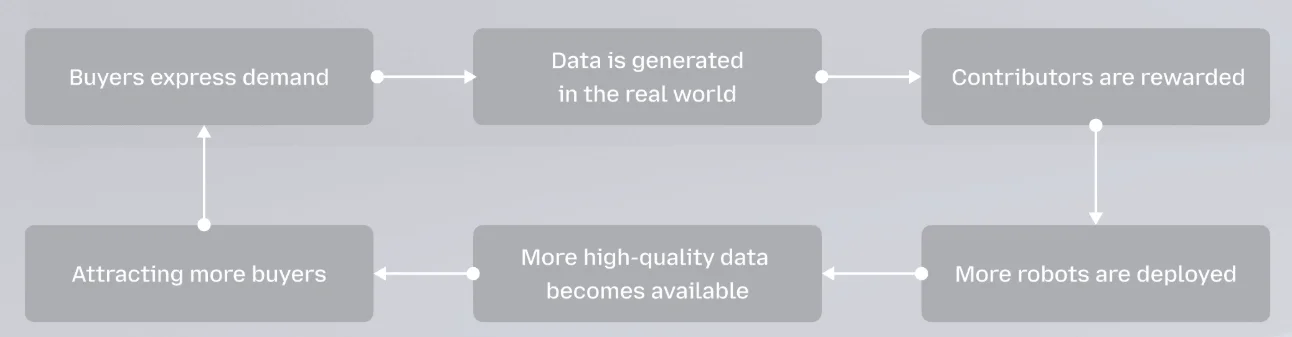
The largest share being allocated to the ecosystem and community stands out. This portion is used to incentivize Proof of Robotic Work and network contributions. In other words, the token economy aims to support not only early investors or the team, but also long-term usage and contribution.
The ROBO coin price changes depending on market conditions. According to CoinGecko, ROBO was trading with an approximate circulating supply of 2.2 billion in early May 2026; its all-time high was recorded at $0.06071 on March 2, 2026. The same source lists Binance, Bybit and OKX among the centralized exchanges where ROBO is traded.
Why Is Fabric Protocol Important?
The importance of Fabric Protocol comes from its claim to combine AI and robotics with blockchain. In the crypto market, many AI projects focus on data, models, agents or computation. Fabric adds machines that perform tasks in the physical world to this picture.
Robots operating in the real world create a more complex problem than digital applications. This is because the process involves not only software output, but also physical safety, task accuracy, energy use, environmental conditions and interaction with humans. Fabric wants to build a more open robot economy by offering shared identity, payment and verification infrastructure in this field.
The project also opens a new area for developers. Software that gives robots new skills, data contributions, verification systems and task markets could gradually form a broader ecosystem. This potential links Fabric not only to token price movements but also to the future of AI and robotics infrastructure.
Still, it is important to remember that the project is at an early stage. Fabric has a strong narrative, but the reliability of robotic systems in the field, the scalability of the verifiable task model and real demand for ROBO within the network will be tested over time.
Fabric Protocol Ecosystem and Use Cases
Fabric Protocol’s use cases revolve around robotic services, AI agents, data markets, autonomous payments and developer applications. Potential scenarios for the network include a robot making a delivery, inspecting an area, collecting environmental data or performing a specific physical task.
For AI agents, Fabric can help digital decision-making systems work more efficiently with physical machines. An AI agent can plan a task, choose the appropriate robot, process the required data and trigger the payment flow. As such systems become more common, the need for more reliable standards for machine-to-machine interactions is increasing.
There is also an important use case on the data side. Robots can continuously generate data from the physical world. The verification, pricing and sharing of this data with different actors are part of Fabric’s economic design. Through this, the project envisions the creation of robot-focused markets for resources such as data, skills, energy and computation.
Fabric Protocol Roadmap
Fabric Protocol’s whitepaper includes a phased roadmap for 2026. In the first quarter of 2026, the project aims to launch the first Fabric components for robot identity, task settlement and structured data collection; it also plans to begin collecting real-world operational data from active robot usage.
In the second quarter of 2026, the project plans to introduce contribution incentives tied to verified task execution and data submission. During the same period, data collection is expected to expand across more robot platforms, environments and use cases; App Store participation among developers and ecosystem partners is also expected to grow.
In the third quarter, more complex tasks, continuous usage and multi-robot workflows come to the forefront. In the fourth quarter, the project aims to improve incentive mechanisms and data systems based on observed performance, increase network reliability and transaction capacity and prepare for larger-scale deployments. After 2026, Fabric plans to move toward a machine-native Fabric Layer 1 powered by real usage data.
Where Can You Buy ROBO Coin?
ROBO coin is traded on centralized cryptocurrency exchanges. According to CoinGecko, Binance is one of the most popular trading venues for ROBO; Bybit and OKX are also listed among other major options. On Binance, ROBO/USDT, ROBO/USDC and ROBO/TRY pairs were opened.
Before buying ROBO, users should check the current price, volume, liquidity, trading pair, network selection and the withdrawal networks supported by the exchange. In Binance’s announcement, ROBO was listed with BNB Smart Chain and Ethereum contracts. For this reason, it is important not to select the wrong network during token transfers.
Frequently Asked Questions (FAQ)
Below, you can find some frequently asked questions and answers about Fabric Protocol:
- What is Fabric Protocol and when did it launch?Fabric Protocol is a blockchain project that aims to build decentralized identity, task coordination, payment and verification infrastructure for robots and AI agents. The project developed through robotic software, OM1 and early ecosystem work throughout 2024 and 2025; the ROBO token gained greater visibility on major exchanges in the first quarter of 2026.
- What is ROBO coin?ROBO coin is the native utility and governance token of the Fabric Protocol ecosystem. It is used for network fees, staking, task coordination, verified contribution rewards and governance processes.
- What is the ROBO token used for?ROBO is used for robot identity, network fees, machine payments, operator participation, developer access, contribution rewards and governance signaling. The token is designed to support the economic flow within the robot economy.
- Who developed Fabric Protocol?Fabric Protocol is developing around an ecosystem supported by Fabric Foundation. The whitepaper includes the signatures of fabric.foundation and CryptoEconLab; OpenMind is also mentioned as an independent actor contributing to early core technologies.
- What is ROBO1?ROBO1 is the concept that represents Fabric Protocol’s general-purpose robot vision. ROBO1 is not the ROBO token; it refers to the robot model that Fabric aims to develop, manage and gradually evolve.
- What does Proof of Robotic Work mean?Proof of Robotic Work is a mechanism that aims to verify real-world tasks completed by robots through sensor data and release rewards after this verification. In this model, task proof replaces the mathematical computations used in classic mining.
- Is Fabric Protocol an AI project?Fabric Protocol is a project located at the intersection of AI and robotics. It does not focus only on developing artificial intelligence models; it focuses on building identity, payment, data and task coordination infrastructure for AI agents and robots.
- What is the total supply of the ROBO token?The total and maximum supply of ROBO is announced as 10 billion tokens. At the time of the Binance listing, the circulating supply was announced as 2.231 billion ROBO, equal to 22.31 percent of the total supply.
- Where can you buy ROBO coin?ROBO coin is traded on centralized exchanges such as Binance, Bybit and OKX. Binance supports ROBO/USDT, ROBO/USDC and ROBO/TRY trading pairs.
- What does the future of Fabric Protocol look like?The future of Fabric Protocol depends on how much robots are used in real-world tasks, whether the Proof of Robotic Work model works in practice and whether the ROBO token creates real demand within the network. The project has a strong narrative, but early-stage risks remain high.
Follow the JR Kripto Guide series for the latest content on Fabric Protocol and robotics-focused blockchain projects.

