
Rollups have become one of the most important scaling solutions in the Ethereum ecosystem in recent years. Thanks to Arbitrum, Optimism, Base, zkSync and various appchain structures, transactions can be processed faster and at lower cost compared to the main network. However, this growth also brings a new problem. When each rollup creates its own structure, transaction sequencing process and liquidity environment, the user experience becomes fragmented.
Espresso is a blockchain infrastructure project that steps in at this point. The project aims to offer fast finality, shared transaction validation and a more unified cross-chain experience for rollups and application-specific chains. In its official documentation, Espresso is described as custom chain infrastructure that provides control, configurability, connectivity and high performance for teams building on-chain systems. Today, the network operates with a structure that aims to provide transaction finality in under three seconds, while its roadmap includes lower latency and higher transaction capacity.
ESP is the native token of Espresso Network. Issued on Ethereum mainnet as an ERC-20 token, ESP is used for the network’s proof-of-stake security, validator structure, delegation process and protocol fees. For this reason, the ESP token is known not only as a tradable asset, but also as one of the key economic tools used in Espresso’s decentralization process.
Espresso’s Definition and Origins
Espresso is an infrastructure network developed to help the Ethereum rollup ecosystem operate in a more connected, faster and more reliable way. In its early stages, the project was mostly associated with the idea of a “shared sequencer.” However, its scope expanded over time. Today, Espresso is described as a Global Confirmation Layer that provides fast transaction finality for rollups and application-specific chains.
Rollups execute transactions outside the Ethereum mainnet and then carry summaries or proofs of these transactions to the main network. This model offers a strong solution for scaling. However, the fact that each rollup has its own sequencer, block production process and user flow makes cross-chain transactions more complex. Espresso aims to make this fragmented structure more compatible.
The project’s Mainnet 0 release was announced in October 2024. This release represented the first production-stage phase of Espresso Network. With Mainnet 0, HotShot was used in a production environment for the first time. In the initial phase, the network was launched with 100 nodes operated by 20 node operators. This period served as the technical preparation phase for Espresso’s transition toward broader validator participation and a proof-of-stake security model.
Espresso’s core idea is based on allowing different rollups to connect to a stronger shared validation layer. This can help users receive faster confirmations, lower latency and more reliable cross-chain interaction when moving from one rollup to another. This approach is especially important for bridging, cross-chain applications, DeFi transactions, NFT minting processes and application-specific chains.
Espresso’s History: Key Milestones
Espresso’s foundations were laid during the period when rollups were rapidly growing in the Ethereum ecosystem. While Arbitrum, Optimism, zkSync, Base and similar networks made significant progress in scaling, a different problem emerged. Rollups could operate quickly and at low cost within their own environments; however, the fact that each network had its own transaction sequencing structure made the cross-chain experience more complicated.
In its early stages, the project especially stood out with the idea of “shared sequencing.” This concept refers to different rollups using a shared sequencing infrastructure instead of isolated sequencers. Espresso approached this model as a critical infrastructure component for Ethereum’s rollup-centric future.
In 2020, one of Espresso Systems’ first financing steps was taken. According to the company’s later disclosed funding history, the project received a $2 million seed investment at an early stage. In 2022, it completed a $30 million Series A round. These two periods became the first major capital stages supporting Espresso’s research and product development process.
In March 2024, a more visible growth phase began for the project. Espresso Systems closed a $28 million Series B funding round led by a16z crypto. With this round, the company’s total funding exceeded $60 million. The investment round made Espresso’s ambition in shared sequencing and rollup infrastructure more visible across the broader crypto ecosystem.
The most important technical milestone in 2024 was Mainnet 0. In Espresso’s official documentation, the Mainnet 0 release is listed as “October 2024.” This release represented the first production-stage phase of Espresso Network and laid the foundations for the Global Confirmation Layer vision. The announcement that the network had started operating on mainnet was published on November 11, 2024.
During the Mainnet 0 phase, Espresso operated with a more controlled validator structure. This period was important for testing the network technically under production conditions and bringing the HotShot consensus protocol into a real-use environment. It also created the foundation for broader validator participation and the transition to a proof-of-stake model.
On April 18, 2025, the Mainnet 1 upgrade went live on the Decaf testnet. According to official documentation, Mainnet 1 was designed to enable permissionless participation through delegated proof-of-stake on Espresso Network. This phase became one of the important testnet-level steps in the network’s decentralization roadmap.
On February 5, 2026, Espresso Foundation announced the details of the ESP token. The initial total supply was announced as 3.59 billion ESP. In the token economy, separate allocations were set for contributors, investors, the airdrop program, future incentives, foundation operations, liquidity provisioning and staking bonuses.
On February 12, 2026, the ESP token was officially launched. With this launch, Espresso moved beyond being only a technical infrastructure project and made its transition to a token-based proof-of-stake security model more concrete. In the same period, the community airdrop covering 10 percent of the total supply also stood out.
On February 27, 2026, Espresso Network started its proof-of-stake transition process. Espresso Foundation described this step as a transition to a more permissionless and decentralized base layer secured by staked ESP. In this process, ESP staking, validator participation and delegation became central to the network’s security.
As of March 4, 2026, Espresso Network started operating on proof-of-stake. According to information shared by the company, the permissioned validator set was removed and the network moved to a model based on open validator participation. Thus, the production process that began with Mainnet 0 in Espresso’s history entered a new stage with the ESP-backed PoS security model.
Today, the ESP coin price is trading around $0.06.
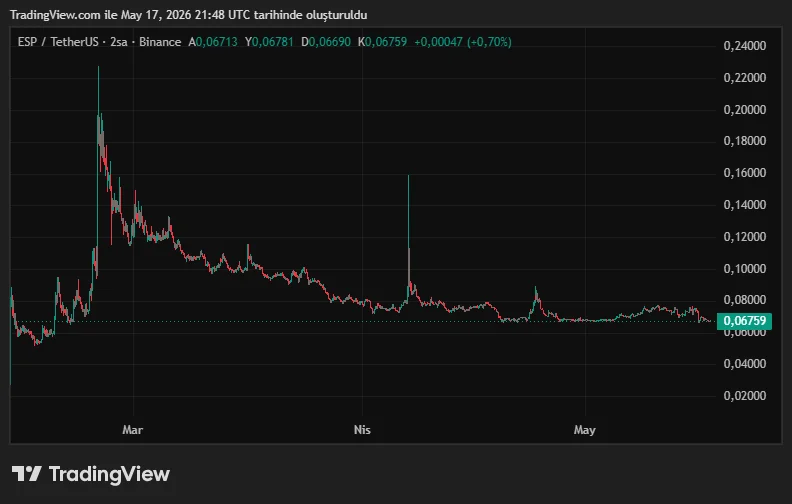
How Does Espresso Work?
To understand how Espresso works, it is necessary to first look at the rollup structure. A rollup executes transactions outside the main chain. These transactions are later secured through mechanisms such as state checkpoints, validity proofs or fraud proofs sent to a Layer 1 network such as Ethereum. In this architecture, Espresso focuses on transaction sequencing and fast confirmation.
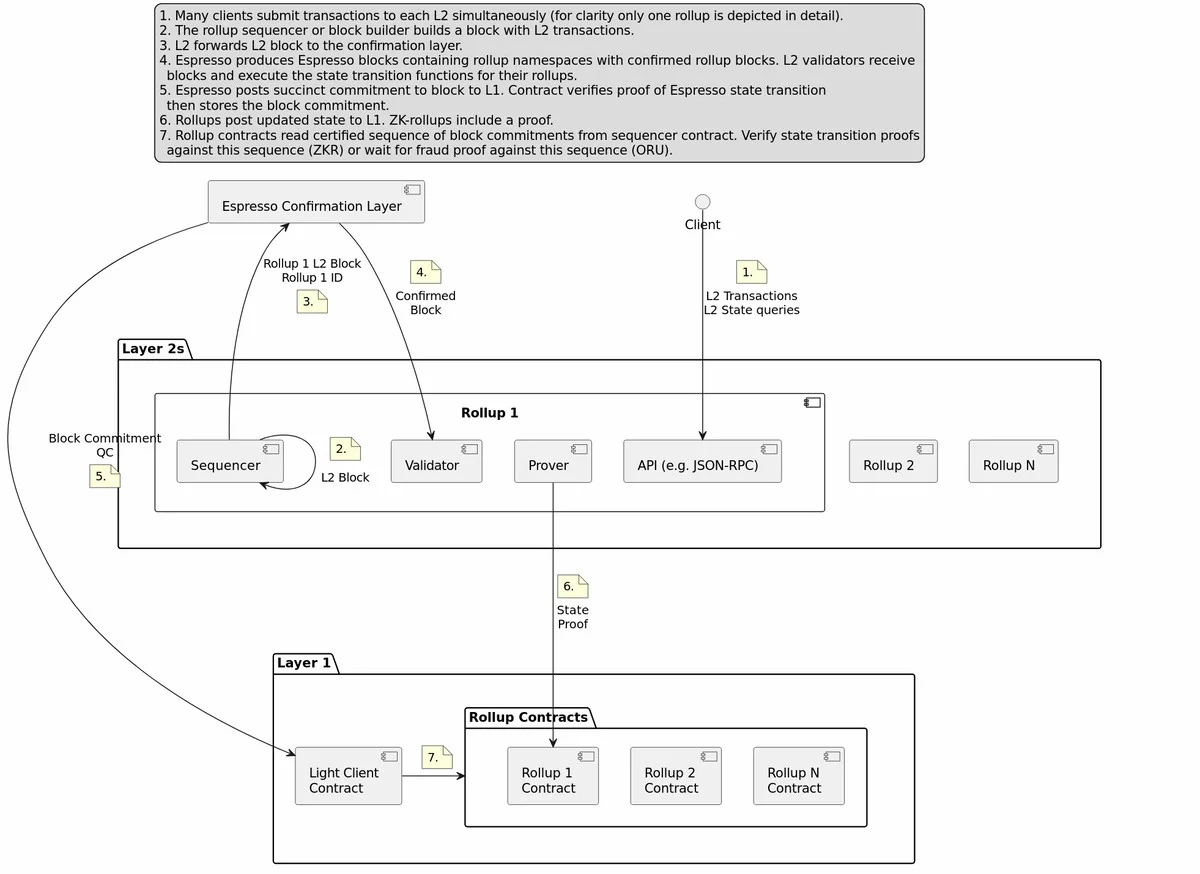
According to official documentation, chains using Espresso interact both with Espresso Network and with the Layer 1 blockchain. Layer 1 works as the main settlement layer where rollups submit their state updates. Espresso, on the other hand, serves as an intermediate layer that provides fast confirmation for rollups.
A simple transaction flow works as follows:
· The user sends the transaction to the relevant rollup’s RPC service or application interface.
· The rollup forwards this transaction to Espresso Network.
· HotShot manages the sequencing and confirmation process of the transaction.
· The transaction is executed by the relevant rollup nodes.
· The block commitment information is sent to the contract on Layer 1.
· The rollup forwards the new state information to Layer 1 and completes the validation process through the required proof mechanism.
Thanks to this structure, Espresso does not only provide fast transaction confirmation for rollups. It also allows different rollups to benefit from the same reliable confirmation layer. This can reduce latency in cross-chain transactions and simplify the user experience.
What Is HotShot?
HotShot is the BFT-based consensus protocol at the center of Espresso Network. The technical side of Espresso’s fast finality and confirmation claim is based on HotShot. This protocol is designed to operate with a large number of participating nodes.
One of HotShot’s key differences is that it does not execute transactions. In other words, HotShot does not run a rollup’s virtual machine or directly calculate user balances. Instead, it focuses on providing the required guarantees for transaction sequencing, confirmation and data availability. Official documentation states that HotShot separates transaction execution from the consensus side, offering a more modular structure.
This separation makes it easier for Espresso to work with different types of rollups. One chain may be EVM-compatible, while another chain may use an application-specific virtual machine. Espresso’s goal is not to change the internal execution logic of each of these chains, but to provide them with a shared and fast confirmation infrastructure.
HotShot is also designed for high scalability. Since participating nodes do not need to directly execute all transaction data, the hardware burden becomes more balanced. This structure aims to support broader validator participation in the future.
What Is EspressoDA?
EspressoDA is the layer associated with data availability in the Espresso ecosystem. In rollup architecture, data availability is a critical component that shows whether transaction data is truly accessible and verifiable. Even if a rollup quickly sequences transactions, its security model weakens if transaction data is not accessible.
In Espresso’s architecture, data availability and transaction execution are handled separately from the consensus mechanism. While HotShot works on fast confirmation and sequencing, EspressoDA is used as a low-cost data availability option. Integrated chains may prefer different data availability solutions; however, Espresso also offers its own DA layer among the default options.
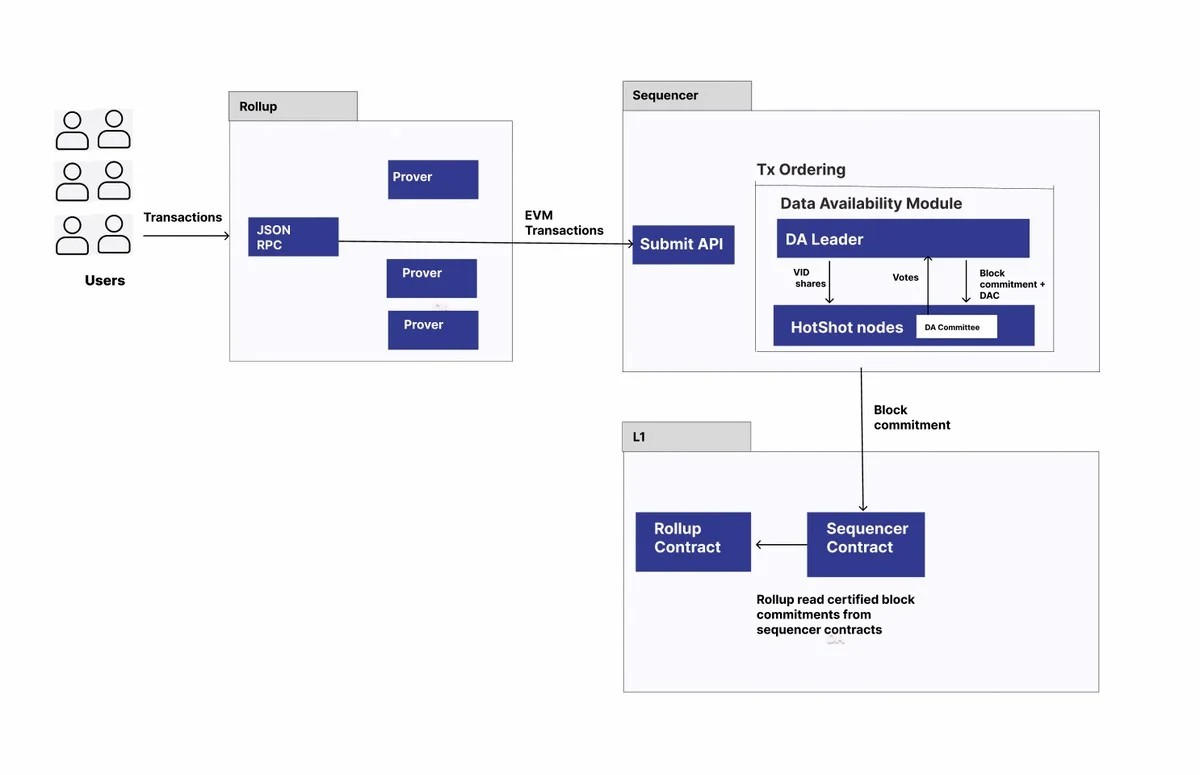
This model is compatible with the modular blockchain approach. Instead of a single network doing everything, different layers take on different tasks. When transaction execution, settlement, consensus and data availability are separated, developers can build more flexible infrastructures according to their own needs.
What Is the ESP Token Used For?
ESP is the native token of Espresso Network and plays a central role in the network’s proof-of-stake structure. The token is an ERC-20 asset issued on Ethereum mainnet. According to the official statement, ESP has two main use cases: proof-of-stake consensus and protocol fees.
The first use case is the staking mechanism. Validators stake ESP to participate in HotShot consensus. ESP holders can also delegate their tokens to validators without having to run their own nodes. This delegation model makes contributing to network security more accessible.
The second use case is protocol fees. Data processing fees within Espresso Network are paid with the ESP token. This structure connects the token to the technical operation of the network. As a result, ESP plays a role not only in governance or community incentives, but also directly in infrastructure usage.
Another important aspect of ESP is its contribution to the decentralization process. With Mainnet 1.0, Espresso aimed to make its validator set more open and move from a fixed operator model to a proof-of-stake model based on economic security. In this transition, ESP staking became central to the network’s security model.
ESP Tokenonomy
ESP’s initial total supply was announced as 3.59 billion tokens. The token does not have a fixed maximum supply. This is due to the dynamic structure of staking rewards. For this reason, ESP supply may change over time depending on network security, staking rewards and protocol mechanisms.
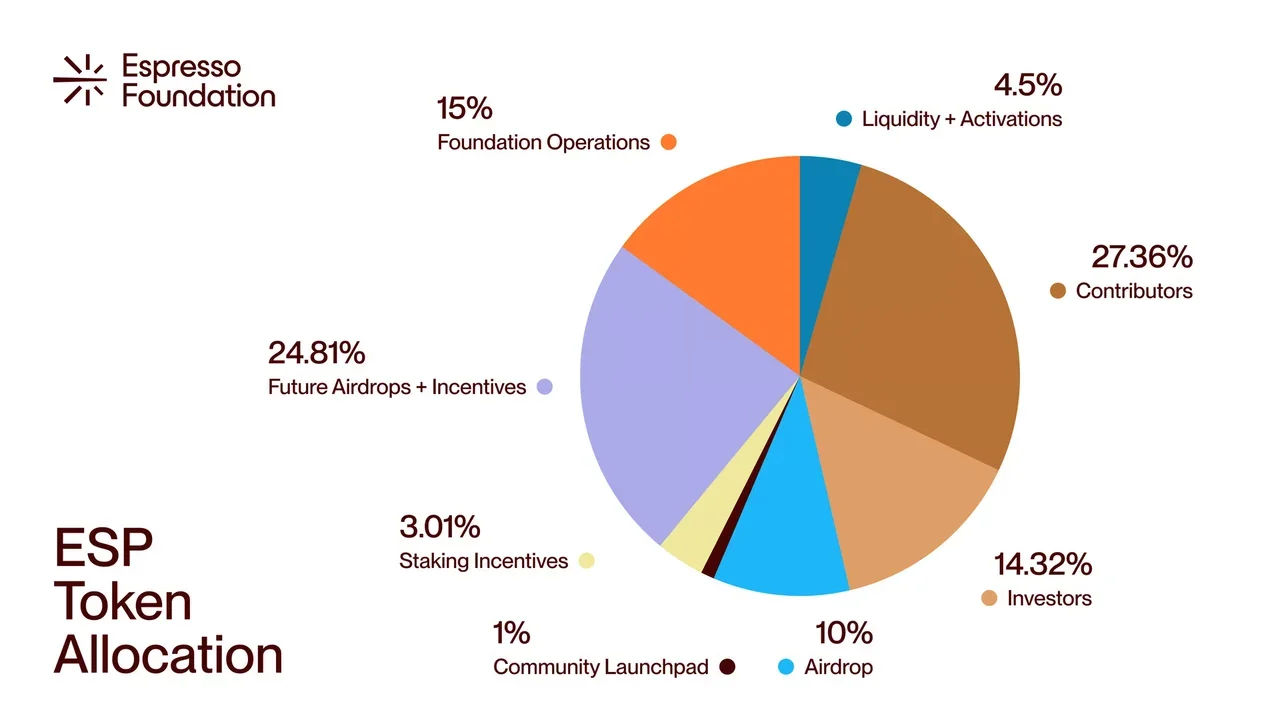
The largest share in the initial supply distribution was allocated to the contributor category. This category includes the teams that contributed to the research and development process of Espresso technology. The contributor share was announced as 27.36 percent. The share allocated to investors stands at 14.32 percent.
In the distribution, 15 percent was allocated to foundation operations, 4.50 percent to liquidity provisioning activities, 3.01 percent to staking bonuses and decentralization efforts, and 1 percent to the community launchpad program.
Espresso Airdrop Process
Espresso Foundation announced a large-scale airdrop program as part of the ESP token launch. According to the statement, more than 1 million addresses were deemed eligible for the airdrop. Eligibility criteria were evaluated across more than 30 activities. In this context, users were assessed not only through surface-level metrics such as transaction count or simple task completion, but also through longer-term participation behavior.
One of the concepts that stood out in the airdrop process was Holder Score. Espresso used this method to analyze users’ past airdrop behavior. The goal was to distinguish addresses that only performed transactions for short-term rewards from users who showed longer-term participation.
The airdrop model was also supported by anti-Sybil checks. In the crypto ecosystem, large airdrop programs often become controversial due to opportunistic participants using multiple wallets. Espresso stated that it adopted a more selective distribution approach at this point.
Another part of the airdrop was staking incentives. ESP holders can contribute to network security by staking their tokens. Additional reward mechanisms were also announced for users who stake for the long term. This structure aims to reduce the immediate sell pressure from token distribution and support longer-term network participation.
How Does Espresso Staking Work?
With the transition to proof-of-stake, Espresso placed the ESP staking model at the center of network security. ESP holders can participate in two ways. The first option is to run a validator node. This path requires technical knowledge, infrastructure management and constant performance monitoring. The second option is to delegate ESP tokens to an existing validator.
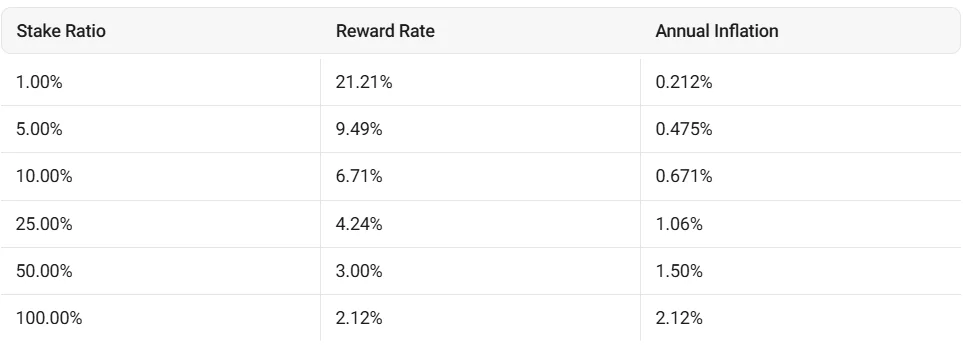
Delegation offers a more practical model for a broader user base. Users can contribute to network security without setting up their own validator infrastructure and can receive a share of the protocol rewards earned by the validator. Validators can also set their own commission rates.
According to Espresso Foundation’s staking guide, the active validator set in HotShot consensus is shaped by stake weight. The top 100 validators with the highest stake are included in the active consensus set. For this reason, staking is not only an individual reward mechanism, but also one of the key elements that define Espresso’s security and decentralization structure.
Performance is also important on the validator side. Operators who want to play an active role in the network need to follow current software versions, operate with a low missed-slot rate and provide stable node performance. Espresso Foundation also announced an initiative called the Validator Bootstrap Program in 2026 to increase validator participation. Under this program, selected operators were planned to receive 1 million ESP in delegation to strengthen their position in the network.
Espresso Ecosystem
Espresso’s value proposition does not come only from its technical architecture. The adoption of the project by rollups, appchains, infrastructure providers and cross-chain applications is also important. In official documentation, Espresso is associated with teams such as Arbitrum, Celo, ApeChain, Morph Chain, Rari Chain and LitVM.
Different integration and contribution examples were also announced under the Espresso Partner Program. In the third quarter of 2025, projects such as ApeChain, t3rn, NodeOps, Huddle01 and Rufus stood out with testnet or mainnet integrations. RARI Chain, AppChain, LogX and Molten Network were among existing integrations. Teams such as Celo and Nethermind were also shown among technical contributors.
In the fourth quarter of 2025, the mainnet integrations of projects such as ApeChain, Huddle01 and Rufus were also highlighted.
One of the most notable use cases for Espresso within this ecosystem is cross-chain experiences. For example, in NFT minting processes, users are expected to carry out transactions across different chains without manual bridging. In such scenarios, fast confirmation becomes a factor that directly affects the user experience.
Is Espresso a Layer 2?
Espresso is not positioned as a classic Layer 2 in the direct sense. It is not a general-purpose rollup like Arbitrum or Optimism. Instead, it works as a confirmation and consensus layer that provides infrastructure for rollups, appchains and different on-chain systems.
This distinction matters. A Layer 2 executes user transactions and manages its own state structure. Espresso, on the other hand, supports integrated chains in transaction sequencing, fast confirmation and data availability. For this reason, it is more accurate to define Espresso as an “infrastructure layer for rollups” or a “Global Confirmation Layer.”
Espresso’s position is compatible with the modular blockchain approach. In modular architecture, each layer takes on a different role. One layer handles transaction execution, another provides settlement and another offers data availability. In this structure, Espresso aims to strengthen the consensus and confirmation side.
Espresso and Its Relationship With the Rollup Ecosystem
The growth of the rollup ecosystem is very important for Ethereum scaling. However, the separate development of many rollups can create a fragmented experience for users and developers. Moving assets between different networks, managing liquidity, switching between applications and waiting for transaction finality can still be complex.
Espresso aims to improve this experience by helping rollups operate in a more coordinated way. Confirmation provided by HotShot is especially important for bridge transactions. As stated in official documentation, while waiting for finality on Ethereum can take much longer in certain cases, the HotShot confirmation process can operate within a timeframe of a few seconds.
This approach also becomes meaningful on the DeFi side. Reliable and fast cross-chain state information is needed for liquidity pools, order books or applications on different rollups to work more compatibly. Espresso aims to provide developers with lower-latency infrastructure in this area.
Espresso’s use cases are not limited to rollup infrastructure. The project aims to offer custom chain infrastructure for different teams building on-chain systems. Official documentation mentions areas such as stablecoins, tokenized assets, exchanges, payment systems and application-specific deployments.
For stablecoin projects, fast and reliable confirmation is important for the payment experience. On the tokenized assets side, transaction finality and cross-chain compatibility stand out in institutional use cases. In gaming, NFT and social applications, users also need to avoid complex bridging processes when moving between chains.
In these areas, Espresso gives developers the ability to design their own chains more flexibly. Teams can build infrastructure that suits their own needs instead of shaping their products around the limitations of existing general-purpose networks. The confirmation layer offered by Espresso also contributes to making this infrastructure more connected.
Frequently Asked Questions (FAQ)
The questions around Espresso generally focus on whether the project is a Layer 2, what the ESP token is used for and what role HotShot consensus plays in the rollup ecosystem. The following questions were prepared to make Espresso Network’s core structure, ESP token economy and staking process easier to understand:
- What is Espresso (ESP)?: Espresso is a blockchain infrastructure that offers fast confirmation, shared sequencing and proof-of-stake security for rollups and application-specific chains. ESP is the native token used for staking, delegation and protocol fees on this network.
- What is the ESP token used for?: The ESP token is used in Espresso Network’s proof-of-stake consensus. Validators stake ESP to participate in HotShot consensus. Users can also delegate their tokens to validators. In addition, data processing fees within Espresso are paid with ESP.
- Is Espresso a Layer 2?: Espresso is not a Layer 2 in the classic sense. It does not operate as a general-purpose rollup that directly executes transactions like Arbitrum or Optimism. Instead, it provides fast confirmation and consensus infrastructure for rollups and appchains.
- What is HotShot?: HotShot is Espresso Network’s BFT-based proof-of-stake consensus protocol. Instead of executing transactions, it provides integrated chains with fast confirmation and reliable transaction sequencing support.
- What is EspressoDA?: EspressoDA is the solution used for data availability in the Espresso ecosystem. Data availability is important for keeping rollup transactions verifiable and accessible. EspressoDA aims to support this process with a low-cost and modular structure.
- What is the total supply of the ESP token?: ESP’s initial total supply was announced as 3.59 billion tokens. However, the token does not have a fixed maximum supply. This is because staking rewards operate dynamically.
- How does ESP staking work?: ESP holders can contribute to network security by staking their tokens. Users with technical infrastructure can run a validator node. Users who want a simpler way to participate can delegate their ESP tokens to existing validators.
- Which projects does Espresso work with?: The Espresso ecosystem includes various integration and contribution examples such as ApeChain, RARI Chain, Celo, Morph Chain, LitVM, t3rn, NodeOps, Huddle01 and Rufus. These projects have taken part in the Espresso ecosystem through testnet, mainnet or technical contribution processes at different periods.
If you want to follow new infrastructure projects, token economies and the technical foundations of blockchain more closely, you can continue exploring JrKripto guides

