
For blockchain developers, the hardest part is often not finding a new idea. It is making that idea work across different networks and smart contracts. Enso aims to bring a process that normally requires hundreds of separate integrations into a single execution layer. The ENSO token supports network security, validation, delegation and governance.
Enso’s Definition and Origins
Enso is an execution network designed to help developers create transactions across different blockchains, protocols and smart contracts. The project describes itself as a unified network that connects the fragmented blockchain landscape.
ENSO is the native crypto asset of this network. It plays a role in validation, staking, delegation and governance within Enso Network. According to the official documentation, ENSO also supports the network’s operation and economic security.
Enso’s core approach allows developers to specify the result they want instead of coding every step of a transaction separately. These outcome-based requests are known as “intents” in the crypto industry.
For example, a developer may want to move USDC from Ethereum to Base and deposit it into a specific yield vault. Under the traditional model, the bridge, swap and vault contracts would need to be integrated separately.
Enso breaks this request into the necessary transaction steps. It then brings together the required protocols, execution route and smart contract calls.
This infrastructure is not limited to token swaps carried out by individual users. Wallets, decentralized finance applications, asset management platforms, fintech companies and AI agents can also use Enso’s infrastructure.
Which networks does Enso support?
Enso Network was designed as a Tendermint-based Layer 1 network. The project’s technical paper states that the network brings smart contract interactions from different blockchains into a shared state map.
It is important to distinguish Enso Network from the networks on which the ENSO token is available. ENSO has an ERC-20 contract on Ethereum and a separate contract on BNB Smart Chain. The official documentation publishes both contract addresses.
Enso’s product infrastructure is not limited to a single network. Its Route API can create transaction paths between tokens and decentralized finance positions across different chains.
The system supports actions such as token swaps, bridging, vault deposits, closing positions and moving assets between protocols. For cross-chain transactions, the target network is included in the request, while Enso selects the relevant bridge and execution route.
The project’s early technical roadmap focused mainly on EVM-compatible networks. Its whitepaper also listed broader support for the Solana Virtual Machine and Move Virtual Machine among its longer-term objectives.
These targets should not be interpreted as features that became available at the same time or reached the same level of maturity. Supported chains, protocols and transaction types may change as Enso updates its APIs and products.
Why was Enso created?
The main problem Enso aims to address is blockchain fragmentation. Each network uses its own state data, smart contracts and technical standards.
Even when a protocol operates on several chains, every deployment may require a separate integration. Developers need to track contract addresses, functions, transaction inputs, outputs and security requirements one by one.
This process extends development timelines. It also increases maintenance, auditing and security costs.
Enso stores different contract interactions within a shared map. It classifies actions such as swapping, borrowing, lending, depositing, repaying, transferring and approving under standardized action types.
Developers can then communicate the outcome they want through an intent request. Enso calculates a route capable of producing that result and generates transaction data that is ready to be signed.
This reduces the need to build a new adapter for every protocol. Much of Enso’s value proposition is based on easing this integration burden.
Enso’s History: Important Milestones
Enso’s history dates back to 2021. During its early period, the project operated under the name Enso Finance and worked on a decentralized finance product focused on social trading and asset management.
Swiss startup reports state that Enso Finance was founded in February 2021 by Connor Howe and Gorazd Ocvirk. That same year, the project completed a $5 million private funding round co-led by Polychain Capital and the Dfinity Beacon Fund.
When the project’s first product failed to attract the expected level of interest, the team shifted its attention toward the infrastructure problems it had encountered during development. According to Enso’s official account, the team lost considerable time to manual integrations, smart contract audits and ongoing maintenance.
This led to the creation of infrastructure components called Actions and Shortcuts. These tools were initially developed for the team’s internal needs, but they later became a service that other developers could use.
Enso’s current official announcements identify Connor Howe as CEO and co-founder. A technical paper published in July 2024 lists Connor Howe, Peter Phillips and Milos Costantini as its authors.
The official website does not provide a detailed list covering every current team member and founder. For this reason, unverified titles associated with the original Enso Finance team and the later Enso Network structure should be treated carefully.
In June 2024, Enso raised more than $4.2 million in additional funding. The round included IDEO Ventures, Hypersphere Ventures and more than 60 angel investors from various Web3 projects.
The announcement stated that the funding would support product development and work on the Tendermint-based network.
The project’s backers include Polychain Capital, Multicoin Capital, Cyber Fund, Spartan, IDEO CoLab Ventures, Hypersphere Ventures and several other crypto investment firms. Enso’s official website lists these organizations among its investors.
The ENSO token launch and exchange listings
The ENSO community sale took place on CoinList in June 2025. A total of 4 million ENSO, equal to 4% of the initial supply, was allocated to the sale.
The sale price was set at $1.25 per token. This corresponded to a fully diluted valuation of $125 million.
According to CoinList, tokens purchased during the sale were fully unlocked at the Token Generation Event. The community allocation did not include a long-term lockup or linear vesting schedule.
ENSO’s Token Generation Event took place on October 14, 2025. Binance Research reported that the token launched with an initial supply of 100 million ENSO and an initial circulating supply of 20.59 million.
On the same date, Binance included ENSO in its HODLer Airdrops program. The first trading pairs on Binance included ENSO/USDT, ENSO/USDC, ENSO/BNB, ENSO/FDUSD and ENSO/TRY.
ENSO was later listed on additional centralized cryptocurrency exchanges. These listings increased accessibility while also contributing to high price volatility during the token’s early trading period.
An exchange listing does not prove a project’s technical success on its own. Trading volume, circulating supply, upcoming token unlocks and broader market conditions can all affect the ENSO price.
Major developments and current status
Enso already had an operational Shortcuts infrastructure before the token launch. In an April 2025 update, the project stated that this system had routed more than $15 billion in transaction volume across over 10 blockchain ecosystems.
Berachain’s Boyco liquidity program became one of Enso’s most prominent use cases. According to figures published by Enso, the Shortcuts infrastructure supported protocol-level transactions involving more than $3.1 billion in assets moving from Ethereum to Berachain.
Enso did not directly provide the bridge in this process. LayerZero and Stargate handled the cross-chain transfer, while Enso created the steps required to route and deposit assets into the target protocols.
The first live phase of Enso Network began with validators in October 2025. Validators came online, ENSO staking opened and transaction data began to be verified through simulation.
The project plans to expand other participant roles, including Graphers and Action Providers, in later stages. Official statements therefore describe the network’s development as a gradual decentralization process.
Enso’s activities in 2026 extended beyond decentralized finance transactions. In June 2026, the team introduced the Enso RWA App, which provides access to tokenized stocks, funds, bonds, commodities and stablecoins.
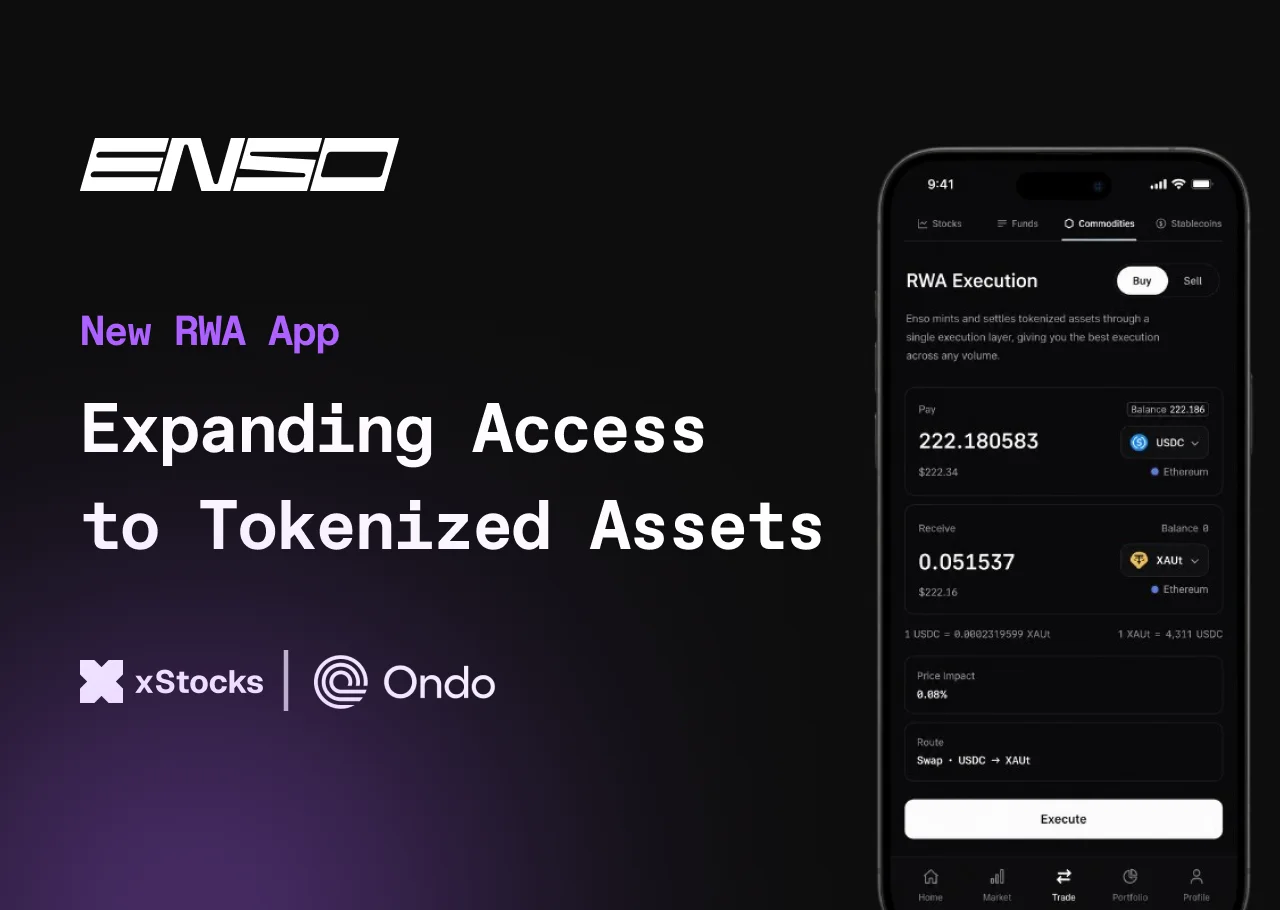
The application launched with xStocks and Ondo integrations. Access to specific assets varies according to the user’s location and the rules imposed by the relevant issuer.
During the same period, Bitget Wallet integrated Enso’s execution infrastructure. The project also expanded its support for the MegaETH ecosystem and continued developing its Quoter product for more reliable transaction simulations.
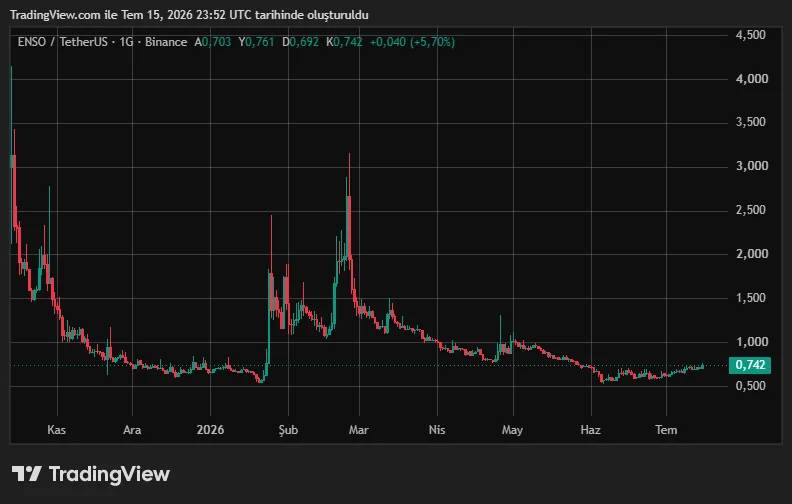
As of July 2026, the ENSO coin price was around $0.74.
How Does the ENSO Token Work?
The first major use case for ENSO is network security. Enso validators lock ENSO to verify transaction data produced by the system.
Validators simulate the calldata generated in response to a request. This process checks whether the transaction can be executed on the target chain and whether it can produce the expected result.
Staking acts as economic collateral within this system. If a validator approves incorrect or malicious transaction data, part of its staked assets may be slashed.
ENSO can also be used for delegation. Token holders who do not want to operate their own validator infrastructure can delegate ENSO to a validator.
Delegators may receive a share of the validator’s verification revenue. Returns can vary depending on validator performance, commission rates, network revenue and current staking conditions.
Governance is another use case for the token. Users who lock ENSO can vote through the Enso DAO on proposals concerning future versions of protocol contracts and the development of the network.
The official token economics page states that staking solely for governance voting does not provide a separate reward. Proposals must also meet the required participation threshold before they can pass.
The whitepaper describes ENSO as the gas asset for network requests and state changes. It also proposes that Graphers, Action Providers and validators stake ENSO to participate in the network.
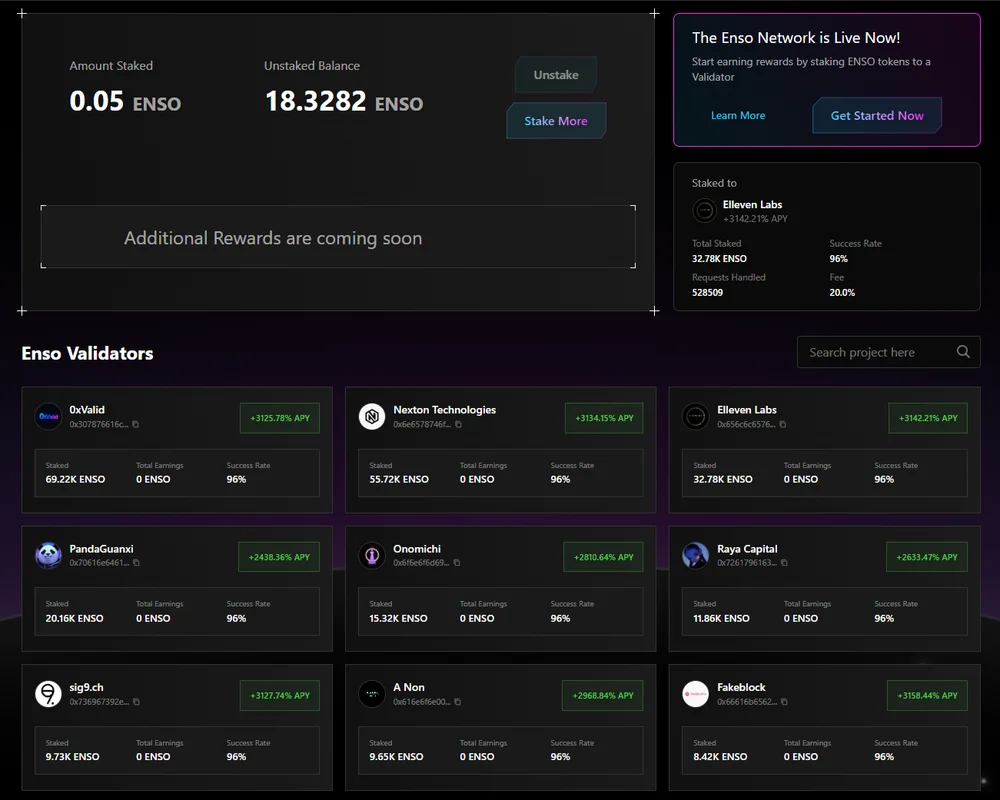
Because all participant roles have not launched at the same stage, these use cases may have different levels of maturity. Validator staking currently stands out as the network’s first active economic role.
ENSO supply and token economics
ENSO launched with a genesis supply of 100 million tokens. However, this figure does not represent the project’s maximum supply.
Enso uses an inflation mechanism to reward validators. Annual inflation begins at 8% and gradually declines each month.
According to the official model, annual inflation falls to 0.35468% in the tenth year. New token issuance then ends, bringing the maximum supply to 127,339,703 ENSO.
This explains why some data platforms show different figures for total supply and maximum supply. The initial supply of 100 million increases over time through validator emissions.
Investors received 31.305% of the initial supply. The team allocation was set at 25%, while the ecosystem allocation, including the airdrop, accounted for 21.59%.
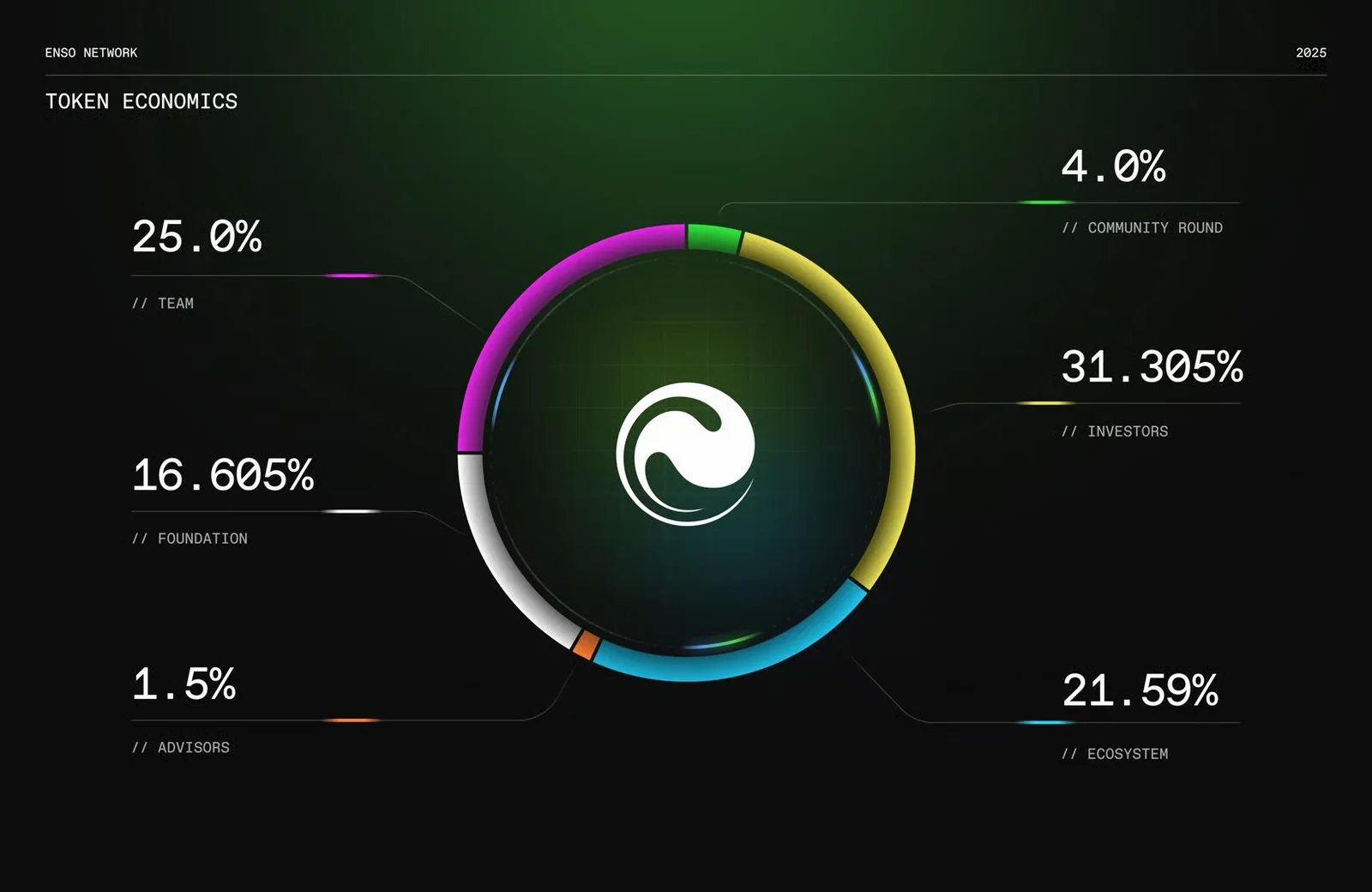
The Enso Foundation received 16.605% of the supply. The CoinList community round was allocated 4%, while two advisers received a combined allocation of 1.5%.
Investor, team and adviser tokens were subject to a one-year cliff. After the first year, these assets begin unlocking linearly on a block-by-block basis over 24 months.
Given that ENSO launched in October 2025, the first major vesting period for these groups may begin around October 2026. Investors should consult the official unlock schedule for exact amounts and dates.
This structure matters when assessing potential supply pressure. If the circulating supply rises while demand fails to grow at the same pace, newly unlocked tokens may create selling pressure.
However, an unlock does not automatically mean that every token will be sold. The team, investors or ecosystem funds may hold, stake or use the unlocked assets for operational purposes.
Staking, validation and network security
Enso’s security model is based on simulating transactions before users sign them. Validators check whether solutions submitted by Graphers or other infrastructure components can operate as intended.
During validation, the current state of the target chain is replicated. The transaction data is executed in this environment, allowing expected balance changes and contract results to be reviewed.
Enso’s technical design allows several solutions to be generated for a single user request. Participants called Graphers combine actions from the shared network map to create alternative transaction routes.
Validators simulate these solutions. The whitepaper describes a system that aims to select a valid solution offering a higher output at a lower execution cost.
Action Providers are developers who add smart contract abstractions to the system. They create modules defining how actions such as swaps, lending and staking should be called.
Action Providers may receive a share of network revenue when their contributions are used. Graphers can also earn fees when the routes they generate are selected.
However, validators were the primary participant role during Enso’s first live network phase. A fully permissionless structure for other participant roles remains part of the project’s later roadmap.
This distinction is important when evaluating the network’s security. Enso’s operational API products and its planned fully decentralized network may not yet be at the same level of maturity.
Enso also offers a separate simulation and verification service called Quoter. It can simulate EVM transactions created outside Enso without modifying them, producing estimated outputs, gas usage and verification results.
Simulation does not eliminate smart contract risk. The state of the blockchain may change between signing and execution, an integrated protocol may be exploited or bridge infrastructure may experience technical problems.
Why Is Enso Important?
The same transaction can require different contracts and tools across separate blockchain networks. This fragmentation may turn a process that appears to require only a few clicks into months of development work behind the scenes.
Enso aims to shorten this process through shared transaction components. Its Route API automatically calculates a suitable path between an initial asset and a target asset or DeFi position.
A simple swap may involve only one action. A more complex transaction may combine bridging, token conversion, approvals and a vault deposit.
Where possible, Enso combines same-chain actions into a single atomic transaction bundle. Cross-chain steps require asynchronous tracking between the source and destination networks.
This approach may allow developers to access more protocols with fewer custom integrations. It can also make it faster to expand a product to new networks and assets.
Enso’s contribution to liquidity comes from its ability to route assets from different chains into specific applications. Even when a user does not hold the correct token on the target network, Enso may create a suitable cross-chain route.
The Berachain Boyco program demonstrated this use case by moving liquidity from different networks into a new ecosystem. Enso prepared the transactions required to deposit assets into target DeFi protocols after they crossed the bridge.
Integrations, community and governance
Enso’s ecosystem includes projects such as CoW Swap, Royco, Velvet, Glider, Wayfinder and Stargate. The official website also states that the network has more than 95 integrations or customers.
Royco used Enso for multi-step DeFi transactions during the Boyco program. Benqi integrated Enso’s routing infrastructure to provide access from different networks to lending products on Avalanche through a single transaction flow.
Contango used Enso to add new asset pairs with a lower integration burden. According to the project’s case study, the platform gained access to more than 300 trading pairs through this infrastructure.
These examples show that Enso is positioned mainly as a background infrastructure provider rather than a direct consumer-facing brand. Users may interact with Enso technology through a wallet or DeFi application without realizing it.
The community also matters for the ENSO token’s distribution and the future of governance. The CoinList round made 4% of the total supply available to individual participants.
Under the governance model, users who lock ENSO can vote on protocol proposals. However, meaningful decentralization depends on more than allowing token holders to vote.
Token distribution, voter participation and the combined share controlled by investors and the team also influence how widely governance power is distributed. The large allocation assigned to investors and the team remains an important factor to monitor.
Who Founded and Developed Enso?
Enso’s foundations were laid in 2021 by Connor Howe and Gorazd Ocvirk. Connor Howe currently stands out as the project’s co-founder and CEO. The team gradually transformed the product, which began as Enso Finance, into Enso Network, an execution and integration infrastructure for multichain applications. Technical contributors such as Peter Phillips and Milos Costantini have also supported the project’s development at different stages.
Frequently Asked Questions
Below are answers to some of the most frequently asked questions about Enso.
- What is Enso and when was it launched?: Enso is an execution network that makes it easier to create transactions across different blockchains and smart contracts. The project’s first company and product development efforts began under the name Enso Finance in 2021. The intent-based technical architecture behind Enso Network was developed in the following years. The ENSO token and the network’s first validator phase launched on October 14, 2025.
- What is the ENSO token used for?: ENSO is used for validator staking, delegation, network security and governance. Its technical design also proposes using the token as gas for network requests and state changes. Graphers and Action Providers are also expected to stake ENSO as additional network roles become available. The maturity of these roles may vary according to the network’s development stage.
- Which network does Enso operate on?: Enso Network was designed as a Tendermint-based Layer 1 blockchain. It maps smart contract actions from different blockchains within a shared state structure. The ENSO token has contracts on Ethereum and BNB Smart Chain. Enso’s Route and Bundle infrastructure can also work with several EVM networks and DeFi protocols.
- Who founded Enso?: Enso’s current official announcements identify Connor Howe as CEO and co-founder. Reports published in 2021 state that Enso Finance was founded by Connor Howe and Gorazd Ocvirk. Connor Howe, Peter Phillips and Milos Costantini are listed as the authors of Enso’s July 2024 technical paper. Since the official website does not provide a detailed list of every current founder and team member, titles from different periods should be distinguished carefully.
- What is the ENSO supply?: ENSO launched with a genesis supply of 100 million tokens. The total supply increases over time through validator emissions.
- Inflation is expected to end after the tenth year, bringing the maximum supply to 127,339,703 ENSO. At the time this guide was prepared, the circulating supply was approximately 20.59 million tokens.
- How can ENSO be staked?: ENSO can be delegated to network validators or locked as validator collateral by participants who meet the technical requirements. Users should check Enso’s official staking interface and supported wallets before completing any transaction. Staking may involve lockup periods, validator commissions and slashing risk. Users should consider validator performance and technical history rather than focusing only on the offered return.
For the latest information about Enso and emerging projects across the crypto ecosystem, follow the JR Crypto Guide series.

