
Being able to use the crypto you have set aside for staking in another DeFi application at the same time changes how you put your capital to work. Capricorn combines a liquid staking service that offers this flexibility on Monad with liquidity pools and infrastructure for coordinating order flow. To understand the project, formerly known as aPriori, it helps to distinguish three components: APR, its ecosystem token; aprMON, which represents staked MON; and Capricorn Exchange, which provides trading liquidity.
What Capricorn Is and How It Started
Capricorn is a DeFi project developing liquid staking and decentralized trading infrastructure. Previously operating as aPriori, the team announced on July 29, 2026, that it was bringing its products under the Capricorn brand following its acquisition of CapricornDEX. The APR ticker remained unchanged.
This history explains the different names readers may encounter when researching the project. Older funding announcements use aPriori, while current technical documentation appears under Capricorn Tech; references to aPriori in earlier documents therefore point to a previous stage of the same project.
On the product side, the rebrand brings staking and exchange services together within a shared structure. The capital base formed by users’ staked assets connects with liquidity that can be used in DeFi transactions.
The Project’s Purpose and Its Relationship with Monad
Capricorn starts from a practical problem: even on a fast blockchain, users can face expensive or inefficient trades. A transaction may settle within seconds while the gap between buying and selling prices remains wide; limited pool liquidity can also increase costs as trade sizes grow.
The team approaches this problem by considering validators, liquidity providers, and traders together. Its official introduction identifies Capricorn Exchange and aprMON as the two main products within this structure.
Monad is the project’s primary development focus. The team sees high throughput and low latency as conditions that can support more sophisticated on-chain market-making systems, so it aims to grow its products within the Monad ecosystem first.
The relationship matters: Monad is the underlying blockchain, while Capricorn develops services on top of it.
Founding Team and Investors
The project’s 2025 funding announcement identifies Ray Song as its founder. Investor Pantera Capital’s team overview lists Ray as CEO and Olivia as CTO.
According to Pantera, Ray worked on special projects at Jump Crypto and gained high-frequency trading experience at Flow Traders. Olivia previously served as a senior software engineer at Coinbase, working on distributed systems and infrastructure requiring high availability.
That experience is reflected in Capricorn’s product choices. The team focuses on questions such as which pool should receive an order, how quickly prices should update, and which trades could expose liquidity providers to losses.
Investors include Pantera Capital, Arrington Capital, and HashKey Capital.
Capricorn’s History and Key Milestones
In 2024, aPriori publicly shared its work on MEV and liquid staking infrastructure for Monad. The team’s research published on July 1, 2024, examined transaction-ordering models across different blockchains and how they could be adapted to Monad.
On July 25, 2024, the project announced an $8 million seed round led by Pantera Capital. Including an earlier round led by Arrington Capital, total funding reached $10 million.
At the time, the team said it would use the new capital to expand its workforce, support security work, and grow its community. Its development agenda included staking and transaction-ordering systems tailored to Monad’s architecture.
A $20 million strategic round announced on August 28, 2025, brought total funding to $30 million. Participants included HashKey Capital, Pantera Capital, Primitive Ventures, and IMC Trading.
The APR Token Launch
The team introduced APR in an official post dated October 22, 2025. The initial distribution targeted groups including community members, early aprMON users, and participants who contributed to the project’s data initiatives.
According to Binance’s announcement, APR began trading on Binance Alpha on October 23, 2025. The APRUSDT perpetual futures contract launched on the same day.
These two products work differently. Buying and selling tokens through Alpha and opening a position on price movements in the futures market involve different assets and risks.
A Binance announcement published under the Capricorn name on August 14, 2026, described a two-round Alpha trading competition. That date should therefore not be treated as APR’s initial launch date or its first day of trading on Binance Alpha.
Capricorn Exchange and Ecosystem Development
One significant step in the project’s trading infrastructure was Swapr, introduced on July 26, 2025. The team described this DEX aggregator as a system that evaluates transaction characteristics and routes trades to suitable liquidity sources.
Swapr’s design considers trade size, the wallet or interface used, historical trading behavior, and market conditions. The aim is to distinguish the risks facing liquidity providers more effectively and offer tighter spreads for suitable trades.
A follow-up article published on August 6, 2025, explained the role of community data in this process. The team said it planned to use relationships between wallets and transaction patterns to train its models, giving community participation a role in technical development.
The move to the Capricorn brand followed these developments. Current product documentation emphasizes liquid staking and exchange pools, while the earlier Swapr articles help explain the team’s focus on order flow.
How Does Capricorn Work, and What Is It Used For?
Liquid staking represents a user’s economic claim on staked assets through a token that can be used in other transactions. This allows users to maintain a staking position while participating in supported DeFi applications.
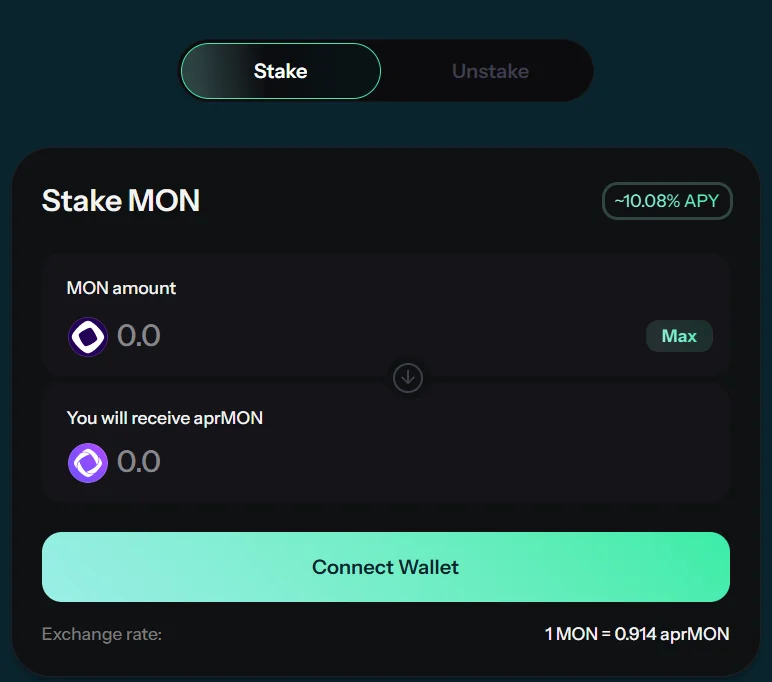
On Capricorn, users deposit MON and receive aprMON in return. The protocol distributes deposited MON across selected validators; aprMON represents the user’s share of the staking vault and their claim on accumulated rewards.
aprMON does not distribute rewards by increasing the number of tokens in a user’s wallet. As rewards accumulate, the amount of MON represented by each aprMON increases, while the user’s aprMON balance can remain unchanged.
For a simplified example, assume a user holds 100 aprMON. If those tokens initially represent 100 MON and later represent 103 MON after rewards accumulate, the user still sees 100 aprMON in their wallet; the 3% increase in this example only illustrates the mechanism and does not indicate an actual yield.
This change in MON value does not guarantee a profit in dollar terms. If MON’s market price falls, the position’s dollar value can decline even while staking rewards accumulate; aprMON’s exchange price may also differ from its theoretical value in the vault.
Exiting the position involves a separate step. According to the developer documentation, users first submit a withdrawal request and receive MON once it becomes claimable; although the documentation generally anticipates a 12–18-hour wait, users should check the application’s current conditions before transacting.
Trading Through Capricorn Exchange
Capricorn Exchange provides liquidity through two different pool models. Proactive AMM, or PAMM, pools update their pricing using oracle price feeds; Capricorn CL pools allow liquidity to be concentrated within specific price ranges.
An oracle is a data source that brings external price information into an on-chain application. The PAMM model uses this information to bring buy and sell quotes closer to prevailing market conditions.
In a CL pool, liquidity providers choose the price range within which their capital will be active. When the market moves outside that range, the position stops earning a share of trading fees and can become entirely composed of one token in the pair.
For example, choosing a narrow range can concentrate the use of capital while the price stays within it. If the price moves away from that range, the user may need to monitor and adjust the position; providing liquidity therefore requires different oversight from simply holding tokens in a wallet.
According to the official documentation, CL positions are represented by NFTs, and trading fees do not automatically compound into the position. Users can claim accumulated fees separately.
There is also an important detail about access: the reviewed trading documentation states that Capricorn Exchange does not provide its own swap interface and that its pools can be accessed through DEX aggregators on Monad. A user can therefore submit a trade through another application while using Capricorn liquidity behind the scenes.
MEV Revenue, Use Cases, and Risks
MEV describes the additional economic value that can arise from including and ordering transactions within blocks. Arbitrage trades that exploit price differences and attempts to move ahead of particular transactions are different examples within this area.
Capricorn aims to connect MEV revenue with its staking system and make transaction flow more orderly. Success depends on the infrastructure, validators, and actual market activity; a fixed additional return cannot be assumed for every period.
Classifying order flow is another part of this approach. According to the project, its models try to distinguish trade types using historical transactions and price movements; these assessments are probabilistic and do not guarantee a perfect result for every trade.
The technical documentation also discloses a detail relevant to security assessments. The PAMM pool contract is open-source and immutable, while its pricing engine is closed-source; an administrator can change the engine’s address subject to specific version-control conditions.
This distinction shows why a review should extend beyond the pool contract alone. The reliability of price data, administrator permissions, and other DeFi applications used alongside the protocol also affect a user’s exposure to risk.
Using aprMON as collateral in a lending application is one example. Even if the application supports it, collateral requirements and liquidation conditions still apply; earning staking rewards does not prevent a borrowing position from being liquidated.
The APR Token and Its Tokenomics
APR is Capricorn’s ecosystem token. Its official introduction connects the token with community participation, incentives, and coordination within the network.
Buying APR and staking MON to receive aprMON create different economic positions. APR investors are exposed to the token’s market price, while aprMON users hold an asset representing their share of MON in the staking vault.
Growth in Capricorn’s trading volume therefore does not automatically generate direct income for APR holders. Such a connection requires clearly defined revenue-sharing mechanisms, eligibility conditions, and supporting contracts.
The reviewed token introduction does not confirm that all APR holders receive regular exchange fees or MEV revenue. An incentive budget should not be interpreted as an unconditional payment to everyone holding the token in a wallet.
Token Supply, Allocation, and Unlocks
The official documentation states a total supply of 1 billion APR. The following table shows the initial allocation described in that document; it does not show the current circulating supply or present-day wallet ownership.
| Allocation category | Share | APR amount |
Early backers | 16% | 160 million |
Core contributors | 16% | 160 million |
Foundation | 16% | 160 million |
Genesis airdrop | 12% | 120 million |
Community incentives | 22% | 220 million |
Ecosystem growth | 17% | 170 million |
Liquidity and market stability | 1% | 10 million |
The initial plan set a three-year schedule with a one-year cliff for the investor allocation. For core contributors, it specified a four-year schedule with a one-year cliff.
An allocation table alone does not reveal how many tokens will be sold in the future. An unlock makes tokens available for use; it does not establish that recipients will sell all of them or none of them.
For the same reason, calculating current unlock amounts from the initial schedule can be misleading without checking subsequent changes. An assessment of current supply requires reviewing new official announcements alongside on-chain movements.
APR Price History and Factors Affecting Its Price
One verifiable starting point in APR’s trading history is its Binance Alpha launch on October 23, 2025. A listing announcement alone, however, does not establish the token’s first trading price or its all-time high.
Price-history analysis should also include data recorded under the former aPriori name. Treating the rebrand as a new token launch could exclude earlier chart data and lead to inaccurate return calculations.
Potential supply entering circulation, buyer demand, and market depth all matter when assessing APR’s price. A price available for a small order does not establish that an order of a different size will execute at the same level.
For example, if a small token purchase pushes the price up significantly, the displayed market capitalization can rise without an equivalent amount of money entering the market. Market capitalization is calculated by multiplying circulating supply by the latest price; it does not represent the amount of cash holders could collectively withdraw.
To assess product usage, readers can track staked MON, pool depth, trading volume, and user behavior after incentives end. These measures help explain demand for the products, while the sources of demand for APR require separate analysis.
Leverage in futures markets can also amplify short-term movements. When product announcements, changes in token supply, and speculative trading coincide, attributing a price move to a single cause does not provide a sound assessment.
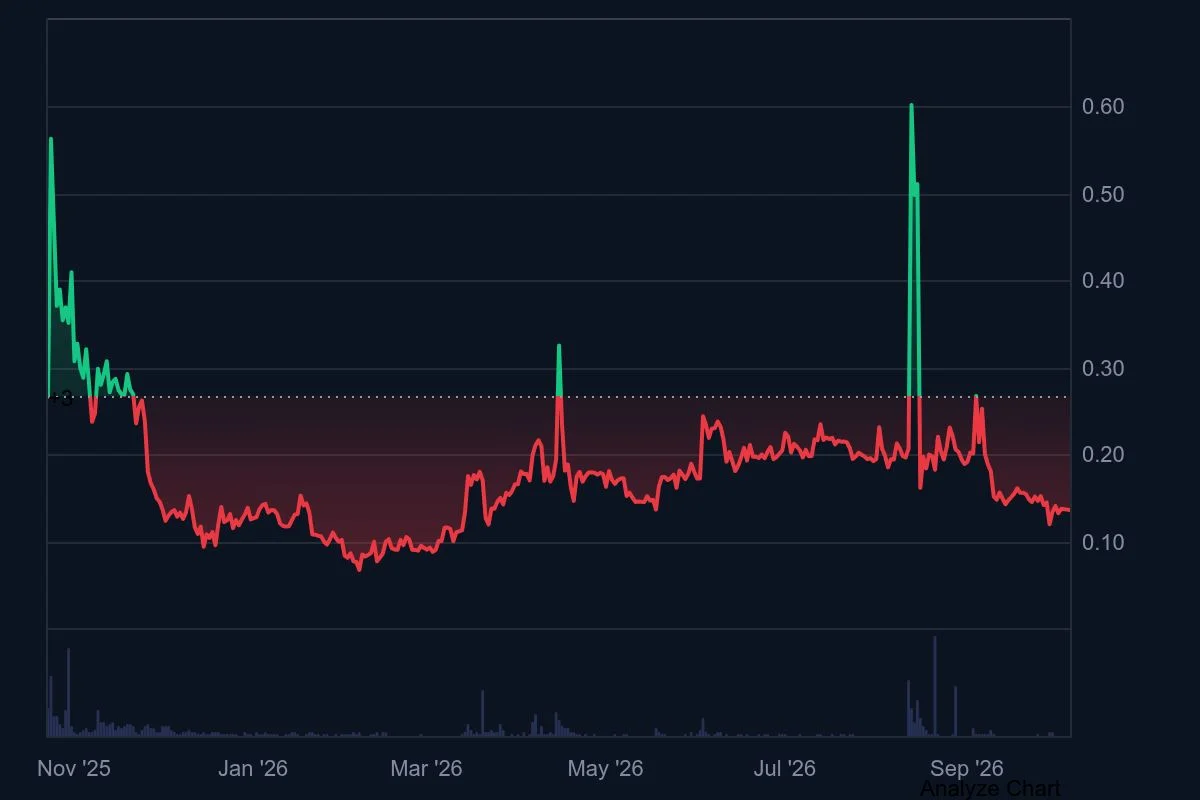
As of October 2026, APR coin price is around $0.13.
Frequently Asked Questions (FAQ)
Below are answers to some frequently asked questions about Capricorn:
- What is Capricorn, and how is it connected to aPriori?: Capricorn is the continuation of aPriori, focusing on liquid staking and decentralized exchange infrastructure. The team announced its new brand on July 29, 2026, following the acquisition of CapricornDEX.
- Who developed Capricorn?: The project’s official funding announcement identifies Ray Song as its founder. Pantera Capital’s team overview lists Ray as CEO and Olivia as CTO.
- What is the difference between APR and aprMON?: APR is the ecosystem token, while aprMON is a liquid staking token representing a share of staked MON. Acquiring one does not provide the same rights or return structure as acquiring the other.
- Which blockchain does Capricorn operate on?: Its staking and exchange products focus on Monad. APR’s initial introduction stated that the token launched on Ethereum and could be claimed on Ethereum and BNB Chain.
- How can users stake through Capricorn?: Users connect a compatible wallet through the staking application linked on the official website, deposit MON, and receive aprMON at the current conversion rate. They should check the network, the amount they will receive, and withdrawal conditions before transacting.
- What are the risks of investing in APR?: Key risks include price volatility, future supply increases, limited market depth, and product adoption falling short of expectations. Users interacting directly with the protocol also face risks associated with smart contracts, oracles, and connected DeFi applications.
Follow JR Kripto’s guides and news to keep up with Capricorn’s aprMON staking model, APR token developments, and liquidity solutions on Monad.

