
Generating yield in decentralized finance (DeFi) is relatively easy. Explaining where that yield comes from and who ultimately carries the risk is much harder. Cap (CAP) focuses directly on this problem. Built on Ethereum, Cap combines its cUSD and stcUSD products with institutional credit, financial guarantees, and blockchain-based collateral infrastructure. CAP serves as the governance token within this system.
What Is Cap (CAP) and How Did It Emerge?
Cap is an onchain credit protocol designed to help digital dollar holders earn yield while distributing credit risk across different market participants. At the center of the project is a model known as the Covered Agent Protocol.
The system is built around more than a single token. Within the Cap ecosystem, cUSD functions as a digital dollar, while stcUSD acts as a yield-bearing savings product. CAP is positioned on the governance and long-term incentive side of the protocol.
There is an important naming distinction. Another Ethereum-based project called Cap Finance has previously used the CAP ticker. This guide focuses on Cap Labs, which operates through cap.app, and the newer CAP token launched in June 2026.
What is the CAP token?
CAP is the ecosystem token of the Cap protocol. Project documentation identifies governance as its primary use case.
CAP holders are expected to participate in governance decisions involving protocol parameters, supported collateral, operator onboarding, and protocol fees. CAP staking mechanisms connected to operators, delegators, and depositors are also mentioned in the documentation. However, as of September 2026, these integrations are still marked as “TBD,” meaning they have not yet been finalized.
CAP therefore serves a different purpose from cUSD. cUSD is the protocol asset designed to track the value of the US dollar, while stcUSD is a yield-oriented product obtained by staking cUSD. CAP itself is not a dollar-pegged stablecoin.
Which network does Cap operate on?
Cap’s main infrastructure operates on Ethereum. cUSD is issued on Ethereum, while the protocol’s Vault, Lender, Oracle, Delegation, and other core smart contracts are deployed on Ethereum mainnet.
The project is not aiming to remain limited to a single network. cUSD and stcUSD can be transferred to other chains through the LayerZero OFT standard.
Cap also launched on MegaETH in early 2026. Users can transfer cUSD and stcUSD created on Ethereum to MegaETH and use them across different DeFi applications.
The CAP token itself is an ERC-20 asset on Ethereum. Supported networks may differ between exchanges, so users should always check the network used for CAP deposits and withdrawals. Upbit also confirmed Ethereum support for CAP deposits when it listed the token in August 2026.
Cap’s purpose and the Covered Agent Protocol model
Cap was built around a key issue in DeFi: a large portion of yield is generated from activities taking place within the crypto market itself. Token incentives, leveraged trading, and strategies tied to market activity can produce high returns during favorable periods. Those yields can also decline quickly when market conditions change.
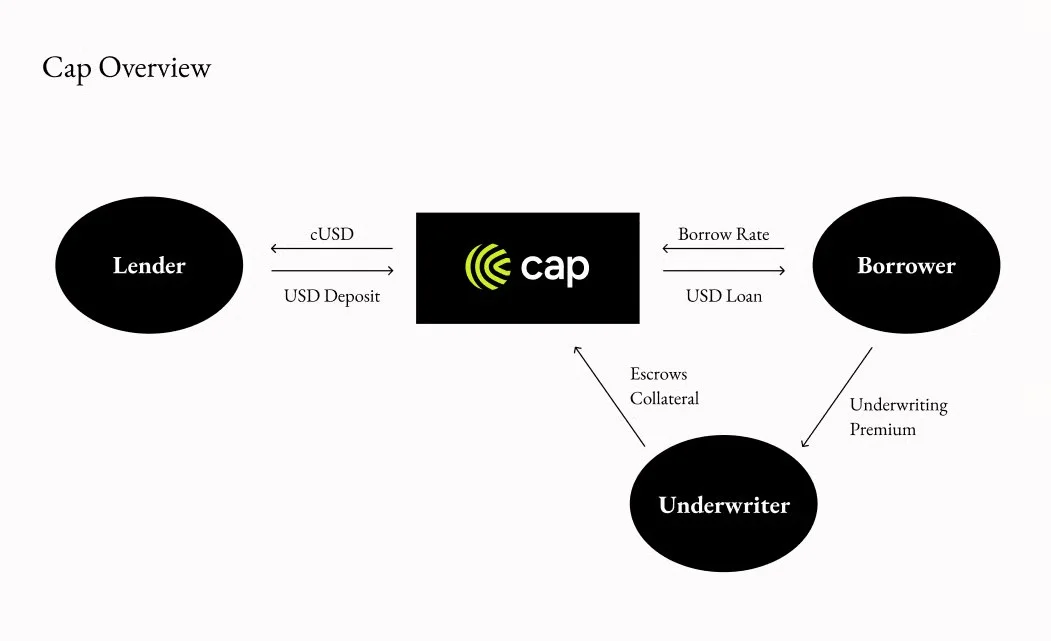
Cap is trying to build a different model. The protocol brings together digital dollar holders, institutional borrowers, and underwriters or delegators willing to take on part of the credit risk.
Users can deposit supported dollar-denominated assets into Cap and mint cUSD. Part of these reserves can then be lent to institutional borrowers approved by the protocol.
For a borrower to access credit, another party must provide collateral against the associated credit risk. Delegators commit assets behind specific operators through shared security networks such as Symbiotic or EigenLayer.
If a borrower fails to repay, the system is designed to absorb losses through the collateral mechanism before they are passed directly to depositors.
Cap’s History: Key Milestones
Cap was first introduced publicly on October 13, 2024. Its early concept focused on creating a more open market where stablecoin yield would not depend solely on incentives issued by the protocol itself.
Throughout 2025, the project concentrated heavily on infrastructure and security. Cap underwent several security reviews involving Zellic, Trail of Bits, Spearbit researchers, Recon, and Sherlock. The project’s code was also made public before its mainnet launch.
Cap officially became available to the public on August 18, 2025. From that date, users could mint cUSD on Ethereum and participate in the Frontier incentive program.
The Homestead program followed Frontier. Launched on January 29, 2026, it was designed to support Cap’s transition from an experimental growth phase toward more permanent institutional credit and liquidity use cases.
CAP token launch and exchange listings
The CAP token launched around ten months after the protocol went live. Its Token Generation Event took place on June 26, 2026.
Part of the token sale was conducted through Uniswap’s Continuous Clearing Auction system. According to Cap’s Q2 report, the Uniswap and Binance Wallet sales raised around 4.2 million USDC.
The Uniswap sale attracted 1,002 bids, while demand reached roughly five times the available allocation.
CAP quickly became available on several centralized exchanges. Cap’s Q2 report listed spot markets on Coinbase, Bithumb, Bybit, Kraken, Crypto.com, Bitvavo, HTX, MEXC, and BitMart. Binance Alpha was also among the first venues to support the token.
On the derivatives side, Binance launched a CAPUSDT perpetual futures contract on June 27, 2026, with leverage of up to 10x. In August, Upbit added KRW, BTC, and USDT markets for CAP, bringing the token to one of South Korea’s largest exchanges.
Cap’s current status
Cap continued to expand its lending activity after the token launch. According to project data from July 2026, the platform had worked with 30 borrowers and 22 underwriters.
Cumulative transfer volume reached $5.6 billion, while the protocol had previously recorded a peak TVL of $500 million.
Current TVL figures vary depending on the methodology used. DefiLlama data from September 7, 2026 showed approximately $339 million in TVL and around $64.6 million in active loans.
Cap’s own Q2 report recorded $272 million in TVL and $41.9 million in outstanding credit as of June 30. During the same period, the number of active borrowers increased 33% quarter over quarter, while the protocol reported a 4.40x credit coverage ratio.
One of the project’s next major technical steps is Cap V2. Cap listed the completion of V2 audits, improvements to its credit engine, and support for additional credit and collateral types among its Q3 2026 targets.
As of early September, there had been no clear official announcement confirming that these goals had been completed. Cap V2 is therefore more accurately viewed as part of the project’s planned development roadmap.
How Does the CAP Token Work?
CAP’s primary role revolves around protocol governance. Cap’s official documentation states that token holders are expected to have a say in protocol parameters, collateral management, operator onboarding, and fees.
This governance role matters because Cap has more adjustable parameters than a conventional token transfer network. Decisions around which assets can be used as reserves, borrowing conditions, collateral limits, and access for different market participants can directly affect the protocol’s risk profile.
CAP is also expected to be used in future staking mechanisms for operators, delegators, and depositors. However, the official documentation does not currently list these integrations as completed features.
It is therefore important to distinguish CAP’s current functionality from its planned future use cases. The token may gain additional functions as the protocol develops, but mechanisms that have not yet gone live should not be treated as guaranteed utility.
CAP supply, allocation, and tokenomics
CAP has a maximum supply of 10 billion tokens. According to CoinMarketCap data from early September 2026, approximately 1.56 billion CAP were in circulation.
This represents around 15.6% of the maximum supply.
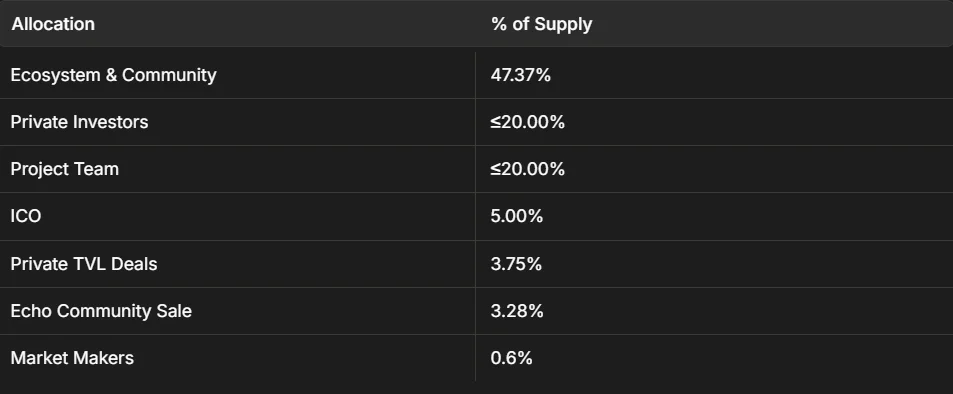
Updated tokenomics data following the TGE shows that approximately 47.37% of the supply is allocated to the ecosystem and community. Allocations for private investors and the team can each reach around 20%.
Other allocations include 5% for the ICO, 3.75% for Private TVL Deals, 3.28% for the Echo Community Sale, and approximately 0.60% for market makers.
The amount of CAP that has not yet entered circulation is particularly important. Roughly 84.4% of the maximum supply remains outside the circulating supply.
Tokens allocated to the team, private investors, and the Echo sale are subject to an initial 12-month lock-up period. On the first anniversary of the TGE, 25% of the relevant allocations are expected to unlock, with the remainder released monthly over the following three years.
This schedule makes future supply pressure an important factor to monitor. A fixed maximum supply prevents unlimited token issuance, although unlocks can still significantly increase the amount of CAP in circulation over time.
Ethereum infrastructure and the relationship between cUSD and stcUSD
Understanding Cap requires separating the roles of CAP, cUSD, and stcUSD. CAP is the governance token, cUSD is the dollar-based reserve asset, and stcUSD is a yield-accruing derivative of cUSD.
Users can deposit supported reserve assets into the Vault and mint approximately the same dollar value in cUSD. The cUSD reserve can include dollar-denominated assets such as USDC, USDT, pyUSD, BUIDL, and BENJI.
Users can also redeem cUSD for available reserve assets.
When cUSD is staked, users receive stcUSD. The yield generated by stcUSD comes from loans provided to institutional operators and from selected strategies used to deploy idle reserves.
For example, idle capital in the reserve can be allocated to lending markets such as Aave. Cap’s Fractional Reserve system collects the resulting yield and distributes it to stcUSD holders through the protocol’s fee mechanism.
When an institutional operator borrows from Cap, its borrowing capacity is limited by collateral provided by delegators. Under default parameters, a 50% LTV can require delegation worth roughly twice the amount of the operator’s loan.
If the position’s health factor falls below a critical level, the liquidation process can begin.
Why Is Cap Important?
Traditional DeFi lending often requires borrowers to deposit collateral worth more than the loan they want to receive. This approach reduces credit risk onchain, although it can also be inefficient from a capital perspective.
For example, a high-frequency trading firm or market maker may not want to lock more than $10 million in liquid collateral to access $10 million in working capital. Traditional finance addresses this problem through credit assessment and institutional debt markets, but these processes generally take place offchain.
Cap introduces a third party. An underwriter or delegator supports the borrower’s performance using their own collateral.
This allows an institution to access liquidity without locking all of its own capital directly. The underwriter earns a premium for taking on the risk, while cUSD and stcUSD users gain an additional layer of protection against borrower defaults.
Cap’s position in DeFi and credit markets
Cap is targeting an area broader than the stablecoin market. The project increasingly positions itself as infrastructure for onchain private credit.
One of the most visible examples of this strategy was its work with Susquehanna Crypto. In the first quarter of 2026, Cap announced a $100 million revolving credit facility for the company.
The protocol has also worked with institutional market participants such as Flow Traders, FalconX, and M11 Credit.
These relationships show that Cap is trying to connect institutional demand for credit with blockchain liquidity, rather than operating solely as a closed yield market for retail DeFi users.
The model also overlaps with the RWA sector. Alongside dollar-denominated loans, Cap is working to integrate tokenized money market funds and additional collateral types into the protocol.
CAP token risks and volatility
The existence of economic protection mechanisms within Cap’s credit model does not make the protocol risk-free. Official documentation identifies smart contract, counterparty, reserve asset, oracle, bridge, liquidation, and third-party DeFi protocol risks.
If an asset in the cUSD reserve loses its dollar peg, the value of the system may be affected. Deploying idle reserves into platforms such as Aave or Morpho also exposes Cap to the technical and liquidity risks of those protocols.
The shared security infrastructure creates another layer of dependency. If the value of delegation supplied through Symbiotic or EigenLayer falls sharply, the health ratios of certain operator positions may deteriorate and trigger liquidations.
CAP’s supply structure is another important factor. Only 15.6% of the maximum supply was circulating in early September 2026, while future team, investor, and ecosystem unlocks are expected to increase circulating supply.
The token has also shown significant market volatility. According to CoinGecko, CAP reached an all-time high of approximately $0.078 on August 14, 2026.
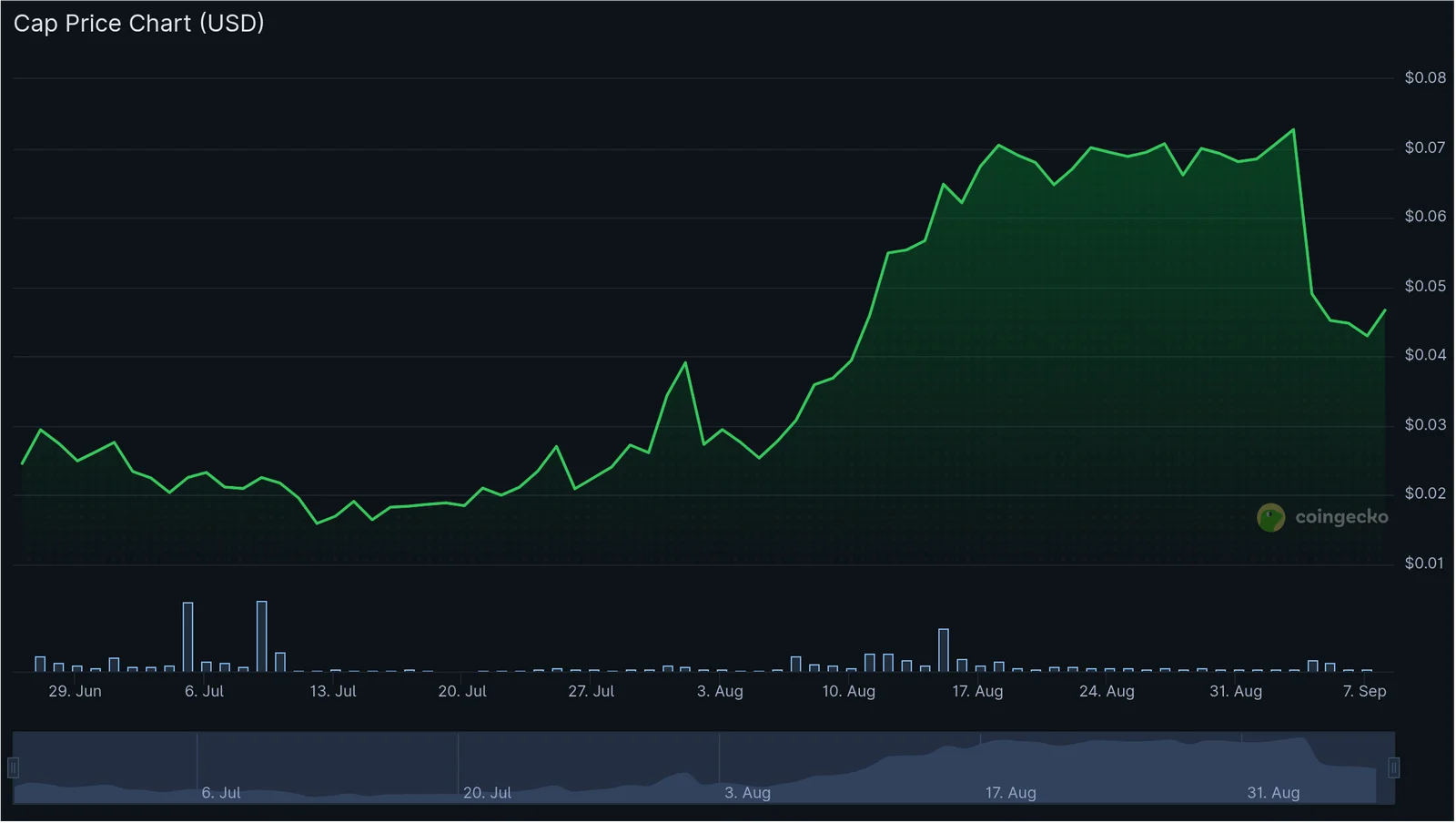
By early September, the price was trading well below that level.
Past price performance does not indicate future returns. CAP’s value may be affected by broader crypto market conditions, token unlocks, protocol adoption, exchange liquidity, and Cap’s ability to scale its institutional credit model.
Cap’s Developers and Ecosystem
Cap Labs was founded by Benjamin Sarquis Peillard. In Cap’s official announcement regarding its Chainlink integration, Peillard is directly identified as the founder of Cap.
Development of the project began in 2024.
Cap’s team does not come from a single protocol background. According to the project, its development team includes contributors who previously worked on DeFi projects such as Beefy Finance, Frax Finance, Redacted/Dinero, and QiDao, as well as developers with Stanford connections.
On the security side, Cap commissioned several independent reviews before launch. Zellic, Trail of Bits, Spearbit researchers, Recon, and Sherlock examined different parts of the codebase.
These audits do not eliminate smart contract risk completely. Cap’s own risk documentation continues to identify potential code vulnerabilities as one of the protocol’s core risks.
Community and governance
The Frontier and Homestead programs played an important role in the early growth of the Cap community. Frontier launched alongside the protocol’s mainnet release in August 2025 and allowed users to earn “Caps” points for minting cUSD and participating in ecosystem activity.
Homestead followed in January 2026. The program introduced different incentives for both cUSD users and delegators participating in the security side of the credit system.
The launch of the CAP token added a governance layer to the community structure. Official token documentation states that CAP is intended to support governance over protocol parameters, collateral management, operator onboarding, and fees.
Cap’s governance structure and token integrations are still developing. The fact that some features, including CAP staking, remain marked as “TBD” indicates that the token economy has not yet reached its final form.
Partnerships, integrations, and use cases
Cap’s ecosystem spans both DeFi protocols and traditional finance firms. Its investors include Franklin Templeton, Triton Capital, GSR, Flow Traders, Laser Digital, IMC, RockawayX, Superscrypt, and other crypto-focused investment firms.
On the credit and underwriting side, the project has worked with Susquehanna Crypto, Flow Traders, FalconX, M11 Credit, Bedrock, and other institutional players.
Symbiotic and EigenLayer are used as part of the shared security infrastructure.
DeFi integrations include protocols such as Pendle, Morpho, and Euler. Markets for cUSD, stcUSD, PT-cUSD, and PT-stcUSD have been created on Euler.
MegaETH is another important part of Cap’s multichain expansion strategy. cUSD and stcUSD can be transferred to MegaETH using LayerZero infrastructure and used there across lending, trading, and payment applications.
Frequently Asked Questions (FAQ)
- What is Cap (CAP), and when was it launched?: Cap is an onchain credit protocol that combines institutional lending with blockchain-based financial guarantees. The project was first introduced in October 2024, while the main protocol launched on Ethereum on August 18, 2025. The CAP token TGE took place on June 26, 2026.
- What is the CAP token used for?: CAP is designed as the governance token of the Cap protocol. It is expected to be used in governance processes covering protocol parameters, collateral management, operator onboarding, and fees. Staking mechanisms for operators, delegators, and depositors remain unfinished features in the official documentation.
- Which network does Cap operate on?: Cap’s core smart contracts operate on Ethereum. cUSD and stcUSD can also be transferred to other networks using LayerZero infrastructure and are available on MegaETH. Ethereum is the main network for the CAP token.
- Who founded Cap?: Cap Labs was founded by Benjamin Sarquis Peillard. The development team also includes contributors with previous experience across DeFi ecosystems such as Beefy Finance, Frax Finance, Redacted/Dinero, and QiDao.
- What is the CAP supply?: CAP has a maximum and total supply of 10 billion tokens. According to CoinMarketCap data from early September 2026, approximately 1.56 billion CAP were in circulation, equal to around 15.6% of the maximum supply.
- What is the difference between Cap, cUSD, and stcUSD?: Cap is the name of the protocol, while CAP is its governance token. cUSD works as a digital dollar created against dollar-denominated reserve assets. stcUSD is obtained by staking cUSD and accrues yield from the protocol’s lending and reserve activities.
- Is CAP suitable for investment?: Whether CAP is suitable for investment depends on the user’s risk profile, expectations, and market conditions. Since a large portion of the token supply has not yet entered circulation, future unlocks, growth in protocol lending activity, development of governance mechanisms, and broader market conditions should be monitored closely. Crypto assets are highly volatile and carry the risk of capital loss.
Follow the JR Kripto Guide series to keep up with new developments in Cap’s onchain credit model, the cUSD ecosystem, and the CAP token.

