
Since the early years of the internet, digital content sharing has continuously evolved, driven by users' search for both freedom and speed. Whether it's music, movies, software, or large data files, systems reliant on centralized servers have become both costly and inefficient over time. It was at this point that the BitTorrent protocol, developed by Bram Cohen in 2001, came into play. BitTorrent offered a peer-to-peer (P2P) structure where files were shared in small batches among users, rather than from a single central point. This approach not only increased download speeds but also created a much more resilient sharing model by distributing the load on the internet. Over the years, BitTorrent has become a global infrastructure preferred by millions of users. However, as technology changed, so did user expectations. Simply sharing files was no longer enough; more sustainable and incentive-focused systems that rewarded contributing users began to be discussed. The acquisition of BitTorrent by the Tron Foundation in 2018 accelerated this transformation. In February 2019, the BitTorrent Token (BTT) was launched, combining classic P2P file sharing with a blockchain-based economy. Now, not only were files shared on the BitTorrent network, but these contributions were also measurable and rewardable with crypto assets. Let's take a closer look at what BitTorrent is, how the BTT token came about, and why this structure is so widely discussed in the crypto ecosystem.
Definition and Origins of BTT
BTT (BitTorrent Token) is the native cryptocurrency used within the BitTorrent ecosystem. It was initially issued on the Tron blockchain with the TRC-10 token standard and forms the basis of the economic incentive mechanism on the BitTorrent network. Launched in 2019, BTT was born from the idea of combining the long-standing peer-to-peer sharing logic of the BitTorrent protocol with blockchain technology. The aim was to tangibly reward users who contributed to file sharing and to increase the sustainability of the network. The BitTorrent network is built on a distributed structure where users are both content consumers and content providers simultaneously. BTT adds an economic layer to this structure. For example, a user who uses the BitTorrent Speed feature can pay BTT for faster downloads; users who share and "seed" files earn BTT in return for their contributions. Thus, participation in the network moves from voluntariness to a measurable incentive system. Developed after Tron's acquisition of BitTorrent, this model stands out as one of the first examples of bringing classic file sharing closer to the Web3 logic.
The History of BTT: Key Milestones
The story of BitTorrent and BTT goes back to an early period when the internet began to move away from centralized structures. In this process, where file sharing was seen not only as a technical need but also as a space of freedom, BitTorrent entered the daily lives of millions of users. Over the years, the protocol grew, the number of users increased, and finally, this massive infrastructure merged with blockchain technology, entering a new phase. The history of BTT offers important clues to understanding this transformation from the classic P2P sharing model to a Web3-based incentive economy.
2001: The Birth of BitTorrent
Bram Cohen developed the BitTorrent protocol to enable faster and more efficient sharing of large files over the internet. Thanks to this structure, users began to share files by simultaneously downloading (peer) and uploading (seeder) instead of downloading them from a single center. This approach reduced the need for central servers, making BitTorrent a popular file-sharing standard on a global scale in a short time.
2018: Tron Acquisition
In July 2018, Justin Sun, founder of the Tron Foundation, acquired BitTorrent for approximately $140 million. This move paved the way for BitTorrent's integration with blockchain technology. The Tron team aimed to connect BitTorrent's large user base with the crypto ecosystem and transform P2P sharing into a model supported by economic incentives.
2019: Launch of the BTT Token
In February 2019, the BitTorrent Token (BTT) was launched on the Tron blockchain using the TRC-10 standard. The total supply was set at 990 billion tokens, which were distributed through sales and ecosystem distributions. BTT offered users faster downloads with features like BitTorrent Speed, while creating an incentive system that rewarded users who shared files with crypto assets.
2021: BTTC Mainnet
In December 2021, the mainnet of the cross-chain network called BitTorrent Chain (BTTC) was launched. During the same period, BTT tokens were rescaled by 1:1000. With this redenomination, the total supply increased to 990 trillion. The newly issued TRC-20 standard tokens were named BTT, while the old TRC-10 tokens were named BTTOLD. This step aimed to increase the multi-chain compatibility of the BitTorrent ecosystem.
2024: Updates to the Ecosystem
As of 2024, the BitTorrent team began to focus on DeFi and decentralized storage solutions through the BTTC network. Incentive models for the BitTorrent File System (BTFS) were updated. BTT evolved from a token used solely to accelerate torrent downloads into a versatile ecosystem token with different use cases such as validator staking, decentralized storage services, and on-network fee payments.
2025: Key Developments in the BitTorrent Ecosystem
2025 marked a period of greater infrastructure focus and consolidation for the BitTorrent ecosystem. BitTorrent Chain (BTTC) evolved into a more mature structure with the active use of the Proof-of-Stake (PoS) model, while the BTT token gained a clearer role in terms of network security and participation. With the activation of the staking mechanism, BTT transformed from a reward tool that only incentivizes file sharing into a fundamental ecosystem component supporting validator participation and network sustainability. During this process, while the multi-chain architecture of BTTC was preserved, the focus was on improvements in performance and security.
Significant updates were also made to the BitTorrent File System (BTFS) that same year. The decentralized storage infrastructure was repositioned to better suit developer and infrastructure use cases. Wallet integrations and on-network management tools that improved user experience were highlighted. Throughout 2025, the BitTorrent team pursued a strategy focused on consolidating the existing Web3 infrastructure, clarifying the real use cases of BTT, and making the ecosystem more sustainable, rather than rapid growth.

Why is BTT Important?
BTT stands out as one of the key bridges built between classic file sharing and the Web3 world. As internet infrastructure becomes increasingly decentralized, the BitTorrent network already offers a massive peer-to-peer (P2P) ecosystem connecting billions of devices. For a network of this scale to operate sustainably, technical solutions alone are not enough; an economic structure that incentivizes user contribution is also needed. This is where BTT comes in, transforming file sharing from a voluntary activity into a measurable model supported by a crypto-based incentive system. Rewarding users who share files ensures the network remains alive and resources are allocated more efficiently. Developed through the merger of the Tron and BitTorrent teams, this structure goes beyond simply being a torrent acceleration tool. Thanks to the BitTorrent Chain (BTTC), BTT becomes a value transfer tool operating between different blockchains such as Ethereum, TRON, and BNB Chain. This cross-chain architecture makes the BitTorrent ecosystem part of a broader Web3 infrastructure. Beyond file sharing, BTT offers a usable tool for decentralized storage solutions, content distribution, publishing, and even infrastructure-focused Web3 services. In this respect, BTT not only modernizes one of the popular file-sharing protocols of the past but also becomes a fundamental building block adapting it to the new blockchain-based internet vision.
Use Cases
- Accelerated downloads and rewards: The BitTorrent Speed feature is one of BTT's best-known and most user-facing use cases. In this system, users downloading torrents can offer BTT to users uploading files to download them faster. Users who share and "seed" files earn BTT depending on how active they are on the network. Thus, file sharing is not solely based on voluntarism; contributing users receive a tangible economic reward. This incentive model ensures that popular files remain on the network longer.
- Distributed storage (BTFS): BTT is also used as a primary payment and reward tool in the decentralized storage platform called BitTorrent File System (BTFS). BTFS allows users to store their files on a distributed network without being tied to a single central server. Users who want to store files pay BTT, while nodes providing storage space are rewarded with BTT for the resources they provide. With updates in 2024, the BTFS incentive model was restructured, aiming for a more sustainable structure suitable for infrastructure use. In this respect, BTFS demonstrates that BTT has a functional role not only in torrenting but also in data storage.
- Network participation and governance: BTT is also used as a staked token for validator nodes that provide network security on the BitTorrent Chain (BTTC). Users who want to become validators contribute to the network's operation by locking a certain amount of BTT and earning staking rewards in return. This mechanism strengthens the decentralized structure of BTTC and provides BTT with a long-term use case. Furthermore, BTT holders may also have the right to participate in some governance processes related to the ecosystem.
- DeFi and ecosystem use: BTT can also be used as a transfer and value transfer tool in decentralized applications within the Tron ecosystem. In Tron-based DeFi projects, it's possible to trade with BTT, provide liquidity, or participate in campaigns. Additionally, BTT is distributed through airdrops, rewards, and incentive programs occasionally organized by the BitTorrent team. These types of campaigns increase the token's circulation within the ecosystem and strengthen interaction with DeFi projects connected to the Tron network.
Token Economy
- Supply and Distribution: BTT's total supply after redenomination is set at 990 trillion tokens. This high supply structure indicates that BTT is designed for microtransactions and on-network incentives. Looking at the distribution plan, approximately 17% of the supply is reserved for early investors. 43% is allocated to the developer side, primarily the Tron and BitTorrent teams. To support ecosystem growth, 19.9% is directly allocated to ecosystem funds, while the remaining 20.1% is distributed through community airdrops. A significant portion of these airdrops were made to BitTorrent users and TRON (TRX) token holders, aiming to help the existing user base adapt to the new system.
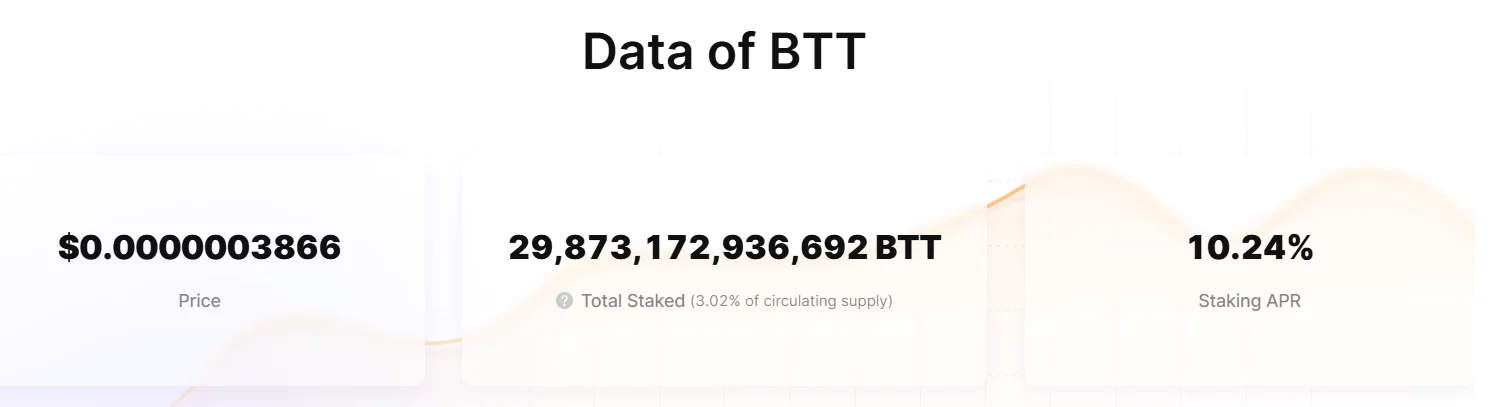
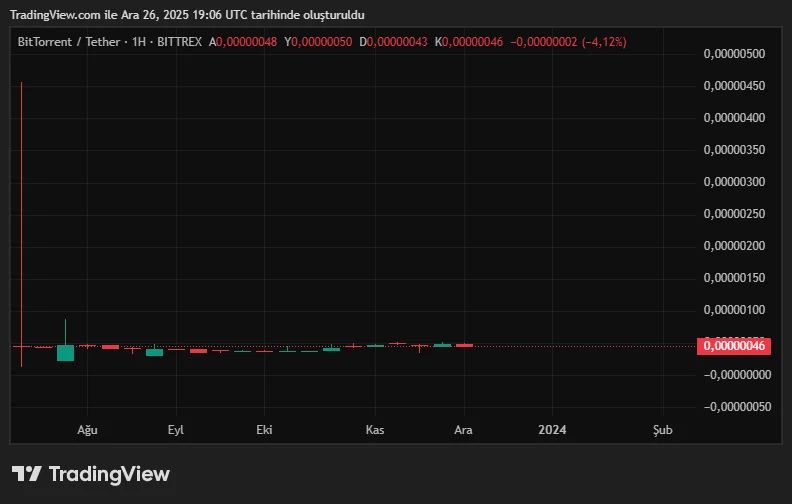
- Price and Market Dynamics: BTT has been traded on many centralized cryptocurrency exchanges since its launch. The high supply of the token causes the unit price to remain at relatively low levels. This makes BTT a token focused on on-network usage and volume rather than short-term price movements. While price fluctuations may occur over time depending on market conditions, BTT is generally considered a low-priced, high-supply token. Therefore, when interpreting BTT's market performance, it is more accurate to consider its use cases and network activity in conjunction with its price. As of December 2025, BTT coin price is approximately $0.0000004.
- Staking and Rewards: BTT is used as part of the Proof-of-Stake (PoS) mechanism on the BitTorrent Chain (BTTC). Users can contribute to network security by staking their BTT and receive staking rewards in return. Average annual returns vary periodically but generally hover around 7%. Staking isn't the only way to earn BTT. Users who share files via BitTorrent Speed can also earn BTT for their network contributions. Furthermore, the distribution of additional incentives through airdrops, campaigns, and new feature launches helps keep the ecosystem vibrant.
- Old and New Tokens (BTTOLD): With the redenomination process carried out in December 2021, the old TRC-10 standard BTT tokens were replaced with new tokens at a ratio of 1:1000. As a result of this process, the new tokens issued under the TRC-20 standard continue to bear the BTT name, while the old tokens are now called BTTOLD. This separation was made to update the technical infrastructure and support BitTorrent Chain's multi-chain compatibility. BTTOLD holders can convert their tokens to the new BTT through supporting centralized exchanges or Tron-compatible wallets.
Who Founded BTT?
The BTT and BitTorrent ecosystem today is backed by the Tron network and BitTorrent Inc. Although Bram Cohen was the original creator of the BitTorrent protocol, the project has been under the control of the Tron Foundation, led by Justin Sun, since 2018. With Tron's acquisition of BitTorrent, this P2P infrastructure, which has served millions of users for years, began to be integrated with blockchain technology. This process laid the foundation for BitTorrent to transform from just a file-sharing protocol into a crypto-based ecosystem.

Frequently Asked Questions (FAQ)
Below, you can find some frequently asked questions and answers about BitTorrent:
- What is BTT (BitTorrent Token)? It is the native cryptocurrency of the BitTorrent network. As a token operating on the Tron blockchain, it is used to increase file sharing speed and reward participants.
- What is BitTorrent Chain (BTTC)? BitTorrent Chain is a cross-chain protocol created by TRON. It allows asset transfers between different blockchains such as Ethereum, TRON, and BNB Chain. In BTTC, the BTT token is staked with PoS and used to pay fees on the network.
- What is the difference between BTT and BTTOLD? When the BTTC mainnet launched in 2021, the old BTT tokens were renewed at a 1000:1 ratio and switched to the TRC-20 standard. The newly released tokens now use the name BTT, while the old TRC-10 tokens are called BTTOLD. You can convert BTTOLD tokens to the new BTT in compatible wallets.
- How to stake BTT and earn rewards? Users who own BTT on BitTorrent Chain can become validators or participate in various staking pools. Those who act as validators and contribute to network security are rewarded with BTT. It is also possible to earn BTT by sharing files with BitTorrent Speed; you receive token rewards as long as you seed after the download is finished.
- How to store BTT and where to buy it? BTT can be stored in wallets compatible with Tron (TRX). For example, software wallets like TronLink or hardware wallets like Ledger can be used. You can buy BTT from cryptocurrency exchanges or decentralized exchanges. As it is a new TRC-20 token, your wallet only needs to support the Tron network.
- Are there any BTT airdrops/campaigns? Yes. Airdrops were conducted to the Tron and BitTorrent communities upon BTT's launch. For example, distributions were made to TRX holders and BitTorrent users. Additionally, community events and updates occasionally include extra reward campaigns.
Explore how BitTorrent (BTT) transforms peer-to-peer file sharing in Web3, the role of BTTC, and real ecosystem use cases through JrKripto Guide series.

