
Leveraged trading in the crypto market is largely limited to digital assets. Avantis aims to build a broader onchain derivatives market by adding currencies, metals, commodities, and indices alongside cryptocurrencies. At the center of the Base-based platform is the AVNT token, which serves several functions ranging from governance to protocol security.
Definition and Origins of Avantis
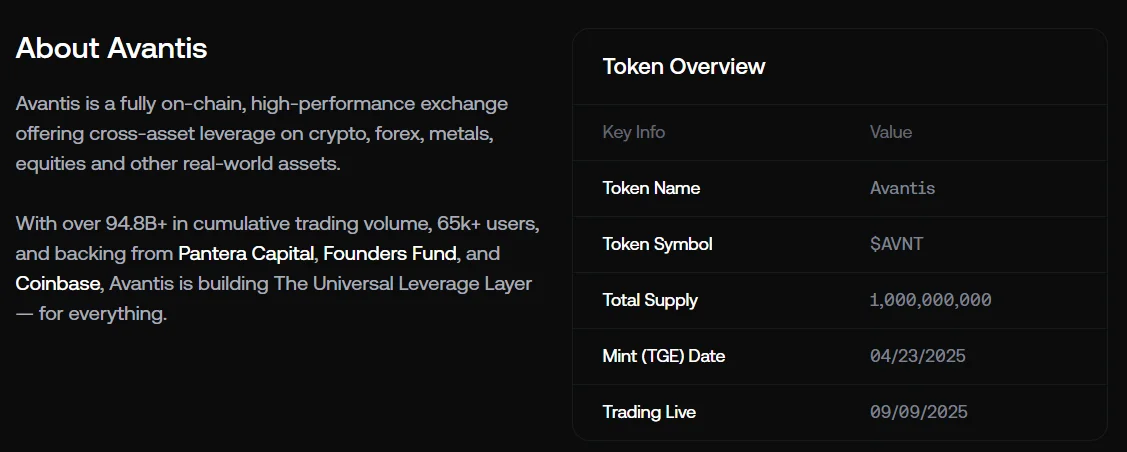
Avantis is a decentralized derivatives exchange that allows users to trade crypto assets and real-world assets with leverage. Through the platform, users can open positions linked to the price movements of Bitcoin, Ethereum, currency pairs, gold, oil, and certain indices.
The platform’s primary products are perpetual futures contracts, commonly known as perpetuals. These contracts do not have a fixed expiration date; traders can keep their positions open as long as they meet the required collateral conditions.
There is an important distinction here. Opening a gold or forex position through Avantis does not mean that the user owns the underlying asset. Instead, the user holds a synthetic position tied to price data supplied by oracle systems.
AVNT is the ecosystem’s ERC-20 utility and governance token. It was designed to support protocol security through staking, reward users, provide access to trading fee benefits, and enable participation in governance processes. Avantis documentation explicitly states that AVNT does not represent ownership in the protocol or shares in a company.
Which network does Avantis operate on?
Avantis operates on Base, an Ethereum Layer 2 network developed by Coinbase. Since Base is EVM-compatible, users can connect to the platform through Ethereum-based wallets such as MetaMask and Coinbase Wallet.
The Layer 2 architecture offers lower transaction costs and faster confirmation times than the Ethereum mainnet. These features matter for a frequently used derivatives exchange because transactions such as opening positions, adding collateral, and closing orders take place onchain.
AVNT is also an ERC-20 token issued on Base. Its official contract address is:
0x696F9436B67233384889472Cd7cD58A6fB5DF4f1
AVNT is not used to pay transaction fees on Base. Users must hold ETH on the Base network in their wallets to cover gas fees.
Why was the project created?
Avantis Labs began developing the project in February 2023 with a two-person team. The idea emerged from the significant gap in trading volume between centralized exchanges and onchain leveraged trading platforms.
According to the developers, decentralized exchanges at the time either compromised the trading experience or relied too heavily on centralized matching engines and keeper networks. Most derivatives products in DeFi also focused on crypto assets such as Bitcoin and Ethereum.
Avantis aimed to address both areas within a single structure. The platform began providing exposure to price movements across cryptocurrencies, forex, metals, and commodities without requiring users to rely on a custodial service.
On the liquidity side, Avantis uses a shared USDC-based structure instead of creating a separate pool for every asset. The USDC deposited by liquidity providers acts as the counterparty to trader positions. This allows the same capital to support trading demand across different markets.
This structure forms the basis of the team’s long-term “Universal Leverage Layer” vision. Avantis aims to create a shared onchain leverage layer for multiple asset classes rather than remaining a perpetual DEX focused on a single type of product.
History of Avantis: Major Milestones
Initial development of Avantis began in early 2023. That same year, the project raised $4 million in a seed funding round led by Pantera Capital. Founders Fund, Galaxy, Modular Capital, and Coinbase-backed Base Ecosystem Fund also participated in the round.
The team launched its public testnet in November 2023. According to figures shared by Avantis, the test period recorded billions of dollars in trading volume and hundreds of thousands of transactions within its first few months. Since these figures primarily reflect testnet activity rather than real capital, they should not be evaluated in the same way as mainnet performance.
Avantis launched its beta version on the Base mainnet on February 2, 2024. During the initial phase, the platform offered approximately 20 trading pairs tied to cryptocurrencies, G10 currency pairs, gold, and silver. It also introduced Loss Protection, a system that provides loss rebates to traders who help improve the balance of open positions. Avantis’ 2023 review and mainnet announcement contain further details about this early period.
The project later completed a second funding round to support its growth. An $8 million Series A round co-led by Founders Fund and Pantera Capital was announced in June 2025, bringing the project’s disclosed total funding to $12 million. The capital was reportedly allocated to product development, new asset classes, and the Avantis V2 infrastructure.
AVNT launch, airdrop, and exchange listings
The Avantis Foundation’s token page shows that the AVNT contract was created on April 23, 2025, while trading began on September 9, 2025. The token entered the market alongside its first airdrop, which targeted early traders, liquidity providers, and community members.
A total of 12.5% of the token supply was allocated to the first airdrop. This allocation covered users who participated in the protocol’s first two reward seasons beginning in February 2024, as well as certain community contributors. The entire airdrop allocation was unlocked at the token launch.
Binance added AVNT to its Alpha platform on September 9 and launched an AVNT/USDT perpetual futures contract. The exchange later listed the AVNT/USDT, AVNT/USDC, and AVNT/TRY spot trading pairs on September 15. Binance stated in its announcement that AVNT was initially classified among new assets carrying a high volatility risk.
AVNT was later listed on Coinbase, Bybit, OKX, Gate, Kraken, and several other centralized exchanges. It is also available through decentralized markets on Base, including platforms such as Aerodrome. Available trading pairs and withdrawal networks may vary between exchanges.
Recent developments and roadmap
As of August 2026, Avantis is preparing to release its V2 version. According to an announcement shared by Base, the V2 rollout is scheduled to begin on August 12. The new version includes broader access to real-world assets, zero-fee trading options, and infrastructure changes intended to improve capital efficiency. Since the rollout is expected to take place in phases, users should not assume that every feature will become available to everyone on the same day.
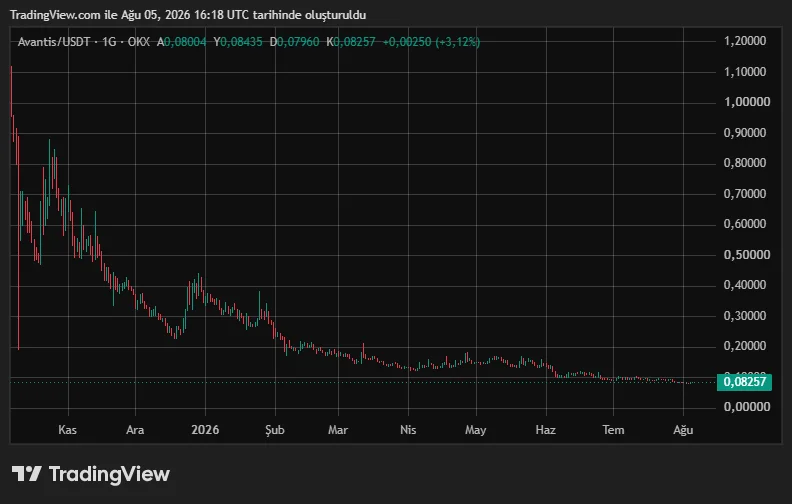
Market data shows that AVNT experienced considerable volatility following its launch. As of August 2026, approximately 334.8 million AVNT tokens are in circulation. The token’s market capitalization stands at around $27 million, while the protocol’s total value locked is approximately $21.5 million.
AVNT reached an all-time high of $2.64 on September 21, 2025. At the beginning of August 2026, the AVNT coin price was hovering around $0.08.
How Does the AVNT Token Work?
AVNT’s first use case relates to protocol security. Token holders can stake their AVNT in the Security Module, providing an additional layer of protection for Avantis liquidity pools.
The profits and losses of traders on Avantis directly affect the condition of the USDC liquidity pool. If the pool’s protection buffer becomes insufficient during extraordinary market movements, part of the staked AVNT may be slashed to cover losses suffered by liquidity providers. Official documentation limits the theoretical slashing rate to a maximum of 20% of the staked amount.
In return for taking on this risk, stakers may receive AVNT rewards, XP boosts, and trading fee discounts. Staking should therefore not be viewed as a risk-free yield product; even if the likelihood of slashing is low, it cannot be eliminated entirely.
AVNT was also designed as a governance token. Token holders are expected to vote on matters such as adding new assets, changing the fee model, expanding to other networks, and developing new products. However, the Avantis Foundation states that governance will be introduced gradually. It would therefore be inaccurate to claim that every AVNT-related decision is currently managed through a fully decentralized DAO.
The token also supports community incentives. Traders, liquidity providers, referral program participants, and ecosystem developers can earn AVNT through certain campaigns.
AVNT supply and tokenomics
AVNT’s initial and maximum supply was set at 1 billion tokens. The distribution of this supply and the schedule under which the tokens enter circulation are important factors for the token’s long-term market structure.
According to Avantis Foundation data, 28.6% of the supply was allocated to onchain incentives. The first airdrop received 12.5%, while developer and ecosystem grants were allocated 9%. Together, these three community-, user-, and developer-oriented categories account for 50.1% of the total supply.
Investors hold a 26.6% allocation. The team and advisers received 13.3%, while the Foundation and liquidity reserve were allocated 2% and 8%, respectively.
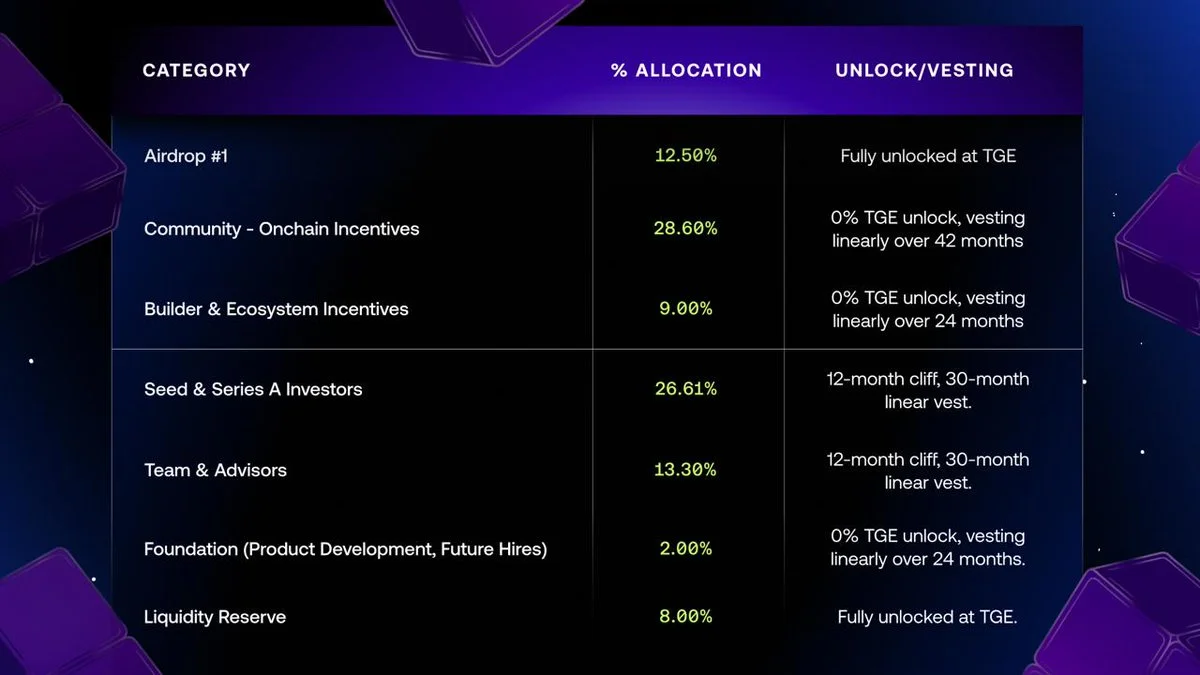
The first airdrop allocation was fully unlocked at launch. Team and investor tokens are subject to a 12-month lock-up period, followed by 30 months of linear vesting. Onchain incentives and ecosystem grants also enter circulation gradually under specific programs.
At the beginning of August 2026, approximately one-third of the maximum supply was in circulation. Future token unlocks could increase the amount available on the market. If demand does not grow at the same pace, the additional supply could put pressure on the price. Investors should therefore consider the circulating supply ratio and unlock schedule alongside the maximum supply.
Although AVNT has a fixed planned supply, the protocol also uses a buyback-and-burn model. Burned tokens cannot re-enter circulation, but the effect on price depends on factors such as trading volume, protocol revenue, and overall market demand.
Security Module and the buyback-and-burn mechanism
Avantis uses an oracle-based synthetic trading structure. Instead of matching buyers and sellers as a traditional exchange would, orders are opened against the protocol’s USDC liquidity pool. Prices come from independent data feeds supplied by Pyth Pro and Chainlink.
Using two price sources aims to reduce reliance on a single potentially faulty or manipulated data feed. However, it cannot completely eliminate risks such as oracle delays, market closures, sudden price gaps, or network issues. Avantis states that both Pyth and Chainlink data are checked during trades.
Zellic and Zokyo audited the protocol’s live smart contracts, while Chaos Labs worked on its risk parameters. Audits can reduce code-related risks, but they cannot guarantee protection against future vulnerabilities or economic attacks.
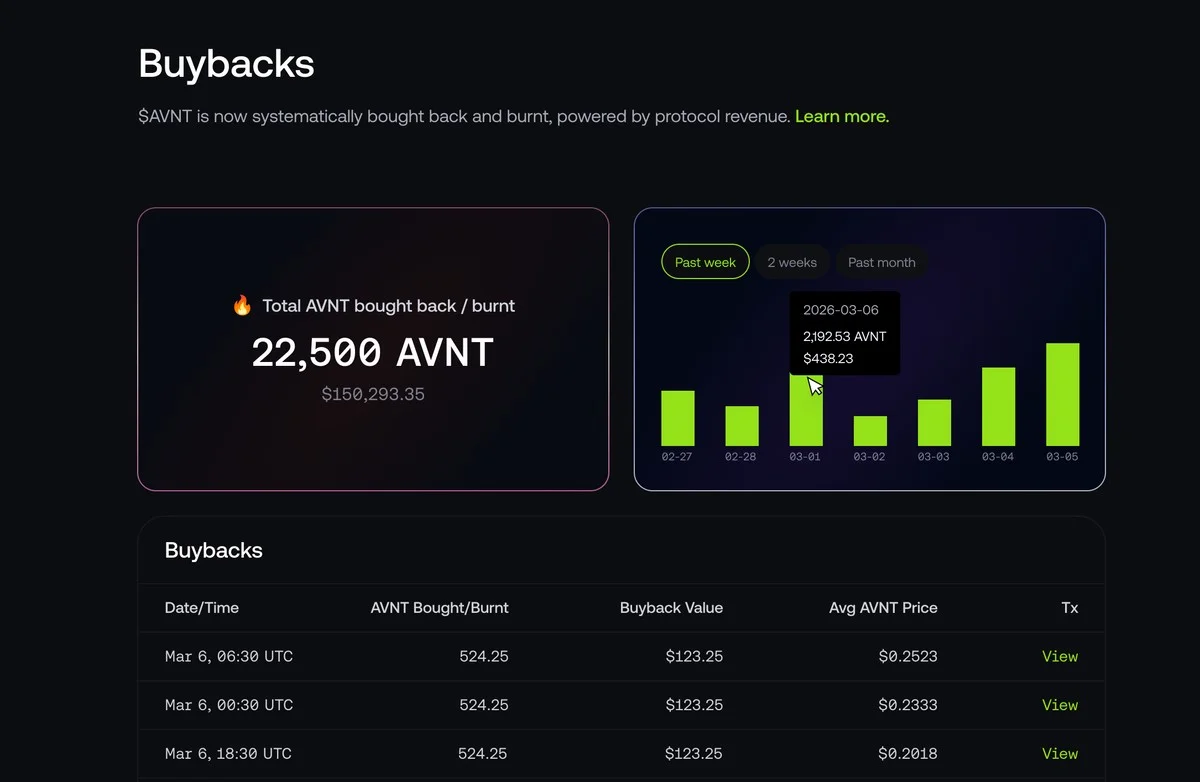
Another mechanism involving AVNT is the systematic buyback-and-burn program introduced in March 2026. Avantis began allocating 30% of its daily protocol revenue from opening, closing, and profit-related fees to purchasing AVNT from the market and burning it. Margin fees are directed to the liquidity pool to protect liquidity providers.
This model reduces the token supply in line with actual protocol usage. However, buybacks also decrease when trading volume and revenue decline. The burn program alone does not guarantee consistent demand or price appreciation.
Why Is Avantis Important?
One of Avantis’ most notable features is its ability to bring different asset classes together within the same USDC liquidity infrastructure. Instead of creating a separate real asset onchain for every currency, commodity, or index, the platform tracks their price movements through synthetic perpetual contracts.
This approach simplifies capital use and allows users to access several markets through a single wallet. In return, traders do not receive ownership of the underlying assets, dividends, or any associated legal rights.
The platform’s Zero-Fee Perpetuals model also differs from conventional fee structures. In eligible markets, users do not pay a fixed entry fee when opening a position; instead, Avantis takes a share from trades that close at a profit. The exact terms may vary depending on the asset and market conditions.
The Loss Rebates system can reimburse up to 20% of the losses incurred by traders who take positions against the more crowded side of the market, provided that certain conditions are met. The system aims to reduce imbalances between long and short open interest. Avantis also uses a positive slippage mechanism that offers better entry prices for some trades that help improve market balance.
Avantis Team and Community
The founding team of Avantis includes CEO Harsehaj Singh and CTO Brank D. Singh previously worked on technology mergers and acquisitions at Lazard before joining Pantera Capital as an investor. Brank D. leads the platform’s technical and trading infrastructure.
Lumena Labs conducts the protocol’s core development work. The involvement of Base Ecosystem Fund as an early investor positioned Avantis among the derivatives projects established on Base during the network’s early development.
Pantera Capital, Founders Fund, Galaxy, Modular Capital, Symbolic Capital, SALT Fund, and Flowdesk are among the organizations that invested in the project. Pyth Network and Chainlink contribute to its price data infrastructure, while ecosystem grants support teams developing new interfaces and applications using the Avantis SDK.
The allocation of more than 50% of the total supply to airdrops, onchain incentives, and developer grants places community participation at the center of the token economy. However, a large community allocation does not mean that control has been fully transferred to token holders. The scope of governance and the Foundation’s authority should continue to be monitored.
Competition, smart contract, and volatility risks
Since Avantis offers high leverage, liquidation is one of its primary risks. Even a small price movement can rapidly close a position and wipe out a large share of the collateral, particularly when leverage ratios such as 100x or 500x are used.
Liquidity providers do not earn risk-free returns either. The pool may incur losses during periods when traders are profitable overall. The Security Module and risk buffers aim to limit this pressure, but the possibility of losses remains under extraordinary conditions.
Smart contract vulnerabilities, oracle failures, Base network outages, bridge-related problems, and governance decisions are among the other technical risks. Audit reports provide a positive signal, but they cannot identify every possible vulnerability in a DeFi protocol in advance.
For AVNT specifically, investors should closely monitor token unlocks, team and investor allocations, and changes in protocol revenue. Buybacks may remain limited during periods of low trading volume. The platform also operates in a highly competitive market that includes Hyperliquid, dYdX, GMX, and several other perpetual DEXs.
Its price history further illustrates the level of risk. AVNT’s decline of more than 90% from its all-time high shows that strong investor backing and product usage alone have not been enough to protect the token’s market value.
Frequently Asked Questions (FAQ)
Below are answers to some of the most frequently asked questions about Avantis (AVNT).
- What is Avantis, and when was it launched?: Avantis is a Base-based decentralized exchange offering synthetic perpetual trading across cryptocurrencies, forex, metals, commodities, and indices. Development began in 2023, and its mainnet beta launched on February 2, 2024. AVNT trading began on September 9, 2025.
- What is the AVNT token used for?: AVNT was designed for staking, protocol security, user rewards, trading fee discounts, and governance. A portion of the tokens staked in the Security Module may be slashed if the protocol faces an extraordinary liquidity shortfall.
- Which network does Avantis operate on?: Avantis and the AVNT token operate on Base, an Ethereum Layer 2 network. Since AVNT is an ERC-20 token, it can be stored in Base-compatible wallets. Network transaction fees are paid in ETH rather than AVNT.
- Who founded Avantis?: The project’s founding team includes CEO Harsehaj Singh and CTO Brank D. Lumena Labs conducts the core development work behind Avantis.
- What is the AVNT supply?: AVNT has an initial and maximum supply of 1 billion tokens. According to CoinGecko data, approximately 334.8 million AVNT were in circulation as of August 3, 2026. This figure may change over time due to ongoing token unlocks and burn transactions.
- Is Avantis suitable for investment?: Whether AVNT is a suitable investment depends on the individual’s risk profile and research. Protocol usage, revenue, token buybacks, and RWA products are among the potentially positive factors worth monitoring. Investors should also consider high volatility, token unlocks, competition, risks associated with leveraged products, and potential smart contract vulnerabilities.
Follow the JR Kripto Guide series for the latest information about Avantis’ RWA-focused derivatives market and new developments within the Base ecosystem.

